Applied Economics

Applied Economics explores real-world economic principles, market behaviour, policy impacts, and decision-making strategies. Learners gain practical skills to analyse trends, solve business problems, and understand financial outcomes effectively in organisations.

Applied Economics
cpdacree aoth ukrlp 24hs fullonline 14days

Get access to 5000+ courses including this for only £49. Learn More.

Overview of Applied Economics

The Applied Economics course provides a comprehensive understanding of economic principles, combining Economic Analysis, Microeconomics, and Macroeconomics to explore real-world financial and business challenges. Learners will develop skills in Market Research, Data Analysis, and Business Economics, enabling them to evaluate economic trends, understand market behaviour, and make informed financial decisions in various professional environments.

This course covers essential topics including Economic Policy, resource allocation, exchange rates, trade barriers, and market failures. Through practical applications of economic theories, learners will gain insight into how governments, businesses, and individuals respond to economic changes. The programme supports better Resource Management and strengthens the ability to analyse complex economic situations effectively.

Designed for aspiring professionals, entrepreneurs, and anyone interested in economics, this course builds a strong foundation in applied economic concepts and decision-making strategies. By exploring different sub-branches of economics, learners will enhance their analytical abilities and apply economic knowledge to business planning, financial strategies, and modern economic challenges.

The course was audited and updated on: 18th July, 2026

Learning Outcomes of Applied Economics

Method Of Assessment​

Learners complete an assignment designed to evaluate their understanding of the course content. The assignment is reviewed by qualified tutors who provide personalised feedback, allowing learners to demonstrate their applied knowledge and skills.

Certification

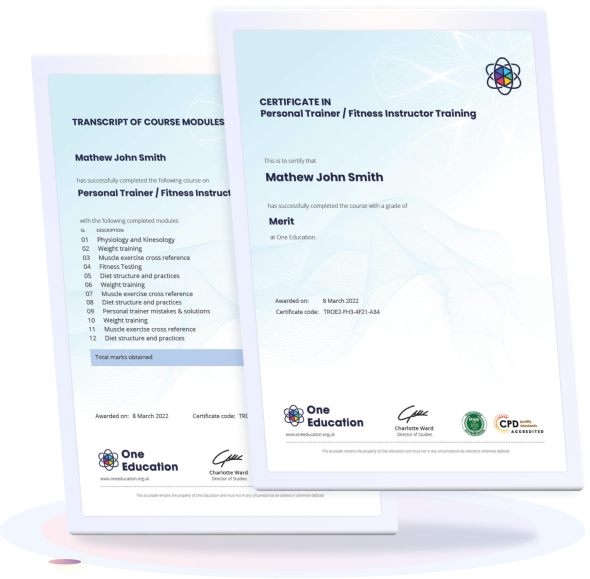
one education Certificate

After completing the Applied Economics course assessment, you will be eligible to receive a CPD-accredited certificate worth £9 from One Education to demonstrate your achievement.

The certificate is also available as a printed hard copy delivered by post for £15.

Why Study This Applied Economics Course?

Applied Economics introduces learners to the practical application of economic theories and principles in real-world decision-making. This course explores economic analysis, market research, microeconomics, macroeconomics, economic policy, resource management, and data analysis to understand how businesses, governments, and individuals respond to economic challenges.

Studying Applied Economics develops analytical thinking, financial decision-making skills, and an understanding of business economics. The course supports learners in applying economic concepts to market trends, organisational strategies, and policy decisions while building valuable knowledge for careers in finance, business, research, management, and related fields.

Course Duration

The Applied Economics course has a total study time of 1 hour, 59 minutes. This comprehensive programme is designed for flexible learning, allowing learners to progress at their own pace while exploring applied economics concepts, including economic analysis, market research, microeconomics, macroeconomics, economic policy, financial decisions, resource management, data analysis, business economics, and real-world economic applications.

Requirements

The Applied Economics course requirements are simple and suitable for beginners. Learners should have a basic understanding of mathematics and general business concepts, an interest in economic analysis, markets, financial decisions, and resource management, and a willingness to explore microeconomics, macroeconomics, and data-driven economic principles. Access to an internet-enabled device and commitment to regular study are recommended for effective learning and successful course completion.

Career Path

Frequently Asked Questions

This course explores the practical application of economic principles, covering economic analysis, market research, microeconomics, macroeconomics, economic policy, financial decisions, resource management, data analysis, and business economics concepts.

No. It is suitable for beginners, students, business professionals, entrepreneurs, and anyone interested in understanding how economics influences markets, organisations, and everyday financial decisions.

The course is delivered online, allowing you to learn at your own pace and develop practical knowledge of economic concepts and real-world applications.

Yes. Economic analysis activities, case studies, market research tasks, data interpretation exercises, practical examples, and quizzes may be included to reinforce learning.

You will receive a certificate of completion after successfully finishing the course.

This course supports career development in business analysis, finance, economics, market research, management, policy support, consulting, entrepreneurship, and roles requiring strong analytical and decision-making skills.

Course Curriculum

Module 01: General Concepts and Microeconomics
Definition of ‘Economy’ and ‘Economics’ 00:04:00
Economics – Theoretical Foundations 00:01:00
Macro and Microeconomics 00:01:00
Microeconomics / Demand and Supply Analysis 00:03:00
The Law and Time of Supply 00:01:00
Equilibrium 00:01:00
Disequilibrium 00:02:00
Elasticity and Market Efficiency 00:02:00
Elasticity 00:03:00
Factors Affecting Demand Elasticity 00:02:00
Total and Marginal Revenue 00:03:00
Market Structure / Competitive Market 00:03:00
Monopoly 00:05:00
Monopoly and Efficient and Monopolistic Competition 00:03:00
Oligopoly and Monopoly 00:05:00
Monopsony in the Real World 00:01:00
Module 02: Macroeconomics
Macroeconomics vs Microeconomics 00:03:00
Aggregated Demand and Supply, and GDP 00:03:00
Gross Domestic Product (GDP) 00:03:00
Economic Growth 00:02:00
Employment and Inflation 00:03:00
Full Employment and Underemployment 00:03:00
Natural Rate of Unemployment 00:03:00
Inflation 00:03:00
Deflation 00:03:00
Module 03: Economic Policies and Natural Market Failure
Economic Policies 00:03:00
The Transition of Monetary Policy to the Economy 00:03:00
The Relationship between the Bank and the Government 00:02:00
Fiscal Policy 00:01:00
The Basics of Fiscal Policy 00:05:00
What does Fiscal Policy Affect? 00:01:00
Source of Market Failure 00:03:00
Externalities 00:02:00
Structural Market Failure 00:02:00
Information Asymmetry 00:03:00
Module 04: Exchange Rates and Trade Barriers
Exchange Rate and Trade Barriers 00:03:00
Interest Rates 00:02:00
Components of Interest Rates 00:03:00
Trade Barriers 00:02:00
Tariffs 00:02:00
Taxation 00:03:00
Deadweight Loss 00:01:00
Module 05: Sub-Branches of Economics
Financial Economics 00:02:00
International Economics 00:02:00
Transaction Cost 00:03:00
Labour Economics 00:02:00
Environmental Economics 00:02:00
Energy Economics 00:01:00
Assignment
Assignment -Applied Economics 00:00:00
Applied Economics
top
Copyright © 2026 One Education © Edukators London Ltd.