Customize Your Resume with Online Courses (Step-by-Step Guide)

May 12, 2023 | 10 minutes | 1568 Readers

Customizing your resume with online courses is one sure way to grab the attention of potential employers. In today’s fast-paced and ever-evolving job market, standing out among a sea of applicants is more essential than ever. Online courses can help you tailor your resume and showcase your ability to adapt, learn, and grow in your desired industry. To help you navigate this process, we’ve crafted a step-by-step guide on how to customise your resume with online courses. We’ll explore the

rating

Bestselling Course

View Details SAVE 94% NOW
Customize Your Resume with Online Courses (Step-by-Step Guide)

Customizing your resume with online courses is one sure way to grab the attention of potential employers.

In today’s fast-paced and ever-evolving job market, standing out among a sea of applicants is more essential than ever.

Online courses can help you tailor your resume and showcase your ability to adapt, learn, and grow in your desired industry.

To help you navigate this process, we’ve crafted a step-by-step guide on how to customise your resume with online courses. We’ll explore the value of online learning, help you choose the right courses for your career goals, and show you how to feature them effectively on your resume.

Why online courses matter?

As we navigate the ever-changing job market, the demand for diverse skills continues to grow.

Staying relevant and competitive often requires expanding your knowledge and abilities through upskilling or reskilling.

Employers appreciate candidates who take the initiative to learn and grow, as it demonstrates a proactive attitude and a genuine interest in their career development.

This is where online courses come into play, offering several key advantages:

  • Flexibility. You can learn at your own pace, on your own schedule, allowing you to balance your professional and personal life more effectively.
  • Affordability. Compared to traditional education, online courses are often more affordable, making it easier for you to invest in your career development without breaking the bank.
  • Relevance. Online courses are frequently updated to reflect current industry trends and needs, ensuring that the skills and knowledge you gain are directly applicable to your field.

And including online courses on your resume not only showcases your newly acquired skills but also communicates your dedication to self-improvement and adaptability.

Furthermore, listing online courses on your resume can help fill potential gaps in your skill set or work experience, making you a more attractive candidate overall.

How to choose the right online courses for your resume

With a plethora of online courses available, choosing the right ones might feel a bit like searching for a needle in a haystack.

It feels like everyone is offering online courses for every topic imaginable nowadays.

This explosion of options, while exciting, can also be overwhelming and make it difficult to identify the courses that truly align with your career goals, are credible, and add value to your resume.

Fortunately, technological advancements have led to the development of innovative solutions such as a resume screening tool, which can help sift through the myriad of courses available, making the selection process more efficient and tailored to individual career paths.

Here’s how to choose the most relevant courses for your career goals:

1. Identify the skills needed for your target job or industry

Start by analyzing job postings and researching industry trends to determine the key skills that employers are looking for.

This will help you identify the courses that best align with your career objectives and the requirements of your target job or industry.

2. Select reputable online course platforms

Ensure that you enroll in courses from reputable platforms to guarantee the quality of your education. Consider factors such as accreditation, reviews, and course content when making your decision.

An example of such an online course platform is One Education, which offers a range of courses designed to advance your professional skills, boost your CV and enhance your career.

One Education offers a range of learning styles, across a number of different subjects, ensuring each individual’s preferences are met. The online courses are suitable for all skill levels and offer a variety of learning materials, including video and audio lectures, online exams, test areas, etc.

The completion of an online course with One Education results in a UK and internationally-recognized professional qualification, ensuring that your learning experience is both valuable and credible. 

3. Balance between hard skills and soft skills courses

While hard skills are essential for executing specific tasks, soft skills play a vital role in effective communication and collaboration.

Strive to achieve a balance between the two types of courses, as this will provide you with a well-rounded skill set that appeals to employers.

4. Prioritize courses that offer certifications or badges

Courses that provide certifications or badges add extra credibility to your resume, as they serve as tangible proof of your newly acquired skills.

Prioritize enrolling in such courses, as they can make your resume more appealing to potential employers and set you apart from other candidates.

Resume Writing & Job Search With LinkedIn and Interview Tips
Teaching and training are more than just a job for the staff at One Education; we take pride in employing those who share our vision for e-learning and its importance in today’s society.
Resume Writing & Job Search With LinkedIn and Interview Tips
Teaching and training are more than just a job for the staff at One Education; we take pride in employing those who share our vision for e-learning and its importance in today’s society.

How to list online courses on your resume

Once you’ve completed your chosen online courses, it’s essential to showcase them effectively on your resume.

With a well-crafted resume that includes online courses, you’ll be well on your way to impressing potential employers and landing your dream job.

Here’s a step-by-step guide to help you list your online courses and certifications on your resume:

Step 1: Create a dedicated section for online courses and certifications

To highlight your commitment to professional development, add a separate section to display your online courses and certifications.

Consider using section titles like:

  • Certifications 
  • Certificates
  • Online Courses
  • Professional Development

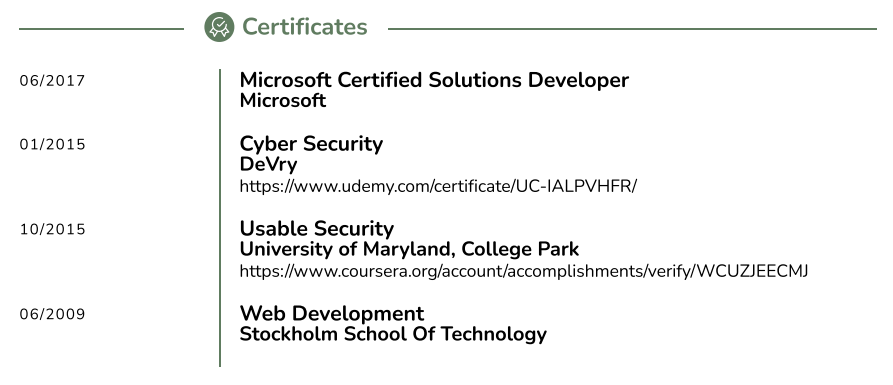
Here is an example of what a Certificates section can look like from an actual resume:

Certificates

This approach will draw attention to your efforts in upskilling or reskilling and enable potential employers to easily assess your additional qualifications.

Step 2: Organize your courses strategically

When listing your online courses, it’s crucial to present them in a way that highlights your skills and knowledge effectively.

Place the most relevant courses at the beginning of the list, ensuring they catch the employer’s attention.

Alternatively, you can group courses by theme or skill set, which demonstrates a strong focus on particular areas of expertise.

For example, consider grouping the courses under subcategories, such as Marketing or Data Analysis.

Step 3: Include essential course information

For each course, provide detailed information that will help potential employers understand the scope of your learning and its relevance to your field.

You should include:

  • Course title (E.g., Digital Marketing Fundamentals)
  • Platform or institution (E.g., Udemy)
  • Date of completion (E.g., Date of Completion: June 2021)

This information will help potential employers understand the scope of your learning and its relevance to your field.

Step 4: Showcase certifications or badges (if applicable)

If you’ve earned certifications or digital badges, make sure to display them prominently on your resume.

You can embed or link to these badges, providing potential employers with easy access to verify your achievements.

Here are two ways how to embed or link to these badges:

  • Linking to badges. For text-based resumes (i.e. in a PDF format) or online formats like LinkedIn, you can add a link to the digital badge. First, find the unique URL assigned to your badge, usually provided by the certifying organization or badge platform (e.g., Credly, Badgr). Then, add a separate line stating “View Badge” or “Verify Certification” with the URL link (check out the picture in Step 1). Alternatively, hyperlink the badge URL to the certification text on your resume (naturally, this doesn’t work for printed resumes).
  • Embedding badges. If you’re using an image-based resume, you can directly embed the digital badge image into the document. Save the badge image to your computer, and then insert it next to the corresponding certification on your resume. Keep the image size small and consistent with the overall formatting of your resume.

However, we do recommend adding a URL link to the badge rather than adding it as a picture, since it’s more ATS-friendly.

By embedding or linking certification badges on your resume, you offer potential employers a quick and easy way to validate your achievements.

This added layer of credibility can set you apart from other candidates, as it showcases your verified skills and accomplishments. 

Step 5: Showcase your newly acquired skills in other sections of your resume

In addition to listing your online courses and certifications, you should also highlight the skills you’ve gained from them in other parts of your resume.

This will help employers see the practical value of your online learning and its impact on your professional growth.

There are two resume sections in which you can mention these online courses:

  • Skills section. Update your Skills section to include the new abilities you’ve gained from your online courses. This will provide employers with a comprehensive overview of your skill set and make it easier for them to assess your qualifications.

For example: Digital Marketing (if you completed a Digital Marketing course)

  • Experience section. Show potential employers that you can put your new skills into practice by including examples in your Experience section. Describe how you’ve used the skills you’ve gained from online courses in previous roles or projects, highlighting the positive impact they’ve had on your work.

For example: Applied advanced Excel techniques learned from the Data Analysis in Excel course on One Education to optimize marketing budget allocation, leading to a 15% increase in return on investment.

By showcasing your newly acquired skills in both the Skills and Experience sections of your resume, you create a cohesive narrative that demonstrates the practical application of your online learning. 

Key takeaways: Online courses on a resume

Online courses play a vital role in today’s job market by providing individuals with the opportunity to continuously learn and adapt to the ever-changing demands of various industries.

As we’ve discussed, online courses offer numerous benefits, including flexibility, affordability, and relevance, making them an ideal choice for those looking to enhance their skills and stay competitive.

By effectively showcasing your online courses on your resume, you demonstrate your commitment to staying current in your field and improving your skill set, which can make you a more attractive candidate to potential employers.

Here’s a recap of how to list online courses on your resume:

1. Create a dedicated section for online courses and certifications.

2. Organize your courses strategically — based on relevance or theme.

3. Include course information, such as the name, the platform/institution, and date. 

4. Showcase certifications or badges (if applicable).

5. Showcase your newly acquired skills in other sections of your resume.

top

Hear What Our Learners Say About Us

Home Courses Search