Food Safety in Manufacturing: A Complete Guide

November 19, 2026 | By Emily Parker | 12 minutes | 13 Readers

Explore food safety in manufacturing, from HACCP and hygiene to allergen management, temperature control and traceability. Learn how effective controls, staff training and accurate records support safer production and compliance.

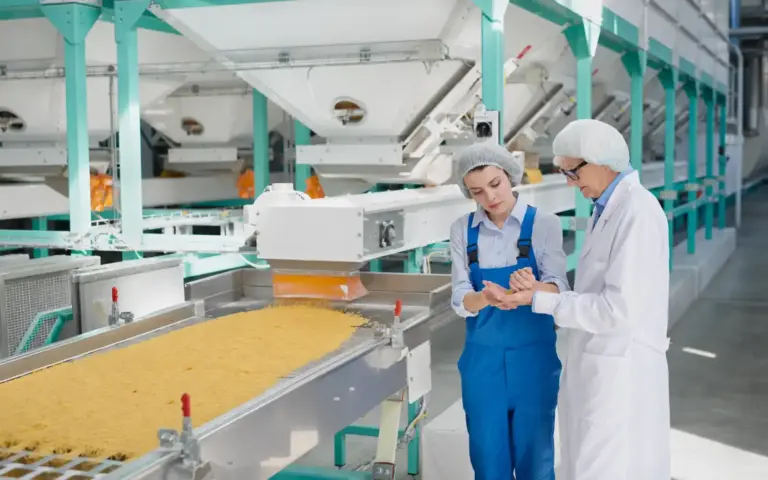
Food production supervisor and worker inspecting pasta on a manufacturing conveyor line.

Introduction

Every product that leaves a food factory carries a simple promise: it is safe to eat. Behind that promise sits a system of controls, checks and trained people working together to prevent contamination, mislabelling and other hazards before food reaches the consumer.

Food safety in manufacturing is more demanding than in a kitchen. Large production volumes, complex supply chains, shared equipment and long distribution routes mean that a single failure can affect thousands of customers, trigger a product recall and damage a brand built over many years.

In this guide, we explain what food safety in manufacturing involves, the UK laws that apply, the main types of food hazards and the practical controls that keep production lines safe. Whether you work on the factory floor, in quality assurance or in a supervisory role, this guide will help you understand your responsibilities and how they fit into the bigger picture.

What Is Food Safety in Manufacturing?

Food safety in manufacturing refers to the systems, procedures and behaviours used to prevent food from becoming harmful during production, processing, packaging, storage and distribution. It covers everything from how raw materials are sourced to how finished products are labelled, stored and traced.

A strong food safety system focuses on prevention rather than detection. Instead of relying on final product testing alone, manufacturers identify where things could go wrong and put controls in place at each stage of the process.

Food safety is closely linked to food quality, but the two are not the same. Quality relates to taste, appearance and consistency, while food safety is about protecting consumer health. A product can look perfect and still be unsafe.

Why Food Safety Matters in Food Manufacturing

  • Protecting consumers: Contaminated or mislabelled food can cause serious illness and severe allergic reactions. Young children, older people, pregnant women and people with weakened immune systems are especially vulnerable.
  • Legal compliance: Food businesses have a legal duty to produce safe food. Breaches can lead to enforcement notices, fines, prosecution and even closure.
  • Brand reputation: A single product recall can damage customer trust and retailer relationships for years.
  • Business continuity: Many retailers and buyers require suppliers to meet recognised food safety standards and pass regular audits before they will stock their products.
  • Reducing waste and cost: Effective controls prevent rejected batches, rework and wasted raw materials.

UK Food Safety Laws for Manufacturers

Food manufacturers in the UK operate within a clear legal framework. The key legislation includes:

  • Food Safety Act 1990: Makes it an offence to sell food that is harmful to health, not of the nature, substance or quality demanded, or falsely described.
  • Regulation (EC) No 852/2004 (as assimilated into UK law): Sets general hygiene requirements and requires food businesses to put in place procedures based on HACCP principles.
  • Regulation (EC) No 853/2004 (as assimilated): Adds specific hygiene rules for businesses handling food of animal origin, such as meat, dairy and fish. Many of these businesses must be approved rather than simply registered.
  • Regulation (EC) No 178/2002 (as assimilated): Sets out general food law principles, including traceability and the duty to withdraw or recall unsafe food.
  • Food Safety and Hygiene (England) Regulations 2013: Provide enforcement powers and temperature control requirements in England, with equivalent regulations in Wales, Scotland and Northern Ireland.
  • Food Information Regulations 2014: Cover food labelling, including mandatory allergen information.

Enforcement is mainly carried out by local authority environmental health and trading standards officers. The Food Standards Agency (FSA) oversees food safety in England, Wales and Northern Ireland, while Food Standards Scotland performs this role in Scotland.

The Four Main Types of Food Hazards

Every food safety system starts with understanding what could make food unsafe. Hazards are usually grouped into four categories.

  1. Biological hazards: Harmful bacteria such as Salmonella, Listeria monocytogenes and E. coli O157, as well as viruses, parasites and moulds. These are a major cause of food poisoning and are controlled through cooking, chilling, hygiene and cleaning.
  2. Chemical hazards: Cleaning chemicals, machine lubricants, pesticide residues and naturally occurring toxins. Controls include approved food-grade chemicals, correct storage and thorough rinsing.
  3. Physical hazards: Foreign bodies such as glass, metal, hard plastic, wood, stones, jewellery and hair. Metal detectors, X-ray systems, sieves and glass and brittle plastic policies help prevent them reaching consumers.
  4. Allergenic hazards: Undeclared allergens caused by cross-contact or labelling errors. Allergen incidents are one of the most common reasons for food recalls, so many manufacturers manage them as a separate hazard group.

HACCP: The Foundation of Food Safety Management

HACCP stands for Hazard Analysis and Critical Control Point. It is a systematic, preventive approach that identifies significant hazards and the points in a process where they must be controlled. UK law requires food businesses to have procedures based on the seven HACCP principles:

  1. Conduct a hazard analysis: Identify hazards that could occur at each process step.
  2. Determine the critical control points (CCPs): Find the steps where control is essential to prevent, eliminate or reduce a hazard to a safe level.
  3. Establish critical limits: Set measurable limits, such as a minimum core cooking temperature and time.
  4. Establish monitoring procedures: Decide how, when and by whom each CCP will be checked.
  5. Establish corrective actions: Define what happens when a limit is not met, including how affected products are handled.
  6. Establish verification procedures: Confirm the system works through audits, reviews and testing.
  7. Establish documentation and records: Keep evidence that the system is applied consistently.

For example, in a ready meal factory the cooking step is often a CCP, with a critical limit for core temperature. On a snack line, the metal detector may be a CCP, with regular checks using test pieces to confirm it rejects contaminated products. The FSA’s free MyHACCP tool guides smaller manufacturers through building a HACCP-based food safety management system.

To build a practical understanding of hazard analysis and critical control points, explore One Education’s HACCP Training course and learn about Hazard Analysis Critical Control Point.

Prerequisite Programmes: The Building Blocks

HACCP only works when good basic hygiene conditions are already in place. These foundations are known as prerequisite programmes (PRPs) and typically include:

  • Premises design and layout, including separation of raw and ready-to-eat areas
  • Cleaning and disinfection schedules
  • Pest control and proofing of buildings
  • Planned maintenance and calibration of equipment
  • Supplier approval and raw material checks
  • Safe water supply and waste management
  • Staff hygiene, health screening and training

Without strong PRPs, a HACCP plan quickly becomes overloaded with critical control points that are difficult to manage.

Personal Hygiene and Staff Practices

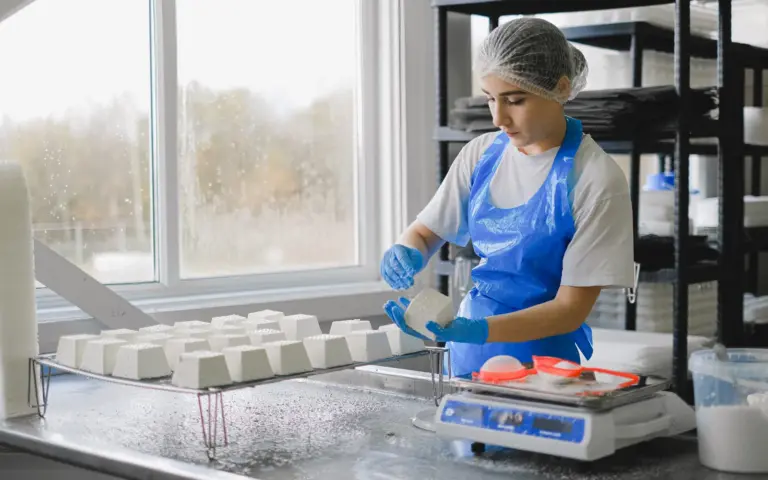
Food handler wearing a hairnet, apron and gloves while preparing cheese in a production room.

People are one of the biggest sources of contamination in any food factory. Good personal hygiene practices include:

  • Handwashing: Washing hands thoroughly before entering production, after breaks, after using the toilet and after handling waste or raw materials. Gloves are not a substitute for handwashing.
  • Protective clothing: Wearing clean overalls, hairnets, beard snoods and dedicated footwear, and removing them before leaving production areas.
  • Jewellery and personal items: Following site rules, which usually allow only a plain wedding band, if anything.
  • Fitness to work: Reporting symptoms such as diarrhoea or vomiting and staying away from work until 48 hours after symptoms have stopped.
  • Wound care: Covering cuts with blue, metal-detectable plasters.
  • Behaviour: No eating, drinking, smoking or vaping in production areas.

Temperature Control

Temperature is one of the most important tools for controlling harmful bacteria. Key points include:

  • Chilled storage: In England, chilled food must generally be kept at 8°C or below. Many manufacturers aim for 5°C or below to give an extra safety margin.
  • Cooking: Cooking processes must be validated to destroy harmful bacteria. A core temperature of 75°C for 30 seconds, or an equivalent time and temperature combination such as 70°C for two minutes, is commonly used.
  • Hot holding: Hot food should be held at 63°C or above.
  • Cooling: Cooked food should be cooled as quickly as possible, often using blast chillers, to limit time in the temperature danger zone.
  • Monitoring: Probe thermometers and data loggers should be calibrated regularly, and readings recorded.

Allergen Management

UK law requires food businesses to declare 14 major allergens when used as ingredients: celery, cereals containing gluten, crustaceans, eggs, fish, lupin, milk, molluscs, mustard, tree nuts, peanuts, sesame seeds, soya and sulphur dioxide (sulphites).

Effective allergen control in manufacturing includes:

  • Obtaining accurate allergen information from suppliers
  • Storing allergenic ingredients separately and clearly labelled
  • Scheduling production so allergen-free products run first
  • Using validated cleaning between product changeovers
  • Checking labels and packaging at start-up and every changeover
  • Using “may contain” warnings only after a proper risk assessment, not as a blanket precaution

For full requirements, review the FSA’s allergen guidance for food businesses.

Cleaning and Sanitation

Effective cleaning removes food residues, allergens and microorganisms from equipment and surfaces. A strong cleaning programme includes:

  • Written cleaning schedules stating what, how, when and who
  • A two-stage process: cleaning to remove dirt, followed by disinfection
  • Clean-in-place (CIP) systems for pipework and tanks
  • Colour-coded equipment to prevent cross-contamination between areas
  • Safe storage of chemicals away from food
  • Verification through visual checks, ATP swabbing and microbiological testing

In high-risk, ready-to-eat areas, many manufacturers also run environmental monitoring programmes to detect Listeria in drains, floors and equipment before it reaches products.

Quality Checks, Monitoring and Record-Keeping

Quality control technician checking a bottled drink on a production line while holding a laptop.

Auditors and inspectors often say, “If it isn’t written down, it didn’t happen.” Accurate records show that controls are working and help investigate problems quickly. Common records include:

  • CCP monitoring and temperature logs
  • Cleaning, pest control and maintenance records
  • Supplier approval and raw material checks
  • Equipment calibration records
  • Staff training records
  • Corrective actions and non-conformance reports

Records must be completed at the time of the check, accurately and honestly. Many manufacturers now use digital systems that alert supervisors when a reading falls outside its limits. Regular internal audits and third-party certification, such as the BRCGS Global Standard for Food Safety or SALSA for smaller suppliers, provide further assurance to customers.

Traceability and Product Recalls

UK food law requires manufacturers to trace food one step back and one step forward. In practice, this means knowing which suppliers provided each ingredient and which customers received each batch of finished product.

Batch or lot codes, accurate goods-in records and dispatch records make this possible. Many sites run regular mock recall exercises to test how quickly they can trace a batch.

If unsafe food has left a manufacturer’s control, it must be withdrawn or recalled, and the relevant enforcement authority must be informed. The FSA’s guidance on food traceability, withdrawals and recalls explains what the law requires.

Building a Strong Food Safety Culture

Procedures and paperwork only work when people follow them consistently. Food safety culture describes the shared attitudes and behaviours that determine how seriously food safety is taken across a business.

A positive food safety culture usually includes:

  • Visible commitment from senior leaders
  • Staff who feel confident to stop the line or report a concern
  • Open reporting of near misses without blame
  • Clear communication of procedures, including for agency and temporary workers
  • Regular, role-appropriate training and refresher sessions

The law requires food handlers to be supervised and instructed or trained in food hygiene matters appropriate to their work. Supervisors and HACCP team members typically need a higher level of training.

If you work in food production or supervise a team, One Education’s Food Manufacturing & Production Compliance Bundle can help you build the knowledge needed to follow safe practices and support compliance on the production floor.

Common Food Safety Mistakes in Manufacturing

  • Treating HACCP as paperwork: A plan that sits in a folder and does not reflect real practice offers little protection.
  • Poor changeover control: Many allergen and labelling errors happen when switching between products.
  • Incomplete or backdated records: These undermine trust and can hide genuine problems.
  • Untrained temporary staff: Agency workers need the same essential hygiene induction as permanent employees.
  • Neglected maintenance: Worn or loose parts can become foreign bodies.
  • Weak supplier checks: Problems with raw materials quickly become problems in finished products.
  • Failing to review HACCP: Plans should be reviewed whenever recipes, equipment, suppliers or processes change.

Conclusion

Food safety in manufacturing is built on prevention. By understanding food hazards, applying HACCP principles, maintaining strong prerequisite programmes and keeping accurate records, manufacturers can protect consumers, meet legal requirements and produce food people can trust.

Above all, food safety depends on people. Well-trained staff who understand why each control matters are a manufacturer’s strongest defence against contamination, recalls and reputational damage.

Ready to strengthen your skills? Explore One Education’s Food Manufacturing & Production Compliance Bundle to develop your knowledge of food hygiene, HACCP, allergen awareness and workplace compliance in one flexible online package.

top
Home Courses Search