How to Become a Crime Scene Investigator: Career Steps, Skills, and Salary Guide

May 22, 2026 | 17 minutes | 0 Readers

Learn how to become a Crime Scene Investigator, including essential skills, career steps, qualifications, and average salary expectations. Start a rewarding forensic science career in criminal investigation and evidence analysis.

rating

Bestselling Course

View Details SAVE 94% NOW

Every fingerprint, bloodstain, and hidden clue tells a story — and Crime Scene Investigators (CSIs) are the professionals trained to uncover the truth behind them. Working at the crossroads of science and criminal justice, CSIs collect, preserve, and analyse evidence from crime scenes to help solve investigations and support legal proceedings. Their work plays a crucial role in identifying suspects, reconstructing events, and ensuring accurate forensic analysis.

The career of a Crime Scene Investigator has become increasingly popular in recent years due to the growing importance of forensic science in modern criminal investigations. Advances in forensic technology, combined with public interest driven by crime documentaries and investigative dramas, have highlighted the value of skilled forensic professionals. As law enforcement agencies continue to rely heavily on scientific evidence, the demand for trained CSIs continues to grow across various sectors.

Becoming a Crime Scene Investigator requires a combination of education, technical expertise, and practical investigative skills. This blog will explore the complete career pathway, including the qualifications needed, essential skills for success, salary expectations, and future career opportunities in the field. Whether you are considering a career in forensic science or simply want to understand the profession better, this guide will provide valuable insights into the world of crime scene investigation.

What Does a Crime Scene Investigator Do?

A Crime Scene Investigator (CSI) is responsible for collecting, preserving, and analysing evidence from crime scenes to support criminal investigations. Their work helps police officers and detectives identify suspects, understand how crimes occurred, and provide reliable evidence for court proceedings. CSIs carefully gather physical evidence such as fingerprints, blood samples, fibres, weapons, and DNA materials while following strict procedures to avoid contamination.

Another important part of the role involves documenting crime scenes before anything is moved. Crime Scene Investigators take detailed photographs, create sketches, and record observations to preserve an accurate visual and written record of the scene. Even the smallest detail can become an important piece of evidence later in the investigation. Their careful documentation ensures that investigators and courts can review the scene accurately.

Crime Scene Investigators also work closely with forensic scientists, detectives, and laboratory specialists to analyse evidence such as fingerprints, blood patterns, and trace materials. In addition, they prepare detailed reports explaining their findings, which may be used during police investigations or legal proceedings. Strong observation skills, teamwork, patience, and attention to detail are essential qualities for success in this profession.

TV vs Reality: What CSI Work Is Actually Like

Television often portrays CSI work as fast-paced and highly dramatic, but real investigations are much more methodical. Most of the job involves careful documentation, scientific procedures, and detailed report writing.

While modern technology is important, successful investigators rely heavily on patience, accuracy, and observation skills. Real crime scene investigation is less about instant discoveries and more about following precise procedures to uncover the truth.

Why Choose a Career in Crime Scene Investigation?

Why Choose a Career in Crime Scene Investigation?

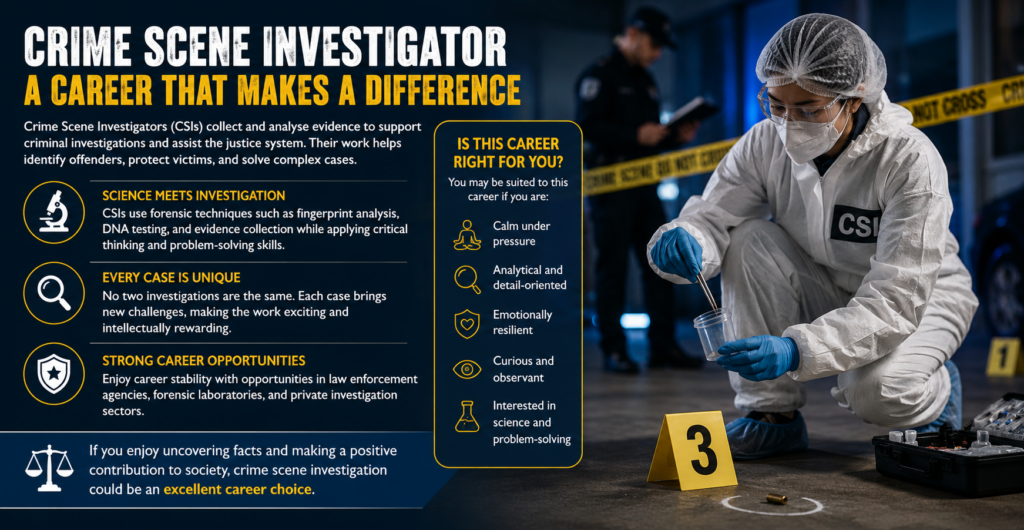
A career in crime scene investigation is exciting, meaningful, and highly rewarding. Crime Scene Investigators (CSIs) help collect and analyse evidence to support criminal investigations and assist the justice system. Their work can help identify offenders, protect victims, and solve complex cases.

This career is ideal for people who enjoy both science and investigation. CSIs use forensic techniques such as fingerprint analysis, DNA testing, and evidence collection while also applying critical thinking and problem-solving skills. Since every case is different, the job remains interesting and challenging, with no two investigations ever being the same.

Crime scene investigation also offers strong career stability, with opportunities available in law enforcement agencies, forensic laboratories, and private investigation sectors.

Is This Career Right for You?

You may be suited to this career if you are:

  • ♦  Calm under pressure
  • ♦  Analytical and detail-oriented
  • ♦  Emotionally resilient
  • ♦  Curious and observant
  • ♦  Interested in science and problem-solving

If you enjoy uncovering facts and making a positive contribution to society, crime scene investigation could be an excellent career choice.

Career Steps to Become a Crime Scene Investigator

Career Steps to Become a Crime Scene Investigator

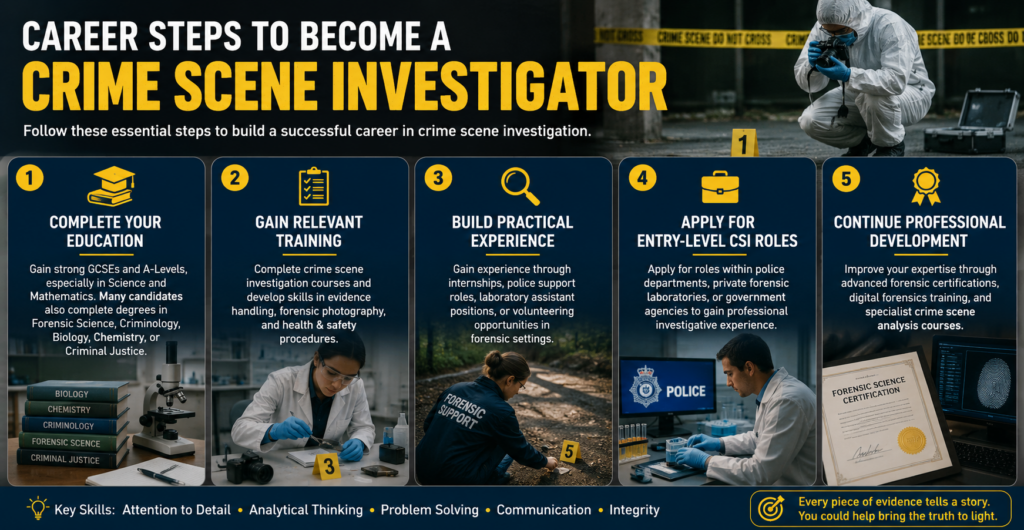
Becoming a Crime Scene Investigator (CSI) requires a combination of education, specialist training, and practical experience. CSIs are responsible for collecting, preserving, and analysing evidence to support criminal investigations. Building a successful career in this field involves developing strong scientific knowledge, attention to detail, and investigative skills while gaining hands-on experience in forensic and law enforcement environments.

Step 1: Complete Your Education

Gain strong GCSEs and A-Levels, especially in Science and Mathematics. Many candidates also complete degrees in Forensic Science, Criminology, Biology, Chemistry, or Criminal Justice.

Step 2: Gain Relevant Training

Complete crime scene investigation courses and develop skills in evidence handling, forensic photography, and health & safety procedures.

Step 3: Build Practical Experience

Gain experience through internships, police support roles, laboratory assistant positions, or volunteering opportunities in forensic settings.

Step 4: Apply for Entry-Level CSI Roles

Apply for roles within police departments, private forensic laboratories, or government agencies to gain professional investigative experience.

Step 5: Continue Professional Development

Improve your expertise through advanced forensic certifications, digital forensics training, and specialist crime scene analysis courses.

Essential Skills Every CSI Needs

Essential Skills Every CSI Needs

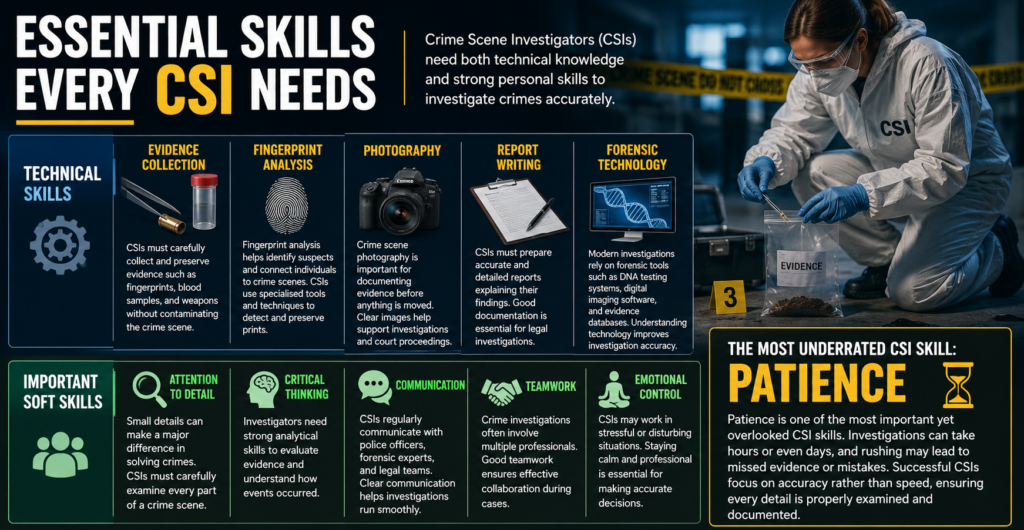
Crime Scene Investigators (CSIs) need both technical knowledge and strong personal skills to investigate crimes accurately. Their role involves collecting evidence, analysing scenes, and working closely with law enforcement teams.

Technical Skills

Evidence Collection

CSIs must carefully collect and preserve evidence such as fingerprints, blood samples, and weapons without contaminating the crime scene.

Fingerprint Analysis

Fingerprint analysis helps identify suspects and connect individuals to crime scenes. CSIs use specialised tools and techniques to detect and preserve prints.

Photography

Crime scene photography is important for documenting evidence before anything is moved. Clear images help support investigations and court proceedings.

Report Writing

CSIs must prepare accurate and detailed reports explaining their findings. Good documentation is essential for legal investigations.

Forensic Technology

Modern investigations rely on forensic tools such as DNA testing systems, digital imaging software, and evidence databases. Understanding technology improves investigation accuracy.

Important Soft Skills

Attention to Detail

Small details can make a major difference in solving crimes. CSIs must carefully examine every part of a crime scene.

Critical Thinking

Investigators need strong analytical skills to evaluate evidence and understand how events occurred.

Communication

CSIs regularly communicate with police officers, forensic experts, and legal teams. Clear communication helps investigations run smoothly.

Teamwork

Crime investigations often involve multiple professionals. Good teamwork ensures effective collaboration during cases.

Emotional Control

CSIs may work in stressful or disturbing situations. Staying calm and professional is essential for making accurate decisions.

The Most Underrated CSI Skill: Patience

Patience is one of the most important yet overlooked CSI skills. Investigations can take hours or even days, and rushing may lead to missed evidence or mistakes. Successful CSIs focus on accuracy rather than speed, ensuring every detail is properly examined and documented.

Qualifications and Certifications

Qualifications and Certifications

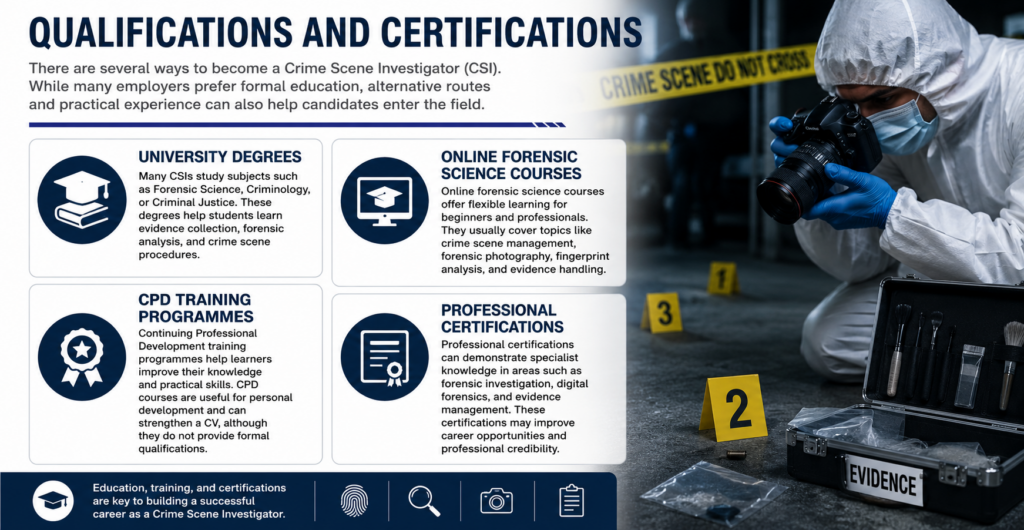
There are several ways to become a Crime Scene Investigator (CSI). While many employers prefer formal education, alternative routes and practical experience can also help candidates enter the field.

University Degrees

Many CSIs study subjects such as Forensic Science, Criminology, or Criminal Justice. These degrees help students learn evidence collection, forensic analysis, and crime scene procedures.

Online Forensic Science Courses

Online forensic science courses offer flexible learning for beginners and professionals. They usually cover topics like crime scene management, forensic photography, fingerprint analysis, and evidence handling.

CPD Training Programmes

Continuing Professional Development training programmes help learners improve their knowledge and practical skills. CPD courses are useful for personal development and can strengthen a CV, although they do not provide formal qualifications.

Professional Certifications

Professional certifications can demonstrate specialist knowledge in areas such as forensic investigation, digital forensics, and evidence management. These certifications may improve career opportunities and professional credibility.

Can You Become a CSI Without a Degree?

Yes, becoming a CSI without a degree is possible in some cases.

Alternative Routes

Some people enter the field through vocational training, online courses, or CPD programmes instead of university education.

Experience-Based Entry

Practical experience in areas such as security, laboratory work, or evidence handling can help candidates develop valuable investigative skills.

Police Training Pathways

Many CSIs begin their careers in police services and later move into forensic investigation roles through internal training and specialist crime scene programmes.

Tools and Technology Used by Crime Scene Investigators

Tools and Technology Used by Crime Scene Investigators

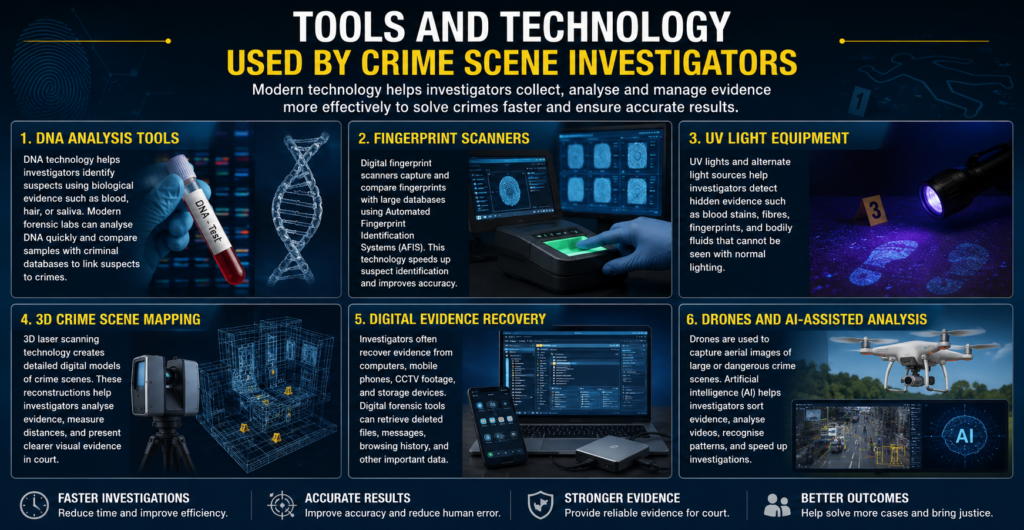
Modern crime scene investigators use advanced technology to collect evidence, solve cases faster, and improve investigation accuracy. These tools help investigators analyse both physical and digital evidence more effectively.

DNA Analysis Tools

DNA technology helps investigators identify suspects using biological evidence such as blood, hair, or saliva. Modern forensic labs can analyse DNA quickly and compare samples with criminal databases to link suspects to crimes.

Fingerprint Scanners

Digital fingerprint scanners capture and compare fingerprints with large databases using Automated Fingerprint Identification Systems (AFIS). This technology speeds up suspect identification and improves accuracy.

UV Light Equipment

UV lights and alternate light sources help investigators detect hidden evidence such as blood stains, fibres, fingerprints, and bodily fluids that cannot be seen with normal lighting.

3D Crime Scene Mapping

3D laser scanning technology creates detailed digital models of crime scenes. These reconstructions help investigators analyse evidence, measure distances, and present clearer visual evidence in court.

Digital Evidence Recovery

Crime scene investigators often recover evidence from computers, mobile phones, CCTV footage, and storage devices. Digital forensic tools can retrieve deleted files, messages, browsing history, and other important data.

Drones and AI-Assisted Analysis

Drones are used to capture aerial images of large or dangerous crime scenes. Artificial intelligence (AI) helps investigators sort evidence, analyse videos, recognise patterns, and speed up investigations.

How Technology Is Changing Crime Scene Investigation

How Technology Is Changing Crime Scene Investigation

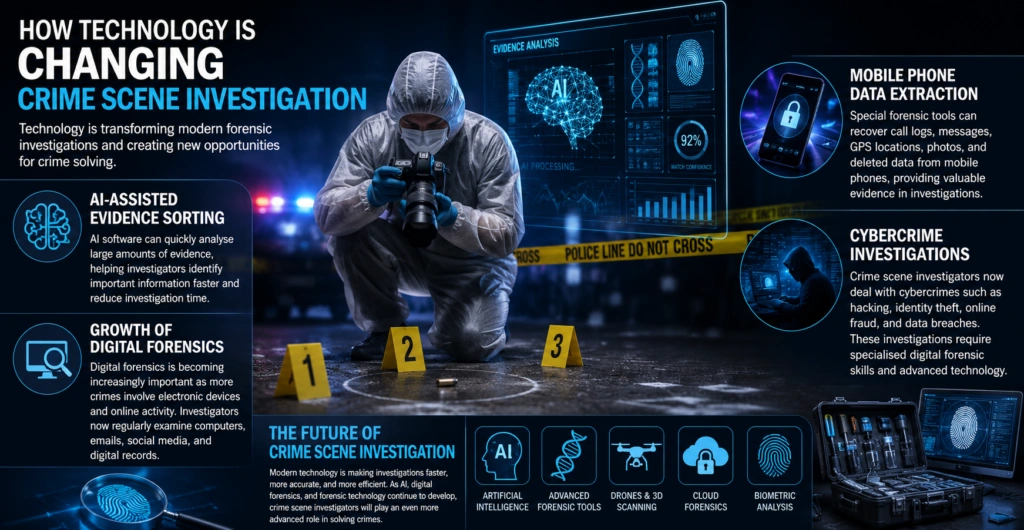
Technology is transforming modern forensic investigations and creating new opportunities for crime solving.

AI-Assisted Evidence Sorting

AI software can quickly analyse large amounts of evidence, helping investigators identify important information faster and reduce investigation time.

Growth of Digital Forensics

Digital forensics is becoming increasingly important as more crimes involve electronic devices and online activity. Investigators now regularly examine computers, emails, social media, and digital records.

Mobile Phone Data Extraction

Special forensic tools can recover call logs, messages, GPS locations, photos, and deleted data from mobile phones, providing valuable evidence in investigations.

Cybercrime Investigations

Crime scene investigators now deal with cybercrimes such as hacking, identity theft, online fraud, and data breaches. These investigations require specialised digital forensic skills and advanced technology.

The Future of Crime Scene Investigation

Modern technology is making investigations faster, more accurate, and more efficient. As AI, digital forensics, and forensic technology continue to develop, crime scene investigators will play an even more advanced role in solving crimes.

CSI Salary Guide (UK + International Comparison)

CSI Salary Guide (UK + International Comparison)

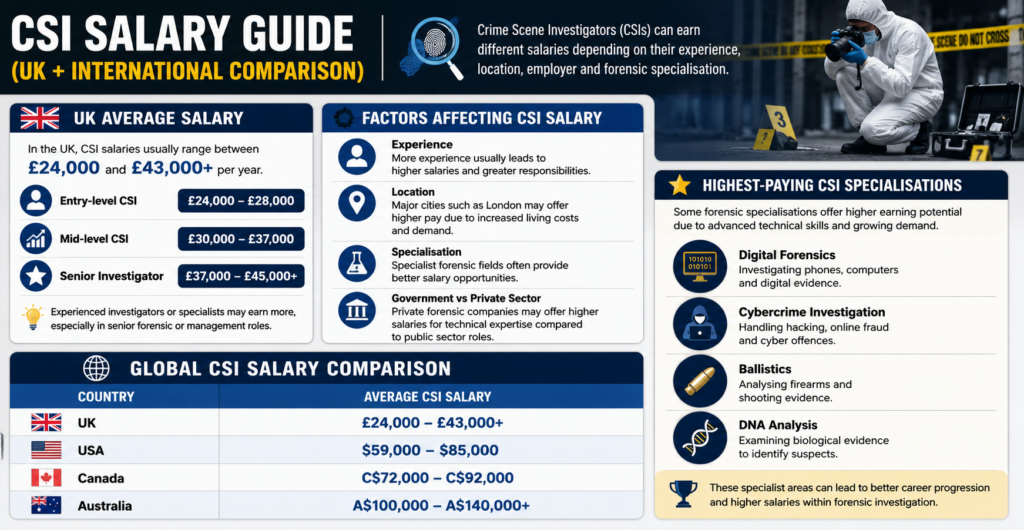
Crime Scene Investigators (CSIs) can earn different salaries depending on their experience, location, employer and forensic specialisation.

UK Average Salary

In the UK, CSI salaries usually range between £24,000 and £43,000+ per year.

  • ♦  Entry-level CSI: £24,000–£28,000
  • ♦  Mid-level CSI: £30,000–£37,000
  • ♦  Senior Investigator: £37,000–£45,000+

Experienced investigators or specialists may earn more, especially in senior forensic or management roles.

Factors Affecting CSI Salary

Experience

More experience usually leads to higher salaries and greater responsibilities.

Location

Major cities such as London may offer higher pay due to increased living costs and demand.

Specialisation

Specialist forensic fields often provide better salary opportunities.

Government vs Private Sector

Private forensic companies may offer higher salaries for technical expertise compared to public sector roles.

Global CSI Salary Comparison

Country Average CSI Salary
UK £24,000 – £43,000+
USA $59,000 – $85,000
Canada C$72,000 – C$92,000
Australia A$100,000 – A$140,000+

Highest-Paying CSI Specialisations

Some forensic specialisations offer higher earning potential due to advanced technical skills and growing demand.

  • ♦  Digital Forensics – Investigating phones, computers and digital evidence
  • ♦  Cybercrime Investigation – Handling hacking, online fraud and cyber offences
  • ♦  Ballistics – Analysing firearms and shooting evidence
  • ♦  DNA Analysis – Examining biological evidence to identify suspects

These specialist areas can lead to better career progression and higher salaries within forensic investigation

Challenges of Working as a Crime Scene Investigator

Challenges of Working as a Crime Scene Investigator

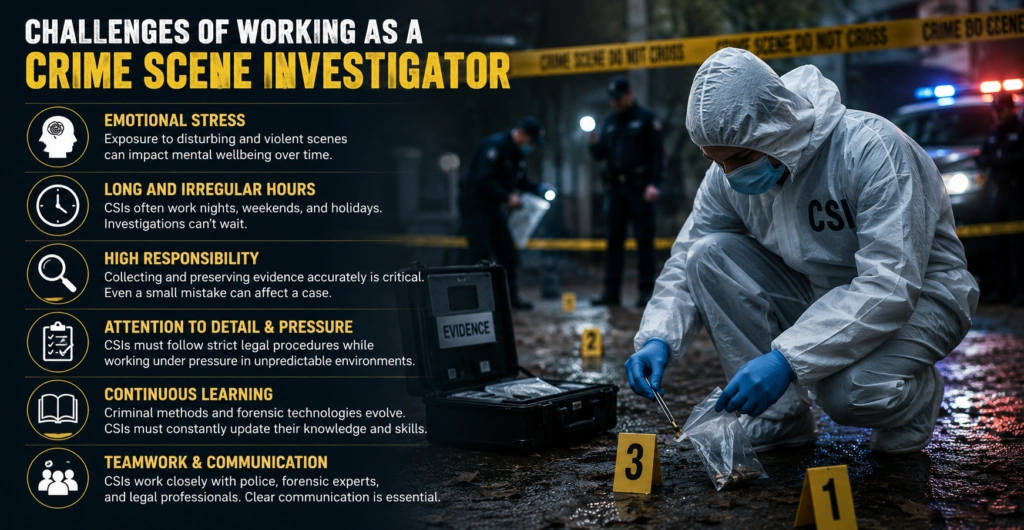
Working as a Crime Scene Investigator can be both physically and emotionally challenging. CSIs are often exposed to disturbing crime scenes, including violent crimes and accidents, which can affect their mental wellbeing over time. They also work long and irregular hours, including nights and weekends, because investigations must begin immediately to protect important evidence.

Another challenge is the high level of responsibility involved in collecting and preserving evidence accurately. Even a small mistake can impact an investigation or court case. Crime Scene Investigators must pay close attention to detail while working under pressure in unpredictable environments. They also need to follow strict legal procedures when documenting and handling evidence.

In addition, modern crime investigations require continuous learning and adaptation. Criminal methods and forensic technologies are constantly evolving, so CSIs must regularly update their knowledge and technical skills. They often work closely with police officers, forensic experts, and legal professionals, making teamwork and communication essential in this demanding career.

Career Progression and Future Opportunities

Career progression in crime scene investigation offers many opportunities for growth and specialisation. Most professionals begin in entry-level forensic or investigative roles before moving into senior positions with greater responsibilities. With experience and additional training, investigators can lead complex cases, supervise teams, or work in specialised forensic departments.

Future opportunities in this field continue to expand as forensic technology advances. Crime scene investigators now work with modern tools such as digital forensics, DNA analysis, and cybercrime investigation techniques. These developments create new career paths in law enforcement agencies, private forensic laboratories, and government organisations.

The demand for skilled forensic professionals is expected to remain strong as criminal investigations increasingly rely on scientific evidence. Experienced investigators may also move into consultancy, research, or teaching roles within the forensic science sector. This makes crime scene investigation a career with long-term stability and continuous learning opportunities.

Conclusion

Becoming a Crime Scene Investigator can be a rewarding career for individuals who are passionate about forensic science, problem-solving, and supporting the justice system. By gaining the right qualifications, developing practical investigative skills, and building experience in evidence collection and analysis, aspiring CSIs can pursue strong career opportunities in law enforcement and forensic services. With competitive salaries, career progression, and growing demand for skilled investigators, this profession offers both professional stability and the chance to make a meaningful impact on criminal investigations.

FAQs — How to Become a Crime Scene Investigator

1. How long does it take to become a CSI?

Becoming a Crime Scene Investigator (CSI) usually takes between 2 and 6 years, depending on the career path you choose. Many employers prefer candidates with a degree in forensic science, criminal justice, or a related field, along with practical training or work experience.

2. Is forensic science difficult?

Forensic science can be challenging because it involves scientific analysis, attention to detail, and critical thinking. However, with proper study, training, and dedication, it is a rewarding field for those interested in science and criminal investigations.

3. Do CSIs carry guns?

Some CSIs carry firearms if they are sworn police officers. However, civilian crime scene investigators usually do not carry guns, as their main role focuses on collecting and analysing evidence rather than law enforcement duties.

4. Can you become a CSI through online courses?

Online courses can help you build foundational knowledge in forensic science and crime scene investigation. While they are useful for learning and skill development, many CSI roles also require practical training, laboratory experience, or formal qualifications.

5. What subjects are best for forensic science?

Subjects such as biology, chemistry, physics, criminology, and mathematics are highly useful for forensic science. These subjects help develop the scientific and analytical skills needed for crime scene investigation.

Sam Walker

Article by

Sam Walker

Sam Walker is an education specialist and author at One Education, bringing over 4 years of experience in creating practical resources and strategies to support teachers and enhance student learning.

top
Home Courses Search