


Table of Content
Share this Resource


What if a pupil has the answer in their mind but cannot find the words to say it? In a classroom full of questions, conversations and new learning, speech delays can make even simple interactions feel overwhelming. A child may stay silent, struggle to join in or become frustrated when others cannot understand what they are trying to communicate. But what can teachers do to help every pupil feel heard, included and confident enough to participate?
Knowing how to support speech delay in class starts with small, thoughtful changes. Giving pupils extra thinking time, using visual prompts and modelling clear language can make everyday learning more accessible without putting pressure on them to speak before they are ready.
Classroom strategies are only part of the picture. Recognising when a pupil may need additional support and working with families, the SENCO and relevant professionals can help ensure their needs are understood. With patience and the right approach, teachers and teaching assistants can create a classroom where every child has opportunities to communicate, learn and belong.
What Does Speech Delay Look Like in the Classroom?
Speech delay describes a situation in which a child’s speech development is slower than expected for their age. A pupil may have difficulty pronouncing sounds, making themselves understood or developing spoken communication.
Speech and language are related, but they are not the same. Speech involves producing sounds and words, while language involves understanding and using words to communicate meaning. A pupil may experience difficulties with one or both.
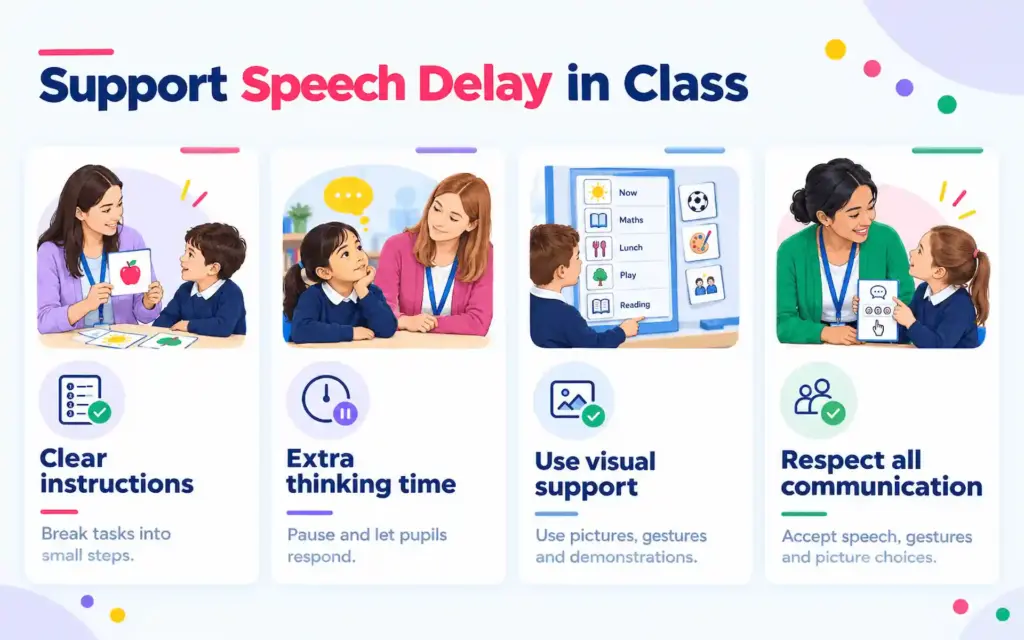
In the classroom, a pupil who is struggling with speech or language development might:
- Use fewer spoken words than expected for their stage of development.
- Find it difficult to pronounce certain sounds or make words clear.
- Struggle to explain an idea, describe an event or answer an open question.
- Rely on gestures, facial expressions or pointing to communicate.
- Need more time to understand instructions or prepare a spoken response.
- Become quiet, frustrated or reluctant to participate in some activities.
These signs do not, on their own, Speech Therapy and SEN Teaching Assistant. A child may be quiet for many reasons, and communication needs can vary considerably. Speaking more than one language is not itself a speech disorder, either.
The important thing for school staff is to notice how a pupil communicates, identify barriers to participation and follow the school’s process for discussing concerns.
Speech Therapy and SEN Teaching Assistant Course
Learn how speech and language develop, and how to support children with communication and special educational needs in the classroom.
- 17 Expert-Led Units
- 2 Free Bonus Courses
- 1 Year Full Access
★★★★★ Rated Excellent (340+ reviews) 🔒 14-day money-back guarantee
How to Support Speech Delay in Class: 8 Practical Strategies
Effective classroom support does not always require specialist equipment or a separate activity. Often, it starts with adapting the way instructions are given, conversations are managed and learning opportunities are presented.

1. Use Short, Clear Instructions
Long instructions can be difficult to follow, especially when pupils are expected to listen, remember several steps and begin an activity at the same time.
Give instructions in manageable parts. Use familiar words where possible, and explain unfamiliar vocabulary before expecting pupils to use it independently.
For example, instead of saying, “Take out your workbook, turn to page twelve, read the first paragraph and answer the questions underneath”, break the task into smaller steps:
- “Take out your workbook.”
- “Open page twelve.”
- “Read the first paragraph.”
- “Now answer question one.”
Allow the pupil time to complete each step. A visual checklist or demonstration can reinforce what you have said.
Check understanding without putting the pupil under pressure. Rather than repeatedly asking, “Do you understand?”, invite them to show you the first step or point to the relevant page.
2. Give Pupils Extra Processing Time
Some pupils need additional time to understand a question, organise their thoughts and prepare a response. If an adult immediately repeats the question, supplies the answer or moves to another pupil, the child may lose the opportunity to participate.
Ask a question and pause. Keep your attention on the pupil, but avoid making the silence feel uncomfortable. If necessary, offer a visual choice or a simpler prompt.
For example, ask, “Would you like the red pencil or the blue pencil?” while showing both options. This gives the pupil a clear opportunity to respond through speech, pointing or another familiar communication method.
Extra thinking time can be especially helpful during whole-class questioning, group discussions and transitions between activities. The aim is to make participation possible without rushing the pupil or speaking on their behalf.
3. Model Language Without Pressuring the Pupil
Children can learn from hearing clear, useful language in everyday situations. Teachers and teaching assistants can model words and short sentences while keeping conversations natural.
Suppose a pupil points to a book. You might say, “You want the storybook.” If the pupil says, “Car go”, you could respond, “Yes, the car is going fast.”
This approach acknowledges the child’s message and provides a useful language model without demanding that they repeat the sentence.
Avoid turning every interaction into a test. Constantly correcting pronunciation or asking a pupil to repeat words can make communication feel stressful.
Instead, respond to what the pupil is trying to communicate. Introduce slightly richer language where appropriate, then give the child time to respond in their own way.
4. Use Visuals, Gestures and Demonstrations
Spoken instructions are only one way to communicate information. Visual support can help pupils understand routines, follow classroom expectations and anticipate what will happen next.
Depending on the pupil’s needs, useful resources may include:
- Visual timetables: Show the order of lessons and daily activities.
- Now-and-next boards: Explain what is happening now and what comes afterwards.
- Picture cards: Represent objects, activities, choices or familiar needs.
- Written keywords: Highlight important vocabulary during a lesson.
- Gestures and demonstrations: Show a pupil how to begin a task rather than relying on spoken explanations alone.
For example, a teacher introducing a science activity might display pictures of the equipment alongside the relevant words. A teaching assistant could point to each item as the pupil collects it.
Choose visuals that support the individual pupil rather than filling the classroom with unnecessary displays. Use the same symbols and routines consistently, and check that the pupil can understand and access them.
Speech and Language UK’s guidance on creating a communication-supportive primary environment offers further ideas for making classroom communication more accessible.
5. Create Low-Pressure Opportunities to Communicate
Not every pupil feels comfortable speaking in front of the whole class. A child may communicate more confidently with a trusted adult, a familiar classmate or a small group.
Provide different ways to participate, such as pointing to an answer, selecting a picture, matching words, demonstrating a task or using an agreed communication aid.
For example, before asking pupils to describe a picture to the whole class, allow them to discuss it with a partner. You could also offer a choice of words or pictures to help a pupil organise their response.
Do not assume that a pupil is unable to understand something simply because they cannot explain it verbally. Look for ways to assess their knowledge without making spoken fluency the only route to success.
Where a pupil uses an established alternative or augmentative communication system, follow the agreed approach and seek advice from the relevant professionals if you are unsure how to support it.
6. Build Communication Into Everyday Lessons
Communication practice does not need to be restricted to a separate intervention. Communication Skills for SEN Teaching Assistants. Ordinary classroom activities provide opportunities for pupils to listen, make choices, exchange ideas and learn new vocabulary.
Consider adapting familiar activities:
- Reading: Pause to discuss pictures, introduce key words and invite responses through speech, gestures or pointing.
- Art: Name colours, materials and actions as pupils work.
- Science: Introduce equipment and process words before a practical investigation.
- Role-play: Use familiar scenarios, objects and simple phrases to encourage interaction.
- Group work: Give pupils clear roles and structured opportunities to contribute.
- Storytelling: Use picture sequences to help pupils organise events and communicate what happened.
Keep activities appropriate to the pupil’s age, interests and communication needs. Older pupils may benefit from subject-specific vocabulary, written prompts or preparation time before a discussion rather than activities designed for younger children.
The Education Endowment Foundation’s evidence review of oral language interventions discusses approaches involving purposeful dialogue, vocabulary development and adult modelling. These approaches can inform classroom practice, although outcomes will vary and no single activity is guaranteed to produce a particular result.
7. Reduce Communication Barriers in the Classroom
A noisy, busy classroom can make it harder for some pupils to listen, understand speech or contribute to conversations. Before assuming a pupil is not paying attention, consider whether the environment is making communication difficult.
Practical adjustments may include:
- Reducing unnecessary background noise during instructions.
- Making sure the pupil can see the speaker’s face when appropriate.
- Giving important information before a noisy transition.
- Using a consistent signal to gain the class’s attention.
- Allowing enough time for pupils to move between activities.
- Seating pupils where they can access teaching and visual information comfortably.
Avoid singling a pupil out unnecessarily. Many of these changes can benefit the whole class, not only children with identified communication needs.
If a pupil regularly struggles to hear or follow spoken information, share your observations with the appropriate school staff and family. Teachers should not attempt to diagnose a hearing problem, but concerns about hearing deserve attention.
8. Recognise and Respect Different Ways of Communicating
Communication is more than spoken words. A pupil may use facial expressions, gestures, pictures, signs, writing or an established communication aid to express their needs and ideas.
A supportive classroom recognises these methods rather than treating speech as the only acceptable response.
For example, if a pupil points to indicate that they need help, acknowledge the message and respond. You can model a relevant phrase, such as “Help me, please”, without making access to help dependent on the pupil saying it aloud.
Praise participation and effort in a natural, age-appropriate way. Avoid drawing unnecessary attention to a pupil’s difficulties or comparing their communication with that of classmates.
Most importantly, do not pressure pupils to speak when they are distressed or unable to respond. Give them appropriate ways to communicate, maintain their dignity and follow any agreed support plan.
Classroom Examples: What Can Teachers Say or Do?
Understanding a strategy is useful, but seeing how it works during a lesson can make it easier to apply.
Swipe left to see the full table →
| Classroom situation | Helpful response | Why it may help |
|---|---|---|
| A pupil does not answer a question immediately. | Pause, then offer a visual clue or two clear choices. | Gives time to process the question and prepare a response. |
| A pupil uses one word to explain an idea. | Acknowledge the message and model a slightly longer sentence. | Provides a language example without demanding repetition. |
| A pupil becomes frustrated when misunderstood. | Stay calm, offer familiar pictures or gestures and check what they are communicating. | Helps the pupil express their needs without increasing pressure. |
| A pupil struggles to follow a multi-step task. | Break the task into smaller instructions and demonstrate the first step. | Makes the activity easier to understand and begin. |
| A pupil avoids speaking in front of the class. | Offer paired discussion, preparation time or another way to contribute. | Creates a more accessible route to participation. |
These are starting points, not universal solutions. Observe how the pupil responds and adapt the approach to their needs and any advice provided by the school’s special educational needs coordinator (SENCO) or speech and language therapist.
How to Adapt Support for Different School Ages
A strategy that works for a young child may not suit an older pupil. Classroom support should reflect the pupil’s age, learning environment, interests and individual communication profile.

Early Years and Nursery
Young children often communicate during play, routines and interactions with familiar adults. Use songs, stories, pretend play, objects and picture choices to create natural opportunities for interaction.
Follow the child’s interests, comment on what they are doing and allow time for a response. Work with families to understand how the child communicates at home and which approaches they find helpful.
Primary School
Primary pupils may need support with classroom instructions, storytelling, vocabulary, reading discussions and group activities. Introduce important words before a lesson, display visual prompts and provide structured opportunities to practise expressing ideas.
If a pupil struggles to answer in front of others, consider whether paired discussion or a visual response would help them demonstrate their understanding.
Secondary School
Older pupils may experience communication difficulties during subject-specific learning, presentations, practical work and social interaction. Support them with key vocabulary, written instructions, advance preparation and opportunities to contribute without unnecessary public pressure.
Respect their privacy and independence. Discuss adjustments appropriately and involve the pupil in decisions about support wherever possible.
Across all age groups, avoid assuming that a pupil’s needs will disappear simply because they get older. Review strategies as learning demands and circumstances change.
How to Recognise Concerns and Record Progress
Teachers and teaching assistants are well placed to notice patterns because they see pupils communicating across different lessons and activities. However, their role is to observe and support, not to diagnose a speech or language disorder.
When concerns arise, record specific, factual observations. Useful information may include:
- The date and classroom situation.
- What the pupil was asked to do or communicate.
- What you observed, without adding assumptions about the cause.
- Which support strategies were used.
- How the pupil responded.
- Whether the difficulty appears across different activities or settings.
For example, “Needed the instruction repeated and completed the first step after a visual demonstration” is more useful than “Does not understand instructions”.
Follow your school’s procedures for sharing concerns with the SENCO, class teacher or other relevant staff. Discuss observations sensitively with the family through the appropriate school process, and respect confidentiality.
Recording what helps a pupil can also make support more consistent when different adults work with them. It provides a clearer basis for reviewing strategies and deciding whether further advice is needed.
When Should School Staff Seek Further Support?
Classroom strategies can improve access to learning, but they should not delay appropriate advice when concerns persist.
School staff should follow the school’s SEND procedures if a pupil regularly struggles to communicate, is difficult to understand, has ongoing difficulty understanding spoken language or experiences communication barriers that affect learning or relationships.
Concerns may also need prompt discussion if a child loses communication skills they previously had or if there are concerns about hearing. School staff should not wait for a particular age or attempt to diagnose the cause before raising appropriate concerns.
A practical approach is to:
- Discuss observations with the relevant school staff. Follow the school’s procedures and involve the SENCO where appropriate.
- Work sensitively with the family. Share specific examples and listen to what they have noticed at home.
- Review the support already in place. Identify which adjustments help and where difficulties remain.
- Explore appropriate advice or assessment. Depending on the circumstances, this may involve a speech and language therapist, hearing assessment or another relevant service.
The exact referral route varies across the UK and may depend on local services and the child’s circumstances. Families can ask their GP, health visitor or local speech and language therapy service about available pathways.
The NHS-linked Evelina London guidance on speech and language development provides examples of when families may wish to seek advice. It is a useful starting point, not a diagnostic checklist for teachers.
For schools in England, the SEND Code of Practice: 0 to 25 years provides statutory guidance on identifying and supporting children and young people with special educational needs and disabilities. The guidance applies in England; education arrangements differ across the other UK nations.
The Department for Education also published training on speech, language and communication for mainstream schools in September 2026. It offers practical resources for teachers and teaching assistants in England.
How Can Teachers and Teaching Assistants Develop Their Skills?
Supporting pupils with speech delay requires patience, observation and an understanding of how communication needs can affect learning. Staff can strengthen their practice by learning about speech and language development, inclusive teaching methods, SEN support and effective communication strategies.
Training can also help teaching assistants and other school staff understand how to work alongside teachers, families and specialist professionals. In England, the Department for Education’s speech, language and communication training provides a useful starting point for school-based professional development.
For a broader overview of staff development, the future pillar blog “Speech and Language Support Training for School Staff” can explore how schools can build consistent, communication-friendly practice across the team.
If you want to develop your understanding of speech and language difficulties and special educational needs, the Speech Therapy and SEN Teaching Assistant Course from One Education may be a useful learning option to explore. Its course content covers speech therapy, language development, speech and language difficulties, SEN support and teaching methodologies.
The course can support learning in these areas, but completing it should not be presented as a qualification to diagnose communication disorders or practise as a registered speech and language therapist. Those professional roles have their own training and registration requirements.
Final Thoughts
Every child deserves to feel heard, understood and included in the classroom. Learning how to support speech delay in class is not about finding a single solution; it is about making small, thoughtful changes that help pupils communicate in ways that work for them. Clear instructions, visual cues, extra thinking time and supportive conversations can turn everyday lessons into valuable opportunities for learning and connection.
Just as importantly, teachers and teaching assistants should recognise when a pupil may need additional help. By recording observations, sharing concerns sensitively with families and working alongside the SENCO and relevant specialists, school staff can help ensure that support is appropriate and consistent.
Progress begins with patience, understanding and the right support. When pupils are given the time and tools to express themselves without unnecessary pressure, they have more opportunities to participate, build confidence and reach their learning potential.
Frequently Asked Questions
Use clear instructions, visual support, extra processing time and regular opportunities to communicate. Model useful language naturally, accept appropriate non-verbal responses and adapt activities to the pupil’s needs. If concerns persist, follow the school’s process for seeking further support.
Teachers can make lessons more accessible by simpl—ifying instructions, introducing key vocabulary, demonstrating tasks and reducing communication barriers. They can also work with teaching assistants, families, the SENCO and relevant specialists to keep support consistent.
Stories, songs, role-play, picture sequencing, shared reading and structured group activities can provide opportunities for communication. Choose activities that match the child’s interests and needs. Avoid forcing a child to speak or assuming that one activity will resolve a delay.
Some children make progress and their communication difficulties may change over time, while others need ongoing support. Outcomes depend on the individual child and the reasons for their difficulties. Teachers should avoid predicting an outcome and focus on appropriate support, monitoring and professional advice when needed.
Not every child will need the same support, and a teacher cannot determine a child’s clinical needs from classroom observations alone. Some pupils benefit from classroom adjustments, while others may need advice or assessment from a speech and language therapist. Decisions should reflect the child’s individual circumstances and the appropriate professional guidance.
Related Articles

 Nov, 09, 2026

Get a FREE Course
- Learn useful skills online free
- Get CPD accredited certificate
- Add it to your CV today!