


Table of Content
Share this Resource


Imagine your child gasping for air or one of your students bleeding out, but you have no idea how to help them! No one wants to be in this kind of tragic situation. Unfortunately, it is not always possible to prevent an accident. But it is possible to provide paediatric first aid and mitigate the impact of the injury or illness.
A child is way more sensitive and prone to danger than an adult. For example, they can hurt themselves while playing or choke on objects lying around them. Also, they have a greater risk of falling ill as their immune system is not fully developed. Therefore, parents and professionals working directly with children require basic paediatric first aid knowledge. And paediatric first aid skills will help you take the proper steps without delay and save a child’s life.
If you have little to no idea about paediatric first aid, this blog is ideal for you. Go through the blog to learn different aspects of performing first aid on children.
What is Paediatric First Aid?
Paediatric first aid is the primary treatment given to a child or infant suffering from injury or illness. This treatment is usually given while qualified medical treatment is on the way. And it is considered paediatric first aid when the injured person has not yet reached puberty.
Sometimes, even a simple injury or mild sickness can become life-threatening if treatment is not provided in the initial stage. That is why it is vital for parents and professionals who work with children to have basic first-aid skills.
What is the Difference Between First Aid and Paediatric First Aid?
When it comes to first aid, there are some basic differences between the first aid treatment provided to a child and an adult person. For example, in paediatric first aid, anyone who has not yet gone through puberty is considered a child.
Among the many reasons, the major factor is the physical development and size difference between an adult and a child. Children’s physical structures are more delicate than adults. That’s why first aid treatment like CPR is provided differently to children. For instance, if you apply the same pressure you would give an adult during CPR on a child, their bones can break. And it can be lethal for infants.
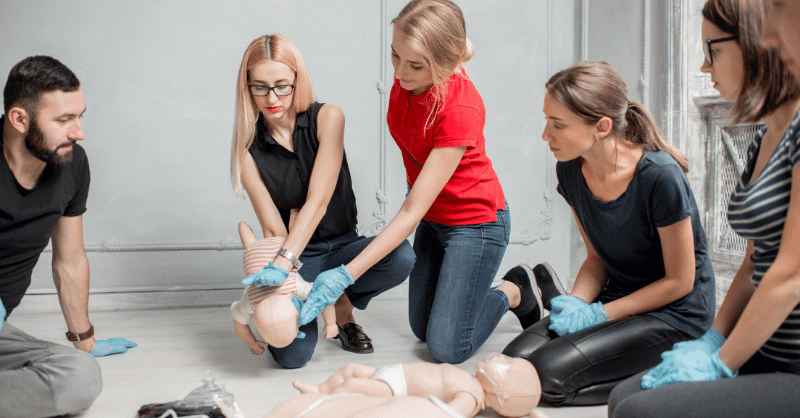
And in case of burns, children require extra attention as their skin is thinner than a full-grown person’s. In addition to that, they have comparatively less blood in their body. Therefore, in the case of bleeding, it needs to be taken care of as soon as possible.
Along with these factors, there’s a major difference. That is, children are more sensitive, and they don’t have the ability to deal with the situations on their own like adults. As a result, children get scared. Also, they are less resistant to pain. Therefore, while performing paediatric first aid, you are not only providing treatment but also have to handle a panicking and scared child.
Why is it Important to Take Paediatric
First Aid Training?
Whether you are a parent or working with children, learning paediatric first aid is a must. The initial steps taken after an injury are crucial. Taking the proper steps in the first stage can have lifesaving effects. You can help children in pain and even save lives with simple paediatric techniques. But, on the other hand, the wrong move can make the situation worse. That is why you need proper training, where you will receive adequate information and instructions.
First aid training teaches you to deal with common illnesses and injuries like cuts, burns, sprains, etc. Along with that, these training programs will teach you how to help a choking child. You will develop the ability to take the right steps to stop bleeding. The training will also show you the techniques to provide CPR. Some training courses will introduce you to different first aid tools and teach you how to utilise them in a proper manner.
You can acquire the essential knowledge and paediatric first aid skills from One Education’s Paediatric First Aid Training course. This course will provide quality first-aid training and help you develop the confidence to act in an emergency.
It's an important part of learning how to care for them!
Professions that Require Paediatric First Aid Knowledge
Anyone can acquire a basic understanding of paediatric first aid, especially parents who want to ensure their child’s safety. However, some occupations require professionals to clearly understand paediatric first aid if they work with children directly. For example –


What Qualities Does a Paediatric First Aider Need?
Taking training and developing first aid skills is mandatory for the first-aider. However, that is not enough. They also require some additional qualities that define them as a good first-aider. These qualities help them take control of the situation and provide quality first-aid treatment. These qualities are –
- Quick thinking ability
- Ability to work under pressure
- Good communication
- Leadership
- Understanding own limitations
Quick Thinking Ability
Along with the training, a good first-aider needs to be quick and prompt. They should be able to assess the situation and come up with a plan without any delay. If a first-aider is slow and unable to act within the first few minutes of an emergency, the situation can go out of hand. Even if they have good treatment skills, it won’t work if the treatment is not provided in the initial stage.
Ability to Work Under Pressure
Being calm and composed is the key to overcoming any emergency. A first-aider must know how to stay calm and manage the whole situation effectively. When an emergency takes place, people start to panic, and it becomes chaotic. Especially when a child is hurt, they get scared, and the situation becomes more intense.
The first-aider needs to be able to work under pressure and stay on the right course. And they have to maintain their composure and take control. Calmness is also vital to investigate the injuries and plan accordingly.
Good Communication
Most of the time, the injured child can’t communicate properly due to pain or loss of consciousness. In that case, you have to communicate effectively with the bystanders and those who were present at the time of the incident. Also, there are some techniques to communicate with the injured child. For example, asking specific questions like how they are feeling or what is the level of their pain.
In addition, when paramedics arrive or the child is under professional care, a first-aider needs to communicate with them effectively. They have to explain the situation and describe the illness or injuries. It helps paramedics or doctors to understand patients’ conditions and provide treatment.
Leadership
It may seem unrelated to paediatric first aid, but leadership skills are very important. A first-aider needs leadership skills in order to control the situation. In times of crisis, people get flustered. They don’t understand what to do, especially when there is more than one injured child. Therefore, a first-aider needs to lead the way. They must be able to control the people and instruct them on what to do. That is why leadership skills play such a significant role in this area.
Understanding Own Limitations
It is crucial for a first-aider to understand their limitation of knowledge. They must know when to stop and call for help. Also, if they are overconfident, it can make the situation even worse. That is why understanding their own limitations is a quality every first-aider should have.
It's an important part of learning how to care for them!
What Should be in a Paediatric First Aid Box?
Every household, school, and workplace must have a first aid kit. A first aid box should include the following list of components –
- General instruction on first aid
- Face shield
- Disposable gloves
- Wound dressing
- Foil blanket
- Low-adherent dressings
- Eyewash / sterile water
- Scissors
- Hypoallergenic adhesive tape
- Hypoallergenic plasters
- A triangular bandage
- Sterile gauze and roller gauze
- Wet wipes
- An inventory of content
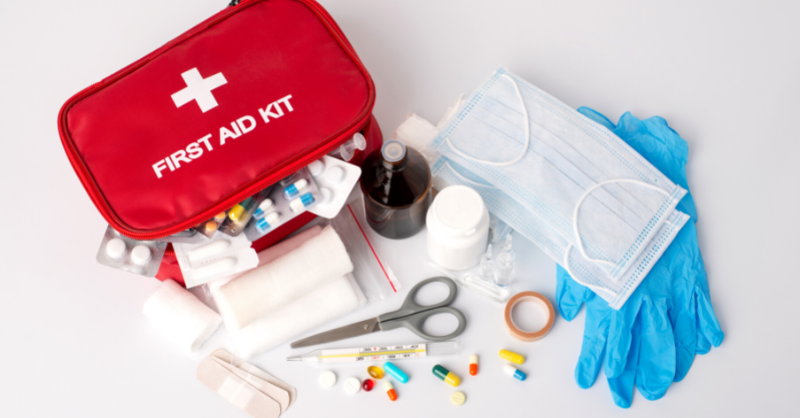
Primary Survey for Paediatric First Aid
You have to conduct a primary survey to identify the problems the patient is facing. Without the initial assessment, you won’t be able to manage the situation. In addition, it helps to take the right actions without any delay.
There are a few mandatory steps you have to follow in order to conduct the primary survey. The steps are called DRABC; this is the acronym for Danger, Response, Airway, Breathing, and Circulation.
Step 1 – Danger
Step 2 – Response
Step 3 – Airway
Step 4 – Breathing
Step 5 – Circulation
These steps are explained in detail below.
Step 1 – Danger
First and foremost, you have to assess the area and ensure there is no risk for you. You can not help someone else if you are in danger. That is why assessing the soundings is vital before jumping in.
Step 2 – Response
Now check if the child injured or ill is responsive or not. To make sure the child is conscious or unconscious, you have to tap the sole of their foot. If the baby does not respond to the tap, you must start first aid treatment instantly.
Step 3 – Airway
Checking the airway is the next step. Try to identify if anything is causing an airway blockage. If you find any issue, treat it immediately. For clearing the airway, place your hand on the forehead of the baby and tilt the head backwards and uplift the chin with the other hand. It will clear the airway of the child and help them breathe.
Step 4 – Breathing
You have to identify if the child is facing difficulties in breathing. Breathing difficulties can create a life-threatening situation. For the first ten seconds, observe and try to listen to the child’s breathing. If you find any abnormality, prepare yourself to provide CPR.
Step 5 – Circulation
The last step of the primary survey is circulation. Observe and try to identify if there is any severe bleeding. If you find that the child is bleeding severely, you have to apply pressure on the wound and call for emergency medical treatment. However, if there is no serious bleeding, put the child in the recovery position — you can learn more about how to place adults and children in the recovery position to ensure it’s done safely and correctly.
Paediatric First Aid - CPR on Children
Cardiopulmonary Respiration, or CPR, is an emergency lifesaving procedure. CPR is performed when a person’s heart stops beating or breathing stops. This is a vital part of general and paediatric first aid.
Human brain cells start to shut down if they do not receive enough oxygen. Therefore, when injuries occur, the oxygen supply to the brain can get disrupted. This disruption can cause severe consequences and even death. The procedure of CPR helps to ensure oxygen supply to the brain cells of the injured child. This treatment prevents serious consequences and increases the chance of survival.
However, providing CPR to infants requires some changes in the process. The reason for this is infants’ bones are very delicate. Therefore, putting too much pressure on their chest can break or fracture the bones.
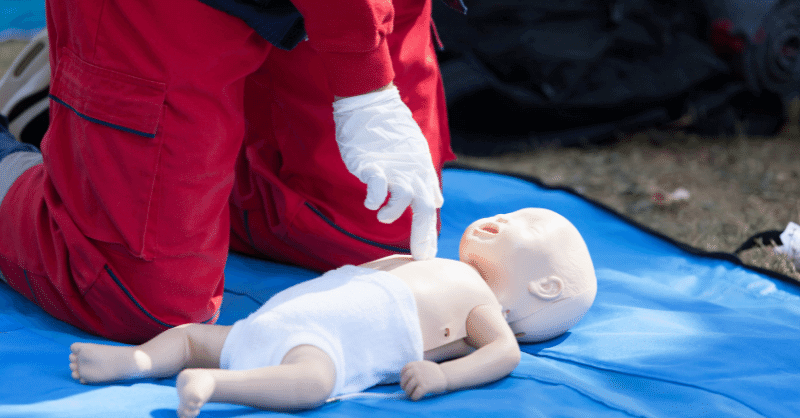
How to Perform CPR on Children?
In order to perform first, you have to put the child on a flat surface. Remember, you can not perform CPR in a sitting position. You can use the two-finger or two-thumb encircling technique to perform CPR on infants. However, if they don’t work, you can also use the heel of your hands to provide pressure.
To perform CPR on a child, you can follow the steps explained below.
Chest Compression
First, find the middle point of the lowest rib joint. One finger width above the middle of the joint is where you must compress the breastbone. Then push down 4 cm if it’s a baby or 5 cm in case of infants. After that, release the pressure and rapidly repeat the process at a rate of 100-120 compression per minute. When you complete 30 compressions, you have to move on to the next procedure.
Artificial Breathing
After 30 compressions are completed, tilt the head of the infant or the child and lift up their chin. Then provide 5 rescue breaths; this will restart the oxygen supply in the bloodstream. For the rescue breath to work, you must seal the child’s mouth with yours and close the nose.
When you blow in the mouth, make sure that it raises the child’s chest. If the chest raises, that means the airway is opening up. You have to complete another round of breathing once the chest settles down. However, there is a possibility the child may vomit. In that case, tilt the head of the child to one side and let the stomach clear out.
How to Provide Paediatric First Aid Treatment for
Burns and Bleeding?
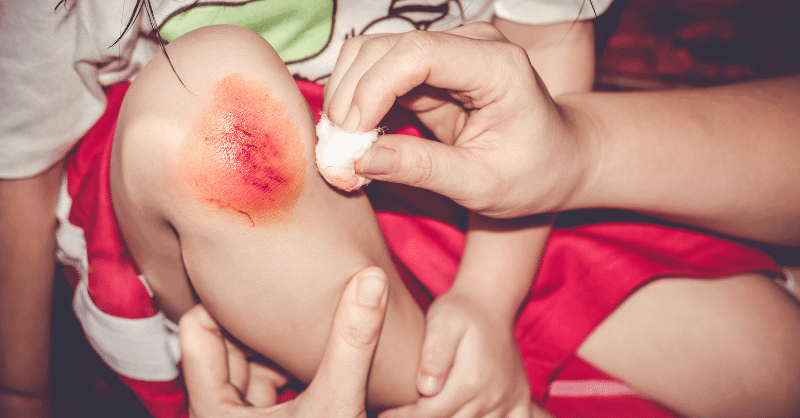
Cuts and burns can be excruciating for toddlers or young children. The skin of children is 15 times thinner than the average adult, which is why the damage caused to their skin is more intense. Therefore, the pain is also more severe.
Paediatric First Aid Treatment for Burns
If the child is suffering from burns, you have to take the following measures.
- First, check if there are any clothes stuck in the burned area. If there is clothing stuck, do not remove it. However, cover other parts of the child’s body to keep them warm and prevent them from going into shock.
- Running water on the burned area for at least 10 minutes. This will stop the burning process and help to reduce pain and swelling.
- Do not touch the area; if there are blisters, don’t touch or break them, as it can cause infection.
- Do not use any sort of ointment or cream without taking expert medical help.
- Lightly cover the area with a clean bandage to protect it from infection.
- If the burn is too severe, rush to the hospital or call for medical help.
Paediatric First Aid Treatment for Bleeding
Just like burning, excessive bleeding can also cause life-threatening situations for a child. Compared to the adult body, children have less blood; therefore, too much blood loss can be deadly for them. In case of situations where a child is bleeding out, you can take the following steps.
- Lie the child down to prevent them from going into shock
- To reduce the bleeding, keep the bleeding area above the heart
- Apply direct pressure on the wound if it’s bleeding too much
- Seek professional medical help as early as possible
It's an important part of learning how to care for them!
How to Provide Paediatric First Aid Treatment for Head Injuries?
Head injuries are quite common among children, especially toddlers. Most of the time, these head injuries are minor and inevitable. However, sometimes head injuries can be severe and are serious consequences. In such cases, proper medical attention is a must.
Now you may ask, how will you know if the injury is major or minor? A few factors can help you identify the severity of the head injury.
In case of bleeding, an ice pack will come in handy. Wrap an icepack on the bleeding area as the first step of first aid procedures. When a child gets injured in their head, keep them under surveillance for 24 hours. It will help in identifying any sign of severe consequences.
Paediatric First Aid – How to Save a Choking Child?
Choking is when some object gets stuck in the airways and causes difficulties in breathing. Usually, it happens when bits of food are blocked in the airway. However, for a child, it can be small toys or other objects lying around the house. This is because it is in children’s nature to explore their surroundings and bite the objects they are curious about. This habit is seen especially at the age of 1-5 years.
How to Provide First Aid Treatment for Choking?
For infants, first, you have to lay the baby across your forearm face down. Position the baby in a way where the head is pointing downwards and it is lower than the body. Put your arm in the infant’s chest and insert your fingers between the jaws. Then use the heel of your other hand to give five forceful blows between the shoulder blades of the infant.
In some cases, the blows might not work. You can try chest thrust in such situations. Keep the infant on your lap and turn them face up. The head should be lower than the body. Use your hand to support the head. Locate the breastbone and place two fingers in the middle, and give five thrusts on the chest, compressing the chest for about 1 and a half inches.
If the child is over one year, lay the child face down, the same as an infant. Then, try to position the child in a forward leaning position and blow five times on the back of the child. If the blows do not work, you have to move on to abdominal thrust.
To perform an abdominal thrust, stand or kneel behind the child. Put your arms under the child’s arm and around their upper abdomen. Make a fist and place it between the rib cage and the navel. Grab that hand with your other hand and pull your fist upwards and inwards forcefully. While applying pressure, make sure you are not applying it on the lower rib cage, as it can cause damage. Repeat this procedure 5 times.
Final Thoughts
Life is unpredictable. You can never know what is coming ahead. You don’t have the power to protect your children from every potential crisis. However, you do have the power to reduce the risk through performing paediatric first aid. Therefore, without any delay, seek Paediatric First Aid Training and ensure the safety of your child and others.
Get a FREE Course
- Learn useful skills online free
- Get CPD accredited certificate
- Add it to your CV today!