The Guide to Catastrophising: Reduce Anxiety by 30%

July 10, 2025 | 11 minutes | 2218 Readers

Do you constantly imagine the worst possible scenarios? Your brain fixates on these thoughts, disrupting your mental health and fuelling anxiety. I’ve faced tough days myself and know the toll it takes. Understanding catastrophising transforms how you handle stress. Many suffer silently, unaware of what’s happening. I wasn’t aware at first either, but learning brought relief. This guide offers evidence-based insights, drawing from sources like the NHS (National Health Service) and Mind, to help you reduce anxiety by 30%. What

rating

Bestselling Course

View Details SAVE 94% NOW
Distressed person sitting in a hallway, representing anxiety and catastrophizing.

Do you constantly imagine the worst possible scenarios? Your brain fixates on these thoughts, disrupting your mental health and fuelling anxiety. I’ve faced tough days myself and know the toll it takes. Understanding catastrophising transforms how you handle stress. Many suffer silently, unaware of what’s happening. I wasn’t aware at first either, but learning brought relief. This guide offers evidence-based insights, drawing from sources like the NHS (National Health Service) and Mind, to help you reduce anxiety by 30%.

What Makes Catastrophising a Hidden Threat?

Catastrophising, a cognitive distortion, prompts your mind to leap to the worst outcomes, even when they’re unlikely. You mentally turn a small issue into a disaster. For example, you think, “I’ll fail this test,” then spiral to, “I’ll never get a job and end up homeless.” The NHS notes that it exaggerates perceived threats, often linking to anxiety disorders and chronic pain. It’s a mental habit, but you can change it with the right tools.

Catastrophising often operates automatically, trapping you in a loop. The more you think this way, the harder it is to stop. Experts, as cited by Mind, call it a cognitive bias, where your brain fixates on negatives and ignores positives. Recognising this pattern is the first step—I learned this the hard way.

Consider this: a meeting delays, and instead of apologising, you panic, thinking, “I’ll get fired and lose everything.” The NHS explains this spiral. Understanding it helps you catch it early. I’ve improved at spotting my patterns, and you can too.

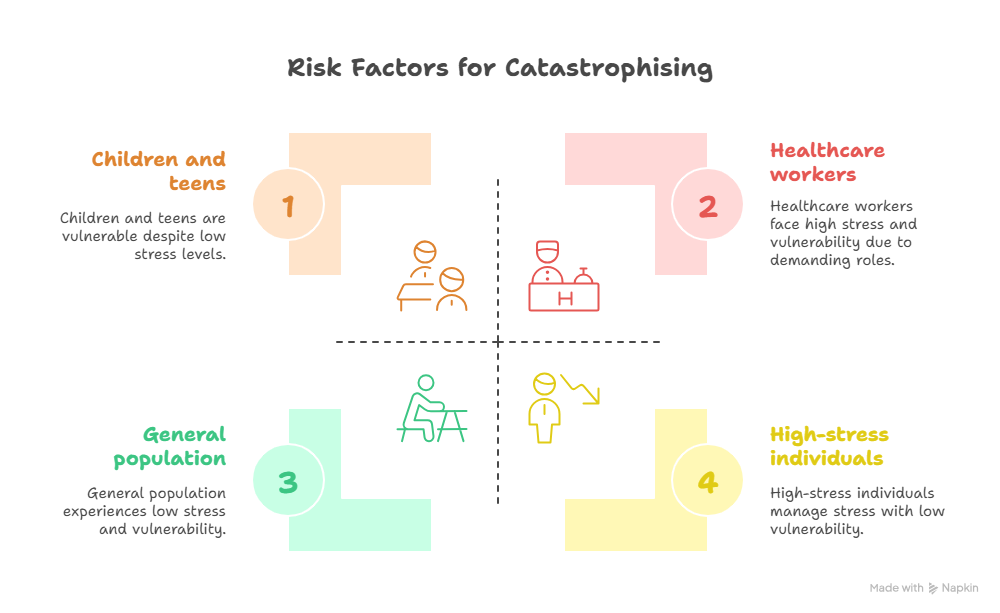
Catastrophising: 4 Surprising Groups Most at Risk

Diagram showing risk factors for catastrophising, categorized into groups: children and teens, healthcare workers, general population, and high-stress individuals

Almost anyone can catastrophise, but some groups face higher risks. People with anxiety disorders often struggle, as their brains stay hyper-alert. Those with chronic pain also battle it, per the NHS. High-stress individuals, like those in demanding jobs, commonly experience it—I’ve seen friends constantly worry, always expecting the worst. Participants in Cognitive Behavioural Therapy (CBT) frequently show this pattern, as therapists note. Stress amplifies its impact across groups.

Children and teens may catastrophise, lacking coping tools for triggers like school pressure or bullying. Adults with past trauma are vulnerable too, as Mind highlights. Caregivers also face risks, constantly worrying about loved ones, with thoughts like, “What if something goes wrong?” dominating their minds. The NHS confirms their higher risk. I’ve seen people carry these burdens.

Work environments, like healthcare or teaching, breed catastrophising. You stay on edge, expecting things to go wrong. The NHS emphasises this. If you’re in a high-pressure role, watch for signs—I’ve felt that pressure, and you might too.

Why Catastrophising Fuels PTSD and How to Break the Cycle

Does catastrophising cause Post-Traumatic Stress Disorder (PTSD)? It doesn’t directly trigger Post-Traumatic Stress Disorder, but it worsens its effects. When you always expect the worst, trauma hits harder. Thoughts like, “I’ll never recover,” make fear feel endless. Studies cited by the NHS mark catastrophising as a risk factor, though not the only one. I’ve felt despair but healed with effort.

Research, as noted by the British Psychological Society, shows a feedback loop: catastrophising after trauma keeps you stuck, replaying the event and expecting more danger. This delays healing. Therapy breaks this cycle—I’ve seen it work. Veterans, many of whom face trauma, struggle with thoughts like, “I’ll never feel safe again.” The NHS connects this to recovery challenges, referencing support similar to that from the United States Department of Veterans Affairs (VA). Support makes a difference.

Mental Health Awareness Diploma

Deepen understanding of mental health with our diploma. Empower yourself and others to break stigma. Start your journey today.

Is Catastrophising a Psychological Disorder?

Catastrophising isn’t a mental illness like depression or schizophrenia. It’s a negative thinking pattern, often a symptom of anxiety disorders. The NHS calls it a red flag, signalling your brain is stuck in overdrive. I once thought I was broken, but it’s not a disorder—your mind is playing tricks. Experts, per Mind, say you can unlearn it.

It’s sometimes confused with Obsessive-Compulsive Disorder (OCD) or Generalised Anxiety Disorder (GAD), but it’s distinct—a specific thought process, not a full diagnosis, per the NHS. Understanding this eases your mind. You’re not “crazy”; you’re stuck in a thought loop. I felt relief learning this, and you might too. Misdiagnosis happens—some dismiss it as “being dramatic,” but the NHS warns against ignoring it. I thought I was overreacting, but I needed help.

What Are the Indicators and Effects of Catastrophising?

How do you spot catastrophising? You overthink everything, always imagining the worst. You might think, “If I’m late, I’ll get fired,” or, “A mistake means everyone will hate me.” You worry excessively about unlikely events, and irrational fears dominate. Physically, your heart races, you feel tense, or you’re exhausted. Iarage your heart races, you feel tense, or you’re exhausted. I’ve felt my stomach knot up, my body believing the disaster is real, even when it’s not.

Catastrophising disrupts sleep. You lie awake, “what ifs” racing through your mind, causing exhaustion or headaches, as Mind notes. It affects your whole body, not just your thoughts. I’ve had nights where my brain wouldn’t stop. Stress from catastrophising also triggers digestive issues, like nausea or loss of appetite, per the NHS. I’ve skipped meals without understanding why.

Your immune system weakens under constant stress, making you catch colds more often, as the NHS points out. Catastrophising keeps you in fight-or-flight mode. I’ve noticed more sickness during stress, and you should monitor this too.

Find the Course That Suits You!

We create outstanding professionals in Employability, Business, Health Care, Marketing, Language, and Functional Skills. Whether you're starting or advancing your career, we turn your passion into success as the UK’s most trusted e-learning course provider.
5000+ course

How to Identify the Indicators and Effects

Identifying catastrophising can be tough, but you can learn how. Start by observing your thoughts. Do you always expect the worst? Ask, “Am I exaggerating this?” or, “What’s the real likelihood of this happening?” If you jump to disasters, that’s a clue. I began monitoring my thoughts, pausing to question, “Is it really that bad?” Usually, it wasn’t. Check your body—constant stress signals a problem.

Keep a thought diary. Write down worries and review patterns weekly. Do you always assume the worst? The NHS recommends this, and I found it eye-opening—most fears never happened. Seeing it on paper clarified reality. Try it yourself. Talk to someone close; they might notice your patterns. My friend pointed out, “You always assume the worst,” and she was right. Mind suggests this for an outside perspective

How Does Catastrophising Influence Your Daily Life?

Catastrophising ruins your day, affecting more than your mind. You avoid decisions, fearing “what if I fail?” so you don’t try. It harms relationships—you push people away with constant worry. I’ve lost focus due to fears. Productivity drops as worry consumes you. If you have chronic pain, catastrophising worsens it, amplifying thoughts like, “This pain will never end.” The Mayo Clinic warns this creates a vicious cycle.

Social events become nightmares. You think, “Everyone will judge me,” and skip them, leading to isolation. I’ve missed fun because of this. Over time, it erodes confidence, making you doubt yourself, as the APA notes. I felt inadequate, but recognizing this helped me fight back. Parenting becomes harder—you worry excessively about your kids, leading to overprotection, per the National Institute of Mental Health.

Consider taking a Mental Health Awareness Diploma or the Designated Mental Health Lead Training from One Education—both offer valuable tools to understand and manage catastrophising and anxiety.

A grayscale portrait of a man covering his face, depicting emotion and mental health themes.

How Can You Manage Catastrophising?

You can manage catastrophising with several methods. Cognitive Behavioural Therapy (CBT) works well, teaching you to challenge thoughts by asking, “Is this true?” or, “What’s more likely?” It retrains your brain. Deep breathing calms you, grounding you in the moment. I’ve tried it—when thoughts spiral, I breathe and focus on my surroundings. The NHS supports Cognitive Behavioural Therapy for this.

Distraction helps too. Shift focus by listening to music or watching a funny video. The NHS suggests this to break the thought cycle. I call a friend to talk about something else, and it works. Find what suits you. Reframe thoughts: instead of “This will go wrong,” think, “I can handle it.” Cognitive Behavioural Therapy teaches this, and with practice, it shifts your mindset. I’ve done it, and you can too.

Exercises to Experiment With

Want activities to try? Practice mindfulness—focus on the moment, notice your breathing, or listen to surrounding sounds. It stops spiralling. Journaling works too—write down thoughts and check if they’re realistic. They usually aren’t. Grounding techniques help: name five things you see to return to reality. Yoga calms your body and mind, stretching out stress—I love it. The NHS suggests these to reduce anxiety.

Try gratitude exercises. Write down three things you’re thankful for daily. It rewires your brain to focus on positives, countering catastrophising, per Mind. I struggled at first but noticed a difference over time. Give it a shot. Here are mindfulness tips:

Practice deep breathing for 5 minutes.

Focus on one sense at a time.

Avoid multitasking during practice.

What Support Options Exist?

You’re not alone—support is out there. Therapists specialising in Cognitive Behavioural Therapy offer a great start, trained to guide you. Support groups, online or in-person, provide comfort through shared experiences. Online resources, like NHS and Mind tips, and mental health apps offer tools. I’ve found comfort knowing others share this struggle. The NHS provides good resources too.

Community programmes, like free workshops or mindfulness classes, are available—check your local health centre. The NHS lists options. I’ve attended a few, meeting understanding people, which reduced loneliness. You might find similar opportunities. Books like “Overcoming Anxiety” by Helen Kennerley teach Cognitive Behavioural Therapy techniques. I read it and found practical steps.

Who Should You Reach Out To?

Need help? Reach out. Psychologists guide you with Cognitive Behavioural Therapy, while counsellors help you talk through issues. If chronic pain is involved, consult a doctor to address both. Talk to a trusted friend—don’t keep it inside. I learned this the hard way; talking helps. The NHS recommends professional support. A life coach can offer strategies, focusing on thought patterns, per the UK Coaching Partnership. I’ve tried one and got practical tips.

If you’re a student, school counsellors provide free stress management help, as the National Education Association notes.

Conclusion

Catastrophising drags your brain to dark places, disrupting your day, relationships, and body. You can fight back—recognize signs, try mindfulness or CBT, and don’t fear seeking help. I’ve had rough days but learned to manage it, and you can too. Check the APA or Mayo Clinic for more info. Better mental health awaits.

Taking control feels empowering. Your thoughts don’t define you—they’re changeable. Resources and caring people are out there. I’ve seen a difference, and you will too. Start with small steps: pick one strategy and build from there. The APA emphasizes consistency. Aim for that 30% anxiety reduction—it’s within reach.

FAQ

What is catastrophic thinking?

You imagine the worst outcomes, often irrationally.

How can I stop catastrophising?

Use CBT techniques, practice mindfulness, or seek professional help.

Is catastrophising linked to chronic pain?

Yes, it worsens pain and emotional stress.

What resources help with catastrophising?

Therapy, CBT self-help books, and APA’s online platforms work.

Can catastrophising affect my kids?

Yes, kids may adopt it if they see it in you. Model calm thinking and teach coping skills early, per the APA.

Does catastrophising impact work?

Yes, it leads to avoiding risks, stressing over deadlines, and burnout, per the Mayo Clinic. Addressing it saves your career.

top

Hear What Our Learners Say About Us

Home Search Cart