What is the PALMS Model of Communication? A Complete Guide

April 17, 2026 | 11 minutes | 712 Readers

Miscommunication is something we all experience. You might send a simple message to a colleague, assuming it is clear, but they interpret it differently and complete the wrong task. This leads to delays, confusion, and frustration. Such situations are common in both professional and everyday settings, often caused by unclear or incomplete communication. Effective communication plays a crucial role in avoiding these issues. It ensures that ideas are shared clearly, expectations are understood, and collaboration runs smoothly. Good communication not

rating

Bestselling Course

View Details SAVE 94% NOW
What is the PALMS Model of Communication? A Complete Guide

Miscommunication is something we all experience. You might send a simple message to a colleague, assuming it is clear, but they interpret it differently and complete the wrong task. This leads to delays, confusion, and frustration. Such situations are common in both professional and everyday settings, often caused by unclear or incomplete communication.

Effective communication plays a crucial role in avoiding these issues. It ensures that ideas are shared clearly, expectations are understood, and collaboration runs smoothly. Good communication not only improves productivity but also builds trust and strengthens relationships within teams and organisations.

This is where the PALMS Model of Communication becomes useful. It offers a structured approach to delivering clear and purposeful messages. In this blog, you will learn what the PALMS model is, how it works, and how you can apply it to communicate more effectively in any situation.

What is the PALMS Model of Communication?

The PALMS Model of Communication is a simple framework designed to help individuals communicate clearly, professionally, and effectively. It breaks communication into five key elements that guide how a message should be structured and delivered, ensuring it is easily understood by the audience. This model is widely used in professional settings to improve both written and verbal communication.

The main purpose of the PALMS model is to enhance clarity, reduce misunderstandings, and make communication more purposeful. By following a structured approach, individuals can organise their thoughts, present information logically, and ensure their message achieves its intended outcome. It is particularly useful in workplaces where clear communication directly impacts productivity, teamwork, and decision-making.

PALMS stands for:

  •      ♦  P – Purpose: Clearly define the reason for your communication.
  •      ♦  A – Audience: Understand who you are communicating with.
  •      ♦  L – Language: Use appropriate tone, style, and level of formality.
  •      ♦  M – Message: Deliver the core information in a clear and concise way.
  •      ♦  S – Structure: Organise your content logically for better understanding.

By applying the PALMS model, individuals can communicate more confidently and professionally, ensuring their messages are both effective and impactful.

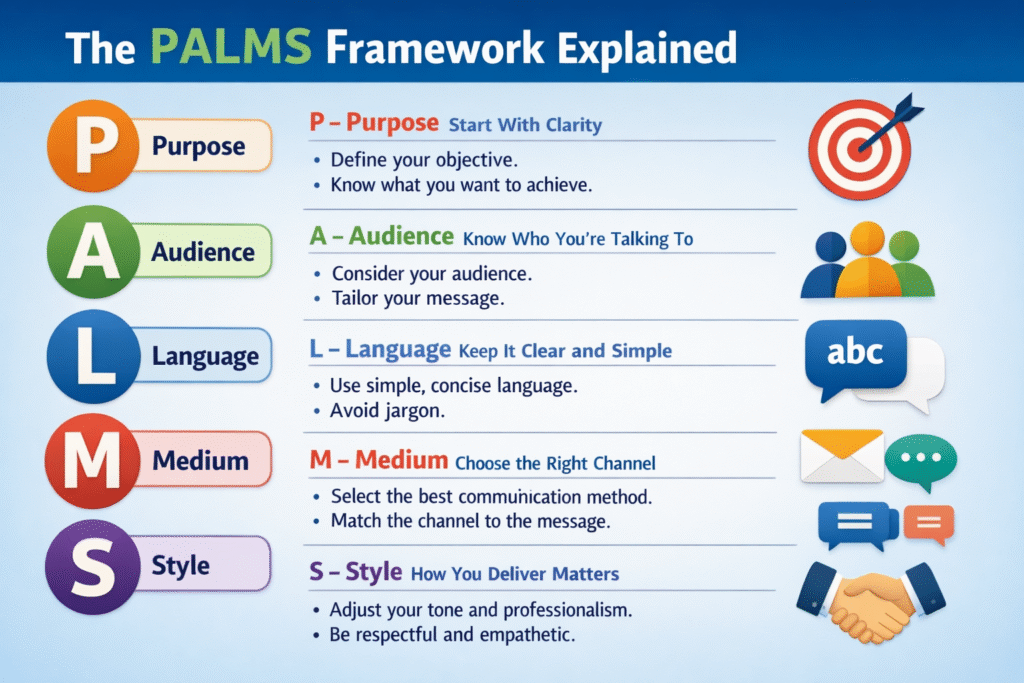
The PALMS Framework Explained

The PALMS Framework Explained

The PALMS Framework is a simple yet powerful approach to improving written and verbal communication. It ensures your message is clear, targeted, and effective—whether you’re drafting an email, leading a meeting, or sending a quick message. Let’s break it down step by step so you can apply it instantly.

P – Purpose: Start With Clarity

Every message should begin with a clear objective. If you’re unsure what you want to achieve, your audience will be equally confused.

Ask yourself:
What outcome do I want from this communication?

Mini Example:

  • Unclear: “Just checking in about the project.”
  • Clear: “Could you confirm the project deadline by Friday so we can proceed?”

A defined purpose keeps your communication focused, saves time, and prevents misunderstandings.

A – Audience: Know Who You’re Talking To

Your message should always be shaped by who will receive it. Different audiences require different tones, levels of detail, and formats.

Why it matters:
Audience awareness helps you communicate in a way that is relevant and engaging.

Example:

  • ♦  To a colleague: “Can you send me the report today?”
  • ♦  To a senior manager: “Could you please share the final report at your convenience today?”

Adapting your message shows professionalism and improves response rates.

Find the Course That Suits You!

We create outstanding professionals in Employability, Business, Health Care, Marketing, Language, and Functional Skills. Whether you're starting or advancing your career, we turn your passion into success as the UK’s most trusted e-learning course provider.
5000+ course

L – Language: Keep It Clear and Simple

Clarity is key. Overcomplicated language often leads to confusion and misinterpretation.

Focus on:

  • ♦  Short sentences
  • ♦  Simple vocabulary
  • ♦  Direct structure

Common mistakes to avoid:

  • ♦  Excessive jargon
  • ♦  Long, complex sentences
  • ♦  Ambiguous wording

Clear language ensures your message is easily understood the first time.

M – Medium: Choose the Right Channel

Not every message belongs in an email. Choosing the right communication channel can significantly impact effectiveness.

Examples:

  • 📧 Email: Formal updates, documentation
  • 💬 Instant message: Quick questions or clarifications
  • 🗣 Meeting: Complex discussions or decision-making

When it goes wrong:
Sending a lengthy, complex issue via chat can create confusion, while scheduling a meeting for a simple update wastes time.

Selecting the right medium ensures efficiency and clarity.

S – Style: How You Deliver Matters

Style refers to your tone, level of professionalism, and emotional impact. Even a clear message can fail if delivered poorly.

Consider:

  • Tone (formal vs informal)
  • Professionalism
  • Emotional sensitivity

Example:

  • ❌ “This needs to be fixed immediately.”
  • ✅ “Could you please prioritise resolving this issue as soon as possible?”

Matching your style to the situation helps build trust and maintain positive relationships.

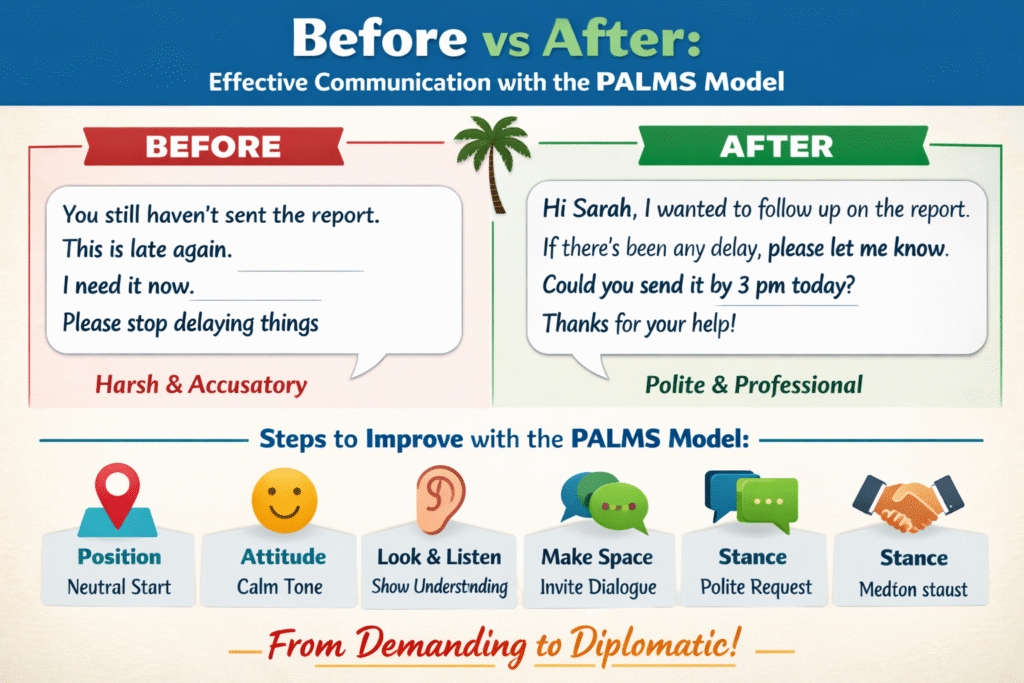
The “Before vs After” Transformation

The “Before vs After” Transformation

Effective communication is not just about delivering a message—it’s about how that message is received. The PALMS model (Position, Attitude, Look & Listen, Make Space, Stance) helps transform blunt or unclear communication into something more professional, respectful, and results-driven.

Before: Poorly Written Message

 You still haven’t sent the report. This is late again. I need it now. Please stop delaying things.

This version sounds harsh and accusatory, which may lead to frustration or resistance.

After: Rewritten Using the PALMS Model

Hi Sarah, I wanted to follow up on the report, as I need it to complete the next stage of the project. If there has been any delay, please let me know. If possible, could you send it by 3 pm today? Thank you for your help.

This version is polite, clear, and more likely to encourage a positive response.

Step-by-Step Improvements

♦  Position:
Instead of starting with blame, the revised message opens neutrally with a follow-up, reducing tension.

♦  Attitude:
The tone shifts from impatient to calm and professional, improving how the message is perceived.

♦  Look & Listen:
Rather than assuming fault, it allows space for explanation, showing understanding.

♦  Make Space:
The improved message invites dialogue, giving the recipient room to respond.

♦  Stance:
The message changes from a demand to a polite request, making collaboration easier.

Why This Works

The “after” version communicates urgency without sounding aggressive. It builds respect, encourages cooperation, and increases the likelihood of getting the desired outcome quickly and professionally.

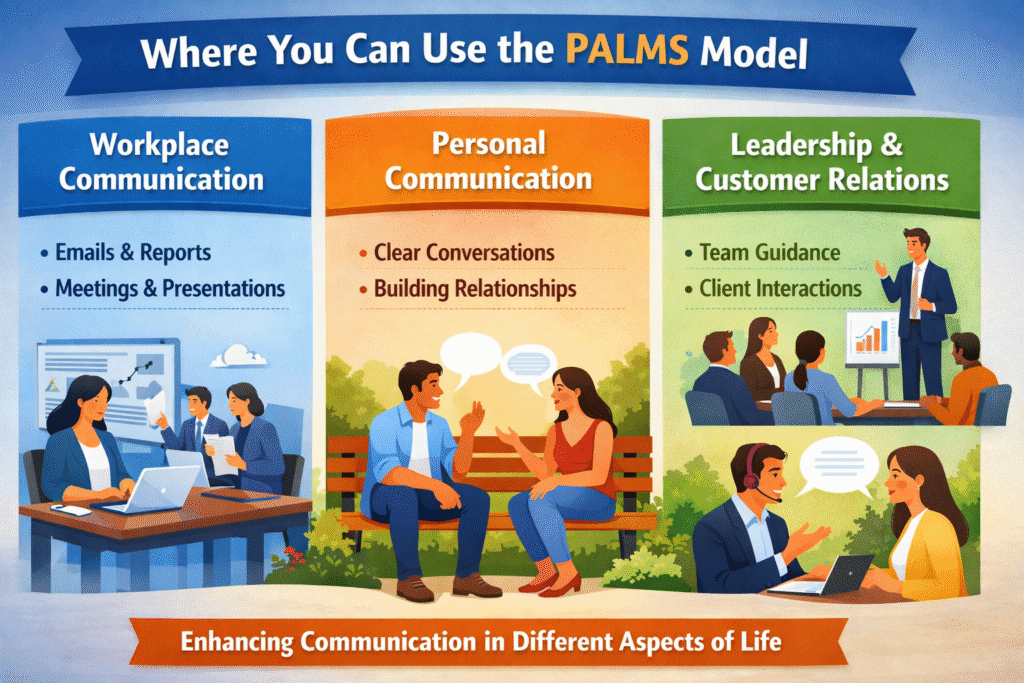
Where You Can Use the PALMS Model

Where You Can Use the PALMS Model

The PALMS Model of Communication can be effectively applied in workplace communication, including emails, meetings, and reports. It helps professionals structure their messages clearly, ensuring the purpose is well understood and reducing the risk of miscommunication. By using this approach, individuals can present ideas confidently, maintain professionalism, and improve overall communication efficiency in organisational settings.

In personal communication, the PALMS model encourages more thoughtful and meaningful interactions. It guides individuals to consider how their message is delivered, leading to clearer expression and better understanding. This is particularly useful in building strong relationships, avoiding unnecessary conflicts, and ensuring respectful and effective everyday conversations.

The model is equally valuable in leadership, team management, and customer interactions. Leaders can use it to provide clear direction, motivate teams, and manage expectations effectively. At the same time, it enhances communication with customers or clients by ensuring messages are professional, structured, and responsive to their needs, ultimately building trust and long-term relationships.

PALMS Model vs Other Communication Models

The PALMS Model of Communication is widely recognised for its simplicity and practical application, especially when compared with traditional communication theories. Unlike more complex frameworks, PALMS is designed to be easily understood and applied in real-life situations. It focuses on improving clarity, engagement, and effectiveness in everyday communication, making it particularly valuable for professionals and learners seeking immediate results.

In comparison, the Shannon-Weaver Model of Communication follows a structured, linear process where a message moves from sender to receiver, often highlighting noise and communication barriers. While useful in technical contexts, it lacks flexibility for human interaction. Similarly, the Transactional Model of Communication presents communication as a dynamic, two-way process, but its conceptual depth can make it less accessible for quick, practical use.

The key advantage of the PALMS model lies in its straightforward and actionable nature. It simplifies communication into clear, usable steps that can be applied instantly in conversations, presentations, and workplace settings. This balance between structure and ease of use makes PALMS a highly effective tool, bridging the gap between theoretical understanding and practical communication skills.

Common Communication Pitfalls​

Common Communication Pitfalls

Even experienced professionals can fall into common communication traps that reduce clarity, create confusion, and weaken impact. The PALMS model of communication offers a practical framework to overcome these issues by focusing on Purpose, Audience, Language, Medium, and Style. Here’s how it addresses the most frequent pitfalls:

1. Misunderstood Emails → Solved by Purpose & Language

 One of the most common issues in workplace communication is unclear or misinterpreted emails. This often happens when the message lacks a clear objective or uses vague, overly complex wording.
PALMS Fix: By defining a strong Purpose, you ensure your message has a clear intention. Pairing this with precise Language makes your communication concise, direct, and easy to understand—reducing back-and-forth confusion.

2. Wrong Tone → Solved by Style

 Using an inappropriate tone—whether too casual, too harsh, or overly formal—can damage relationships and lead to misinterpretation. Tone is especially tricky in written communication where context is limited.
PALMS Fix: The Style element helps you adjust tone based on the situation and recipient. Whether it’s a professional email, a persuasive proposal, or a friendly update, choosing the right style ensures your message is received as intended.

3. Poor Channel Choice → Solved by Medium

Choosing the wrong communication channel can delay decisions and reduce effectiveness. For example, sending a long email instead of having a quick call can slow down urgent matters.
PALMS Fix: The Medium component guides you to select the most appropriate channel—email, phone, video call, or face-to-face—based on urgency, complexity, and context, ensuring efficient communication.

4. Generic Messaging → Solved by Audience

 Messages that are too broad or generic fail to engage the recipient. Without considering the audience’s needs, expectations, or level of understanding, communication loses its impact.
PALMS Fix: By focusing on the Audience, you tailor your message to suit their knowledge, preferences, and interests. This makes communication more relevant, engaging, and persuasive.

Conclusion

The PALMS Model of Communication provides a practical and structured approach to delivering clear, effective, and impactful messages. By focusing on Purpose and Language, it helps eliminate misunderstandings in written communication, ensuring clarity from the outset. Style addresses tone-related issues, allowing communicators to present messages in a way that is appropriate and professional. Medium ensures that the right communication channel is selected for maximum effectiveness, while Audience encourages tailoring messages to specific recipients rather than relying on generic content.

FAQs — What is the PALMS Model of Communication?

1. What is the PALMS model of communication?
The PALMS model is a structured communication framework based on Purpose, Audience, Language, Medium, and Style. It helps individuals organise their message clearly and deliver it in a way that is easy to understand.

2. Why is the PALMS model important?
It ensures communication is clear, purposeful, and audience-focused. By following this model, you can reduce misunderstandings and improve the overall effectiveness of your message.

3. How can I use the PALMS model at work?
Start by defining your purpose, then consider your audience. Choose appropriate language, select the right communication channel, and adjust your style to suit the situation for better professional outcomes.

4. What are the benefits of structured communication?
Structured communication improves clarity, saves time, and ensures key information is delivered logically. It also enhances teamwork, decision-making, and overall productivity.

5. Is the PALMS model suitable for personal communication?
Yes, it can be used in everyday conversations to express thoughts clearly, avoid confusion, and build stronger personal relationships.

Find the Course That Suits You!

We create outstanding professionals in Employability, Business, Health Care, Marketing, Language, and Functional Skills. Whether you're starting or advancing your career, we turn your passion into success as the UK’s most trusted e-learning course provider.
5000+ course
Sam Walker

Article by

Sam Walker

Sam Walker is an education specialist and author at One Education, bringing over 4 years of experience in creating practical resources and strategies to support teachers and enhance student learning.

top

Hear What Our Learners Say About Us

Home Courses Search