Beginner’s Guide to BSL Level 1: 7 Essential Skills to Start Learning

March 28, 2026 | 17 minutes | 746 Readers

British Sign Language (BSL) is a visual form of communication used widely by the Deaf community in the UK. It combines hand movements, facial expressions, and body language to convey meaning, making it a complete and recognised language with its own grammar and structure. In recent years, interest in learning BSL has grown significantly as awareness of accessibility, equality, and inclusive communication continues to increase across workplaces, education, and public services. This beginner’s guide is ideal for anyone with little or no

rating

Bestselling Course

View Details SAVE 94% NOW

British Sign Language (BSL) is a visual form of communication used widely by the Deaf community in the UK. It combines hand movements, facial expressions, and body language to convey meaning, making it a complete and recognised language with its own grammar and structure. In recent years, interest in learning BSL has grown significantly as awareness of accessibility, equality, and inclusive communication continues to increase across workplaces, education, and public services.

This beginner’s guide is ideal for anyone with little or no prior knowledge of sign language who wants to develop practical communication skills. Learning BSL Level 1 can help you interact more confidently with Deaf individuals, support inclusive environments, and enhance your career prospects in sectors such as healthcare, education, and customer service. Developing these essential skills not only strengthens communication but also promotes empathy, confidence, and social connection.

What is BSL Level 1?

What is BSL Level 1?

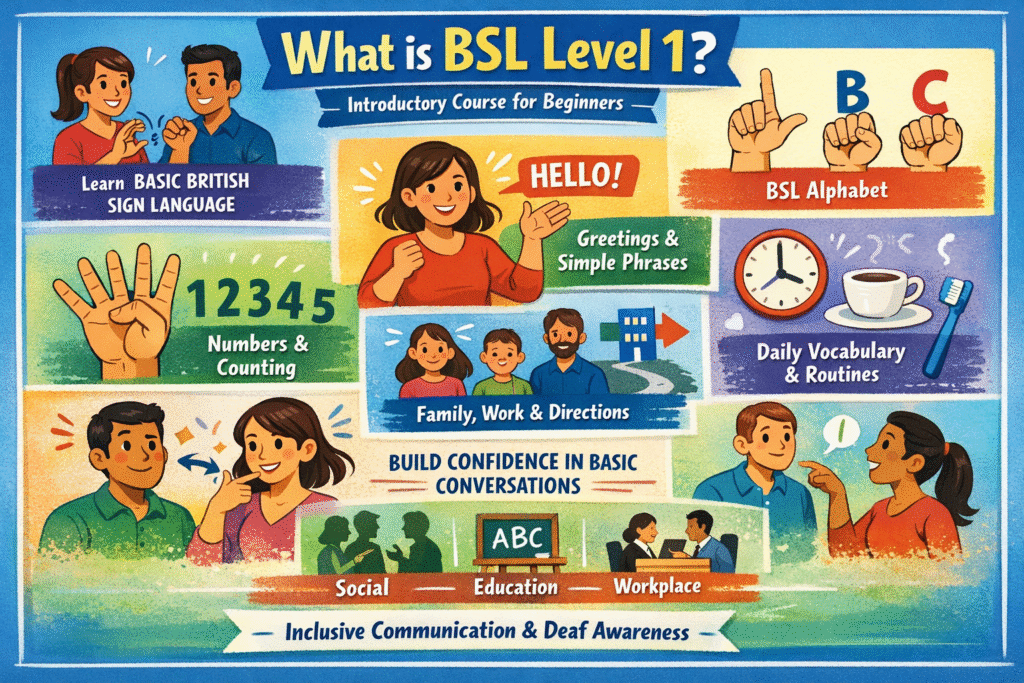
BSL Level 1 is an introductory course designed to help learners understand the basics of British Sign Language (BSL). The main purpose of BSL Level 1 is to develop essential communication skills that allow individuals to interact confidently with Deaf or hard-of-hearing people in everyday situations. It focuses on practical language use rather than complex grammar, making it ideal for beginners who have little or no prior experience in sign language.

Beginners typically learn how to use the BSL alphabet, common greetings, numbers, simple questions, and everyday vocabulary related to topics such as family, work, directions, and daily routines. The course also introduces basic facial expressions and body language, which are important elements of effective signing. Through regular practice and interactive learning, learners gradually build confidence in understanding and using simple signs.

By completing BSL Level 1, learners gain the ability to hold basic conversations, respond to simple requests, and communicate more inclusively in social, educational, or workplace environments. This foundation not only improves communication skills but also promotes greater awareness and respect for Deaf culture.

Why Learn BSL as a Beginner?

Learning British Sign Language (BSL) as a beginner supports personal development by improving communication skills, confidence, and cultural awareness. It also helps strengthen memory and focus while learning a valuable new language.

BSL knowledge can create career opportunities in education, healthcare, and customer service, where inclusive communication is highly valued. It promotes social inclusion, supports community engagement, and enhances your CV by adding a unique and practical skill.

7 essential BSL skills to learn

7 Essential Skills to Start Learning BSL

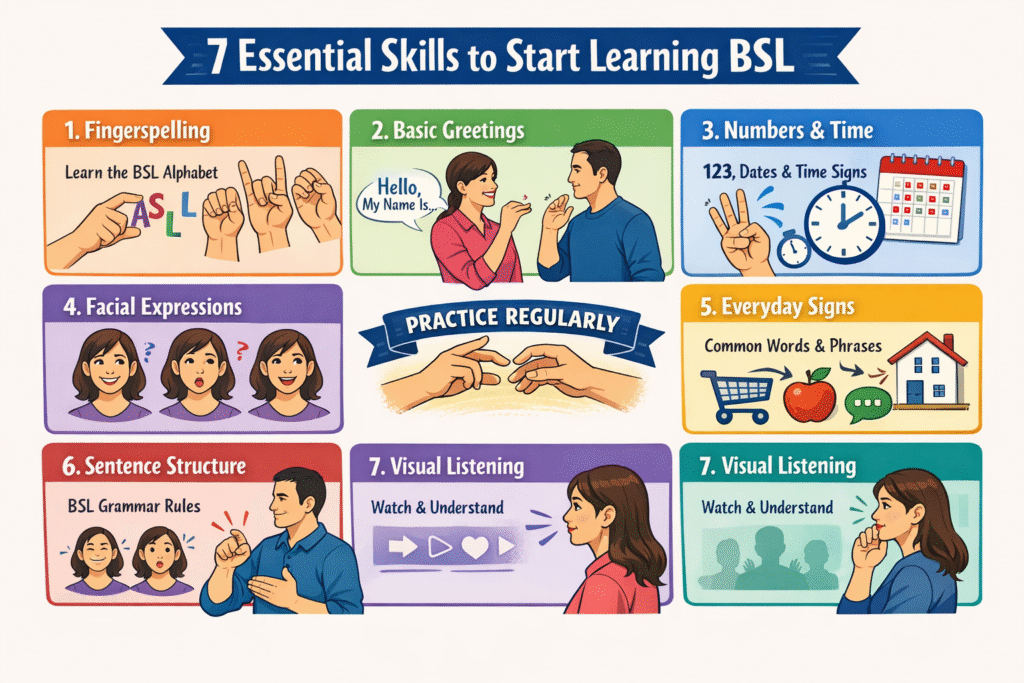
Learning BSL starts with key skills like fingerspelling, basic greetings, and common everyday signs. Strong facial expressions, clear hand movements, and understanding numbers and simple questions also help build confident communication. Regular practice improves both signing and understanding skills.

Skill 1 – BSL Alphabet and Fingerspelling

Learning the BSL alphabet and fingerspelling is one of the first and most essential steps in British Sign Language. It helps learners communicate names, places, and unfamiliar words that may not yet have specific signs. This skill builds confidence in everyday conversations and improves clarity when interacting with Deaf or hard-of-hearing individuals. By practising fingerspelling regularly, learners develop better hand coordination, visual recognition, and communication fluency, which are all important for progressing in BSL.

Importance of spelling names and unfamiliar words:

  • ♦  Helps introduce yourself and spell personal names clearly.
  • ♦  Supports communication when a specific sign is not known.
  • ♦  Improves understanding of new vocabulary during conversations.
  • ♦  Enables accurate spelling of places, brands, or technical terms.
  • ♦  Builds confidence in real-life Deaf community interactions.
  • ♦  Strengthens memory, hand movement control, and visual focus. 

Skill 2 – Basic Greetings and Introductions

Basic greetings and introductions form the foundation of everyday communication. Learning simple conversational phrases helps beginners start conversations confidently, respond politely, and build positive first impressions in social, academic, or professional settings. These essential expressions are used daily, making them crucial for developing fluency and comfort when interacting with others.

  • ♦  Saying hello and goodbye in formal and informal situations
  • ♦  Introducing yourself clearly using simple, structured sentences
  • ♦  Asking someone’s name and responding politely in conversations
  • ♦  Using courteous phrases like please, thank you, and excuse me
  • ♦  Engaging in short, friendly exchanges to build communication confidence
  • ♦  Responding appropriately to greetings in real-life everyday scenarios
  • ♦  Practising correct pronunciation and natural conversational tone
  • ♦  Building confidence to start and maintain basic social interactions

Skill 3 – Numbers, Dates, and Time Signs

Understanding numbers, dates, and time signs is essential for clear and practical communication in everyday situations. This skill helps learners manage schedules, organise plans, and respond confidently to time-related information. Whether arranging appointments, discussing deadlines, or following timetables, recognising these signs improves accuracy and independence. Developing this ability also supports better participation in work, education, and social environments where timing and numerical details are important.

  • ♦  Recognise and use numbers confidently in daily communication situations.
  • ♦  Understand how to express and interpret dates correctly.
  • ♦  Learn common signs related to time, schedules, and appointments.
  • ♦  Improve planning skills by following timetables and deadlines effectively.
  • ♦  Communicate availability and time preferences clearly with others.
  • ♦  Build confidence in managing routines, meetings, and organised activities.

Skill 4 – Facial Expressions and Body Language

Facial expressions and body language are essential non-manual features that carry meaning in British Sign Language (BSL). They work alongside hand movements to express emotions, clarify grammar, and provide important context. Without accurate facial and body signals, signs may lose their intended meaning or appear unclear. Developing awareness of these visual cues helps learners communicate more naturally, understand conversations better, and build confidence when interacting with Deaf or hard-of-hearing individuals.

  • ♦  Facial expressions show emotions such as happiness, confusion, surprise, or concern.
  • ♦  Eyebrow movements can indicate questions, emphasis, or sentence structure.
  • ♦  Head tilts and nods help confirm understanding or add conversational flow.
  • ♦  Mouth patterns support meaning and pronunciation of certain BSL signs.
  • ♦  Body posture shows attitude, engagement, and interaction with the listener.
  • ♦  Shoulder and torso movements help describe direction, distance, or perspective.
  • ♦  Eye gaze is used to manage turn-taking and maintain visual attention.
  • ♦  Consistent non-manual signals improve clarity and overall signing fluency.

Skill 5 – Everyday Vocabulary and Common Signs

Building everyday vocabulary is an essential step in developing confident communication skills. Learning common signs used in daily life helps you interact more effectively in social, personal, and professional situations. This skill focuses on recognising and using practical signs related to routine activities, making conversations clearer and more meaningful. By understanding frequently used signs, learners can improve fluency, respond naturally, and participate more actively in real-life interactions.

Key Areas Covered:

  • ♦  Signs related to food and drinks, including common meals and snacks
  • ♦  Everyday travel signs such as transport, directions, and locations
  • ♦  Family-related signs to describe relationships and home situations
  • ♦  Basic workplace signs used in jobs, tasks, and responsibilities
  • ♦  Frequently used daily conversation signs for simple interactions
  • ♦  Signs that support shopping, ordering, and asking for assistance
  • ♦  Practical signs for time, routine activities, and common places

Skill 6 – Sentence Structure and Grammar Basics

Understanding sentence structure and grammar basics is essential when learning British Sign Language (BSL), as its grammatical system is very different from spoken or written English. BSL follows its own visual language rules, using space, facial expressions, and body movements to create meaning. Unlike English, which relies heavily on word order and auxiliary verbs, BSL often uses topic–comment structure and visual context to communicate clearly and effectively.

Key Differences Between BSL Grammar and Spoken English:

  • ♦  BSL uses a topic–comment sentence structure instead of subject–verb–object order.
  • ♦  Facial expressions and body language act as grammatical markers in communication.
  • ♦  Time indicators are usually placed at the beginning of a sentence.
  • ♦  BSL does not rely on articles like “a”, “an”, or “the.”
  • ♦  Verb direction and movement can show who is giving or receiving action.
  • ♦  Questions are often shown through raised eyebrows and head movements.
  • ♦  Plural forms are expressed through repetition or spatial placement of signs.
  • ♦  BSL grammar focuses more on visual clarity than spoken word sequence.

Skill 7 – Listening (Visual Understanding) Skills

Listening in sign language focuses on visual understanding, where learners develop the ability to accurately follow signed conversations through observation, attention, and interpretation. This skill helps individuals recognise signs, facial expressions, and body language used during communication. By strengthening visual listening abilities, learners can respond appropriately, engage confidently in real-life interactions, and build meaningful connections within the signing community.

Key areas of developing visual listening skills include:

  • ♦  Observing hand shapes, movements, and positioning during signed conversations
  • ♦  Understanding facial expressions and non-manual signals for clearer meaning
  • ♦  Following the pace and flow of natural signing in group discussions
  • ♦  Identifying key signs and contextual clues to grasp overall messages
  • ♦  Practising focus and attention to improve real-time visual comprehension
  • ♦  Responding accurately based on what is visually received and understood
How to Practise BSL Effectively

How to Practise BSL Effectively

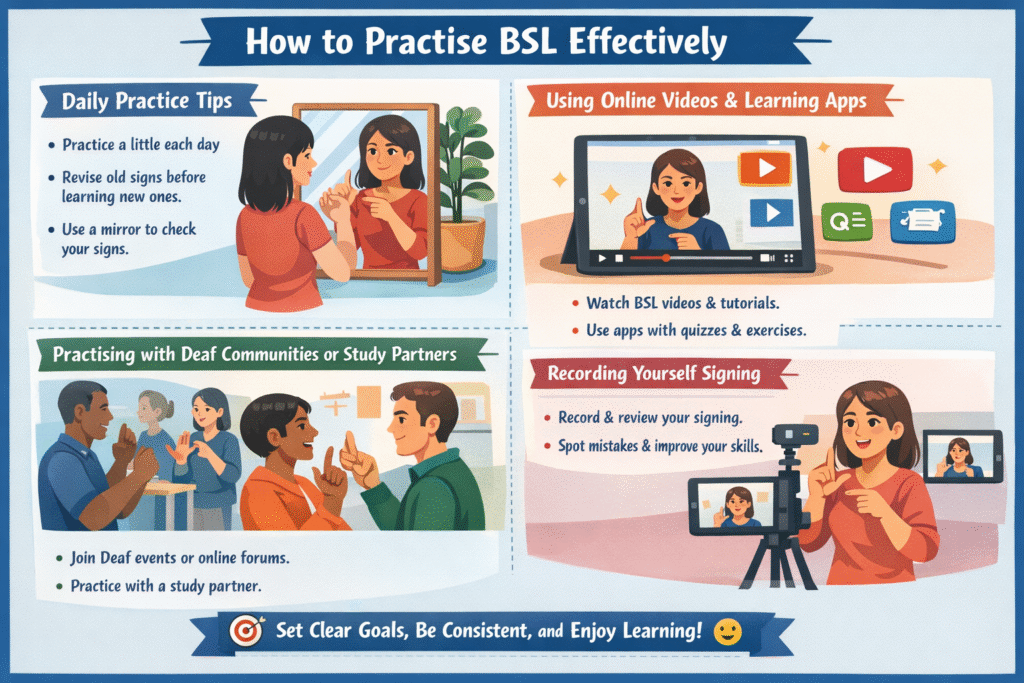
Learning British Sign Language (BSL) becomes easier and more enjoyable when you practise regularly and use practical techniques to build confidence. Consistent effort helps improve your hand shapes, facial expressions, and overall fluency. Setting clear goals and creating a structured routine can make a significant difference in your progress.

Daily Practice Tips

Short, focused practice sessions each day are more effective than long, irregular study periods. Try to revise previously learned signs before moving on to new vocabulary. Practising in front of a mirror can help you check your hand movements and facial expressions. Repetition and consistency are key to developing muscle memory and improving signing speed.

Using Online Videos and Learning Apps

Online videos and learning apps provide visual demonstrations that are essential for mastering BSL. Watching native signers helps you understand natural signing pace, expressions, and context. Interactive apps also offer quizzes, exercises, and progress tracking, making your learning journey more engaging and structured.

Practising with Deaf Communities or Study Partners

Real-life interaction is one of the most effective ways to strengthen your BSL skills. Joining Deaf community events or online forums allows you to experience authentic communication. Study partners can also help you practise conversations, correct mistakes, and stay motivated throughout your learning process.

Recording Yourself Signing for Improvement

Recording your signing sessions helps you identify areas that need improvement. By reviewing your videos, you can notice unclear signs, incorrect positioning, or missing facial expressions. Comparing your recordings with expert demonstrations can guide you towards more accurate and confident signing over time.

Study Options for BSL Level 1

Study Options for BSL Level 1

Learning BSL Level 1 offers a range of study options designed to suit different lifestyles, learning preferences, and career goals. Whether you prefer structured face-to-face sessions or the convenience of digital platforms, you can choose a method that supports steady progress and practical skill development.

Online vs Classroom Learning

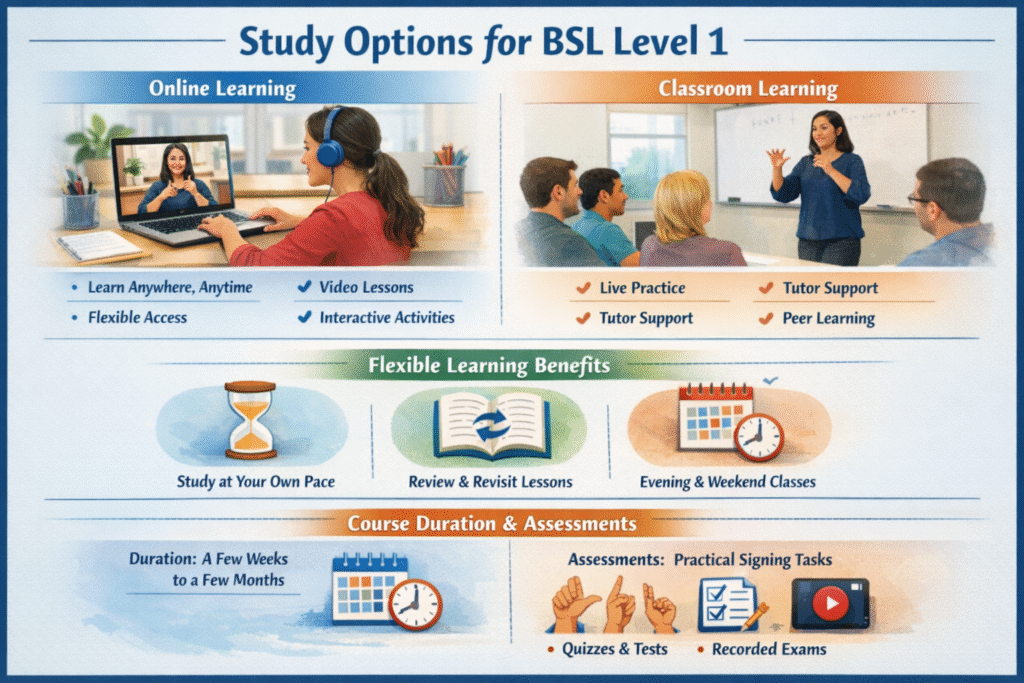
Online learning has become increasingly popular for BSL Level 1 courses. It allows learners to access video lessons, interactive activities, and assessments from any internet-enabled device. This option is ideal for individuals balancing work, studies, or family responsibilities. In contrast, classroom learning provides direct interaction with tutors and peers, offering real-time feedback and opportunities for live signing practice. Both formats focus on building foundational signing skills, understanding deaf awareness, and developing confidence in everyday communication.

Flexible Learning Benefits

Flexible study options make it easier to learn at your own pace. Many online courses offer lifetime or extended access to materials, enabling learners to revisit lessons and practise regularly. This flexibility supports better knowledge retention and reduces the pressure of fixed schedules. Classroom settings may also offer evening or weekend sessions, helping learners manage their commitments effectively.

Typical Course Duration and Assessment Methods

BSL Level 1 courses usually take a few weeks to a few months to complete, depending on the study mode and individual availability. Assessments often include practical signing tasks, short quizzes, and sometimes recorded demonstrations to evaluate communication skills. These methods ensure learners can apply their knowledge confidently in real-world situations.

Career and Progression Opportunities​

Career and Progression Opportunities

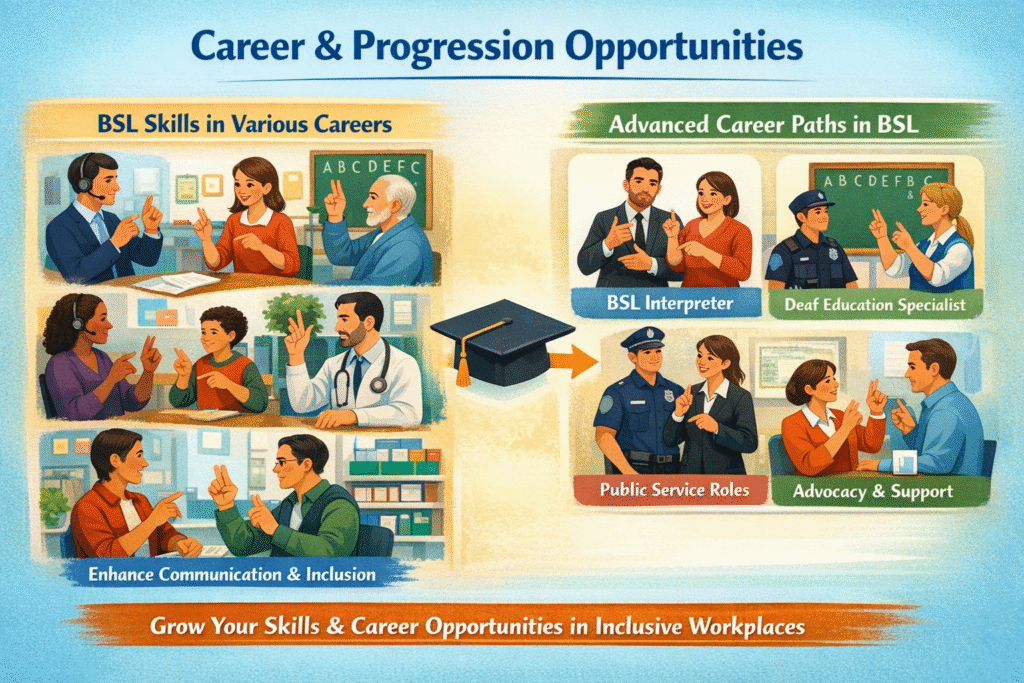
Learning basic British Sign Language (BSL) can support careers in customer service, education support, healthcare, social care, community outreach, and retail. These skills improve communication with Deaf or hard-of-hearing individuals, enhance service quality, and show a strong commitment to inclusion and equal access in everyday professional environments.

BSL knowledge also offers progression opportunities. After introductory learning, individuals can advance to higher-level qualifications and eventually specialise in areas such as interpreting, education, public services, or advocacy. In inclusive workplaces, BSL competence is increasingly valued for strengthening teamwork, customer satisfaction, and accessibility.

Common Challenges Beginners Face

Starting sign language can be exciting, but beginners often face challenges such as memorising signs and recognising similar hand movements or facial expressions. Consistent practice, repetition, and using visual learning tools can make it easier to remember signs and improve understanding over time.

Another common difficulty is building confidence and adapting to regional sign variations. Learners may feel nervous about making mistakes, which can slow progress. Practising regularly with supportive groups, using diverse learning resources, and focusing on real-life communication can help develop fluency and strong signing skills.

Conclusion

Starting with BSL Level 1 is an important first step for anyone who wants to communicate effectively with the Deaf community and build meaningful connections. It provides the essential foundation needed to understand basic signs, finger spelling, everyday conversations, and Deaf awareness, helping learners grow in confidence from the very beginning.

Beginning your BSL journey today can open doors to new personal experiences, stronger social inclusion, and valuable communication skills. Alongside enhancing empathy and cultural understanding, BSL Level 1 can also support career development in sectors such as education, healthcare, customer service, and community support. Taking this first step not only improves your ability to connect with others but also adds a practical and respected skill to your CV for future opportunities.

FAQs – Beginner’s Guide to BSL Level 1: 7 Essential Skills to Start Learning

  1. 1. Is BSL Level 1 difficult to learn?
    BSL Level 1 is designed for beginners, so it is not considered difficult. With regular practice and consistent exposure to signs, learners can build confidence and basic communication skills quickly.
  2. 2. How long does it take to complete BSL Level 1?
    The time required varies depending on the course format and study pace. Many learners complete BSL Level 1 within a few weeks to a few months through part-time or online learning.
  3. 3. Can I learn BSL online?
    Yes, many recognised providers offer BSL Level 1 courses online. Video demonstrations, interactive exercises, and practical assignments help learners develop signing skills effectively from home.
  4. 4. Is BSL useful for jobs in the UK?
    BSL skills are valuable in sectors such as education, healthcare, social care, and customer service. Learning BSL can improve communication with Deaf individuals and enhance employability in inclusive workplaces.
  5. 5. Do I need qualifications to use BSL professionally?
    Basic communication can be used without formal qualifications. However, professional roles such as interpreters or specialist support workers usually require higher-level accredited BSL training and practical experience.
  6. 6. What essential skills are covered in BSL Level 1?
    BSL Level 1 focuses on everyday vocabulary, finger spelling, simple sentence structure, facial expressions, and understanding Deaf awareness. These skills help learners communicate in common social situations.
Sam Walker

Article by

Sam Walker

Sam Walker is an education specialist and author at One Education, bringing over 4 years of experience in creating practical resources and strategies to support teachers and enhance student learning.

top
Home Courses Search