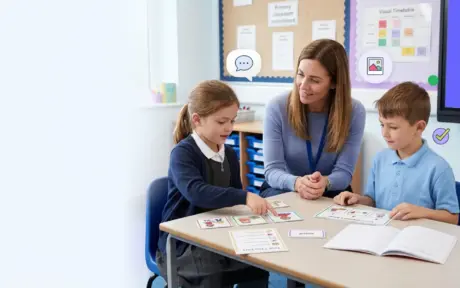
Communication Skills for SEN Teaching Assistants

November 13, 2026 | By Michael Hansen | 19 minutes | 242 Readers

Discover seven essential communication skills for SEN teaching assistants, from active listening and clear language to empathy and adaptability, with practical classroom examples for supporting pupils with SEND.

A teaching assistant explains a task, but the pupil looks uncertain and doesn’t begin. The instruction seemed clear, so what went wrong? Sometimes, the difference lies not in what we say but in how we communicate.

Effective SEN teaching assistant communication skills include active listening, clear language, non-verbal communication, patience, empathy, positive feedback and adaptability. These skills help teaching assistants understand pupils’ needs, give accessible instructions and encourage classroom participation.

Whether you’re starting your SEN career or already supporting pupils, knowing how to adapt your communication can make everyday interactions more productive. Wider speech and language support training for school staff can also help school staff develop their understanding of communication needs.

Why Are Communication Skills Important for SEN Teaching Assistants?

SEN teaching assistants support pupils with special educational needs (SEN) by helping them access learning, communicate and participate in school activities. They work alongside teachers, adapting support to each pupil’s abilities and needs.

Strong communication helps pupils understand instructions, express preferences, ask questions and develop independence. It also helps teaching assistants recognise when their approach needs adjusting.

The Education Endowment Foundation’s guidance on teaching assistants emphasises effective classroom support and opportunities for pupils to become more independent.

Importantly, not every pupil with SEN has the same communication difficulties. Understanding different speech and language needs in schools helps teaching assistants respond to individual needs rather than relying on one communication method.

7 Essential Communication Skills for SEN Teaching Assistants

Effective communication involves more than speaking clearly. The following seven skills provide a practical foundation for supporting pupils with different communication needs.

Infographic showing seven essential SEN teaching assistant communication skills, including active listening, clear language, empathy and adaptability.

1. Active Listening and Understanding Pupil Responses

Active listening means paying attention to what pupils communicate through words, gestures, expressions or other methods.

For example, a pupil might point towards their workbook instead of explaining that they’re struggling. A teaching assistant who notices this can check whether help is needed without making assumptions.

Allow pupils to finish communicating before responding. Avoid interrupting, guessing their answers or expecting everyone to communicate through speech.

2. Using Clear and Simple Language

Long instructions can be difficult for some pupils to process, especially when several tasks are introduced together.

Instead of saying, “Take out your book, find yesterday’s work and finish the next three questions,” begin with a manageable instruction such as, “Open your workbook.”

Once the pupil is ready, introduce the next step.

Use familiar vocabulary, speak at a suitable pace and check understanding through an appropriate response or demonstration.

3. Non-Verbal and Visual Communication

Not every pupil communicates primarily through spoken language. Gestures, symbols, pictures and communication devices can provide other ways to understand and express messages.

For instance, a visual timetable might help a pupil anticipate the next classroom activity.

Some pupils use augmentative and alternative communication (AAC), including communication boards or electronic devices. Teaching assistants should follow each pupil’s established communication arrangements and relevant specialist guidance.

Remember that eye contact is not a reliable measure of attention for every pupil.

4. Patience and Giving Pupils Time to Respond

Some pupils need additional time to understand a question, organise their thoughts or communicate an answer.

Repeating a question immediately can interrupt that process.

After asking something, allow appropriate processing time. Observe whether the pupil is preparing a response before offering further support.

Patience also means recognising that silence does not necessarily indicate unwillingness or a lack of understanding.

5. Empathy and Respectful Communication

Communication becomes more supportive when pupils feel respected and heard.

A pupil struggling to express frustration may need reassurance, space or an alternative way to communicate.

Rather than saying, “There’s nothing to worry about,” acknowledge the situation: “I can see this is difficult. Would you like some help?”

Use age-appropriate language and respect individual preferences. Empathy involves recognising feelings without assuming you know exactly what someone is experiencing.

6. Positive Feedback and Encouragement

Specific feedback helps pupils recognise what they have achieved.

Instead of saying only “Well done”, try “You explained which activity you wanted.”

Encourage effort, participation and independent communication without insisting on a particular type of response.

Praise should feel genuine and appropriate to the pupil’s age and preferences. Avoid making communication feel like a performance that must always be rewarded.

7. Adapting Communication to Individual Needs

The most important skill is recognising when your usual approach needs to change.

One pupil may benefit from visual prompts, another from shorter instructions, while someone else may prefer written choices or additional response time.

Adapt your language, pace and methods according to the individual rather than a diagnostic label.

For wider classroom approaches, explore SLCN classroom strategies.

England’s Department for Education also provides speech, language and communication training resources for school staff, including practical scenarios and inclusive teaching principles.

QLS Endorsed Course Limited Time Offer

Speech Therapy and SEN Teaching Assistant Course

Learn how speech and language develop, and how to support children with communication and special educational needs in the classroom.Support children's speech, language and SEN needs in class.

  • 17 Expert-Led Units17 Units
  • 2 Free Bonus Courses2 Free Courses
  • 1 Year Full Access1 Year Access
Offer price £29£425
Enrol Now

★★★★★ Rated Excellent (340+ reviews)340+ reviews 🔒 14-day money-back guarantee14-day money-back

2 Free Bonus CoursesLanguage Development & Autism
93%OFF

How to Communicate Effectively With SEN Pupils in the Classroom

Knowing the skills is one thing. Applying them during a busy school day requires observation, flexibility and practice.

Giving Instructions That Pupils Can Understand

Imagine a pupil struggling to begin a classroom activity.

Instead of repeating the entire explanation, try breaking it into smaller steps:

  1. Get the pupil’s attention in a way that suits them.
  2. Give one clear instruction.
  3. Allow time for the pupil to respond.
  4. Check understanding through an appropriate action, demonstration or response.

Where helpful, use a familiar visual cue alongside spoken instructions.

Supporting Pupils Who Communicate Without Speech

A pupil who does not use speech may communicate through gestures, facial expressions, symbols or an AAC device.

Give them sufficient time to express choices and avoid answering on their behalf unnecessarily.

For example, when choosing between two activities, present the options through the pupil’s established communication system and allow them to indicate their preference.

The goal is meaningful communication, not simply encouraging spoken answers.

Responding When Communication Breaks Down

If a pupil appears confused or frustrated, consider changing your approach rather than repeating the same words.

You might simplify the instruction, introduce a visual prompt or offer an appropriate choice.

Where speech delay is involved, additional approaches may be relevant. See support pupils with speech delay in class for more focused guidance.

Free download

TA Communication Toolkit

9 printable pages: swap sheets, phrase bank, scenario cards, lanyard prompts and a communication passport.

Download PDF

Communicating With Teachers, SENCOs and Families

SEN teaching assistant discussing classroom support with a teacher and SENCO during a UK school staff meeting.

SEN teaching assistant communication skills also matter when working with adults.

Regular communication with the class teacher helps maintain consistent support. Rather than reporting that a pupil “wasn’t listening”, describe what happened: “The pupil completed the first instruction but needed a visual prompt for the second.”

In England, the special educational needs coordinator (SENCO) helps coordinate SEN provision. Teaching assistants may also work alongside speech and language therapists and other professionals, following agreed recommendations within their role.

When communicating with parents or carers, follow school procedures and share information through appropriate channels.

Safeguarding concerns require particular care. Staff must follow their school’s reporting procedures and applicable statutory guidance, including England’s Keeping children safe in education. Concerns should not be treated as ordinary informal updates.

Common Communication Mistakes SEN Teaching Assistants Should Avoid

Even well-intentioned communication can sometimes reduce a pupil’s confidence or independence.

Less helpful approach Better alternative
Giving several instructions simultaneously Break instructions into manageable steps
Repeating questions immediately Allow appropriate processing time
Insisting on eye contact Respect individual communication preferences
Speaking for a pupil Allow opportunities for independent expression
Offering continuous prompts Give pupils time to attempt tasks independently

The aim is not to communicate perfectly every time. It’s to notice when something isn’t working and adjust your approach.

How Can SEN Teaching Assistants Improve Their Communication Skills?

Communication improves through observation, feedback and experience. Pay attention to how pupils respond, reflect on difficult interactions and discuss suitable approaches with teachers or specialists.

Structured learning can also build confidence. Those exploring speech and language training for teaching assistants can develop a broader understanding of communication needs and classroom support.

One Education’s Speech Therapy and SEN Teaching Assistant course introduces speech and language development, communication difficulties, SEN support and working with other professionals.

It offers introductory knowledge rather than professional registration or a licence to practise as a speech and language therapist.

Conclusion

Effective communication begins with understanding the individual pupil. Clear instructions, active listening, patience and adaptable approaches can make classroom interactions more accessible and supportive.

For SEN teaching assistants, developing these skills is an ongoing process. By observing pupils, collaborating with colleagues and reflecting on everyday experiences, you can become a more responsive and confident communicator.

Frequently Asked Questions

Seven useful skills are active listening, clear language, non-verbal communication, patience, empathy, positive feedback and adaptability. This is a practical framework, not an official mandatory list.

Use clear, respectful language, allow response time and adapt communication to the child’s individual needs. Visual supports or alternative communication methods may help.

They can use the pupil’s preferred communication methods, such as gestures, symbols, communication boards or AAC devices, while following individual support arrangements.

A good communicator listens carefully, respects pupil preferences, adapts instructions, notices non-verbal responses and works effectively with teachers and other professionals.

Teaching assistants can improve through practical experience, observation, feedback from colleagues, reflective practice and appropriate speech and language support training.

top
Home Courses Search