An Introduction to Graph Theory

  • Instructor Unique
  • Original
  • Video Training

Explore the fundamentals of graph theory, including vertices, edges, paths, and networks. Learn how graph concepts solve real-world problems in computing, data analysis, logistics, and decision-making effectively.

An Introduction to Graph Theory
cpdacree aoth ukrlp 24hs fullonline 14days

Get access to 5000+ courses including this for only £49. Learn More.

Overview of An Introduction to Graph Theory

An Introduction to Graph Theory provides a comprehensive foundation in Graph Theory, exploring the principles of vertices, edges, and Graph Structures. This course introduces learners to Discrete Mathematics concepts, Graph Algorithms, and mathematical networks while developing essential Problem Solving skills. Discover how graph-based models are used to represent relationships, systems, and real-world challenges.

This course covers key topics including Paths, Graph Types, Trees, Digraphs and Tournaments, Planar Graphs, and Graph Operations. Learners will explore Combinatorial Methods and understand how different graph structures support Network Analysis. Through practical examples and theoretical concepts, this course builds confidence in applying Graph Theory techniques across various academic and professional fields.

Designed for learners interested in mathematics, computing, and analytical problem solving, An Introduction to Graph Theory explores the wide range of Graph Applications in technology, science, and data-driven industries. By studying Graph Colourings, algorithms, and network models, learners will gain valuable knowledge of mathematical networks and develop skills for analysing complex systems effectively.

The course was audited and updated on: 24th July, 2026

Learning Outcomes of An Introduction to Graph Theory

Method Of Assessment​

Learners complete an assignment designed to evaluate their understanding of the course content. The assignment is reviewed by qualified tutors who provide personalised feedback, allowing learners to demonstrate their applied knowledge and skills.

Certification

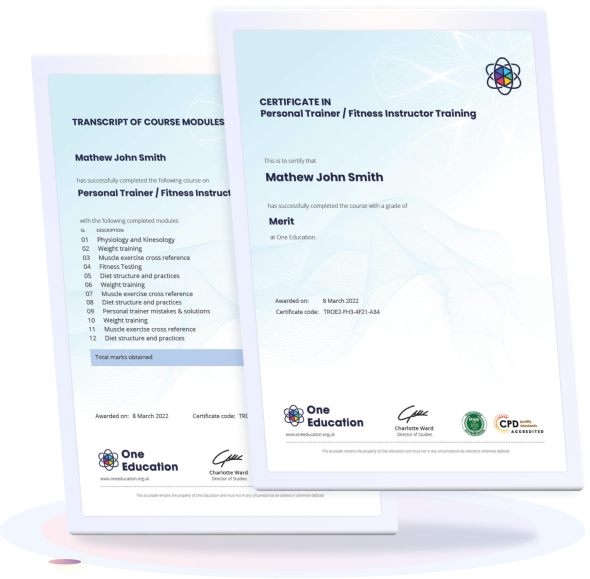
one education Certificate

After completing the An Introduction to Graph Theory course assessment, you will be eligible to receive a CPD-accredited certificate worth £9 from One Education to demonstrate your achievement.

The certificate is also available as a printed hard copy delivered by post for £15.

Why Study This An Introduction to Graph Theory Course?

An Introduction to Graph Theory introduces learners to the fundamental concepts of graph structures, including vertices, edges, graph algorithms, and network analysis. This course explores discrete mathematics, combinatorial methods, mathematical networks, and practical graph applications used to represent and solve complex problems.

Studying An Introduction to Graph Theory develops logical reasoning, analytical thinking, and problem-solving skills through the study of mathematical relationships and structures. The course supports learners interested in mathematics, computer science, data analysis, engineering, and technology by providing a strong foundation in graph-based methods and applications.

Course Duration

The An Introduction to Graph Theory course has a total study time of 9 hours, 50 minutes. This comprehensive programme is designed for flexible learning, allowing learners to progress at their own pace while exploring graph theory concepts, including graph structures, vertices and edges, graph algorithms, network analysis, discrete mathematics, combinatorial methods, mathematical networks, graph applications, problem-solving techniques, and real-world uses of graph theory.

Requirements

The An Introduction to Graph Theory course requirements are simple and suitable for beginners. Learners should have a basic understanding of mathematics, an interest in logical reasoning, problem-solving, and mathematical structures, and a willingness to explore concepts such as graphs, vertices, edges, algorithms, and networks. Access to an internet-enabled device and commitment to regular study are recommended for effective learning and successful course completion.

Career Path

Frequently Asked Questions

This course introduces the fundamentals of graph theory, covering vertices and edges, graph structures, graph algorithms, network analysis, discrete mathematics, graph representations, combinatorial methods, mathematical networks, and real-world applications of graphs in problem-solving.

No. It is suitable for beginners, students, mathematics learners, computer science enthusiasts, and anyone interested in developing logical thinking and problem-solving skills using graph-based concepts.

The course is delivered online, allowing you to learn at your own pace and develop essential knowledge of graph theory and discrete mathematical concepts conveniently.

Yes. Graph exercises, algorithm-based activities, problem-solving tasks, mathematical examples, case studies, and quizzes may be included to reinforce learning.

You will receive a certificate of completion after successfully finishing the course.

This course supports career development in computer science, software development, data science, network engineering, cybersecurity, operations research, mathematics, and other fields requiring analytical and computational skills.

Course Curriculum

Course Promo
Graph Theory Promo 00:02:00
Module 01: Supplements
Textbook Recommendations 00:02:00
Tools and Softwares 00:05:00
Sets 00:09:00
Number Sets 00:10:00
Parity 00:12:00
Terminologies 00:07:00
Module 02: Fundamentals
Introduction 00:03:00
Graphs 00:11:00
Subgraphs 00:09:00
Degree 00:10:00
Sum of Degrees of Vertices Theorem 00:23:00
Adjacency and Incidence 00:09:00
Adjacency Matrix 00:16:00
Incidence Matrix 00:08:00
Isomorphism 00:08:00
Module 03: Paths
Introduction 00:01:00
Walks, Trails, Paths, and Circuits 00:13:00
Examples 00:10:00
Eccentricity, Diameter, and Radius 00:07:00
Connectedness 00:20:00
Euler Trails and Circuits 00:18:00
Fleury’s Algorithm 00:10:00
Hamiltonian Paths and Circuits 00:06:00
Ore’s Theorem 00:14:00
Dirac’s Theorem 00:06:00
The Shortest Path Problem 00:16:00
Module 04: Graph Types
Introduction 00:01:00
Trivial, Null and Simple Graphs 00:10:00
Regular Graphs 00:10:00
Complete, Cycles and Cubic Graphs 00:10:00
Path, Wheel and Platonic Graphs 00:11:00
Bipartite Graphs 00:14:00
Module 05: Trees
Introduction 00:01:00
Trees 00:14:00
Cayley’s Theorem 00:03:00
Rooted Trees 00:10:00
Binary Trees 00:14:00
Binary Tree Traversals 00:18:00
Binary Expression Trees 00:09:00
Binary Search Trees 00:19:00
Spanning Trees 00:10:00
Forest 00:07:00
Module 06: Digraphs and Tournaments
Introduction 00:01:00
Digraphs 00:12:00
Degree 00:09:00
Isomorphism 00:08:00
Adjacency Matrix 00:10:00
Incidence Matrix 00:05:00
Walks, Paths and Cycles 00:12:00
Connectedness 00:05:00
Tournaments 00:08:00
Module 07: Planar Graphs
Introduction 00:01:00
Planar Graphs 00:10:00
Kuratowski’s Theorem 00:14:00
Euler’s Formula 00:10:00
Dual Graphs 00:11:00
Module 08: Graph Operations
Introduction 00:01:00
Vertex and Edge Deletion & Addition 00:08:00
Cartesian Product 00:10:00
Graph Join and Transpose 00:04:00
Complement Graphs 00:05:00
Module 09: Graph Colourings
Introduction 00:01:00
Vertex Colourings 00:05:00
Edge Colourings 00:09:00
Total Colourings 00:05:00
Assignment
Assignment – An Introduction to Graph Theory 00:00:00
An Introduction to Graph Theory
top