Sensors

Sensors detect physical changes like temperature, pressure, motion, or light and convert them into signals, enabling devices and systems to monitor environments, automate processes, and improve accuracy and efficiency.
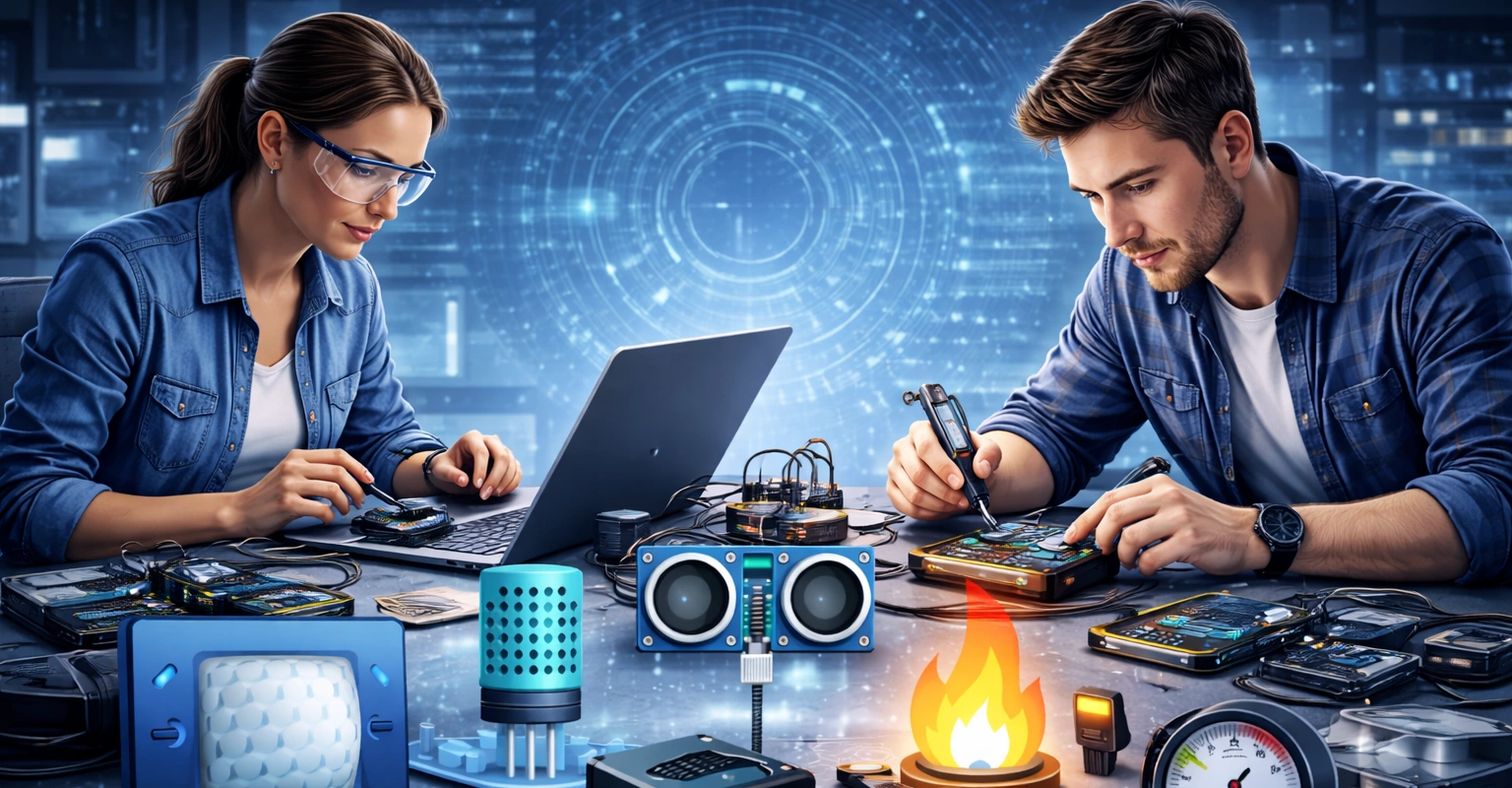
Engineers working with electronic sensors in a technology lab, testing and configuring motion, temperature, pressure, and ultrasonic sensors for automation and monitoring systems.

Get access to 5000+ courses including this for only £49. Learn More.

Overview of Sensors

This sensors course introduces IoT sensors, smart sensors and industrial sensors, explaining how modern measurement systems work, where sensors are applied, and how data supports automation, monitoring and efficient decision-making.

Learners explore temperature sensors, pressure sensors, motion sensors and proximity sensors, covering mechanical and electrical transducers, speed measurement, flow meters and force sensing principles used across engineering and control environments.

The course also examines optical sensors, gas sensors and position sensors, alongside depth gauges, focusing on accurate signal detection, calibration basics and reliable sensor selection for industrial and automation systems.

Learning Outcomes of Sensors

Method Of Assessment​

Learners complete an assignment designed to evaluate their understanding of the course content. The assignment is reviewed by qualified tutors who provide personalised feedback, allowing learners to demonstrate their applied knowledge and skills.

Certification

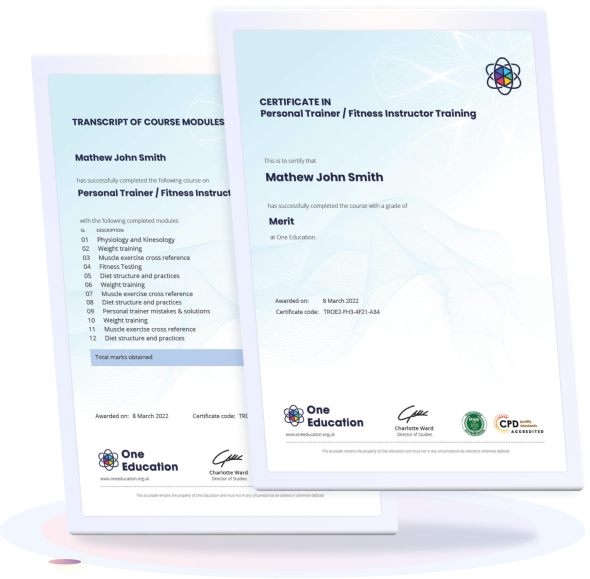
one education Certificate

After completing the Sensors assessments, learners qualify for a CPD QS accredited certificate from One Education.

The certificate is available in two formats: a PDF version for £9 or a printed hard copy delivered by post for £15.

Why Study This Sensors?

Rapid advances in automation, smart manufacturing, and connected technologies have increased the importance of accurate sensing systems across modern industries. From temperature and pressure monitoring to motion detection and gas measurement, sensors play a critical role in maintaining efficiency, safety, and data-driven decision-making in industrial, commercial, and technological environments.

Studying Sensors online strengthens technical understanding of sensing principles, device selection, and performance evaluation across diverse applications. CPD recognition highlights professional development, supports progression into engineering and technology-focused roles, and demonstrates up-to-date knowledge aligned with evolving industry expectations.

Course Duration

The Sensors course is designed with a concise total study time of 1 hour and 28 minutes, allowing learners to complete the full content within a short and manageable period. The structured modules support steady progress, making it possible to finish the course comfortably according to individual availability and learning preference.

Requirements

The sensors course online requirements are straightforward and accessible. Individuals with a basic awareness of technology, measurement systems, or an interest in learning how sensors function in real-world applications are welcome to enrol. As the programme is delivered entirely online, learners only need a stable internet connection and a compatible digital device to access the study materials and progress through the training at a comfortable pace.

Career Path

Frequently Asked Questions

A sensor is a device that detects physical, chemical, or environmental changes and converts them into measurable signals. These signals are then processed by electronic systems for monitoring, control, or automation purposes.

Common sensor categories include temperature, pressure, proximity, motion, optical, gas, and force sensors. Each type is designed to measure a specific condition in industrial, domestic, or digital environments.

Sensors are widely used in smart homes, healthcare equipment, industrial automation, vehicles, environmental monitoring, and Internet of Things (IoT) systems. Their role is to improve safety, efficiency, and data accuracy.

Analogue sensors produce continuous electrical signals that vary with measurement changes, while digital sensors provide discrete numerical outputs. Digital sensors are often easier to integrate with modern computing systems.

IoT sensors are connected sensing devices that transmit collected data through networks to cloud platforms or control systems. They support real-time monitoring, predictive maintenance, and intelligent automation.

Temperature and pressure sensors help maintain safe operating conditions, protect equipment, and ensure accurate production control. They are essential in manufacturing, energy systems, and engineering processes.

Course Curriculum

Section 1: Introduction and Getting Started
Unit 1: Introduction 00:01:00
Unit 2: Instructor’s Introduction 00:03:00
Unit 3: Into the Sensors World 00:05:00
Section 2: Temperature Sensors
Unit 1: Thermocouple 00:08:00
Unit 2: Resistance Type Sensor 00:06:00
Unit 3: Liquid Expansion and Vapour Pressure Sensors 00:02:00
Unit 4: Bimetallic Types 00:03:00
Unit 5: Glass Thermometer 00:03:00
Section 3: Mechanical Pressure Transducers
Unit 1: Pressure Sensors 00:01:00
Unit 2: Bourdon Tube 00:03:00
Unit 3: Piston Type 00:03:00
Unit 4: Capsules and Bellows 00:02:00
Unit 5: Diaphragms 00:02:00
Section 4: Electrical Pressure Transducers
Unit 1: Electrical Pressure Transducers 00:01:00
Unit 2: Strain Gauge Types 00:03:00
Unit 3: Piezo Electric Types 00:02:00
Section 5: Speed Transducers
Unit 1: Optical Types 00:03:00
Unit 2: Magnetic Pickups and Tachometers 00:03:00
Section 6: Flow Meters
Unit 1: Positive Displacement Types 00:03:00
Unit 2: Inferential Type Meters 00:04:00
Unit 3: Tapered Plug Type 00:04:00
Unit 4: Variable Area Types 00:04:00
Section 7: Force Sensors
Unit 1: Force Sensors 00:05:00
Section 8: Position Sensors
Unit 1: Resistive Type 00:03:00
Unit 2: Optical Type 00:06:00
Unit 3: Inductive Type 00:03:00
Section 9: Depth Gauges
Unit 1: Depth Gauges 00:02:00
Assignment
Assignment – Sensors 00:00:00
top
OE Footer
Home Search Cart