For many SENDCos, the journey does not begin with a carefully planned ambition to lead SEND provision. It often starts much more naturally—supporting a pupil who is struggling, adapting a lesson that is not working, working closely with a teaching assistant, speaking with a concerned parent, or simply becoming the colleague others turn to when a child needs something different.
These everyday experiences can gradually develop into a stronger commitment to inclusion and a desire to make a wider difference. But how do you go from being the person who cares about inclusion to the person responsible for leading SEND across an entire school? The answer is rarely one straightforward career path.
Becoming a SENDCo involves much more than gaining the required qualifications. It is a journey built through practical experience, growing SEND knowledge, collaboration, leadership and increasing responsibility. This article explores that real career journey—from those early classroom experiences to taking the lead on SEND provision and supporting pupils, families and colleagues across the school.
First, What Does “Climbing Up to SENDCo” Actually Look Like?
There is no single career ladder to becoming a SENDCo. People reach the role through different routes depending on their experience, school and responsibilities.
A typical journey might look like:
Teaching Assistant / Support Role → Teacher → SEND Responsibility → Assistant/Deputy SENDCo → SENDCo
Or:
Teacher → SEND Champion / Subject Responsibility → SENDCo
Or even:
Teacher → Pastoral or Inclusion Role → SEND Leadership → SENDCo
The job titles are less important than the responsibility you gain along the way. You may begin by supporting individual pupils, identifying barriers to learning and adapting activities. As your experience develops, you start understanding different areas of SEND, communicating with families, coordinating support and working with outside professionals.
Eventually, your role expands beyond individual pupils. You begin helping colleagues improve inclusive teaching, coordinating SEND provision and contributing to decisions that affect the whole school.
A simple way to understand the progression is:
Supporting individual pupils → Supporting teachers → Coordinating provision → Leading inclusion strategically
So, climbing towards SENDCo is not really about collecting job titles. It is about developing the knowledge, responsibility and influence needed to improve SEND provision and create a more inclusive learning environment across the school.
The Starting Point: Becoming the Teacher Who Notices
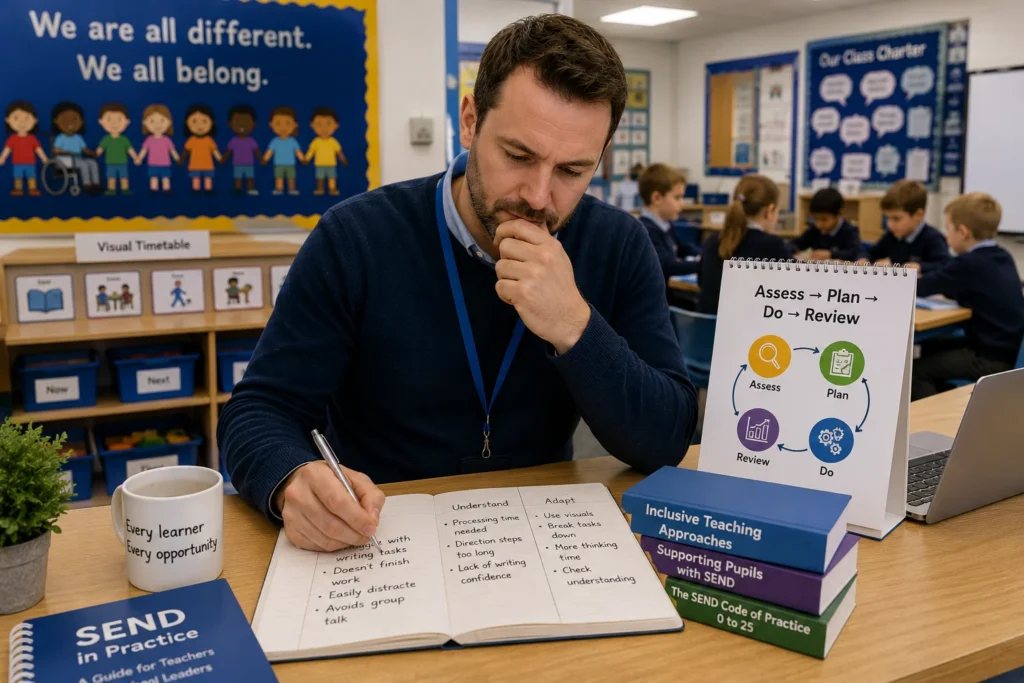
The journey towards becoming a SENDCo often starts before the job title or qualification. It begins by noticing pupils for whom the usual classroom approach is not enough.
A pupil struggling with written work, communication or concentration may need more than encouragement. Instead of asking, “Why aren’t they keeping up?”, you begin asking, “What is making learning difficult, and what can I change?” This might mean using visual resources, breaking instructions into smaller steps or allowing more processing time.
You also learn from teaching assistants, SENDCos, specialist teachers and SEND-focused CPD, developing your understanding of inclusive teaching, reasonable adjustments and the Assess → Plan → Do → Review approach.
Importantly, not every difficulty indicates SEND. Sometimes better scaffolding or a different teaching strategy is enough. When difficulties continue despite appropriate support, however, further SEND provision may need to be considered.
This is where the SENDCo journey really begins: noticing barriers, understanding the pupil behind them and finding practical ways to make learning more accessible.
Continue Your Professional Development
Interested in developing your SEN knowledge? Explore our SENCO – Special Educational Needs Coordination course and discover more professional development courses to support your career goals. Browse all courses at One Education.
The First Real Step Up: Taking Responsibility Beyond Your Own Classroom
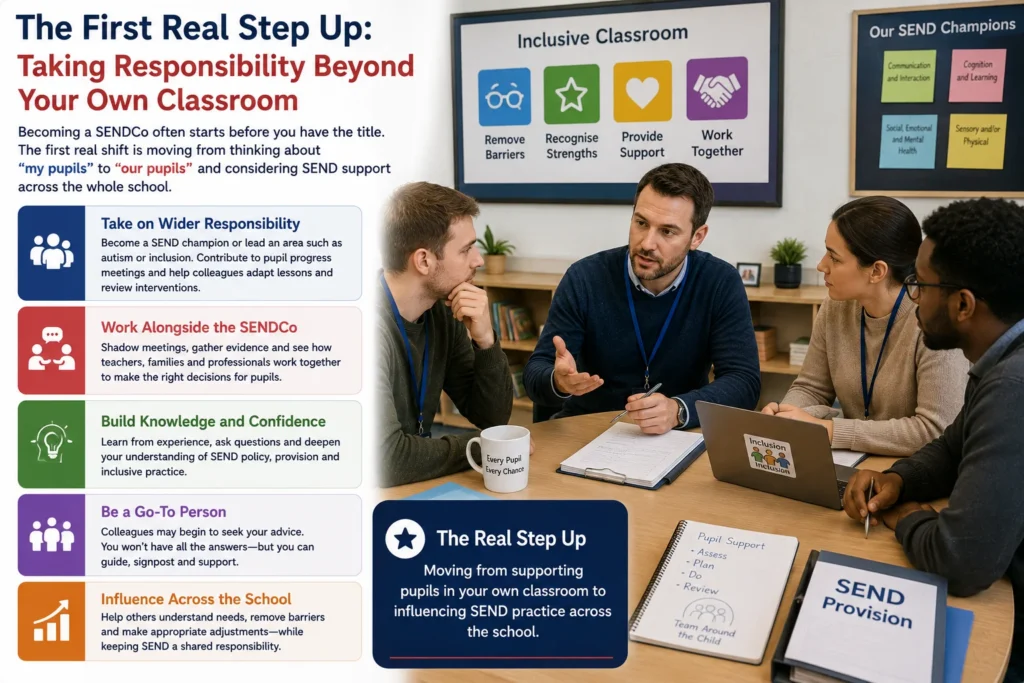
Becoming a SENDCo often starts before you have the title. The first real shift is moving from thinking about “my pupils” to “our pupils” and considering SEND support across the whole school.
This might mean becoming a SEND champion, leading an area such as autism or inclusion, mentoring teaching assistants, contributing to pupil progress meetings or helping colleagues adapt lessons and review interventions.
Working alongside the existing SENDCo is particularly valuable. Shadowing parent meetings, gathering evidence and seeing how teachers, families and professionals make decisions can help you understand SEND beyond the classroom.
Over time, colleagues may begin coming to you for guidance. You will not always have every answer — SEND leadership is about helping others understand needs, remove barriers and make appropriate adjustments, while keeping SEND a shared responsibility.
That is the real step up: moving from supporting pupils in your own classroom to influencing SEND practice across the school.
Learning the Part of SEND That Isn't Taught at the Front of a Classroom
Being a strong classroom practitioner is a good starting point for becoming a SENDCo, but the role requires a wider understanding of whole-school SEND systems and responsibilities.
You need to understand the SEND Code of Practice, the Graduated Approach — Assess, Plan, Do, Review, SEN Support and the school’s responsibilities around EHCPs and reasonable adjustments. Accurate record keeping is also important for tracking provision, progress and impact.
SENDCos also work with professionals such as educational psychologists, speech and language therapists, occupational therapists and local authorities. Knowing when to seek specialist support and how to apply recommendations is an important part of the role.
The key transition is moving from “How can I support this pupil?” to “How can we provide the right support across the school?”
That shift marks the move from classroom practitioner to SEND leader.
Then Comes the Biggest Shift: From Helping Children to Leading Adults
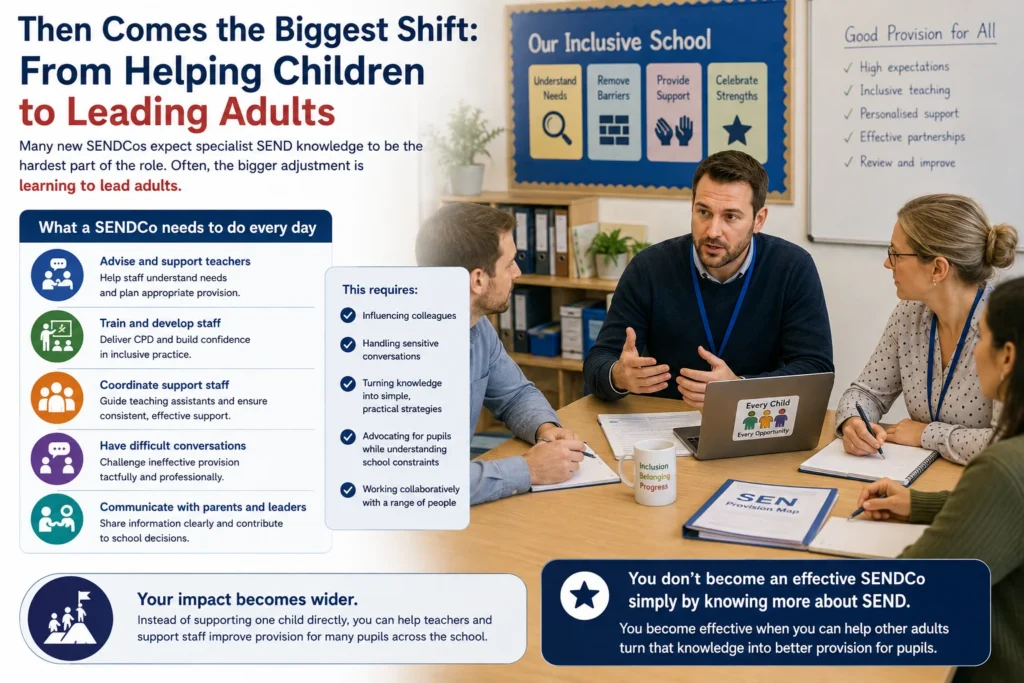
Many new SENDCos expect specialist SEND knowledge to be the hardest part of the role. Often, the bigger adjustment is learning to lead adults.
A SENDCo must advise teachers, train staff, coordinate teaching assistants, challenge ineffective provision tactfully, communicate with parents and senior leaders, and contribute to wider school decisions.
This requires more than knowing what good SEND provision looks like. You need to influence colleagues, handle difficult conversations and turn your knowledge into practical strategies that teachers can use. At the same time, you must advocate for pupils while recognising the everyday constraints schools face.
Your impact also becomes wider. Instead of supporting one child directly, you can help teachers and support staff improve provision for many pupils across the school.
You do not become an effective SENDCo simply by knowing more about SEND. You become effective when you can help other adults turn that knowledge into better provision for pupils.
Do You Have to Be a Teacher Before Becoming a SENDCo?
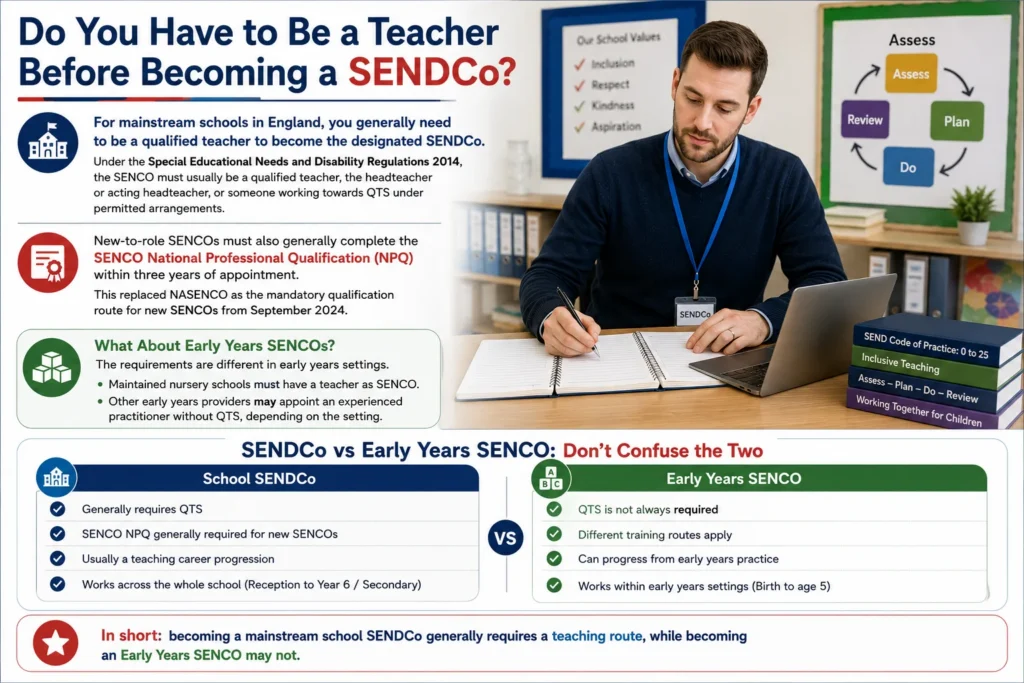
For mainstream schools in England, you generally need to be a qualified teacher to become the designated SENDCo. Under the Special Educational Needs and Disability Regulations 2014, the SENCO must usually be a qualified teacher, the headteacher or acting headteacher, or someone working towards QTS under permitted arrangements.
New-to-role SENCOs must also generally complete the SENCO National Professional Qualification (NPQ) within three years of appointment. This replaced NASENCO as the mandatory qualification route for new SENCOs from September 2024.
What About Early Years SENCOs?
The requirements are different in early years settings. Maintained nursery schools must have a teacher as SENCO, while other early years providers may appoint an experienced practitioner without QTS, depending on the setting.
SENDCo vs Early Years SENCO: Don’t Confuse the Two
| School SENDCo | Early Years SENCO |
|---|---|
| Generally requires QTS | QTS is not always required |
| SENCO NPQ generally required for new SENCOs | Different training routes apply |
| Usually a teaching career progression | Can progress from early years practice |
In short: becoming a mainstream school SENDCo generally requires a teaching route, while becoming an Early Years SENCO may not.
The Qualification Step: What Do SENDCos Need in 2026?
In mainstream schools in England, a SENDCo must be a qualified teacher or the headteacher. For most aspiring SENDCos, this means gaining Qualified Teacher Status (QTS) and relevant teaching experience first.
NPQ for SENCOs
Since September 2024, the NPQ for SENCOs has replaced NASENCO as the mandatory qualification for new SENDCos. It must normally be completed within three years of appointment.
The programme takes around 18–22 months, with approximately 1–2 hours of study per week. It has a strong leadership focus, covering statutory SEND requirements, identifying needs, teaching, behaviour, leadership and implementing effective SEND provision. Participants must also complete a written assessment.
What About NASENCO?
NASENCO was the previous mandatory qualification, which is why it still appears in older guidance and search results. SENDCos who have already completed NASENCO generally do not need to take the new NPQ simply because the qualification requirements have changed.
In short: Qualified teacher → SENDCo appointment → complete the NPQ for SENCOs within three years.
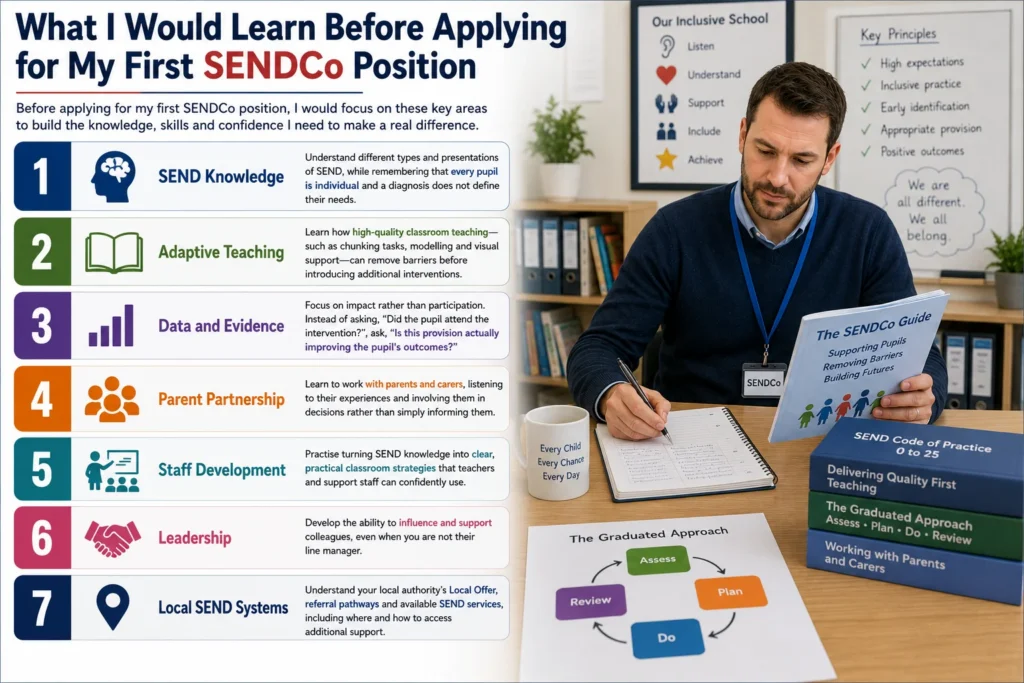
What I Would Learn Before Applying for My First SENDCo Position
Before applying for my first SENDCo position, I would focus on these key areas:
1. SEND Knowledge
Understand different types and presentations of SEND, while remembering that every pupil is individual and a diagnosis does not define their needs.
2. Adaptive Teaching
Learn how high-quality classroom teaching—such as chunking tasks, modelling and visual support—can remove barriers before introducing additional interventions.
3. Data and Evidence
Focus on impact rather than participation. Instead of asking, “Did the pupil attend the intervention?”, ask, “Is this provision actually improving the pupil’s outcomes?”
4. Parent Partnership
Learn to work with parents and carers, listening to their experiences and involving them in decisions rather than simply informing them.
5. Staff Development
Practise turning SEND knowledge into clear, practical classroom strategies that teachers and support staff can confidently use.
6. Leadership
Develop the ability to influence and support colleagues, even when you are not their line manager.
7. Local SEND Systems
Understand your local authority’s Local Offer, referral pathways and available SEND services, including where and how to access additional support.
These areas would give me a strong practical foundation for stepping into my first SENDCo role with greater confidence.
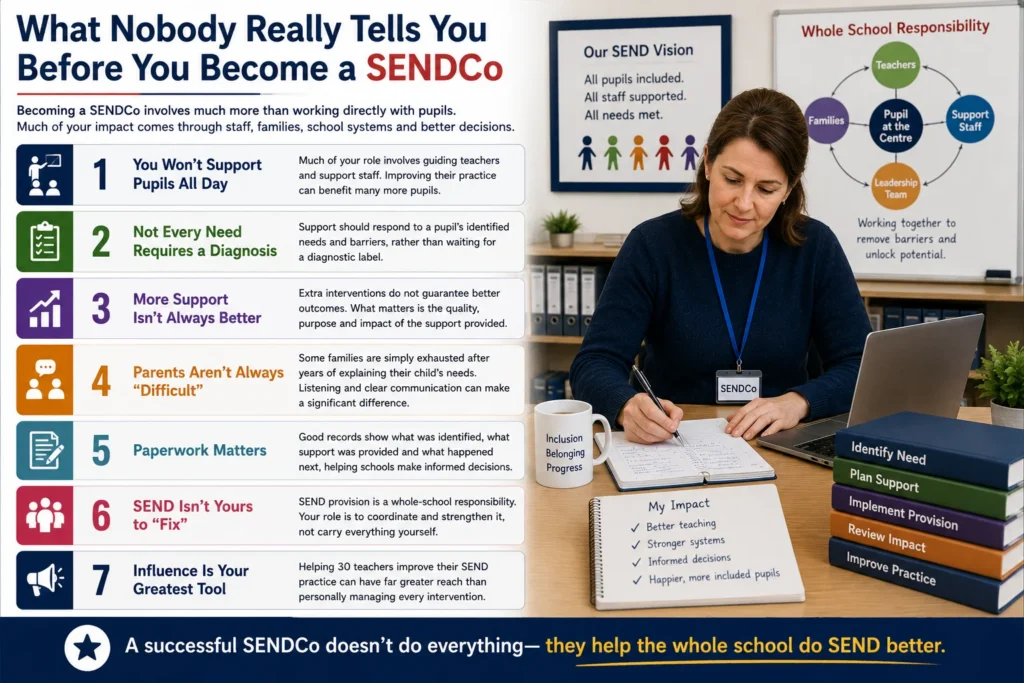
What Nobody Really Tells You Before You Become a SENDCo
Becoming a SENDCo involves much more than working directly with pupils. Much of your impact comes through staff, families, school systems and better decisions.
You Won’t Support Pupils All Day
Much of your role involves guiding teachers and support staff. Improving their practice can benefit many more pupils.
Not Every Need Requires a Diagnosis
Support should respond to a pupil’s identified needs and barriers, rather than waiting for a diagnostic label.
More Support Isn’t Always Better
Extra interventions do not guarantee better outcomes. What matters is the quality, purpose and impact of the support provided.
Parents Aren’t Always “Difficult”
Some families are simply exhausted after years of explaining their child’s needs. Listening and clear communication can make a significant difference.
Paperwork Matters
Good records show what was identified, what support was provided and what happened next, helping schools make informed decisions.
SEND Isn’t Yours to “Fix”
SEND provision is a whole-school responsibility. Your role is to coordinate and strengthen it, not carry everything yourself.
Influence Is Your Greatest Tool
Helping 30 teachers improve their SEND practice can have far greater reach than personally managing every intervention.
A successful SENDCo doesn’t do everything—they help the whole school do SEND better.
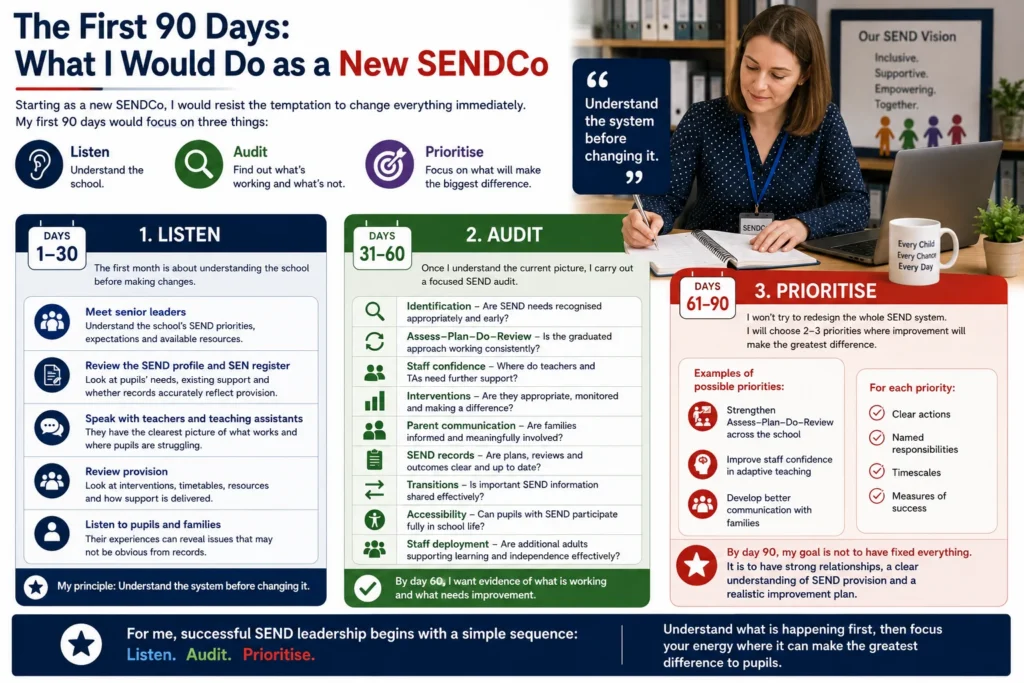
The First 90 Days: What I Would Do as a New SENDCo
Starting as a new SENDCo, I would resist the temptation to change everything immediately. My first 90 days would focus on three things:
Days 1–30: Listen
Days 31–60: Audit
Days 61–90: Prioritise
Days 1–30: Listen
The first month would be about understanding the school before making changes.
I would meet senior leaders to understand the school’s SEND priorities, expectations and available resources. I would then review the SEND profile and SEN register, looking at pupils’ needs, existing support and whether records accurately reflect current provision.
Just as importantly, I would speak with teachers and teaching assistants. They often have the clearest picture of what works in the classroom and where pupils are struggling.
I would also review existing provision and listen to pupils and families. Their experiences can reveal issues that may not be obvious from records alone.
My principle would be simple:
Understand the system before changing it.
Days 31–60: Audit
Once I understood the current picture, I would carry out a focused SEND audit.
I would look at:
- Identification – Are SEND needs recognised appropriately and early?
- Assess–Plan–Do–Review – Is the graduated approach working consistently?
- Staff confidence – Where do teachers and TAs need further support?
- Interventions – Are they appropriate, monitored and making a difference?
- Parent communication – Are families informed and meaningfully involved?
- SEND records – Are plans, reviews and outcomes clear and up to date?
- Transitions – Is important SEND information shared effectively?
- Accessibility – Can pupils with SEND participate fully in school life?
- Staff deployment – Are additional adults supporting learning and independence effectively?
By day 60, I would want evidence of what is working and what needs improvement, rather than relying on assumptions.
Days 61–90: Prioritise
At this stage, I would avoid trying to redesign the whole SEND system.
Instead, I would choose two or three priorities where improvement could make the greatest difference.
These might include strengthening Assess–Plan–Do–Review, improving staff confidence in adaptive teaching or developing better communication with families.
Each priority would have clear actions, responsibilities and measures of success.
By day 90, my goal would not be to have fixed everything. It would be to have strong relationships, a clear understanding of SEND provision and a realistic improvement plan.
For me, successful SEND leadership begins with a simple sequence:
Listen. Audit. Prioritise.
Understand what is happening first, then focus your energy where it can make the greatest difference to pupils.
Are You Actually Ready to Become a SENDCo?
Becoming a SENDCo requires more than knowledge of SEND. You need to support colleagues, communicate with families, interpret evidence and help improve SEND provision across the setting.
Quick SENDCo Readiness Check
Ask yourself:
- ♦ Can I explain SEND without relying entirely on diagnostic labels?
- ♦ Can I advise another teacher confidently?
- ♦ Can I handle sensitive conversations with parents and carers?
- ♦ Can I challenge practice professionally?
- ♦ Do I understand the SEND Code of Practice?
- ♦ Can I interpret evidence rather than simply collect it?
- ♦ Can I coordinate different professionals effectively?
- ♦ Can I prioritise when several pupils need support?
- ♦ Am I comfortable leading change?
- ♦ Can I advocate strongly while remaining realistic about resources?
Not All “Yes”? That’s Okay.
You do not need to answer “yes” to every question before applying for a SENDCo role. Instead, your “not yet” answers can highlight where to focus your professional development.
The key question is not whether you already know everything—it is whether you are willing to recognise your gaps, keep learning and develop into the role.
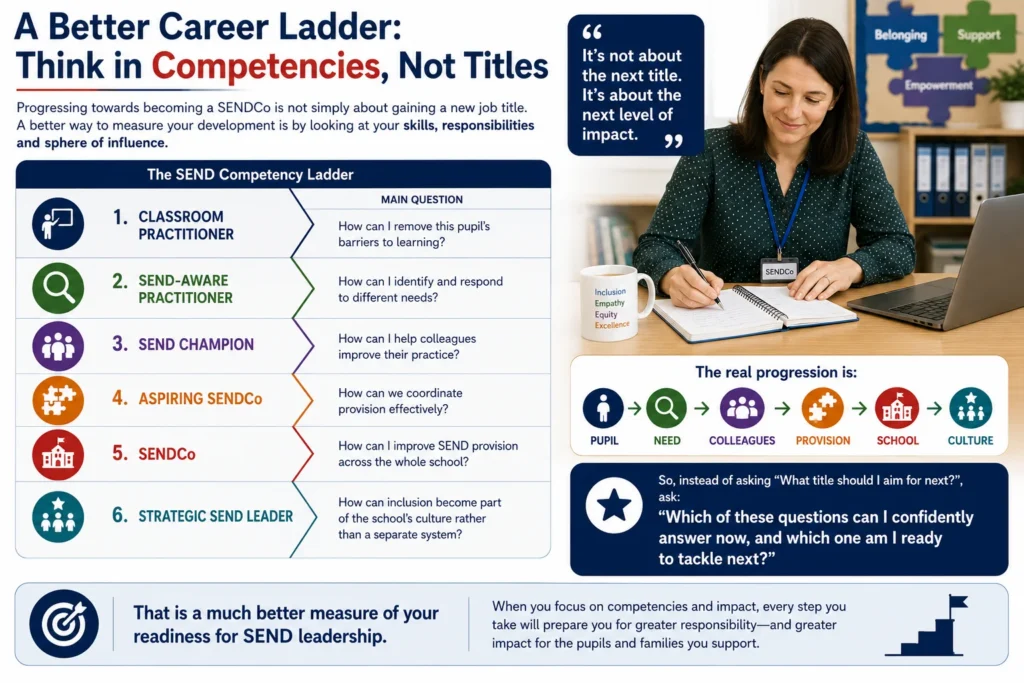
A Better Career Ladder: Think in Competencies, Not Titles
Progressing towards becoming a SENDCo is not simply about gaining a new job title. A better way to measure your development is by looking at your skills, responsibilities and sphere of influence.
The SEND Competency Ladder
| Stage | Main Question |
|---|---|
| Classroom Practitioner | How can I remove this pupil's barriers to learning? |
| SEND-Aware Practitioner | How can I identify and respond to different needs? |
| SEND Champion | How can I help colleagues improve their practice? |
| Aspiring SENDCo | How can we coordinate provision effectively? |
| SENDCo | How can I improve SEND provision across the whole school? |
| Strategic SEND Leader | How can inclusion become part of the school's culture rather than a separate system? |
The real progression here is:
Pupil → Need → Colleagues → Provision → School → Culture
You begin by removing barriers for individual pupils. As your SEND knowledge grows, you become better at recognising different needs and adapting your practice. The next step is helping colleagues do the same.
From there, your focus expands to coordinating provision, improving whole-school SEND systems and, ultimately, embedding inclusion into the school’s everyday culture.
So, instead of asking “What title should I aim for next?”, ask:
“Which of these questions can I confidently answer now, and which one am I ready to tackle next?”
That is a much better measure of your readiness for SEND leadership.
FAQs — How did you climb your way up to being a SENDCo?
Can I become a SENDCo without being a teacher?
For a mainstream school in England, the SENCO is generally required to be a qualified teacher. Early years settings have different SEND arrangements and requirements.
What qualification does a SENDCo need in 2026?
New SENCOs in England are required to complete the NPQ for SENCOs where the statutory requirement applies. This qualification replaced the previous NASENCO qualification.
How long does it take to become a SENDCo?
There is no fixed timeline. It depends on your teaching experience, SEND responsibilities, leadership development and available opportunities.
Is being a SENDCo a senior leadership role?
Not always. However, it is a strategic leadership role, and the SENDCo should work closely with the headteacher and senior leadership team.
Is being a SENDCo stressful?
It can be demanding because of the workload, statutory responsibilities and competing priorities. However, it can also be highly rewarding because you can directly improve support and outcomes for pupils with SEND.
Article by
Sam Walker is an education specialist and author at One Education, bringing over 4 years of experience in creating practical resources and strategies to support teachers and enhance student learning.
Related Articles
Get a FREE Course
- Learn useful skills online free
- Get CPD accredited certificate
- Add it to your CV today!

Aug, 14, 2026