Signs for countries in British Sign Language have changed

August 29, 2026 | 15 minutes | 12 Readers

Yes, signs for countries in British Sign Language (BSL) have changed over time. BSL is a living language, not a fixed collection of signs. Just like spoken languages, it naturally develops as communities, cultures and ways of communicating evolve. Country signs can also vary between generations and regions. A sign commonly used by older BSL users may differ from the version preferred by younger signers, while Deaf communities in different parts of the UK may use their own variations. As

rating

Bestselling Course

View Details SAVE 94% NOW

Yes, signs for countries in British Sign Language (BSL) have changed over time. BSL is a living language, not a fixed collection of signs. Just like spoken languages, it naturally develops as communities, cultures and ways of communicating evolve.

Country signs can also vary between generations and regions. A sign commonly used by older BSL users may differ from the version preferred by younger signers, while Deaf communities in different parts of the UK may use their own variations.

As BSL continues to evolve, some traditional country signs have become less common, while newer or alternative variants are now more widely used. Understanding these changes can help BSL learners recognise different signs, communicate more naturally and keep their signing knowledge up to date.

Why Have BSL Signs for Some Countries Changed?

BSL signs for some countries have changed because language naturally evolves, cultural attitudes shift, and Deaf communities are more internationally connected. Some older signs are being replaced with alternatives considered more respectful or closer to those used by Deaf people in the countries themselves.

🌍 Language Evolves

Like any living language, BSL changes over time. New generations and changing communication habits naturally influence how countries are signed.

🤝 Cultural Awareness Has Grown

Some traditional signs were based on outdated or stereotypical representations. Greater cultural awareness has encouraged the use of more respectful alternatives.

🌐 Deaf Communities Are More Connected

Travel, social media and international Deaf communities expose BSL users to signs used in other countries, encouraging some of these signs to be adopted or adapted.

👐 Local Signs Have Greater Influence

Where appropriate, BSL users may increasingly use signs recognised internationally or within the country itself, supporting respectful cross-cultural communication.

Key takeaway: Changes to country signs show that BSL is a living language that continues to evolve alongside its community and society.

Which-Country-Signs-Have-Changed-in-British-Sign-Language

Which Country Signs Have Changed in British Sign Language?

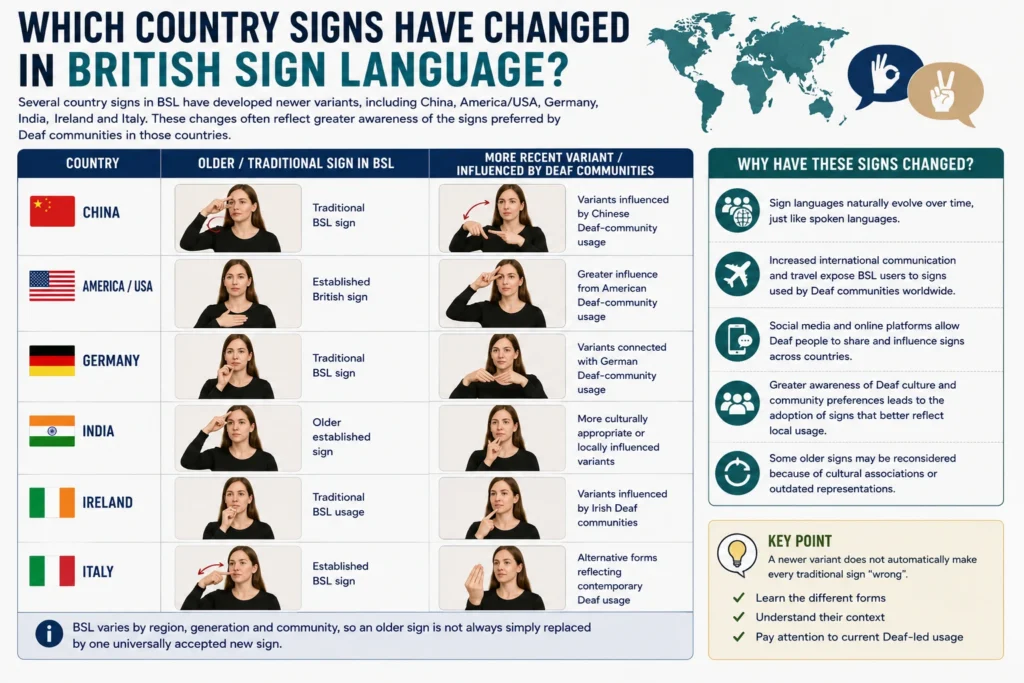
Several country signs in BSL have developed newer variants, including China, America/USA, Germany, India, Ireland and Italy. These changes often reflect greater awareness of the signs preferred by Deaf communities in those countries. However, BSL varies by region, generation and community, so an older sign is not always simply replaced by one universally accepted new sign.

Older/Traditional Sign vs More Recent Variant

Country Older/Traditional Usage More Recent Approach
🇨🇳 China Traditional BSL sign Variants influenced by Chinese Deaf-community usage
🇺🇸 America/USA Established British sign Greater influence from American Deaf-community usage
🇩🇪 Germany Traditional BSL sign Variants connected with German Deaf usage
🇮🇳 India Older established sign More culturally appropriate or locally influenced variants
🇮🇪 Ireland Traditional BSL usage Variants influenced by Irish Deaf communities
🇮🇹 Italy Established BSL sign Alternative forms reflecting contemporary Deaf usage

Why Have These Signs Changed?

Sign languages naturally evolve. Greater international communication, travel and social media have exposed BSL users to signs used by Deaf communities worldwide. Some older signs may also be reconsidered because of cultural associations or outdated representations.

Key point: A newer variant does not automatically make every traditional sign “wrong”. Learn the different forms, understand their context and pay attention to current Deaf-led usage.

Continue Your Professional Development

Interested in developing your communication skills? Explore our British Sign Language Level 1 & 2 course and discover more professional development courses to support your career goals. Browse all courses at One Education.

Why Was the BSL Sign for China Changed?

The traditional BSL sign for China became less common because some Deaf people considered its visual reference outdated and culturally inappropriate. An alternative variant has since become increasingly common, particularly among younger BSL users.

What Did the Traditional Sign Represent?

The traditional variant was associated with stereotypical representations of Chinese facial features. Although it had been used for many years, some Deaf people felt this visual association could be disrespectful or culturally insensitive.

What Alternative Became More Common?

An alternative sign for China gradually gained wider use within the BSL community. This reflects how BSL, like any living language, changes as cultural awareness, community preferences and everyday language use develop.

Do Younger and Older BSL Users Sign China Differently?

Research shows a particularly strong generational difference. Older BSL users were more likely to retain traditional variants, while younger signers showed a clear preference for the alternative.

📊 Research Highlight: Only 12% of younger participants produced the traditional variant examined, while 61% used the alternative identified by researchers.

What Does This Change Tell Us?

The shift does not necessarily mean the traditional sign was officially “banned”. Instead, it demonstrates natural language change within the Deaf community. For BSL learners, it is useful to recognise older variants while following contemporary usage and the preferences of Deaf signers.

Who Decides When a Country Sign Should Change?

No single organisation officially decides when a country sign in BSL should change. Signs usually evolve gradually through Deaf community usage, cultural awareness and changing preferences.

Who Actually Influences the Change?

The Deaf community plays the central role in determining which signs become widely established. Deaf people from the country being represented can also influence preferred signs, particularly when older versions are considered outdated, stereotypical or culturally inappropriate.

Schools, BSL teachers, interpreters, Deaf organisations, media and content creators can then help newer signs spread by introducing them to wider audiences.

Can More Than One Sign Be Correct?

Yes. Several signs for the same country may exist at the same time. Regional, generational and community differences are natural parts of BSL. An older sign may remain in use while another gradually becomes more widely preferred.

Key takeaway: BSL is a living language. Country signs are generally shaped by community preference and everyday usage rather than a central authority announcing that one sign has officially replaced another.

Are Old BSL Country Signs Offensive or Simply Outdated?

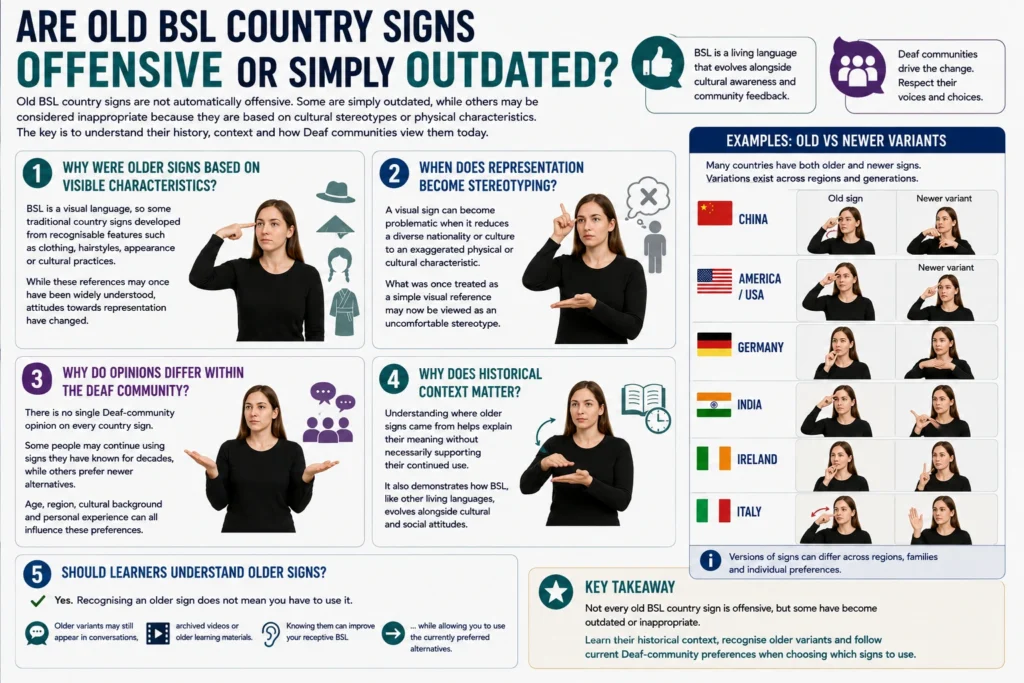
Old BSL country signs are not automatically offensive. Some are simply outdated, while others may be considered inappropriate because they are based on cultural stereotypes or physical characteristics. The key is to understand their history, context and how Deaf communities view them today.

Why Were Older Signs Based on Visible Characteristics?

BSL is a visual language, so some traditional country signs developed from recognisable features such as clothing, hairstyles, appearance or cultural practices. While these references may once have been widely understood, attitudes towards representation have changed.

When Does Representation Become Stereotyping?

A visual sign can become problematic when it reduces a diverse nationality or culture to an exaggerated physical or cultural characteristic. What was once treated as a simple visual reference may now be viewed as an uncomfortable stereotype.

Why Do Opinions Differ Within the Deaf Community?

There is no single Deaf-community opinion on every country sign. Some people may continue using signs they have known for decades, while others prefer newer alternatives. Age, region, cultural background and personal experience can all influence these preferences.

Why Does Historical Context Matter?

Understanding where older signs came from helps explain their meaning without necessarily supporting their continued use. It also demonstrates how BSL, like other living languages, evolves alongside cultural and social attitudes.

Should Learners Understand Older Signs?

Yes. Recognising an older sign does not mean you have to use it. Older variants may still appear in conversations, archived videos or older learning materials. Knowing them can improve your receptive BSL while allowing you to use the currently preferred alternatives.

Key takeaway: Not every old BSL country sign is offensive, but some have become outdated or inappropriate. Learn their historical context, recognise older variants and follow current Deaf-community preferences when choosing which signs to use.

Why Are There Different BSL Signs for the Same Country?

Different BSL signs can exist for the same country because British Sign Language has regional dialects, generational differences and international influences. Like spoken language, BSL naturally varies between communities and changes over time.

Regional and Generational Differences

Signers from different UK cities may prefer different signs for the same country. Age can also influence usage, as older signers may use traditional variants while younger signers adopt newer ones.

International Influence

Greater international contact through travel, Deaf communities, education and online communication can introduce alternative country signs into BSL. Some of these variants may gradually become more widely used.

Is a Different Sign Wrong?

Not necessarily. A less common sign is not automatically incorrect. It may simply be a regional, generational or older variant that remains familiar within particular Deaf communities.

🗺️ Visual idea: Add a small UK map showing different regional sign variants, with the caption: “Where you learn and use BSL can influence which sign variant you encounter.”

Key takeaway: BSL variation is natural. The sign someone uses may reflect their region, generation, community and exposure to other sign languages.

Are-BSL-Country-Signs-Becoming-More-International

Are BSL Country Signs Becoming More International?

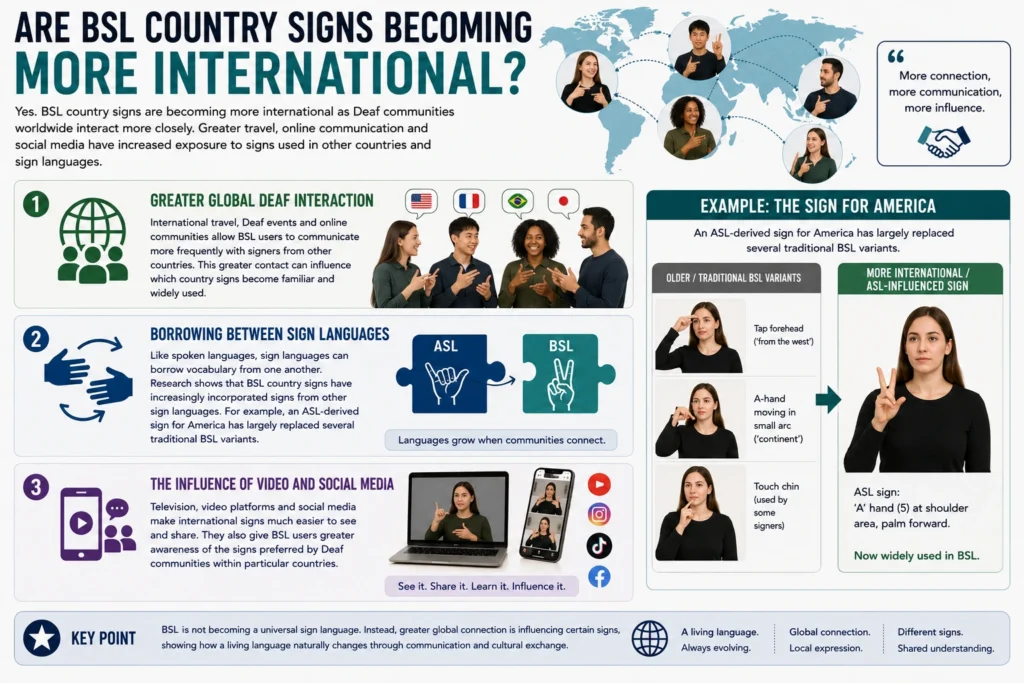
Yes. BSL country signs are becoming more international as Deaf communities worldwide interact more closely. Greater travel, online communication and social media have increased exposure to signs used in other countries and sign languages.

🌍 Greater Global Deaf Interaction

International travel, Deaf events and online communities allow BSL users to communicate more frequently with signers from other countries. This greater contact can influence which country signs become familiar and widely used.

🔄 Borrowing Between Sign Languages

Like spoken languages, sign languages can borrow vocabulary from one another. Research shows that BSL country signs have increasingly incorporated signs from other sign languages. For example, an ASL-derived sign for America has largely replaced several traditional BSL variants.

📱 The Influence of Video and Social Media

Television, video platforms and social media make international signs much easier to see and share. They also give BSL users greater awareness of the signs preferred by Deaf communities within particular countries.

Key Point: BSL is not becoming a universal sign language. Instead, greater global connection is influencing certain signs, showing how a living language naturally changes through communication and cultural exchange.

How Should You Learn the Current BSL Signs for Countries?

Learn current BSL country signs from Deaf BSL users, qualified teachers and reliable, up-to-date resources. Avoid relying entirely on older books, as BSL evolves and some country signs may change over time.

Learn, Compare and Watch

Pay attention to how Deaf signers use country signs in real conversations. Remember that regional variants are common in BSL, so a different sign does not necessarily mean a wrong sign.

Use BSL SignBank

BSL SignBank is particularly useful because it documents regional variants and their distribution, rather than presenting only one possible sign for every country.

Stay Open to Change

If you encounter an unfamiliar variant, ask respectfully about its use and origin. Most importantly, remain open to learning new forms as BSL continues to develop.

Best approach: Learn → Watch → Compare → Ask → Practise → Keep Updated

Will BSL Country Signs Continue to Change?

Yes. BSL country signs will continue to change because British Sign Language is a living language that evolves with the Deaf community. Greater international communication, social media and cultural awareness can introduce new sign variants and help them spread more widely.

Some regional signs may gradually become less common, while newer variants may gain popularity, particularly among younger generations. However, variation will remain a natural part of BSL, and today’s commonly used signs may change again in the future.

The key takeaway: Rather than memorising a permanently fixed list of country signs, learners should follow and respect current Deaf community usage. Staying open to change is an important part of learning and using BSL respectfully.

FAQs — Signs for countries in British Sign Language have changed

  • Why have some country signs in British Sign Language changed?

  • Some country signs have changed because older signs were considered outdated, culturally inappropriate or potentially offensive. The newer signs aim to reflect how Deaf communities from those countries identify themselves and encourage more respectful communication.

  • Who decided to change the BSL signs for countries?

  • The changes have largely been influenced by Deaf communities and native sign language users. BSL continues to evolve through everyday use, cultural awareness and greater communication between Deaf communities around the world.

  • Which country signs in BSL have changed?

  • Signs for several countries have been updated or are increasingly being signed differently. Rather than relying on older traditional BSL signs, signers may now use signs preferred by the Deaf communities associated with those countries.

  • Why are older BSL country signs considered inappropriate?

  • Some older signs were based on physical features, stereotypes or outdated cultural perceptions. As awareness has grown, many signers have moved towards signs that are more respectful and culturally appropriate.

  • Do I need to stop using the old country signs immediately?

  • It is best to learn and use the currently preferred signs whenever possible. However, you may still encounter older signs, particularly when communicating with people who learnt BSL at a different time.

  • Are the new country signs the same as signs used in those countries?

  • In some cases, BSL users adopt or adapt the sign used by the country’s own Deaf community. These are sometimes called indigenous or endonym signs, although usage can vary between communities and individuals.

Sam Walker

Article by

Sam Walker

Sam Walker is an education specialist and author at One Education, bringing over 4 years of experience in creating practical resources and strategies to support teachers and enhance student learning.

top
Home Courses Search