Concept Artist vs Graphic Designer: Which Creative Career Fits You? (UK Salaries, Skills, Tools)

November 19, 2026 | By Michael Hansen | 9 minutes | 320 Readers

Compare concept art and graphic design in the UK: what each job involves, the tools they share, verified salary data, and a six-question quiz to find your fit.

If you love drawing, design and visual storytelling, two job titles come up again and again: concept artist and graphic designer. Both are creative, both use Photoshop, and both are about communicating ideas visually. But day to day they are very different jobs, with different markets, routes and pressures.

This guide compares the two side by side, using verified UK data where it exists, and saying plainly where it does not. At the end there is a quick quiz to help you work out which suits you.

Explore both creative paths.

Build your Photoshop, Illustrator and graphic design skills with one course bundle. A practical starting point, whichever direction you choose.

The two careers at a glance

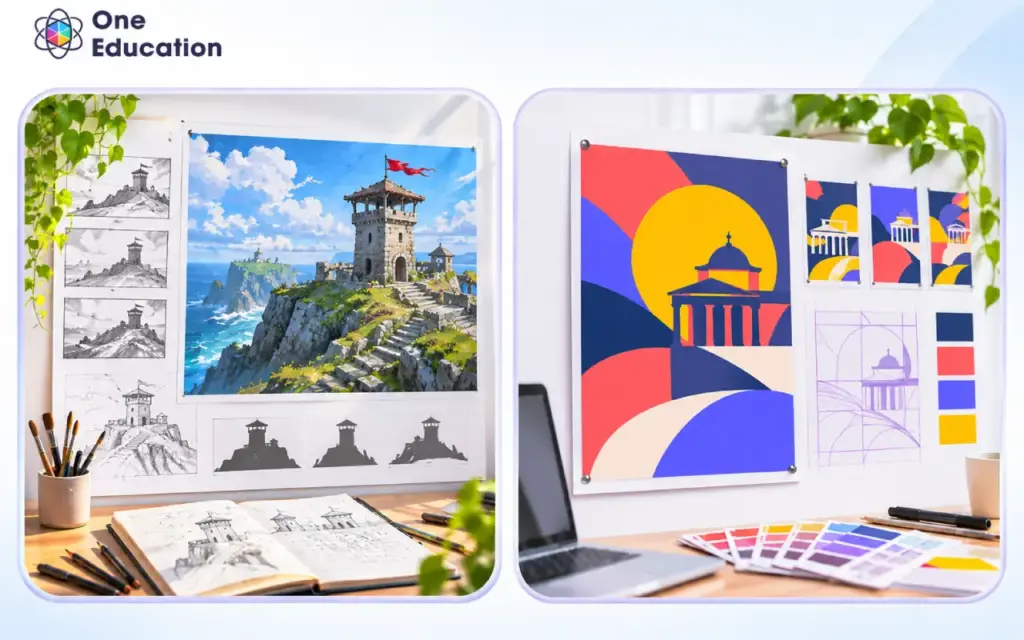
Concept Artist Graphic Designer
Main Job Invent how characters, places and objects look before they are built Communicate a message clearly through layout, type, colour and image
Typical Industries Games, film, TV, animation Almost every industry: brands, agencies, publishing, charities, retail
Typical Output Sketches, paintings, design sheets, mood boards Logos, adverts, packaging, social graphics, reports, websites
Core Tools Photoshop, drawing tablet, often 3D (such as Blender) Illustrator, Photoshop, InDesign, Figma
Number of UK Jobs Small and competitive Large and steady
Verified UK Salary No official figure £25,000 starter to £40,000 experienced (National Careers Service)

What a concept artist does

A concept artist answers the question: what does this look like? Before a game level, film set or character is built, someone has to explore dozens of options quickly and help the team pick one.

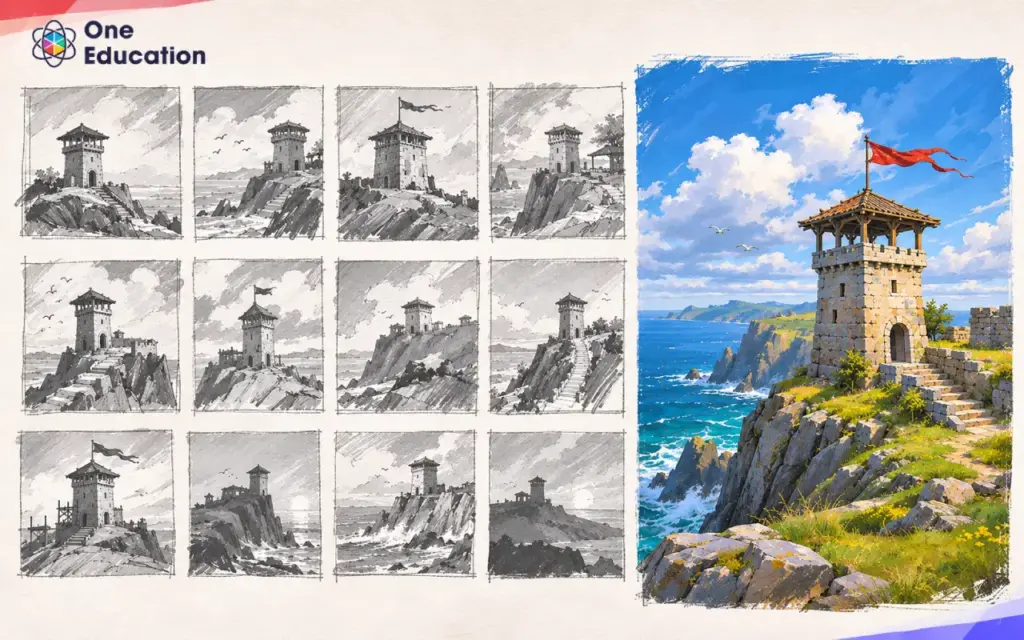
Concept art development sheet showing twelve coastal watchtower sketches alongside a finished colour environment painting.

A typical week might include:

  • Sketching 20 to 50 rough thumbnails of a building, creature or costume
  • Painting a few chosen ideas in more detail
  • Producing “callout” sheets showing an object from several angles for 3D artists
  • Painting key moments to set the mood of a scene
  • Taking feedback from art directors and redrawing, often many times

Speed and range matter more than perfect finish. Concept art is a working tool for a team, not a gallery piece. The best concept artists also understand how things are built, so their designs make sense to the 3D artists who follow them.

The honest picture: concept art roles are relatively few, and most are in games, film and animation studios. Competition is strong and studios expect a high-quality portfolio. TIGA’s 2026 skills report found art was the joint second-hardest discipline for UK games studios to fill (14% of those reporting shortages), but it also found that 82% of new hires were experienced practitioners. In other words, there is demand, but it is mostly for people who can already show professional-level work.

What a graphic designer does

A graphic designer answers a different question: how do we get this message across? The work is about clarity, hierarchy and brand, making sure the right person notices the right thing and understands it fast.

A typical week might include:

  • Designing social media graphics and adverts for a campaign
  • Laying out a brochure, report or menu
  • Creating or applying a brand identity: logo, colours, fonts
  • Preparing files correctly for print or web
  • Presenting options to a client or manager and refining them

Graphic design is broader and more commercial. Nearly every business needs it, which means more jobs, more freelance work and more routes in. You can work in-house for one brand, at an agency with many clients, or for yourself.

The tools both careers share

The good news is that the first skills you learn are the same for both.

  • Adobe Photoshop: painting, photo editing, compositing. Essential for concept art, very useful for design
  • Adobe Illustrator: vector shapes, logos, icons and typography. Essential for graphic design, handy for concept artists creating clean shapes and graphics
  • Drawing fundamentals: shape, value (light and dark), perspective and composition matter in both
  • Colour theory: choosing palettes that create mood (concept art) or stand out clearly (design)

If you are unsure which career you want, learning Photoshop and Illustrator first is a safe bet. It keeps both doors open while you work out where your interest really lies.

UK salaries and demand

For graphic design, there is solid data. The National Careers Service lists a typical salary of £25,000 as a starter, rising to £40,000 when experienced, with typical hours of 37 to 40 a week.

For concept art, we could not find an official or reliable UK salary figure. Pay varies widely between studios, freelance day rates and seniority, so we have not quoted a number. If you are considering this route, check UK studio job adverts and speak to working artists for a realistic picture.

Which fits you? A six-question quiz

Answer each question with A or B.

  1. When you draw, do you prefer (A) inventing creatures, places and characters, or (B) arranging images and words so they look clean and clear?
  2. Would you rather (A) produce 30 rough ideas in a day, or (B) polish one piece until every detail is right?
  3. Do you get more excited by (A) games, films and fantasy worlds, or (B) brands, posters, packaging and books?
  4. Which sounds better: (A) a small number of highly competitive jobs at studios, or (B) lots of options across many industries, including freelance?
  5. Do you prefer (A) painting and rendering, or (B) typography and layout?
  6. Is your dream portfolio (A) a gallery of worlds and characters, or (B) a set of real-looking brand and campaign projects?

Mostly A: concept art is pulling you. Focus on drawing fundamentals, Photoshop painting and fast idea generation. Expect to build a strong portfolio before applying.

Mostly B: graphic design looks like a better fit. Learn Illustrator, typography and layout, and build three to five realistic brand projects.

A mix: you are not alone. Many people work in graphic design while building concept art skills on the side, or move into roles such as key art, illustration or UI design that sit between the two.

Your first 30 days, whichever you choose

  • Week 1: Learn the basics of Photoshop: layers, brushes, selections and adjustment layers.
  • Week 2: Learn the basics of Illustrator: shapes, the pen tool, type and colour.
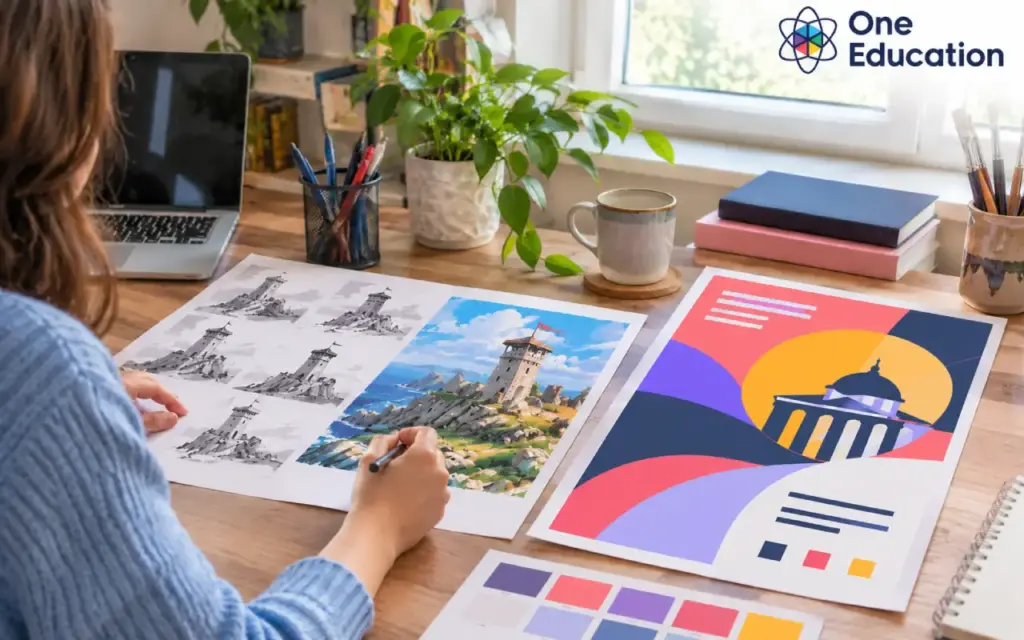
  • Week 3: Make one project for each path: three thumbnail sketches of an original location (concept art) and a poster for an imaginary event (graphic design).
  • Week 4: Finish whichever piece you enjoyed more, then ask two people for honest feedback and revise it.

At the end of the month you will know far more about which path suits you than any article can tell you.

Frequently Asked Questions

Build strong drawing fundamentals, learn Photoshop painting, and create a portfolio of original characters, environments or props shown from idea to final design. Degrees in illustration or games art can help, but studios mainly hire on portfolio quality.

According to the National Careers Service, a typical graphic designer earns around £25,000 as a starter, rising to about £40,000 with experience.

Not formally, but the fundamentals overlap: composition, colour and clear visual communication. Concept artists who can also present ideas cleanly, with good layout and labelling, are easier for teams to work with.

If you lean towards concept art, start with Photoshop. If you lean towards graphic design, start with Illustrator. If you are unsure, learn the basics of both. A bundle course is often the simplest way to do that.

Explore both creative paths.

Build your Photoshop, Illustrator and graphic design skills with one course bundle. A practical starting point, whichever direction you choose.

top
Home Courses Search