Legal Requirements for Phlebotomy in the UK Healthcare Sector

May 18, 2026 | 11 minutes | 31 Readers

If you are considering a career as a phlebotomist in the UK, one of the first questions you will likely encounter is: do you need a licence? It is a fair question. Phlebotomists collect blood samples, work with needles, follow infection prevention procedures, and handle specimens that must be correctly identified and processed. In a healthcare setting, that sounds like a role that should carry formal legal authorisation. The short answer is no — there is no standalone national licence

If you are considering a career as a phlebotomist in the UK, one of the first questions you will likely encounter is: do you need a licence? It is a fair question. Phlebotomists collect blood samples, work with needles, follow infection prevention procedures, and handle specimens that must be correctly identified and processed. In a healthcare setting, that sounds like a role that should carry formal legal authorisation.

The short answer is no — there is no standalone national licence for phlebotomists in the UK. But that does not mean there are no rules. The better question is not simply whether a licence is required, but what the law and the healthcare sector actually expect before someone can perform blood collection professionally.

No Licence — But No Shortage of Rules

When people hear that there is no official phlebotomy licence, they sometimes assume the role is loosely controlled. It is not. Phlebotomy in the UK operates within a regulated healthcare environment where patient safety, infection prevention, accurate documentation, and strict procedure all matter.

The key distinction is this: phlebotomy in the UK is not licence-led — it is competence-led. Employers focus on whether a worker has the right training, supervision, practical ability, and workplace sign-off to perform venepuncture safely. NHS job adverts consistently reference in-house competency packages, formal training programmes, and structured supervision as core requirements — not a licence.

What the Law Actually Requires

There is no single statute that states “You must hold a phlebotomy licence.” Instead, the legal framework is built on broader health and safety obligations that apply directly to clinical roles.

Health and Safety at Work etc. Act 1974 — Under Section 2, employers must ensure, so far as is reasonably practicable, the health, safety, and welfare of their employees. This includes providing appropriate information, instruction, training, and supervision. The Health and Safety Executive (HSE) recognises this Act as the cornerstone of workplace health and safety legislation in Great Britain.

Management of Health and Safety at Work Regulations 1999 — These regulations go further by requiring employers to take employees’ capabilities into account before entrusting them with tasks. In plain terms, a healthcare employer should not permit someone to perform phlebotomy unless they are suitably prepared to do so safely.

In a phlebotomy setting, these legal duties translate into clear, practical responsibilities:

  • ♦  Ensuring staff are adequately trained before performing blood draws
  • ♦  Supervising those who are still developing their skills
  • ♦  Assessing whether individuals are competent to carry out venepuncture safely
  • Implementing safe systems of work for sharps handling, specimen management, and patient care

So while there is no national licensing requirement, the law places a clear and enforceable responsibility on employers to ensure that clinical tasks are only carried out by properly prepared staff. This is why NHS employers typically structure phlebotomy roles around formal training, supervised practice, and competency assessments.

Sharps Safety and Clinical Governance

Under HSE guidance on needlestick and sharps injuries in health and social care, most sharps-related incidents can be prevented through proper training, safer systems of work, and correct use of equipment. In practice, this creates clear expectations for anyone working in phlebotomy:

  • ♦  Following approved blood collection procedures at all times
  • ♦  Safe and immediate disposal of sharps after use
  • ♦  Strict adherence to infection prevention and control protocols
  •  ♦  Correct response to exposure incidents or needlestick injuries
  • ♦  Compliance with local clinical and laboratory policies

Sharps injuries are treated as serious occupational hazards, requiring reporting, investigation, and follow-up. Even without a licence, phlebotomy is a safety-critical clinical activity with genuine legal responsibilities attached.

Why Training Matters More Than a Certificate Alone

Why Training Matters More Than a Certificate Alone

Many learners assume that completing a phlebotomy course makes them immediately job-ready. Employers, particularly within the NHS, often see it differently. A certificate can open the door, but practical competence is what helps you step through it.

Strong phlebotomy training builds genuine clinical understanding across several key areas:

  • ♦  Venepuncture technique
  • ♦  Infection prevention and control, including hand hygiene and infection pathways
  • ♦  Patient communication and managing patient anxiety
  • ♦  Specimen handling and labelling accuracy
  • ♦  Sharps safety and waste management
  • ♦  Recognising and responding to adverse reactions, patient distress, or needlestick incidents

Even with solid training, NHS employers typically expect more than course completion alone. Common additional requirements include existing practical competence in venepuncture, willingness to complete in-house competency assessments, recent hands-on experience, and completion of structured supervised clinical practice. The course qualification and the competency assessment work together — neither replaces the other.

Competency Assessment: The Real Gatekeeper

Competency Assessment: The Real Gatekeeper

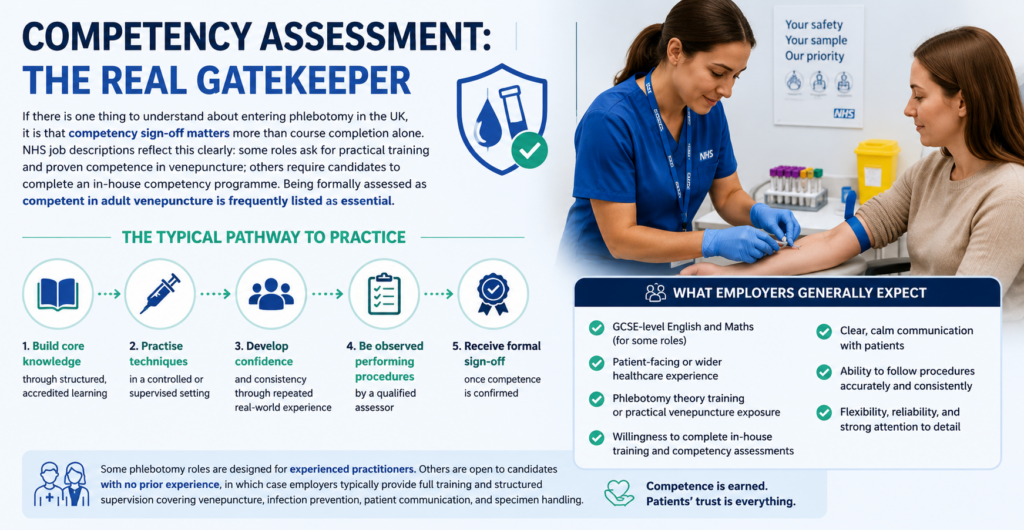
If there is one thing to understand about entering phlebotomy in the UK, it is that competency sign-off matters more than course completion alone. NHS job descriptions reflect this clearly: some roles ask for practical training and proven competence in venepuncture; others require candidates to complete an in-house competency programme. Being formally assessed as competent in adult venepuncture is frequently listed as essential.

The Typical Pathway to Practice

Phlebotomy is not a “learn once, start immediately” kind of role. Most practitioners move through a structured pathway:

  • ♦  Build core knowledge through structured, accredited learning
  • ♦  Practise techniques in a controlled or supervised setting
  • ♦  Develop confidence and consistency through repeated real-world experience
  • ♦  Be observed performing procedures by a qualified assessor
  • ♦  Receive formal sign-off once competence is confirmed

What Employers Generally Expect

While requirements vary between employers and roles, NHS recruitment patterns show some consistent themes:

  • ♦  GCSE-level English and Maths (for some roles)
  • ♦  Patient-facing or wider healthcare experience
  • ♦  Phlebotomy theory training or practical venepuncture exposure
  • ♦  Willingness to complete in-house training and competency assessments
  • ♦  Clear, calm communication with patients
  • ♦  Ability to follow procedures accurately and consistently
  • ♦  Flexibility, reliability, and strong attention to detail

Some phlebotomy roles are designed for experienced practitioners. Others are open to candidates with no prior experience, in which case employers typically provide full training and structured supervision covering venepuncture, infection prevention, patient communication, and specimen handling.

Health Checks, Screening, and Entry Requirements

Health Checks, Screening, and Entry Requirements

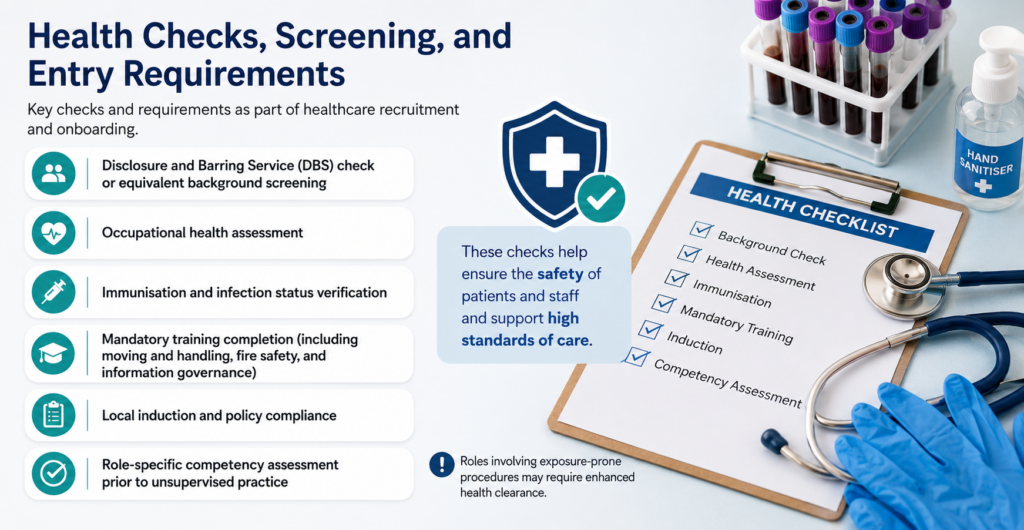
Beyond training and competency assessment, most healthcare employers include additional checks as part of recruitment and onboarding. Depending on the role, these may include:

  • ♦  Disclosure and Barring Service (DBS) check or equivalent background screening
  • ♦  Occupational health assessment
  • ♦  Immunisation and infection status verification
  • ♦  Mandatory training completion (including moving and handling, fire safety, and information governance)
  • ♦  Local induction and policy compliance
  • ♦  Role-specific competency assessment prior to unsupervised practice

Government healthcare guidance also notes that roles involving exposure-prone procedures may require enhanced health clearance. While phlebotomy roles vary in their classification, healthcare recruitment generally involves structured checks to protect both patients and staff. 

In Summary

There is no standalone national licence required to work as a phlebotomist in the UK. However, the absence of a licensing system should not be mistaken for an absence of regulation. Phlebotomy is governed by health and safety law, clinical governance frameworks, and strong employer-led oversight. The expectation of demonstrated competence is real, and in a role involving needles, blood exposure, and patient wellbeing, it carries genuine weight.

For anyone looking to enter the profession, the practical path is clear: invest in structured, accredited training; seek supervised clinical practice; work towards formal competency sign-off; and engage with professional bodies such as the National Association of Phlebotomists (NAP) to demonstrate commitment to the role. Licensing may not be required — but professionalism always is.

Recommended Training Resources

Phlebotomist Training  — Covers blood composition, equipment use, routine venepuncture, dermal puncture, infection control, complications, quality assessment, and specialised collection procedures. Suitable as a foundation before progressing to supervised clinical practice.

FAQs — Legal Requirements for Phlebotomy in the UK Healthcare Sector

1. What does a phlebotomist do?

A phlebotomist collects blood samples from patients using a needle and vacutainer, then labels, documents, and sends specimens to a laboratory for analysis. They also follow infection control procedures, safely dispose of sharps, and communicate with patients to manage anxiety during the process.

2. How long does it take to become a phlebotomist in the UK?

Most people are ready for unsupervised employment within one to six months, depending on the route taken. A short private course takes one to five days, but you will also need supervised clinical practice and a formal competency sign-off before most employers will clear you to work independently.

3. What qualifications are needed to be a phlebotomist in the UK?

There are no qualifications required by law, but most NHS employers prefer at least two GCSEs in English, Maths, and ideally Science, alongside a Level 2 or Level 3 Award in Phlebotomy from a recognised provider. In practice, demonstrated venepuncture competency and a formal sign-off carry more weight than the certificate alone.

4. How much does a phlebotomist earn in the UK?

NHS phlebotomists typically earn between £23,000 and £28,000 per year at Band 2 and Band 3. Senior, specialist, and private sector roles can reach £32,000 to £35,000 depending on experience, location, and responsibilities.

5. Can I work in the NHS with no experience?

Yes — many NHS Trusts recruit trainee phlebotomists and healthcare assistants with no prior clinical experience and provide full in-house training. Completing a phlebotomy theory course beforehand and including any patient-facing or voluntary work on your application will strengthen your chances considerably.

Sam Walker

Article by

Sam Walker

Sam Walker is an education specialist and author at One Education, bringing over 4 years of experience in creating practical resources and strategies to support teachers and enhance student learning.

top
Home Courses Search