Table of Content
Share this Resource


Manufacturing EHS training helps UK production teams understand workplace safety responsibilities. Manufacturing environments involve machinery, hazardous chemicals, heavy equipment and physical handling risks. Understanding these hazards supports safer practices and informed workplace decisions.
Effective EHS awareness also supports environmental management and regulatory compliance. This guide explores essential safety topics and relevant UK legislation. Discover how risk assessments, COSHH and equipment safety relate to manufacturing. Learn about manual handling, fire prevention and workplace incident investigation.
We also explore ISO 14001 and environmental auditing principles. Whether you’re a production worker, supervisor or EHS coordinator, relevant knowledge matters. Online learning offers flexibility around shifts and daily responsibilities. The Manufacturing & Production EHS Bundle brings related safety topics together.
What Is Manufacturing EHS Training?
Manufacturing EHS training is learning that covers environmental, health and safety duties on production sites, including risk assessment, COSHH, manual handling and incident investigation.
Rather than treating each subject on its own, it shows how everyday shop-floor decisions affect people, equipment and the environment. Typical topics include:
- Safety management responsibilities and how they are shared across a site
- Hazard identification and risk assessment principles
- Equipment safety, hazardous substances and manual handling
- Working at height, fire safety and emergency awareness
- Accident and incident investigation
- Environmental management and auditing concepts
You may also see it called manufacturing safety training, production EHS training or factory safety training. The names differ, but the aim is the same: safer, better-organised production.
Why Health and Safety Training Matters for UK Production Teams
UK employers must protect the health and safety of the people who work for them. Under the Management of Health and Safety at Work Regulations 1999, that includes assessing risks and acting to remove or control them. Manufacturing EHS training supports knowledge of these duties, although it does not replace workplace instruction or role-specific competence.
There is a practical benefit too. When team leaders, coordinators and maintenance staff share the same safety vocabulary, procedures become easier to write, follow and review. Handovers are clearer, audits are more structured and conversations with managers are more productive.
Key UK laws at a glance
| Law | Why it matters on a production site |
|---|---|
| Health and Safety at Work etc. Act 1974 | Sets the general duties of employers and employees. |
| Management of Health and Safety at Work Regulations 1999 | Requires risk assessment and arrangements to manage risk. |
| Control of Substances Hazardous to Health (COSHH) Regulations 2002 | Covers exposure to hazardous substances. |
| Provision and Use of Work Equipment Regulations 1998 (PUWER) | Covers safe machinery and work equipment. |
| Manual Handling Operations Regulations 1992 | Covers hazardous lifting, carrying and repetitive tasks. |
| Work at Height Regulations 2005 | Covers planning and controlling work at height. |
| RIDDOR 2013 | Covers reporting of certain injuries, diseases and dangerous occurrences. |
Common Production Hazards Teams Should Recognise
Every site is different, but many hazards appear again and again. Moving machinery and poor guarding stand out, particularly during setup, cleaning and maintenance. Hazardous substances, such as solvents, cleaning agents or process chemicals, add risks that are not always visible. Heavy, awkward or repeated lifting causes strain over a shift.
Other hazards come from the way work is organised: cluttered walkways, rushed changeovers, unclear shift handovers and last-minute schedule changes. Good manufacturing EHS training teaches learners to look at the whole picture, meaning the task, the equipment, the environment and the people involved.
Naming hazards clearly lets teams raise concerns earlier, write better risk assessments and agree practical controls. That shared awareness is why many organisations choose structured learning for team leaders, coordinators and maintenance colleagues.
Risk Assessment: Where Manufacturing EHS Training Starts
Almost every other topic builds on risk assessment. The Health and Safety Executive guidance on risk assessment sets out three basic actions: identify the hazards that could cause injury or illness, decide how likely harm is and how serious it could be, and act to eliminate the hazard or control the risk.
On site, that might mean assessing a new line layout, a changed material or a task done differently on nights. Learners explore how these situations are assessed and documented. They also explore wider safety management ideas, such as who is responsible for what and how procedures are communicated. For a step-by-step walkthrough, read our guide to risk assessment in manufacturing.
COSHH, Equipment and Manual Handling on Site

These three topics cover much of what production colleagues handle every day.
Equipment safety. Learners explore guarding, safe use of machinery and how portable appliance testing (PAT) and risk assessment support equipment safety. This matters for operators and for maintenance and facilities staff.
COSHH. The HSE guidance on COSHH explains that employers must plan, manage and monitor the substances hazardous to health in their workplaces. Learners cover the thinking behind this: identifying substances, understanding exposure and recognising common controls. Our guide to COSHH training goes deeper.
Manual handling. The HSE guidance on manual handling says employers should avoid hazardous handling where reasonably possible, assess the tasks that remain and reduce the risk as far as is reasonably practicable. Manufacturing EHS training helps learners spot where lifting, carrying and repetitive tasks create risk. See also our guide to manual handling in manufacturing.
Working at Height, Fire and Emergency Awarenes
Some of the most serious situations are the ones teams hope never to face, so planning and awareness matter.
Working at height. Maintenance on overhead equipment, loading racks or roof access carry their own risks. Learners meet the principles of assessing and planning such work, and the HSE guidance on working at height is a useful reference for the wider legal picture. Our guide to working at height safety adds production examples.
Fire and emergency planning. Training explores why clear procedures, regular checks and well-understood roles matter when something goes wrong.
First-aid awareness. Manufacturing EHS training can build awareness of workplace first aid and emergency response. Awareness is not competence, though. Completing awareness learning alone does not make someone a workplace first aider, so check your workplace’s own training requirements first.
Learning from Incidents: Root Cause Analysis
When something goes wrong, the goal is to learn from it, not just record it. Manufacturing & Production EHS Bundle introduces accident investigation principles: gathering facts, understanding what happened and working out why.
A key idea is root cause analysis. Instead of stopping at the obvious cause, such as operator error, it asks which conditions allowed the incident to happen. That might be unclear procedures, poor layout, missing guarding or rushed handovers. This topic is especially useful for EHS coordinators, supervisors and quality teams, who often gather evidence, write up findings and follow up actions. Useful questions include what happened, which controls failed, what must change and who owns each action.
Environmental Management and ISO 14001 Basics
The E in EHS is easy to overlook, yet production sites handle waste, energy, emissions and materials every day. Manufacturing EHS training links environmental management with occupational health and workplace safety, so learners see how all three shape production decisions.
A central topic is ISO 14001:2015, the international standard for environmental management systems. Learners meet its main concepts and how environmental auditing checks that a system is working as planned. You do not need to be an auditor to benefit, because knowing the language helps operations and quality teams contribute to audits and improvements. For example, a team that understands waste and energy controls can spot spills, leaks and unnecessary use sooner. Read our explainer on ISO 14001 training.
Who Needs Manufacturing EHS Training?
It suits individual learners and teams building more structured EHS practices. These roles often benefit most:
| Role | How the learning helps |
|---|---|
| Production team leaders | Strengthens knowledge of hazards, risk control and safety management responsibilities. |
| New EHS coordinators | Connects incident investigation, risk assessment and environmental management (see how to become an EHS coordinator). |
| Maintenance and facilities staff | Builds understanding of machinery, portable appliances and hazardous substances. |
| Operations and quality teams | Links safety management and environmental auditing to site procedures. |
If you are planning a longer-term move, training can support your development alongside real experience. Roles such as health and safety adviser, production manager or environmental consultant usually also ask for experience, competence and sometimes formal qualifications. Training does not guarantee a job, promotion or salary. Read more about health and safety careers in manufacturing.
Putting Your Learning into Practice on Site
Learning helps most when it changes everyday conversations. Use it to prepare plain-language shift briefings, to review an existing risk assessment and ask whether it still matches the task, or, after a near miss, to ask better questions than “who made the mistake?”. Environmental topics help too: understanding how auditing works makes it easier to gather evidence and follow up actions after an internal review.
Try one topic a week: walk your area with a single hazard in mind, then note one improvement to raise at the next team meeting. Always follow your organisation’s procedures, and speak to your manager or EHS lead before changing a process. Remember that manufacturing EHS training supports knowledge, not authority.
Shift handover safety checklist
- Which machines are guarded, isolated or out of service?
- Are any hazardous substances open, spilled or newly delivered?
- Which tasks have changed since the last risk assessment?
- Are walkways, exits and fire equipment clear?
- Have near misses and incidents been reported and passed on?
How to Choose Online Manufacturing EHS Training
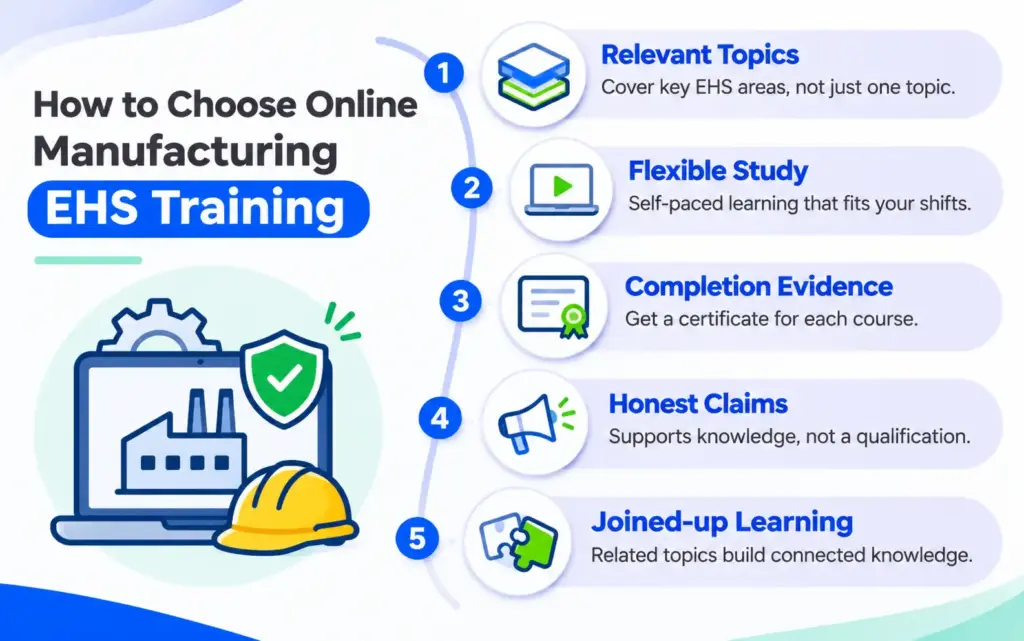
Not every online option suits a production schedule. Look for these points:
- Relevant topics. Check that the learning covers risk assessment, equipment safety, COSHH, manual handling, incident investigation and environmental management, not only one narrow area.
- Flexible study. Self-paced learning with a generous access period lets you keep going when shifts change. A regular slot of twenty or thirty minutes after a shift often works better than one long session.
- Clear completion evidence. Look for a completion certificate for each course, and be clear that it is not a regulated qualification.
- Honest claims. Training that supports knowledge is useful, but no course alone makes you qualified for an EHS role or a workplace first aider.
- Joined-up learning. Related topics bought together make it easier to build connected knowledge than collecting single courses one by one.
For more on what to compare, see our guide to online EHS training.
Single Courses vs a Bundle
When comparing manufacturing EHS training options, this is how separate courses and a bundle differ in practice.
| What to compare | Separate courses | A bundle |
|---|---|---|
| Topic coverage | You search for and choose each topic yourself. | A planned set of connected topics. |
| Joined-up learning | Topics can overlap or leave gaps. | Safety, health and environment linked together. |
| Access period | Can differ from course to course. | One access period for everything. |
| Certificates | Collected from several places. | A PDF completion certificate per completed course. |
| Effort to compare | Many providers and pages to review. | One purchase decision. |
A bundle is not always the right choice. If you only need one narrow topic, a single course may be enough. If you need joined-up knowledge across a site, a bundle is usually simpler to manage.
The Manufacturing & Production EHS Bundle
The Manufacturing & Production EHS Bundle brings 14 courses together as one learning path. It connects workplace safety training, incident investigation and environmental management topics, with 12 months’ access to self-paced online learning so you can study around your shifts and personal commitments.
Through the bundle, learners can:
- Explain safety management responsibilities within manufacturing and production environments
- Identify workplace hazards and describe risk assessment principles
- Recognise equipment safety, COSHH and manual handling considerations
- Understand working-at-height risks and fire emergency planning principles
- Describe first-aid awareness and workplace emergency response considerations
- Explain accident investigation and root cause analysis principles
- Understand ISO 14001:2015 environmental management and auditing concepts
- Recognise how PAT and risk assessment support equipment safety
Each completed course includes a PDF completion certificate, provided you meet that course’s completion requirements. These certificates do not confer a regulated professional qualification.
Ready to build your manufacturing EHS training in one place? Enrol in the Manufacturing & Production EHS Bundle today.
Final Thoughts
Manufacturing EHS training helps UK production teams connect risk assessment, equipment safety, incident investigation and environmental management into one clear picture. It will not replace on-site instruction or experience, but it gives teams the knowledge to take part in safer, better-organised production.
If you want all of these topics in one place, with 12 months’ access to study around your shifts, the Manufacturing & Production EHS Bundle is a practical place to start..
FAQs About Manufacturing EHS Training
EHS stands for Environment, Health and Safety. These areas cover environmental protection, employee wellbeing and workplace safety. Manufacturing EHS training explores how these responsibilities connect.
UK employers must provide suitable health and safety training. Requirements depend on workplace risks and employee responsibilities. Online EHS courses may support broader workplace training needs.
Requirements vary by employer, industry and job responsibilities. Some roles request NEBOSH, IOSH or relevant professional qualifications. Practical experience and workplace knowledge are also important.
Common hazards include machinery, chemicals, noise and manual handling. Slips, trips, electrical risks and fire hazards also matter. Risk assessments help identify suitable workplace control measures.
EHS means Environment, Health and Safety. HSE commonly means Health, Safety and Environment in workplace management. In the UK, HSE also refers to the Health and Safety Executive.
Many introductory online courses accept learners without previous EHS experience. Beginners can explore safety principles and common manufacturing hazards. Check individual course requirements before enrolling.
Companies can review hazards and conduct regular risk assessments. Staff training, equipment maintenance and incident reporting also support safety. Regular reviews help identify areas requiring further attention.
Related Articles

 Nov, 21, 2026