Best Phonics Courses for Teaching Assistants

November 25, 2026 | By Michael Hansen | 14 minutes | 366 Readers

Looking for the best phonics course as a teaching assistant? See what good training covers, how to compare online options and what a phonics certificate means.

rating

Bestselling Course

View Details 95% OFF

Supporting children as they learn to read requires more than recognising letters and sounds. Teaching assistants need to understand how phonics works, how children develop decoding skills and how to provide consistent support during reading activities.

A phonics course for teaching assistants can help develop these skills, whether you’re preparing for your first classroom role or already supporting pupils in a primary school.

The best phonics courses cover essential reading skills, practical classroom techniques and methods for supporting different learners. However, the right choice depends on your experience, the school’s teaching approach and the type of training you need.

This guide explains what makes a good phonics course for teaching assistants, how different training options compare and what to check before enrolling.

Comparing phonics courses? Use our 7-point checklist to check each one.

Why Is Phonics Training Useful for Teaching Assistants?

Teaching assistants often help pupils practise reading, recognise letter sounds and develop confidence during literacy activities. Without a clear understanding of phonics, providing consistent support can be challenging.

Phonics training helps TAs understand how spoken sounds relate to written letters and how children use this knowledge to read unfamiliar words.

In England, the Department for Education’s reading framework provides guidance on systematic synthetic phonics, early reading instruction and additional support for pupils who need it.

Teaching assistants can apply this knowledge when:

  • Supporting individual pupils during reading practice.
  • Helping small groups blend and segment sounds.
  • Reinforcing phonics activities planned by the class teacher.
  • Observing difficulties and sharing feedback with teaching staff.
  • Encouraging pupils to practise previously taught sounds.

For example, a TA might help a Reception pupil blend the sounds /c/, /a/ and /t/ to read cat, using the approach taught by their school.

Primary school teaching assistant helping a pupil blend letter sounds using phonics cards.

Phonics is one part of the broader skill set needed for classroom work. Other important abilities are discussed in the essential teaching assistant skills guide.

What Phonics Skills Should a Teaching Assistant Course Cover?

A useful phonics course should develop both subject knowledge and the practical skills needed to support children’s reading.

Understanding Sounds, Letters and Phonics Terminology

Teaching assistants should feel comfortable using basic phonics terminology.

Important concepts include:

  • Phonemes: Individual sounds in spoken words.
  • Graphemes: Letters or groups of letters representing sounds.
  • Grapheme–phoneme correspondences: The relationships between written letters and spoken sounds.
  • Phonological awareness: Awareness of the sound structure of spoken language.

Understanding these concepts helps TAs follow teaching instructions and explain sounds consistently.

For example, the word ship contains three phonemes, represented by the graphemes sh, i and p.

A beginner-friendly course should introduce terminology through clear examples rather than relying entirely on technical explanations.

Blending, Segmenting and Early Reading Support

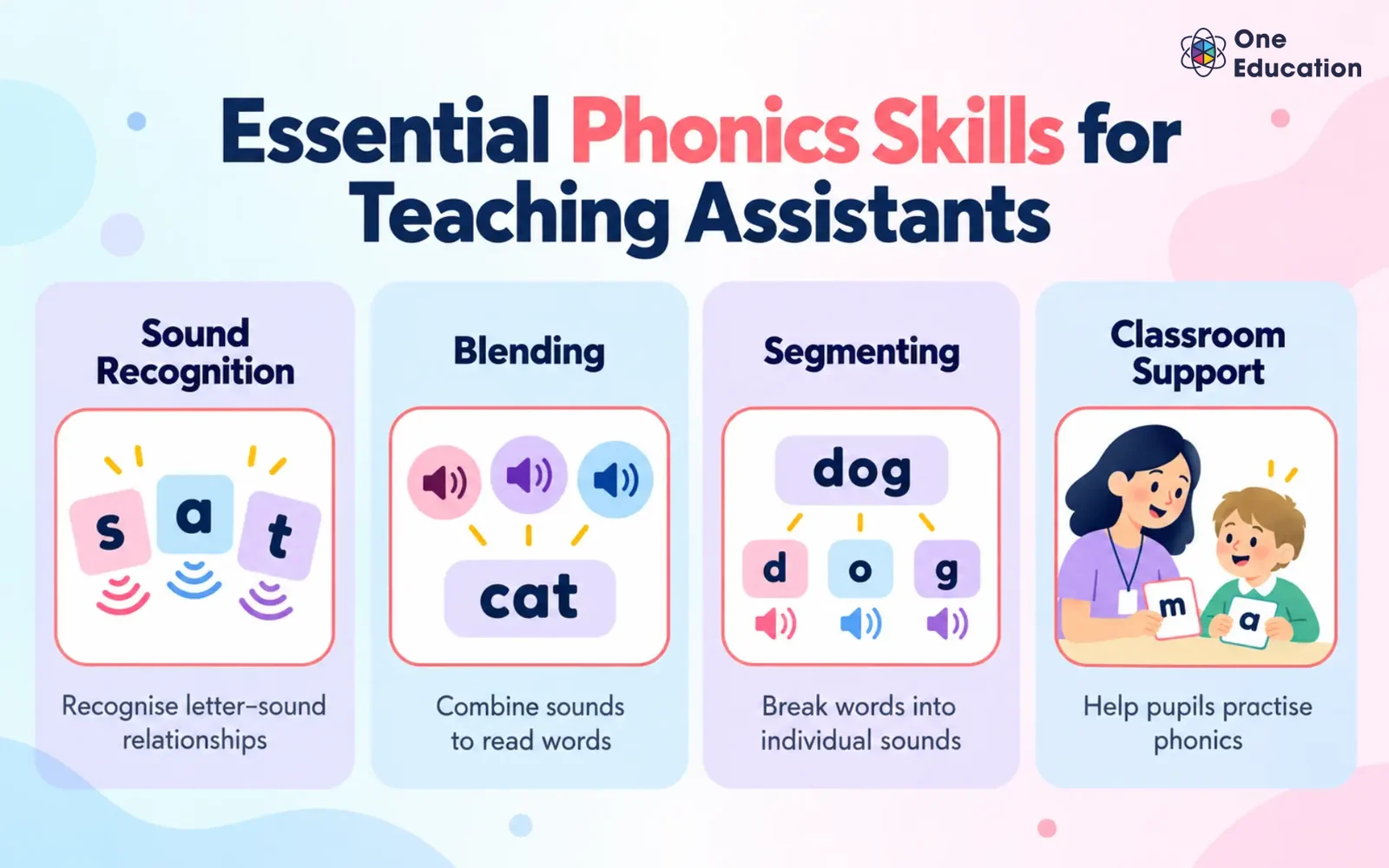
Blending and segmenting are two essential phonics skills.

Blending involves combining individual sounds to read a word. A child might blend /d/, /o/ and /g/ to read dog.

Segmenting involves breaking a spoken word into its individual sounds, which supports spelling.

Teaching assistants should also understand decoding, sound recognition and the use of appropriately matched decodable books.

Training that connects these skills with classroom activities is particularly useful. Understanding a method is important, but knowing how to support a pupil using it makes the learning more practical.

Supporting Pupils Through Classroom Activities

Phonics support should follow the school’s chosen teaching programme and the class teacher’s instructions.

A trained TA may help pupils revisit previously taught sounds, practise unfamiliar words or develop confidence through short reading activities.

Some children need additional practice or a different level of support. Teaching assistants should understand how to follow agreed strategies and communicate observations to the teacher.

For more detailed classroom techniques, readers may benefit from a phonics teaching methods blog.

Infographic showing four essential phonics skills for teaching assistants: sound recognition, blending, segmenting and classroom support.

How to Choose the Right Phonics Course for Teaching Assistants

Not every course suits every learner. Before enrolling, consider your experience, learning goals and the phonics support you expect to provide.

Check That the Course Matches Your Experience

If you’re new to classroom work, look for introductory phonics training that explains sounds, letters, blending and early reading.

Existing teaching assistants may prefer courses covering practical support strategies, assessment and different learning needs.

Experienced practitioners may benefit from more focused training related to their school’s phonics programme.

A course with an advanced-sounding title is not necessarily the best option. Relevant content matters more than impressive terminology.

Review the Course Content and Classroom Relevance

Look beyond the course title and check its learning outcomes.

Useful areas include:

  • Phonics principles and terminology.
  • Blending, segmenting and decoding.
  • Structured teaching approaches.
  • Supporting reading and spelling activities.
  • Recognising when pupils need additional practice.
  • Working with different learning needs.

A course should help you understand how knowledge can be applied, even if practical competence will also require supervised experience.

Consider Online Learning, Flexibility and Assessment

Online phonics training can suit teaching assistants balancing professional responsibilities with further learning.

However, course formats vary.

Some provide self-paced lessons, while others involve scheduled sessions or practical activities. Assessment arrangements and access periods may also differ.

Before choosing a course, check whether you can revisit lessons, how your learning will be assessed and whether the study commitment fits your schedule.

Understand the Certificate Before Enrolling

A certificate may provide useful evidence of professional development, but its value depends on what it represents.

Check who issues it, what assessment is required and whether it is a completion certificate or part of a regulated qualification.

Also check whether certificate fees are included in the course price.

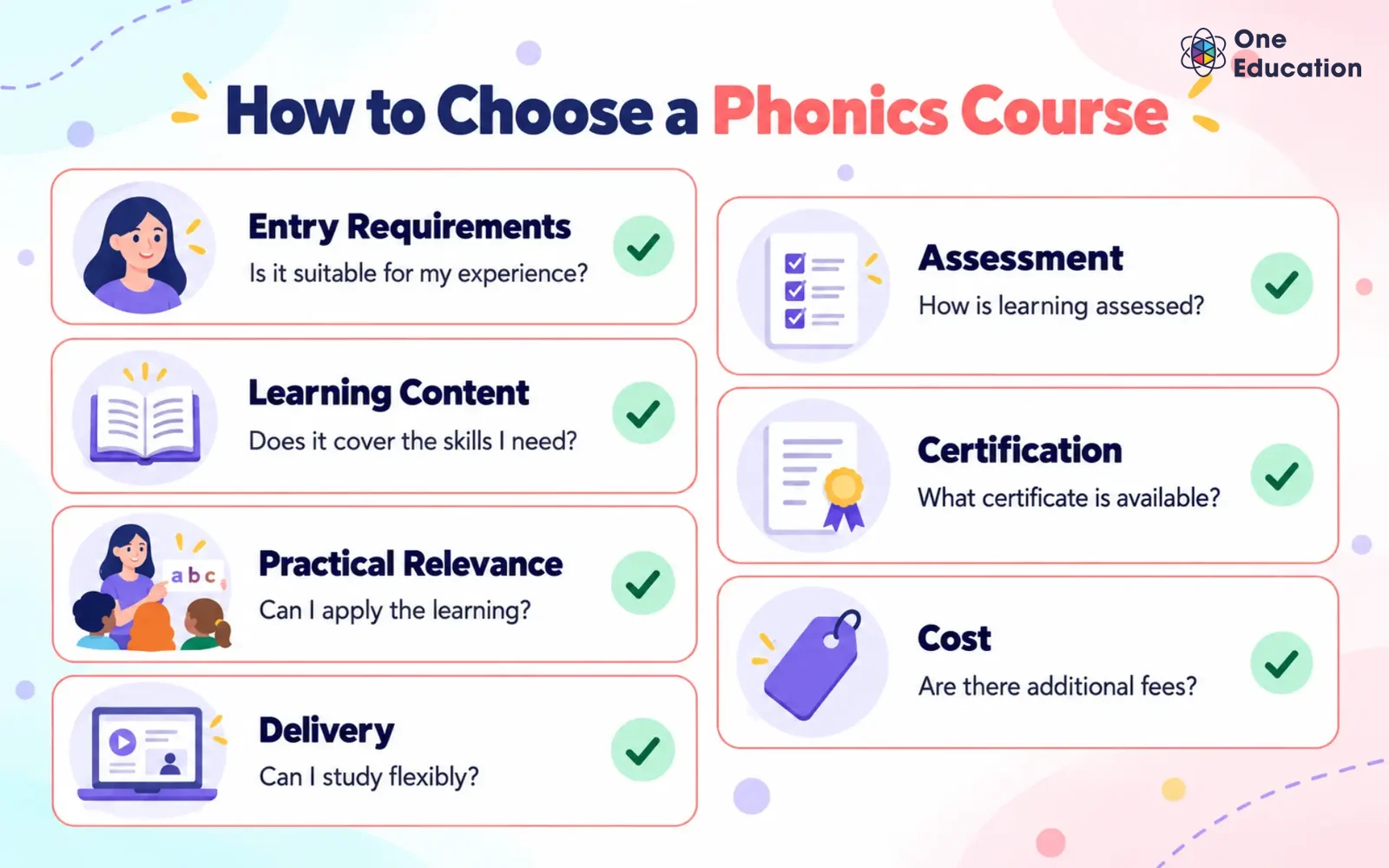
Seven-point checklist for choosing a phonics course, covering entry requirements, content, practical relevance, delivery, assessment, certification and cost.

Phonics course selection checklist

What to checkQuestion to ask
Entry requirementsIs the course suitable for my experience?
Learning contentDoes it cover the phonics skills I need?
Practical relevanceWill it help me understand classroom support?
DeliveryCan I study around my commitments?
AssessmentHow will my learning be assessed?
CertificationWhat certificate will I receive?
CostAre there additional fees?

Using these criteria makes it easier to choose training based on your needs rather than advertising claims.

What Types of Phonics Training Can Teaching Assistants Choose?

Teaching assistants can consider different training options depending on their responsibilities and current knowledge.

Training typeSuitable forMain benefit
Introductory phonics trainingBeginners and aspiring TAsBuilds foundational knowledge
School-specific phonics trainingExisting school staffSupports consistent use of the school’s programme
Online phonics CPD coursesWorking TAs and career changersProvides flexible, structured professional development

If you want to compare training options in more detail before choosing a course, our guide to Phonics Teaching Courses: UK Training Comparison explains the different options available to UK learners.

Introductory courses are useful when you need to understand phonics terminology and basic reading techniques.

School-specific training may be particularly valuable for TAs who need to follow a particular systematic synthetic phonics programme.

Online phonics CPD courses can help learners develop broader knowledge at their own pace.

These are general training options, not formal qualification levels. Some teaching assistants may benefit from combining independent study with guidance from experienced school staff.

Do Teaching Assistants Need a Phonics Qualification?

There is no single phonics qualification required for every teaching assistant position.

In England, schools set their own entry requirements for directly recruited teaching assistants. The National Careers Service teaching assistant profile explains that people can enter the occupation through college courses, apprenticeships, volunteering or direct applications.

Phonics training can complement these routes by developing relevant literacy-support knowledge.

CPD Certificates vs Regulated Qualifications

A CPD course and a regulated qualification are not necessarily the same thing.

CPD training focuses on continuing professional development and improving knowledge or skills.

A course completion certificate generally confirms that a learner has completed specified training or assessments.

A regulated qualification has a formally recognised regulatory status, which should be verified through the relevant awarding organisation or qualification register.

Completing a standalone phonics course does not automatically provide a regulated teaching assistant qualification or qualified teacher status.

If you’re planning a broader career route, a teaching assistant qualifications guide can help explain the training options to investigate.

Is One Education’s Phonics Teaching Course Suitable for TAs?

Adult learner reviewing phonics teaching materials during online professional development study in a UK learning centre.

One Education offers an online Phonics Teaching Course designed for teaching assistants, early years practitioners and others interested in supporting children’s literacy development.

The course covers phonics principles, structured teaching methods, phonological awareness, assessment and supporting children with different learning needs.

It includes approximately five hours and seven minutes of learning material, self-paced online access and a final multiple choice assessment.

After completing the course assessments successfully, learners can obtain a CPD certificate from One Education. The PDF and printed certificate options are available for additional fees.

The course may suit TAs seeking flexible professional development. However, it does not replace a regulated teaching qualification or school-based practical training.

CPD Accredited Online Course

Build Confident Phonics Skills to Support Your Class

Learn phonics principles, structured teaching methods and assessment at your own pace, online.

  • Around 5 hours of self-paced learning
  • Phonological awareness, assessment and SEN support
  • CPD certificate after the final assessment
Save 95%£19.00£425.00
Enrol Now for £19.00 →
Self-paced online accessCPD certificateFinal multiple-choice assessment

Review the current curriculum, entry requirements and certificate arrangements to decide whether they match your goals.

Choosing Phonics Training That Meets Your Needs

The best phonics course for teaching assistants is one that matches your experience, develops useful classroom knowledge and supports your professional goals.

Compare course content, learning flexibility, practical relevance and certificate arrangements before enrolling. Choosing training that complements your school’s approach can help you provide more confident, consistent reading support.

FAQs

Free phonics resources and training opportunities may be available through education organisations or school professional development programmes. Check the learning content, eligibility and whether a certificate is included before choosing an option.

Yes. Some online phonics courses are designed for beginners without formal teaching qualifications. However, entry requirements vary, so check that your chosen course matches your existing knowledge and experience.

Course length depends on the provider, content and delivery method. Some introductory training is relatively short, while broader programmes require more study. Check the learning hours, assessment requirements and access period separately.

Phonics training can demonstrate relevant knowledge and a commitment to professional development. However, it does not guarantee employment or replace the qualifications and experience required by individual employers.

The best phonics course for a beginner covers essential sounds, blending, segmenting and practical classroom support techniques. Look for clear explanations, flexible learning options and suitable assessments. A beginner-friendly course should help you build confidence in phonics before progressing to more advanced training or school-specific teaching methods.

top
Home Courses Search

Chat with us