Phonics Training for Early Years Staff: What to Look For

November 24, 2026 | By William Evans | 12 minutes | 6 Readers

Discover what effective phonics training for early years staff should include, from phonological awareness and teaching techniques to assessment and inclusive learning. Explore essential course features to choose training that supports your professional development and children’s early literacy skills.

Phonics training can make a real difference to how early years staff support children’s first steps towards reading. However, not every course covers the same skills, teaching methods or age groups. Choosing the right training means looking beyond the course title.

Effective phonics training for early years staff should cover sound awareness, phonics terminology, age-appropriate activities, assessment and inclusive teaching approaches. It should also reflect the responsibilities of nursery practitioners, Reception staff and teaching assistants.

Whether you are new to early years education or developing existing skills, knowing what to look for helps you select training that is relevant to your setting and useful in everyday practice.

EYFS and Phonics Teaching Diploma

Build a strong foundation in early childhood education and phonics teaching with practical techniques to support young learners’ development and early literacy. Learn to adapt teaching methods for diverse learning needs, engage parents and develop skills for early years education roles.

What Should Early Years Staff Look for in Phonics Training?

A worthwhile phonics course should offer more than an introduction to letters and sounds. It should build the knowledge and practical skills staff need to support children’s early literacy development.

When reviewing early years phonics training, look for these essential features:

  • Clear phonics knowledge: Explanations of phonemes, graphemes, blending and segmenting.
  • Age-appropriate methods: Activities suited to nursery children and Reception pupils.
  • Practical teaching examples: Opportunities to see how phonics techniques work in real settings.
  • Assessment skills: Guidance on observing progress and recognising learning gaps.
  • Inclusive approaches: Strategies for supporting children with different learning needs.
  • Curriculum relevance: Content that reflects England’s Early Years Foundation Stage (EYFS).

The right balance depends on your responsibilities. A nursery practitioner may need greater emphasis on spoken language and listening, while Reception staff may require more detailed systematic phonics instruction.

Essential Skills a Good Phonics Course Should Cover

Course descriptions often promise improved teaching skills, but the actual curriculum matters more. The following areas are particularly valuable when assessing phonics training for early years practitioners.

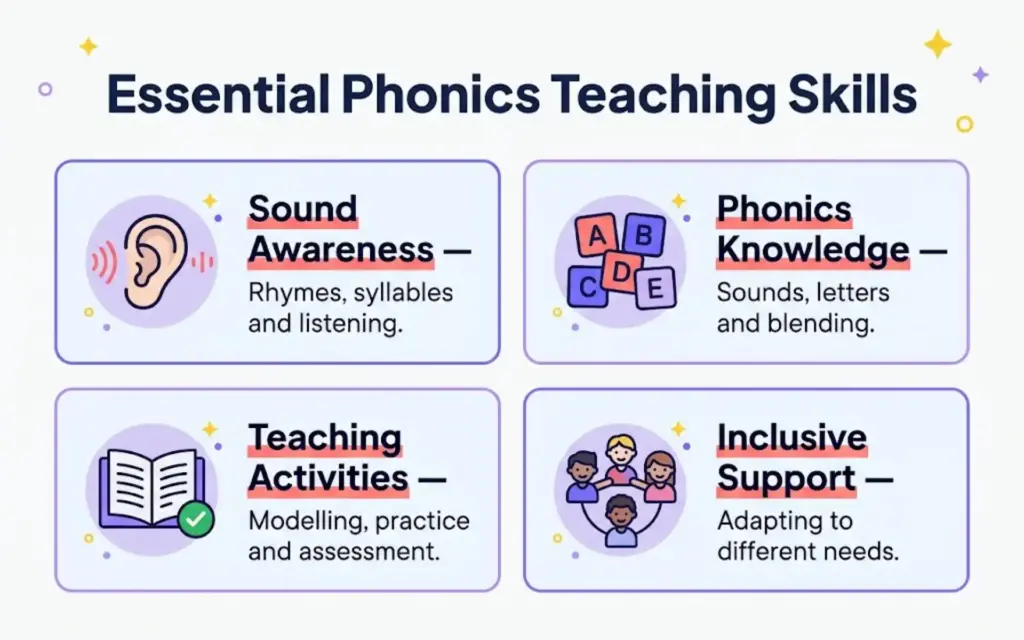
Infographic showing four essential phonics training skills: sound awareness, phonics methods, practical activities and inclusive support.

Phonological Awareness and Early Language Skills

Before children connect letters with sounds, they benefit from developing an awareness of spoken language.

Training should explain phonological awareness, including recognising rhymes, syllables and individual sounds within words. It should also highlight the importance of stories, songs, listening games and everyday conversations.

For example, children might identify words beginning with the same sound or clap the syllables in familiar names.

These activities help develop early listening and language skills without introducing formal reading tasks before children are ready.

Phonics Terminology and Systematic Teaching Methods

Early years staff should feel comfortable using essential phonics terminology.

Useful training should explain:

  • Phoneme: An individual sound in spoken language.
  • Grapheme: A letter or group of letters representing a phoneme.
  • Blending: Combining individual sounds to read a word.
  • Segmenting: Breaking a spoken word into individual sounds, particularly for spelling.

Reception staff should also understand systematic synthetic phonics (SSP), where children are taught sound–letter correspondences in a planned sequence.

According to the Department for Education’s reading framework, systematic synthetic phonics plays an important role in teaching early reading in England.

Good training should explain these principles clearly and show how they connect to classroom instruction.

Practical Teaching Activities and Assessment

Knowing phonics terminology is useful, but staff must also recognise how to apply that knowledge.

Look for training that demonstrates sound modelling, oral blending, appropriate practice activities and ways to check children’s understanding.

For example, during a Reception activity, a practitioner might say the individual sounds /c/ /a/ /t/ and encourage children to blend them into cat.

Training should also explain how observations and assessments can identify children who need additional practice.

The goal is not simply to complete activities but to recognise whether children are developing the intended skills.

Inclusive Phonics Support for Different Learners

Children do not all develop early literacy skills at the same pace. Training should therefore introduce inclusive approaches.

This may include supporting children with special educational needs and disabilities (SEND), helping children who speak English as an additional language (EAL), and adapting explanations or activities where appropriate.

For example, some children may benefit from additional modelling, shorter practice opportunities or carefully chosen visual resources.

Effective phonics training should encourage staff to respond to individual needs while maintaining suitable learning expectations.

However, general phonics CPD should not be confused with specialist diagnostic or therapeutic training.

Should Nursery and Reception Staff Choose Different Phonics Training?

Yes, their training priorities may differ because nursery and Reception staff support different stages of early literacy development.

The EYFS statutory framework sets standards for learning, development and care from birth to five in England. However, staff responsibilities and teaching approaches vary across settings.

Nursery practitioner using listening games and Reception teacher helping children practise letter sounds in UK early years classrooms.
Nursery staff should prioritise Reception staff should prioritise
Spoken language and listening Systematic synthetic phonics
Songs, rhymes and sound awareness Blending, segmenting and decoding
Storytelling and language-rich play Planned phonics progression
Early observation of communication skills Checking phonics knowledge and progress

Nursery practitioners usually benefit from training focused on developing children’s communication and preparing them for later literacy learning.

Reception staff often require more structured phonics knowledge, particularly when delivering or supporting a school’s chosen teaching programme.

Teaching assistants should consider the activities they support and the expectations of their class teacher or phonics lead.

Some practitioners may benefit from broader EYFS knowledge alongside phonics instruction. The differences are covered further in combined or separate EYFS and phonics training.

How to Evaluate a Phonics Training Course Before Enrolling

A course may sound relevant, but its content, delivery and learning outcomes should match your professional needs.

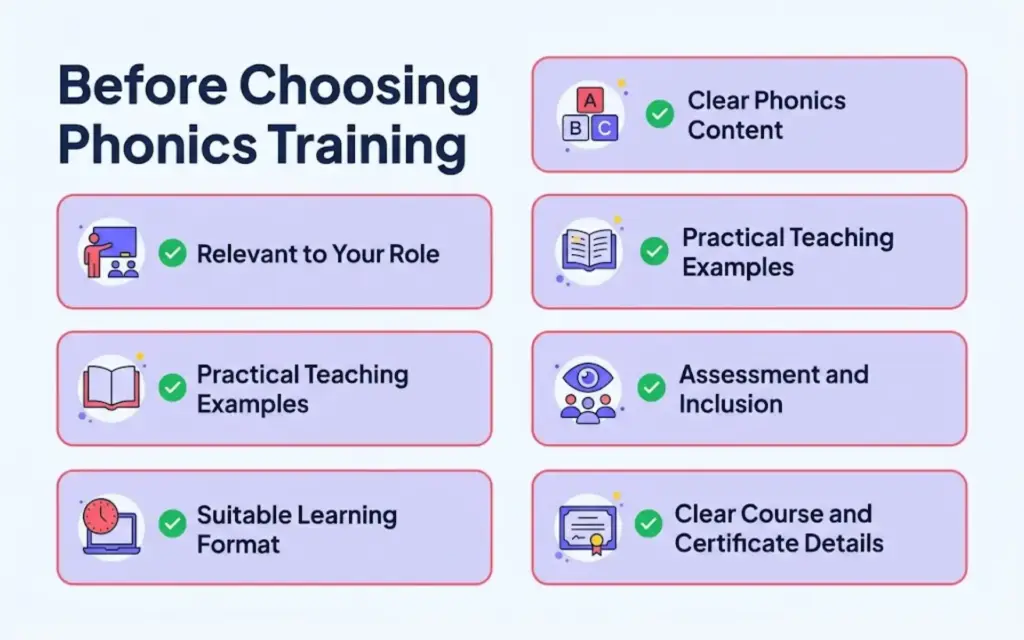
Six-point checklist for choosing phonics training, covering role relevance, course content, teaching practice, inclusion, study format and course credibility.

Use this checklist before choosing online phonics training in the UK.

What to check Questions to ask
Role relevance Does the training suit nursery, Reception or teaching assistant responsibilities?
Course content Are phonological awareness, phonics methods and practical applications covered?
Teaching examples Does the course demonstrate how staff can apply the knowledge?
Assessment and inclusion Will it help you recognise progress and support different learners?
Learning format Can you study at a suitable pace alongside work commitments?
Course credibility Are the provider, learning outcomes, assessment and certificate details clear?

It is also worth checking whether your setting follows a particular systematic synthetic phonics programme.

The DfE guidance on choosing a phonics teaching programme explains the validation process for SSP programmes in England.

Importantly, a validated phonics programme is not the same as an individual staff-training course. Schools are not legally required to choose a programme from the DfE’s validated list, although consistent and systematic teaching remains important.

Cost is another consideration, particularly when comparing course duration, access and learning content. For further information, see EYFS and phonics training costs.

Finally, check what completion evidence you will receive. A CPD certificate may demonstrate professional development, but it does not automatically provide a regulated teaching qualification. Our guide to choosing an EYFS and phonics certificate course covers this distinction in more detail.

A Relevant Training Option: EYFS and Phonics Teaching Diploma

If you want training that combines early years knowledge with phonics teaching techniques, One Education offers an EYFS and Phonics Teaching Diploma.

The online course covers EYFS teaching methods, child development, phonics instruction, speaking and phonological awareness, assessment, parental involvement and supporting individual learning needs.

It is designed for flexible, self-paced study and includes a final multiple-choice assessment. Learners who successfully complete the assessment can obtain a CPD certificate in digital or printed format for an additional fee. 

The course may suit beginners and existing early years professionals looking to develop their knowledge. However, its certificate does not replace qualified teacher status or any regulated qualification required for particular roles.

Conclusion

Choosing suitable phonics training starts with understanding the skills your role requires and how those skills support children’s early literacy.

Good training should strengthen phonics knowledge, provide practical teaching examples and address assessment, inclusion and age-appropriate learning.

Before enrolling, compare course content, learning outcomes and delivery methods with your setting’s needs. The most useful training is not necessarily the longest or most expensive, but the one that helps you apply relevant knowledge with greater confidence.

Develop Your Teaching Skills

Ready to Build Your EYFS and Phonics Teaching Knowledge?

Develop your understanding of early childhood development, EYFS teaching approaches and effective phonics instruction. The EYFS and Phonics Teaching Diploma also explores parent engagement and ways to support children with diverse learning needs.

100% Online Learning Self-Paced Study CPD-Certified Certificate
£29 Current listed price, ex VAT
Explore This Course → Instant access · 14-day money-back guarantee

Frequently Asked Questions

Yes. Systematic synthetic phonics remains an important part of early reading instruction in England, particularly in Reception and Key Stage 1. Education frameworks differ across the UK’s four nations, so specific teaching expectations may vary.

Phonics training can be valuable for nursery practitioners, particularly when it covers language development, listening, rhymes and phonological awareness. Whether specific training is required depends on the practitioner’s role, employer and professional responsibilities.

Teachers typically introduce letter–sound correspondences systematically, helping children blend sounds to read words and segment words for spelling. They use modelling, guided practice, assessment and additional support where necessary.

You can complete phonics CPD training to develop your subject knowledge and receive a course certificate. However, there is no single general phonics certificate that automatically grants qualified teacher status. Formal teaching roles may require recognised professional qualifications.

There is no single programme that is best for every setting. Schools in England should consider their chosen approach, teaching consistency, staff training and pupils’ needs. The DfE publishes a list of validated systematic synthetic phonics programmes to support school decision-making.

top