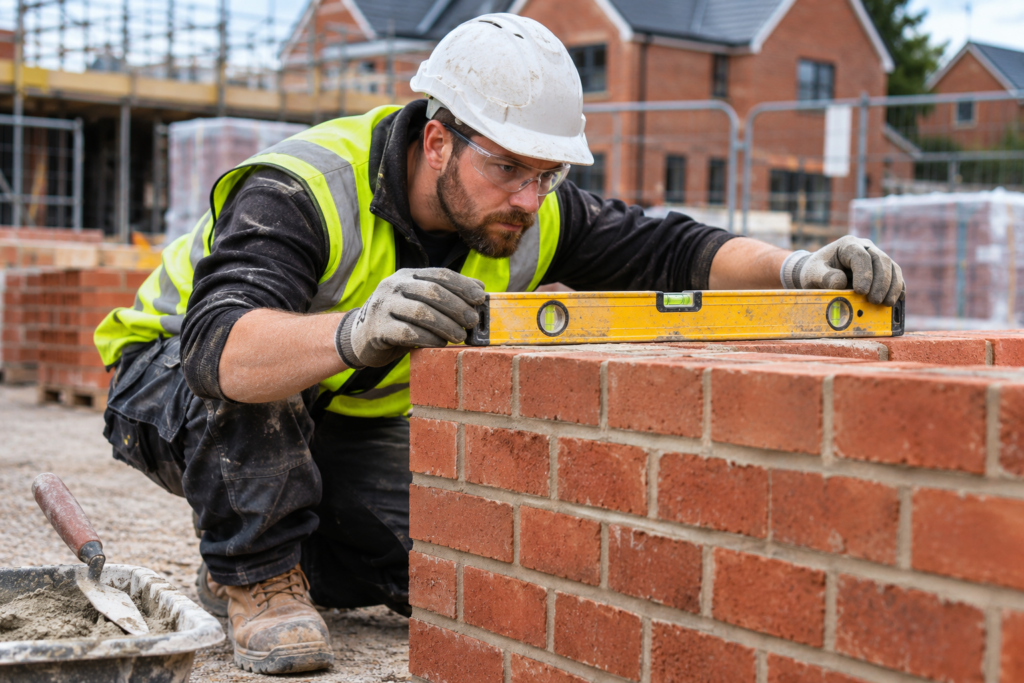
Learning how to become a bricklayer starts with choosing a practical training route. You could take an apprenticeship, study at college or begin in a site-support role and train alongside experienced workers.
The right route depends on your experience, available opportunities and the qualifications employers request. Online learning can introduce trade knowledge and safety subjects, but bricklaying also requires supervised practice and assessment.
This guide explains entry routes, essential skills, site-card considerations and career opportunities. It focuses mainly on England, while recognising that qualifications and apprenticeship arrangements differ across the UK.
What Does a Bricklayer Do?
Bricklayers construct and repair walls and other structures using bricks, blocks and mortar. Work may involve new buildings, extensions, repairs or specialist projects.
Typical activities include:
- Reading drawings and checking dimensions.
- Setting out work accurately.
- Preparing and placing mortar.
- Laying bricks or blocks to the required pattern.
- Checking alignment, level and vertical accuracy.
- Finishing joints and checking completed work.
- Coordinating activities with colleagues and supervisors.
A good result depends on preparation and accuracy. Small errors can affect later work, so checking your work is part of the craft.
Expect a physically active role involving outdoor work and changing site conditions. Before committing, try a supervised practical introduction to understand what the work involves.
How to Become a Bricklayer: Choose Your Entry Route
There is no single route that suits everyone. The National Careers Service describes college study, apprenticeships and progression through work as options.
Take a Bricklaying Apprenticeship
An apprenticeship combines employment with structured training and assessment. It allows you to develop skills in a workplace while studying the knowledge behind the trade.
Look for vacancies with construction companies and specialist bricklaying contractors. Ask how training is delivered, who supervises your work and which qualification or completion award you receive.
In England, a Level 2 bricklaying apprenticeship is an established route. Confirm the current programme duration, assessment arrangements and English and math’s requirements with the employer and provider.
Study at College or a Practical Training Centre
A college course can introduce workshop skills and construction knowledge. Some providers also offer short practical tasters for people considering a career change.
Before enrolling, establish whether the programme includes practical assessment, workplace experience or progression towards an occupational qualification.
Ask what successful learners usually do next. A classroom or workshop certificate does not automatically demonstrate competence across real site conditions.
Start in a Site-Support Role
You may begin as a laborer or hod carrier with a bricklaying team and develop through further training.
Seek an employer who can explain how progression will work. Agree which activities you can observe and practice, who will provide supervision and how your learning will be reviewed.
Simply spending time on site does not guarantee development. Look for opportunities that build relevant skills and provide constructive feedback.
Explore Learning Alongside Your Practical Route
If you want background study alongside workplace or workshop experience, explore the Bricklaying & Masonry Trade Course Bundle.
Compare its seven subjects with your learning needs. Use it to support preparation while planning any separate practical training and qualifications required.
Build the Skills Employers Need
Understanding how to become a bricklayer involves developing accuracy, practical judgement and reliable working habits.
Measurement and Setting Out
You need to interpret dimensions and check positions against the drawing or instructions.
Practise under supervision and learn how errors affect the next stage. Ask for feedback on accuracy before concentrating on speed.
Tool Use and Workmanship
Developing trowel control, consistent joints and accurate positioning takes repetition. Supervised practice helps you recognise problems and correct your technique.
One Education’s Bricklaying course introduces subjects including tools, bonding, basic techniques and joint finishes. Review its syllabus as background learning alongside practical instruction.
Communication and Reliability
Bricklayers work with other trades, site supervisors and delivery teams. Clear communication helps coordinate resources and avoid misunderstandings.
Arrive prepared, follow agreed instructions and report uncertainty promptly. Employers need workers who can recognise when a task requires further guidance.
Reading Conditions and Following Instructions
Materials, access and working conditions can change. Learn how to recognise when the planned method needs review.
Do not make unfamiliar technical decisions simply to keep work moving. Ask the responsible person before continuing outside your competence.
Understand Qualifications and CSCS Requirements
When comparing routes into bricklaying, separate course certificates from occupational competence qualifications and site-access requirements.
A relevant NVQ or SVQ assesses competence against occupational standards. Other courses may provide knowledge, workshop learning or CPD certification.
Many employers and sites request an appropriate CSCS or equivalent scheme card. Check the occupation, qualification and test requirements before paying for training.
The official CSCS qualifications guidance explains that skilled-card applicants need an accepted construction qualification. Some temporary routes depend on registration for an appropriate qualification.
A general labouring card should not be treated as evidence of qualified bricklaying competence. Likewise, completing an online course does not automatically provide a skilled-worker card.
If you already have experience, ask an assessment provider which qualification suits your work. Confirm that you can demonstrate the required activities before enrolling.
How the Seven-Course Bundle Supports Preparation
The Bricklaying & Masonry Trade Course Bundle combines trade knowledge with safety awareness and an introduction to subcontracting administration.
| Course | Relevance to Your Preparation |
|---|---|
| Bricklaying | Introduces trade topics to explore alongside supervised practice. |
| Manual Handling Training | Supports awareness of handling tasks and associated risks. |
| Working at Height Level 2 | Introduces learning relevant to work-at-height awareness. |
| COSHH Training for Assessors | Explores hazardous substances, assessment and control principles. |
| First Aid at Work | Provides first-aid learning to compare with employer requirements. |
| Asbestos Awareness Training | Supports awareness of asbestos-related risks. |
| Construction Industry Scheme (CIS) | Introduces a payment and tax-administration subject relevant to some subcontracting arrangements. |
Choose subjects according to your responsibilities. Not every course corresponds to a requirement for every beginner vacancy.
Before enrolling, check the assessment, certification, access period and complete cost. Do not assume that a course title or level number establishes regulated qualification status.
The bundle does not replace practical bricklaying assessment, an accepted occupational qualification or site-specific instruction.
Ready to review the options? View the Bricklaying & Masonry Trade Course Bundle and match its content to your development plan.
Learn to Work Safely from the Start
Safety knowledge matters throughout your route into bricklaying. Follow the employer’s arrangements and ask for instruction before using unfamiliar equipment or methods.
Handling Bricks, Blocks and Materials
Handling risks depend on the load, task, working position and environment. Consider how work can be organised and what suitable assistance or equipment is available.
For related background learning, review Manual Handling Training. Apply learning through the workplace’s task-specific assessment and instructions.
Dust and Hazardous Substances
Cutting or disturbing construction materials can create harmful dust. HSE’s construction-dust guidance explains why exposure needs effective control.
Use the assessed methods and equipment provided for the task. Do not assume visible dust is the only concern or that protective equipment alone resolves every risk.
The bundle’s COSHH Training for Assessors covers hazardous-substance topics. Course completion should support learning, rather than automatically being treated as proof of competence for every assessment.
Height, Emergencies and Existing Buildings
Work-at-height learning does not establish competence to use every access system. Obtain the instruction and supervision relevant to your work.
Check whether first-aid responsibilities require practical assessment and a particular certificate. An online course should not automatically be treated as meeting every employer requirement.
Asbestos-awareness learning does not authorise disturbing or removing asbestos-containing materials. Follow site procedures when suspect materials are encountered.
Find Your First Opportunity and Show Your Readiness
Search apprenticeship vacancies, local construction employers and practical training providers. Ask what opportunities exist for beginners and how progression is supported.
Prepare a concise application showing:
- Relevant work or practical learning.
- Reliability and teamwork.
- Examples of following instructions.
- Qualifications held or being studied.
- Willingness to learn and seek guidance.
Use genuine examples from previous employment, education or supervised activities. Explain what you did and what you learned.
At the interview, ask about supervision, typical projects, travel and training arrangements. A clear development route is more useful than a vague promise of future opportunities.
Bricklayer Pay and Career Progression
The National Careers Service lists an indicative annual salary range of £25,000 to £45,000, with typical hours of 40 to 44 per week. Its bricklayer career profile provides broader role information.
Actual earnings depend on experience, location, employment arrangements and available work. Apprentice pay differs from qualified-worker earnings.
If comparing employed work with subcontracting, consider expenses, travel, time without work and administrative responsibilities. A quoted daily rate is not the same as take-home income.
With experience, you may explore supervision, specialist craft work or self-employment. Further responsibilities require appropriate development and evidence of competence.
CIS learning may become relevant to subcontracting plans. It is not a qualification for practising the trade or a substitute for appropriate tax advice.
Plan Your Next Step into Bricklaying
Knowing how to become a bricklayer helps you choose training with a clear purpose. Compare local opportunities, check qualification requirements and prioritise supervised practical development.
Then identify the knowledge you can build alongside that experience. Explore the Bricklaying & Masonry Trade Course Bundle and decide which subjects support your next step.
Frequently Asked Questions
Yes, beginner routes exist. Look for apprenticeships, practical courses or employers offering structured training rather than roles expecting an experienced tradesperson.
The timeline depends on your route, previous learning and assessment requirements. Ask for the full programme schedule, including practical development and final assessment.
Online study can explain concepts and safety subjects. Competent trade work also requires practical instruction, repetition and assessment.
Age alone does not determine suitability. Consider physical demands, finances, training availability and opportunities to gain supervised experience.
Related Articles