Choosing between combined EYFS and phonics training and separate courses can be confusing, particularly if you are starting your journey into early years education.
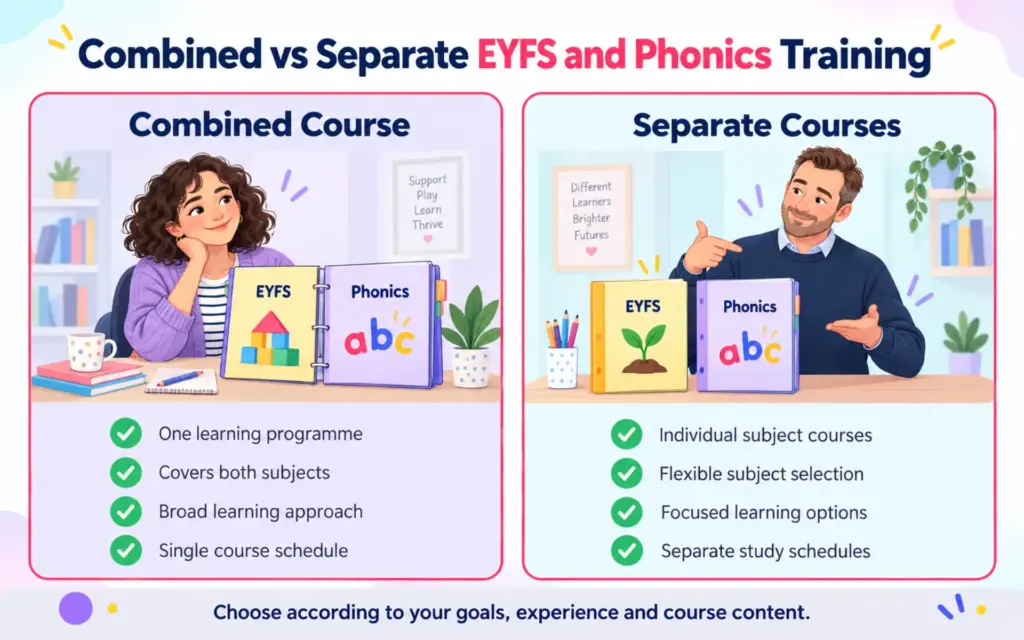
A combined course may suit learners who want to develop knowledge of both subjects through one learning programme. Separate courses may be better for those who need more focused training in a particular area.
The right choice depends on your experience, learning goals, budget and career plans.
This guide compares both options to help you decide which approach best meets your needs.
EYFS and Phonics Teaching Diploma
What Is the Difference Between Combined and Separate EYFS and Phonics Courses?
Combined EYFS and phonics training covers both subjects within one course. Separate training involves studying EYFS and phonics through individual courses, potentially with different providers.
The Early Years Foundation Stage (EYFS) sets standards for children’s learning, development and care from birth to five in England. The EYFS statutory framework explains the requirements that early years providers must follow.
Phonics focuses on relationships between letters and sounds, helping children develop early reading skills.
Although these subjects are connected, they address different aspects of children’s learning.
Combined training introduces both areas through one programme, while separate courses allow learners to select training that addresses individual knowledge needs.
Combined vs Separate EYFS and Phonics Training: Key Differences
The main differences involve subject coverage, learning depth, study arrangements and certification.
| Factor | Combined EYFS and Phonics Course | Separate EYFS and Phonics Courses |
|---|---|---|
| Subject Coverage | Both subjects are covered within one programme. | Each subject has its own dedicated course. |
| Learning Depth | Depth depends on the topics included in the combined curriculum. | Allows learners to choose more specialised subject content. |
| Study Time | One course with a defined learning schedule. | Total study time depends on the duration of both courses. |
| Cost | Usually involves one course fee, although additional costs may apply. | Separate fees apply to each course. |
| Flexibility | Depends on the provider’s study arrangements. | Courses can potentially be completed at different times. |
| Assessment | May include assessments covering both subjects. | Each course may have its own assessment requirements. |
| Certification | Certification depends on the course provider and programme. | Each course has its own certification arrangements. |
| Best Suited To | Learners seeking broad knowledge of EYFS and phonics together. | Learners with specific subject interests or development needs. |
Subject Coverage and Learning Depth
Combined training can help learners understand how early childhood development and phonics instruction relate to one another.
For example, a combined course might introduce early years learning principles before examining phonological awareness, sound recognition and phonics teaching techniques.
Separate courses offer more control over subject selection.
Someone with existing EYFS knowledge could choose a phonics course that concentrates on teaching techniques, assessment or supporting children with different learning needs.
However, separate courses are not automatically more advanced. The syllabus determines how much depth a course provides, not whether it is combined or standalone.
Study Time, Cost and Flexibility
One combined course may be easier to organise because learners follow a single programme.
However, it is not necessarily faster or cheaper.
Two short standalone courses might require less time than one extensive combined programme. Equally, a combined course may avoid repeating introductory material.
Before enrolling, compare total learning hours, fees, assessment arrangements and course access periods. For a closer look at course fees, certificate charges and overall value, How Much Does EYFS and Phonics Training Cost? provides a useful starting point when planning your training budget.
Assessment and Certification
Combined and separate courses may also have different assessment structures.
Some courses award certificates after successful completion of an assessment, while others have different completion requirements.
Having two certificates instead of one does not automatically mean better professional recognition.
What matters is the type of certificate awarded and whether it meets your intended learning or employment requirements.
When Is a Combined EYFS and Phonics Course a Good Choice?
Combined training can be suitable for learners who want to build knowledge across both subjects without choosing separate learning programmes.
Beginners Wanting a Broad Foundation
If you are new to early years education, you may want to understand how children’s development connects with early literacy.
Combined training can introduce EYFS principles alongside phonics concepts, helping you see where the subjects overlap.
The Education Endowment Foundation explains that early years literacy development involves more than phonics alone. Communication, oral language and other literacy activities also contribute to children’s learning.
Understanding this wider context may be useful for beginners exploring early years education or classroom support.
Learners Seeking a Single Study Pathway
A combined course may also appeal to people balancing learning with employment or other commitments.
Instead of researching, enrolling in and managing two separate courses, you follow one programme covering both subjects.
This can make study planning more straightforward, although the experience depends on the provider.
When Might Separate EYFS and Phonics Courses Be Better?
Separate courses can be useful when your learning needs are more specific.
You Already Have EYFS or Phonics Knowledge
Suppose you already work in an early years setting and understand the EYFS framework.
You may not need another introduction to child development or early years learning principles. Instead, you might benefit from focused phonics training.
Similarly, someone familiar with phonics instruction may prefer additional learning about early years development, welfare requirements or inclusive practice.
Separate courses allow you to concentrate on the areas most relevant to your experience.
You Need More Specialist Learning
Some learners want to develop knowledge of a particular phonics approach, assessment technique or aspect of supporting children with additional needs.
A specialist standalone course may address these interests in greater detail.
However, you should examine the curriculum carefully rather than assuming that separate training offers greater depth.
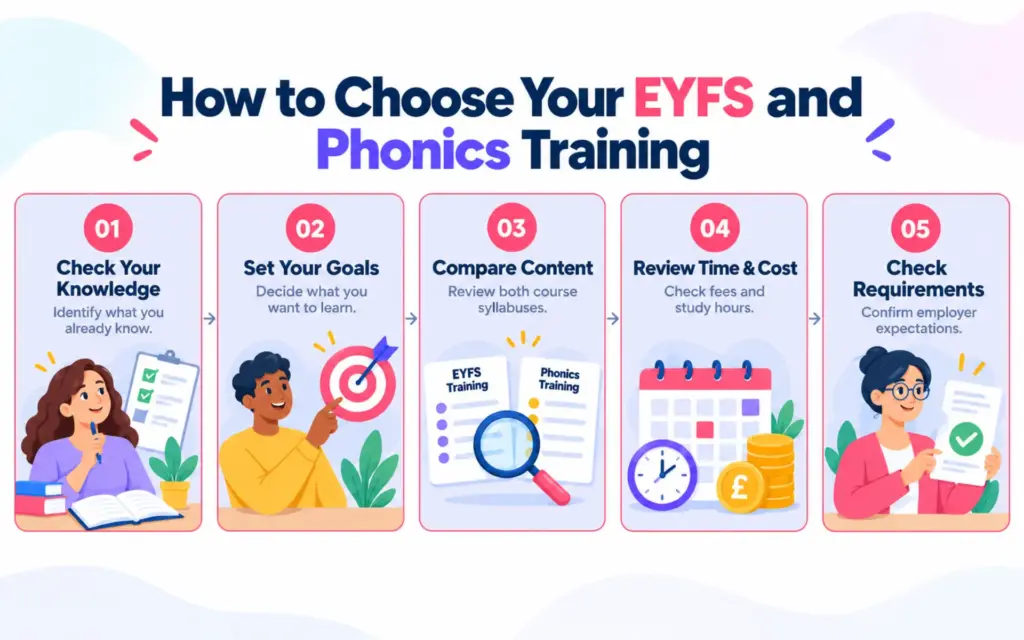
How to Choose Between Combined and Separate Courses.
The best approach is to compare courses against your actual learning needs rather than selecting one based on its title. For additional guidance on reviewing course content, study options and suitability,
1. Identify Your Existing Knowledge
Start by considering what you already understand.
Are you unfamiliar with both EYFS and phonics, or do you have experience in one area?
Beginners may benefit from broader learning, while existing practitioners might prefer focused training.
2. Decide What You Want to Learn
Think about the knowledge you hope to develop.
For example, you might want to understand early childhood development alongside phonics teaching. Alternatively, you might only need additional knowledge of phonics assessment.
Your learning goals should guide your decision.
3. Compare the Course Content
Check the modules before enrolling.
Look for topics that match your interests, including early years development, phonological awareness, phonics teaching methods and supporting individual learning needs.
A course title alone cannot establish how thoroughly those subjects are covered.
4. Review the Total Time and Cost
Compare the complete cost of studying, including any additional certificate fees.
Check the estimated learning hours, access period and assessment requirements.
A cheaper course is not necessarily better value if it does not cover the knowledge you need.
5. Check Your Career Requirements
If you are studying with a particular job in mind, investigate what employers expect.
The National Careers Service outlines several teaching assistant career routes, including college courses, apprenticeships, volunteering and direct applications.
Course completion alone does not guarantee employment or establish eligibility for every education role.
Do Combined or Separate Courses Provide Recognised Qualifications?
Neither combined nor separate training automatically provides a regulated qualification.
It is important to distinguish professional-development courses from qualifications required for particular roles.
A CPD certificate can demonstrate that you have completed relevant learning. However, it does not necessarily satisfy requirements for employment as a qualified teacher or early years practitioner.
In England, certain early years staffing arrangements depend on recognised qualifications.
The Department for Education provides guidance on early years qualifications recognised for staffing ratios.
Before choosing a course, check whether your intended position requires a specific qualification, professional status or practical experience.
Remember that EYFS is the statutory framework for England. Early years education arrangements differ across Scotland, Wales and Northern Ireland.
Whether you complete one course or two, the number of certificates does not determine your professional eligibility.
An Example of Combined EYFS and Phonics Training
For learners interested in studying both subjects together, One Education offers the EYFS and Phonics Teaching Diploma.
The online course covers early childhood development, EYFS teaching techniques, phonics instruction, phonological awareness and supporting different learning needs.
It provides approximately 8 hours and 42 minutes of self-paced learning.
Learners who successfully complete the required assessment are eligible for a CPD-certified certificate, available for an additional fee.
This is a professional-development course, not a replacement for a regulated teaching qualification.
Reviewing its curriculum alongside standalone alternatives can help you decide which format suits your goals.
Final Verdict: Which Training Route Should You Choose?
Combined EYFS and phonics training can be a practical starting point for learners seeking broad knowledge of both subjects. Separate courses offer more flexibility for targeted learning.
Choose the route that matches your current knowledge, learning objectives, budget and professional requirements. The most suitable training is the one that meets your needs, not simply the one offering more subjects or certificates.
EYFS and Phonics Teaching Diploma
FAQs
Combined training may suit beginners who want knowledge of both subjects within one course. Separate courses may be preferable if you already understand one subject or want to focus on a particular skill.
The best option depends on your existing experience and learning objectives.
Not necessarily. Costs depend on course fees, learning materials, assessments and certificate charges.
Compare the total cost of a combined programme with the combined price of the two standalone courses you are considering.
Yes, beginners can consider combined courses designed for learners without previous teaching experience.
Check each provider’s entry requirements, curriculum and assessment methods before enrolling.
Yes, further standalone study may be possible after completing combined training, subject to the course’s entry requirements.
This may be useful if you later identify a particular phonics teaching topic you want to study in greater depth.
Further resources
- Communication And Interpersonal Skills in Food And Beverage Service
- The Importance of Effective Communication in Healthcare
- Effective Communication Skills For Social Workers
- Why is Communication Skills of Physicians Important for Patients' Satisfaction?
- How to Improve Your Interpersonal Communication Skills
- How Do People Develop Cross Cultural Communication Skills?
- Marriage Advice: The 8 Communication Skills of Happy couple
- 10 Essential Communication Skills for Workplace
- 10 Best Assertive Communication Worksheets and Techniques
- How to Tell Someone to Improve Their Communication Skills?
- Different Types Of Communication: Everything You Need To Know
- A Definitive Guide To Basic Interpersonal Communication Skills
- The Importance of Listening Skills in Communication
- 20 Great Jobs to Consider if you have Good Communication Skills
- A Definitive Guide To Basic Interpersonal Communication Skills
- 20+ Effective Communication Skills (Good for a Resume)
Related Articles
Get a FREE Course
- Learn useful skills online free
- Get CPD accredited certificate
- Add it to your CV today!