Construction projects rarely succeed on enthusiasm alone. They succeed on carefully managed budgets, accurate measurements and clear contracts. Quantity surveying sits at the heart of that process, helping teams predict, track and control what a build will cost. If you enjoy numbers, practical problem-solving and working with different people, this could be a rewarding path.
Yet many beginners are unsure where to start, which qualifications employers expect, or how a quantity surveyor differs from an estimator or a contracts manager. This guide answers those questions in plain English, using trusted UK sources rather than guesswork. It explains what a quantity surveyor does, the main quantity surveying requirements in the UK, and the routes into the profession, from degrees and apprenticeships to part-time study. It also shows how construction cost knowledge links to related roles, so you can plan a realistic first step. It is written for beginners, so no prior experience is needed.
Add YoWhat Is Quantity Surveying and What Does a Quantity Surveyor Do?
Quantity surveying is the profession that manages the money side of construction. A quantity surveyor (often shortened to QS) works out the likely cost of materials, labour and time, then monitors spending until the project is complete. The National Careers Service describes quantity surveyors as people who oversee construction projects by managing risks, controlling costs and making sure work is completed on time. You can read the full role description in its official job profile.
Daily tasks can include checking that plans are feasible, measuring drawings, pricing tenders, negotiating contracts and work schedules, checking payment valuations and reporting on finances. A tender is a priced offer to carry out work. A bill of quantities is a detailed list of the materials and tasks a project needs, with amounts attached.
Picture a school extension. Before work begins, the QS measures the plans and estimates the cost. As building continues, they compare the budget with actual spending and flag problems early. They may work for a contractor, a client or a consultancy, and the focus of the job changes slightly depending on who employs them. Whichever employer they work for, accuracy and clear communication are what keep a cost plan trustworthy.
Why Construction Cost Knowledge Matters in the UK
Every construction project has money at stake. Without clear cost control, even a well-designed building can run over budget, fall behind schedule or end in disputes between the people involved. That is why construction cost expertise is valued across housing, commercial, public and infrastructure projects, from small refurbishments to large developments. Clients, lenders and contractors all rely on cost information to make decisions, so reliable figures protect everyone’s time and money.
For beginners, this matters because cost skills are transferable. Someone who understands how a project is priced, measured and paid for can work in very different settings. The same knowledge supports related roles such as estimating, commercial management and contract administration, so you keep your options open as your interests develop.If you are curious but not ready for a full degree, a short structured option such as the Quantity Surveying & Construction Cost Career Bundle can help you learn the vocabulary and basic concepts. It will not replace formal routes, but it can show you whether the work suits you before you commit significant time and money to a longer qualification.
Key Benefits of a Career in Quantity Surveying
One benefit is variety. A quantity surveyor may spend one day in an office reviewing figures and the next on site checking progress against the plan. This mix suits people who like both analysis and practical, hands-on environments, and who prefer not to sit at a desk all week. It is also a role where you keep learning, because every project brings different materials, designs and contract arrangements.
Another is career flexibility. Cost and commercial skills are used by contractors, consultancies, housing providers and public bodies, so you are not tied to one type of employer. Over time, the experience you gain can lead towards senior commercial or contract management positions, depending on your qualifications and goals.
There is also a sense of purpose. Your work helps projects stay fair, financially realistic and well organised, which benefits clients, builders and the people who eventually use the building. Many people also value the visible result: a finished building they helped to deliver. Please remember that no career path offers guaranteed outcomes, and progress depends on your qualifications, experience and local opportunities. Pay is covered later in this guide, using published figures rather than promises.
How to Start a Quantity Surveying Career: 5 Steps
Here is a practical order to follow, though many people move through these steps in a different sequence.
- Understand the basics. Learn what quantity surveyors do and how construction projects are organised, from design and tendering through to building work and handover.
- Check the quantity surveying requirements. The National Careers Service lists routes such as a degree, an apprenticeship or starting as an assistant. Read the entry criteria and decide which fits your circumstances, budget and available time.
- Choose your learning route. Compare degrees, apprenticeships, college courses and flexible online study. A structured introduction to construction management topics can help you build confidence while you decide.
- Practise key skills. Work on measuring from plans, basic costing, spreadsheets and reading simple contracts. Short, regular practice exercises are more effective than occasional long sessions.
- Apply your knowledge. Look for entry-level roles, work experience or trainee posts, ask for feedback, and keep learning as you gain experience.
Keep notes on what you learn at each stage, so you can show employers a clear record of your progress. Progress does not need to be fast to be useful, and steady effort over several months often counts for more than a rushed start.
Skills Every Quantity Surveyor Needs
Core Knowledge
Strong number skills come first. You will need to measure quantities from drawings, estimate costs, understand construction methods and read contract documents with care. Familiarity with spreadsheets and cost software is also useful, because most cost reports are built there.
You should also know the basics of building materials, project stages and health and safety. The National Careers Service notes that the role includes making sure health and safety and building regulations are followed, so awareness of these rules matters from the start. Keeping up to date with construction methods is part of the job too. Beginners often find that practising with real drawings, even simple house plans, makes these skills far easier to remember and apply.
Supporting Skills
Soft skills are just as important. Communication helps you explain costs to clients and site teams in plain language, while negotiation skills help when agreeing prices or resolving disagreements calmly. Attention to detail prevents costly errors, and problem-solving helps you respond when plans or prices change. Teamwork matters because you will work with architects, engineers, site managers and subcontractors. Confidence grows with practice, so treat every small task as useful experience.
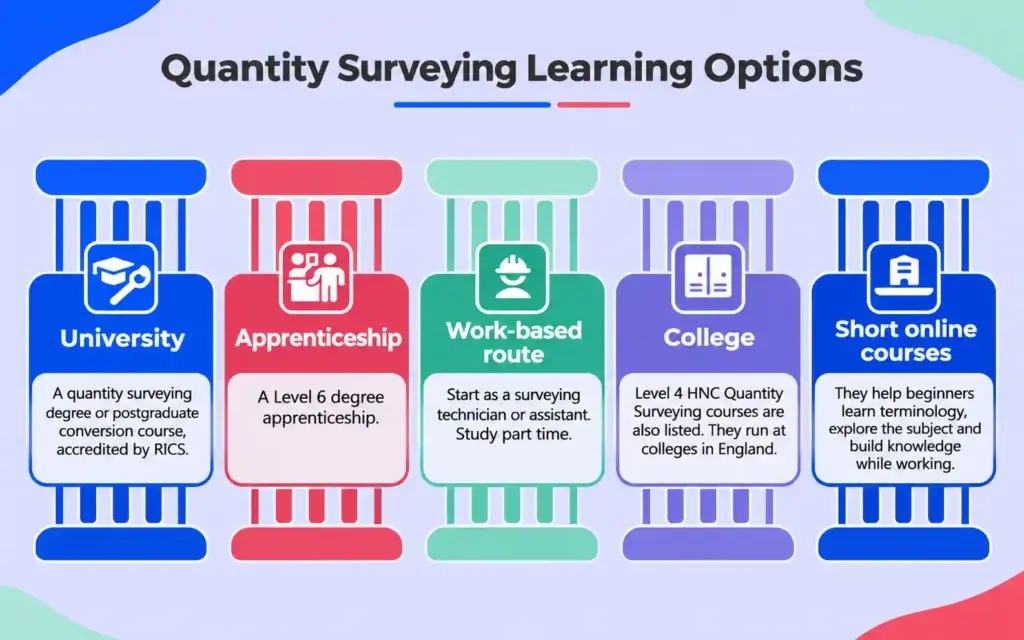
Quantity Surveying Courses and Learning Options
There is more than one way to learn quantity surveying. The Quantity Surveying & Construction Cost Career Bundle from One Education offers structured study in this area. If you are interested in a Quantity Surveying career, explore the bundle to see whether its topics match your goals.
The National Careers Service lists these routes:
- University: A quantity surveying degree or postgraduate conversion course, accredited by RICS.
- Apprenticeship: A Level 6 degree apprenticeship.
- Work-based route: Start as a surveying technician or assistant. Study part time.
- College: Level 4 HNC Quantity Surveying courses are also listed. They run at colleges in England.
Other things to consider:
- Short online courses: Quantity surveying courses can sit alongside these routes. They help beginners learn terminology, explore the subject and build knowledge while working.
- Not a substitute: Short courses should not replace degrees, apprenticeships or professional routes. Some employers expect these.
- Employer expectations: Check what your target employers ask for.
- Comparing options: Weigh cost, study time and entry requirements. Think about work or family commitments.
- Course details: Read the course page before you enrol. It shows the content and any awards.
The right route depends on your goals, time and budget. Compare each option carefully before you decide.
Where Quantity Surveying Can Take You
Quantity surveying skills lead to a range of cost-focused roles. The National Careers Service describes an estimator as someone who works out how much the different parts of a project will cost. It gives average pay of £22,000 for a starter and £40,000 for an experienced estimator, and notes that a CSCS card or equivalent is needed to work on a construction site. Full details are in its estimator profile.
A construction contracts manager oversees the contractual and legal requirements of building projects. The same source gives £30,000 as a starter salary and £70,000 as experienced. For quantity surveyors, it lists £26,000 and £70,000 respectively. You can compare the contracts manager profile for more detail.
These are average figures for guidance only, and actual pay varies by employer, location and experience. Quantity surveyors work alongside construction workers, site managers and design teams, so teamwork is part of everyday life. Realistic limits include pressure near deadlines, the need for ongoing study and the fact that entry routes can take several years. Moves between these roles are common, and many professionals widen their responsibilities as they gain experience and further qualifications. Always check current vacancies and employer requirements, because the job market changes over time.
Tips and Common Mistakes for Beginners
Start by learning to read drawings and measure accurately, because every cost estimate depends on correct quantities. Build a simple glossary of construction terms, and ask questions when you meet unfamiliar language. Speaking to people already working in the field can also give you a clearer picture of daily life than any job description.
A common mistake is ignoring payment rules. If you work with subcontractors, learn how the Construction Industry Scheme (CIS) works. GOV.UK explains that contractors deduct money from a subcontractor’s payments and pass it to HMRC, and that these deductions count as advance payments towards the subcontractor’s tax and National Insurance. The official GOV.UK page explains who must register.
Another mistake is rushing into a route without checking the requirements. Read entry criteria carefully and compare your options before paying for anything. Finally, do not treat estimates as fixed. Review costs regularly, record changes and communicate early when figures move, because small problems are far easier to fix than large ones. Keep a short checklist of the questions you ask on every project, such as scope, budget, timeline and who approves changes. Reviewing it after each task builds good habits.
Final Thoughts on Starting in Quantity Surveying
Quantity surveying offers a clear route into the commercial side of construction for people who enjoy numbers, detail and teamwork. The main quantity surveying requirements depend on the route you choose, so check each option carefully and start with realistic goals. Build your knowledge step by step, and use practical experience to reinforce what you learn. Progress in this field comes from steady learning, so be patient with yourself and celebrate small milestones along the way.
If you would like structured support, One Education offers a Quantity Surveying & Construction Cost Career Bundle that may suit your learning needs. Whichever path you pick, take the first small step today by reading a job profile or exploring a short course.
Frequently Asked Questions
A quantity surveyor manages the costs of a construction project. They estimate quantities and prices, help agree contracts, monitor spending and report on finances, so the project stays within its budget as far as possible. They also advise clients on commercial risks.
Common routes include a quantity surveying degree, a Level 6 degree apprenticeship, or starting as a surveying assistant and studying part time. Entry grades vary, so check the National Careers Service and individual providers.
Yes, there are other routes. The National Careers Service lists apprenticeships and working as a surveying technician or assistant while studying part time. Requirements differ by employer, so confirm what they expect.
They can be useful for learning terminology and testing your interest. Short courses help beginners, but they may not replace the degree or apprenticeship routes some employers ask for. Always check what your target employers require before you enrol on any course.
Related Articles