Best Online Teaching Assistant Courses for Beginners

November 20, 2026 | By Michael Hansen | 30 minutes | 312 Readers

Starting a career in education does not always require previous classroom experience. Choosing the right training, however, can be confusing when courses offer different certificates, qualifications and study options. The best online teaching assistant course for beginners depends on what you want to achieve. Introductory courses can help you develop classroom knowledge, while regulated qualifications may be more appropriate if you want formal recognition. This guide compares the main training options for UK beginners, explains what to check before enrolling

Starting a career in education does not always require previous classroom experience. Choosing the right training, however, can be confusing when courses offer different certificates, qualifications and study options.

The best online teaching assistant course for beginners depends on what you want to achieve. Introductory courses can help you develop classroom knowledge, while regulated qualifications may be more appropriate if you want formal recognition.

This guide compares the main training options for UK beginners, explains what to check before enrolling and helps you choose a course that matches your experience and career goals.

Which Online Teaching Assistant Courses Are Best for Beginners?

There is no single best course for everyone. Some learners want to explore teaching assistant work before committing to a qualification. Others already know they want to work in a school and need training that supports that goal.

Here are the main options worth comparing.

Swipe left to see the full table →

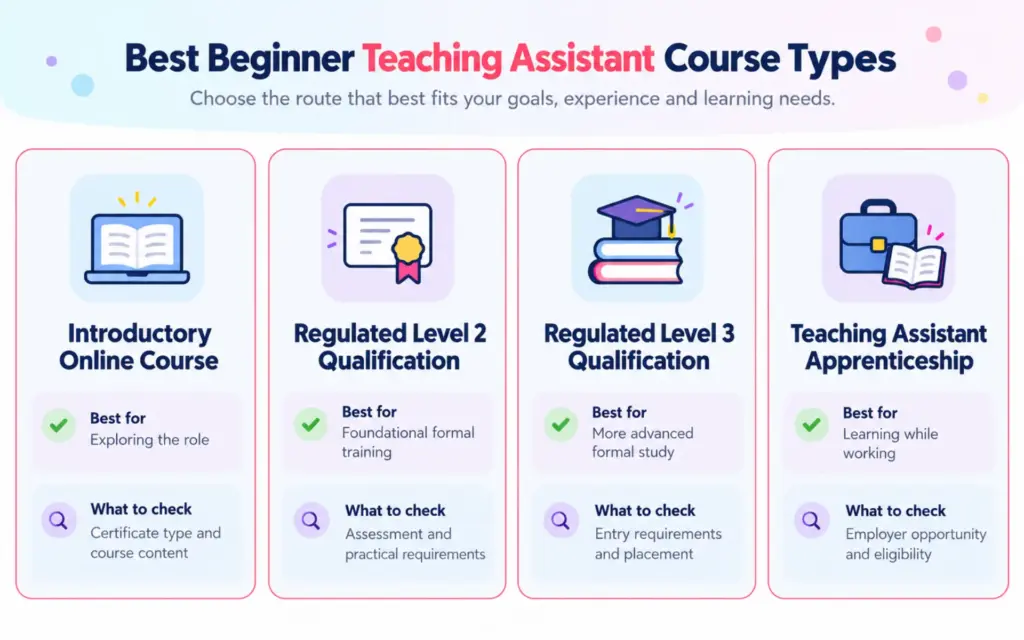
Course Type Best For Important Considerations
Introductory online teaching assistant course Complete beginners exploring the role Check certificate recognition and course content
Regulated Level 2 qualification Learners seeking foundational formal qualifications Review assessment and practical requirements
Regulated Level 3 qualification Learners working towards a higher-level qualification Check entry requirements and workplace assessment
Teaching assistant apprenticeship Learners wanting employment alongside training Requires an appropriate apprenticeship opportunity
Comparison infographic showing the main online teaching assistant course types for beginners in the UK

Not sure which route suits you? Answer a few quick questions below.

TA Course Finder

About 1 minute

Free course finder

Which Teaching Assistant Course Is Right for You?

Answer 7 quick questions to find the best starting route, what to check before you pay, and how long it could take.

  • Regulated and CPD routes explained
  • Placement, funding and study time for your situation
  • Personalised next steps you can copy or print

Loading the course finder… If it doesn’t start, refresh the page.

All teaching assistant routes at a glance

Introductory online course (CPD)

Regulated?
No
Placement?
No
Study time
Short and self-paced
Good for
Exploring the role before you commit

Level 3 Award in Supporting Teaching and Learning

Regulated?
Yes
Placement?
No
Study time
85 guided hours (120 total)
Good for
A regulated qualification without school access (age 16+)

Level 2 Certificate in Supporting Teaching and Learning

Regulated?
Yes
Placement?
Yes, for the whole course
Study time
225 guided hours (321 total)
Good for
A foundation-level qualification (age 16+)

Level 3 Certificate or Diploma in Supporting Teaching and Learning

Regulated?
Yes
Placement?
Yes, about 100 hours (Certificate) or 200 hours (Diploma) recommended
Study time
250 guided hours, 350 total (Diploma: 380 guided, 530 total)
Good for
A fuller Level 3 if you work or volunteer in a school

Level 3 teaching assistant apprenticeship

Regulated?
Yes, included
Placement?
You are employed in a school
Study time
Up to 2 years
Good for
Earning while you train (usually needs GCSE English and maths at grade 4)

Apply directly and volunteer

Regulated?
Not needed by every school
Placement?
Volunteering helps
Study time
Depends on vacancies
Good for
Starting work soon. Each school sets its own requirements.

Qualification hours are from NCFE CACHE qualification factsheets and apply in England. Schools usually ask for GCSE English and maths at grade 4 or above and need an enhanced background check. Wales, Scotland and Northern Ireland have their own qualification frameworks.

Introductory Online Teaching Assistant Courses

Introductory courses focus on essential classroom knowledge, including child development, communication, behaviour support and safeguarding awareness.

Many offer flexible study without fixed lesson times. They can suit beginners who want to understand the profession before pursuing further qualifications.

However, an introductory course does not necessarily provide a regulated qualification or practical classroom experience. For a clearer comparison of professional development and formally recognised training, see Teaching Assistant CPD vs Regulated Qualifications before choosing your next step.

Level 2 Supporting Teaching and Learning Courses

A regulated Level 2 qualification may suit learners seeking formal training in supporting pupils and teachers.

Depending on the programme, assessment may involve written work, practical evidence or workplace activities. Always check the specific qualification requirements.

Level 3 Teaching Assistant Qualifications

Regulated Level 3 qualifications provide another route for learners seeking recognised training in supporting teaching and learning.

Some programmes require practical classroom experience and assessment. Beginners should check whether they meet the entry requirements and can access a suitable placement.

Teaching Assistant Apprenticeships

Apprenticeships combine employment with structured training.

According to the National Careers Service’s teaching assistant career guidance, a Level 3 Teaching Assistant apprenticeship is one possible route into the profession in England.

For a broader comparison of providers, qualification options and buying considerations, our guide to Online Teaching Assistant Courses can help you explore the available choices.

How to Choose an Online Teaching Assistant Course as a Beginner

The right course should match your starting point, available study time and intended outcome. Before enrolling, consider the following factors.

Check the Entry Requirements

Some beginner courses accept learners without previous teaching experience. Regulated qualifications and apprenticeships may have additional conditions.

Check whether you need English and maths qualifications, school-based experience, a minimum age or access to particular learning equipment.

Remember that meeting a course’s entry requirements does not automatically mean meeting an employer’s recruitment criteria.

Understand the Certificate or Qualification

This is one of the most important distinctions when comparing online courses.

A certificate of completion demonstrates that you have completed training. A CPD certificate may provide evidence of professional development. Neither automatically means you have gained a regulated qualification. If you want to know what different courses actually award, Teaching Assistant Certificates: What Do You Receive? explains the certificates available and what they represent.

Similarly, a course advertised at Level 3 is not necessarily an Ofqual-regulated Level 3 qualification.

If formal recognition matters to your plans, check the qualification and awarding organisation through the government’s Register Regulated Qualifications.

That register covers regulated qualifications in England and Northern Ireland, with separate arrangements for Scotland and Wales.

Check Whether Classroom Experience Is Required

A fully online course may cover theory without requiring a school placement.

By contrast, certain regulated qualifications require practical evidence or assessment in an educational setting.

If you are not currently working or volunteering in a school, establish whether you can meet those requirements before paying.

Compare Study Flexibility, Support and Assessment

Look beyond the course title and consider:

  • Study format: Can you learn at your own pace?
  • Course access: How long can you access the materials?
  • Assessment: Are there examinations, assignments or workplace observations?
  • Learner support: Is guidance available when you need help?
  • Certification: What certificate is available, and does it cost extra?

A course that fits your circumstances is often more useful than one chosen simply because it advertises a higher level.

What Skills Should a Beginner Teaching Assistant Course Cover?

A useful beginner course should introduce the knowledge and practical principles involved in supporting pupils and teachers.

Important areas include:

  • Child development: Understanding how children develop and learn.
  • Classroom communication: Giving clear explanations, listening and working effectively with teachers.
  • Learning support: Helping pupils participate in reading, writing, numeracy and other activities.
  • Positive behaviour support: Encouraging appropriate behaviour and following classroom expectations.
  • Special educational needs and disabilities (SEND): Understanding inclusion and different learning needs.
  • Safeguarding awareness: Recognising concerns, maintaining professional boundaries and following reporting procedures.

For example, when supporting a small-group reading activity, a teaching assistant may need to explain instructions, encourage participation and recognise when a pupil needs additional help.

Safeguarding knowledge is especially important. In England, the Department for Education’s Keeping Children Safe in Education 2026 sets out statutory safeguarding guidance for schools and colleges.

Online learning can introduce these responsibilities, but staff must also follow their school’s procedures and receive appropriate workplace training.

Teaching assistant supporting children in a UK primary classroom during a small-group learning activity

Can You Become a Teaching Assistant With No Experience?

Yes. Previous teaching assistant experience is not always essential, and a university degree is not a general requirement for teaching assistant roles in England.

However, individual schools determine their recruitment criteria. Employers may expect English and maths qualifications, relevant skills or experience working with children.

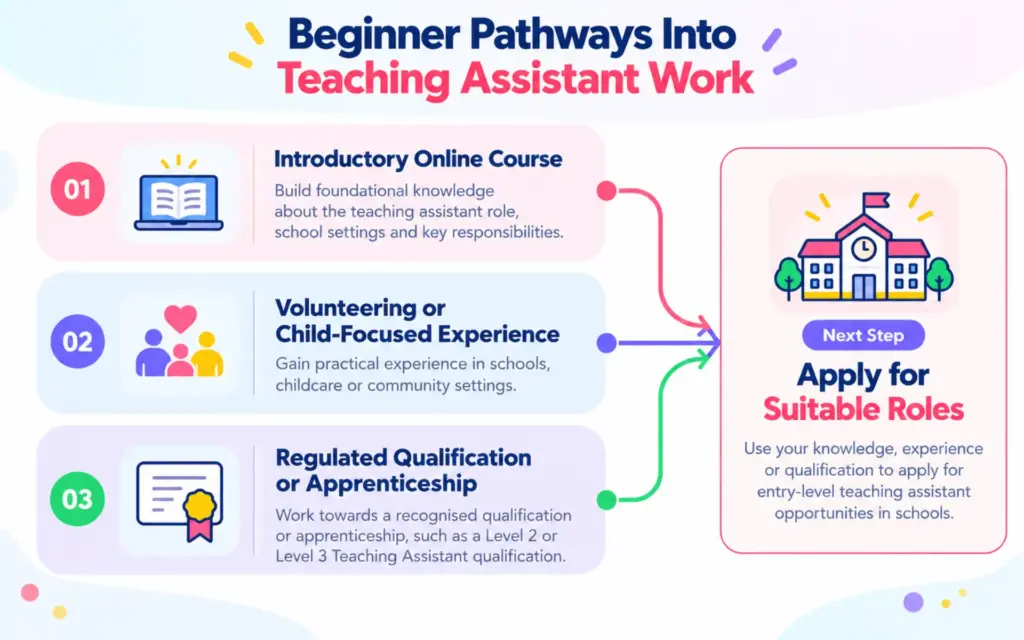
Career pathway infographic showing beginner routes into teaching assistant work in the UK

Do You Need Previous School Experience?

Experience can strengthen an application, but there are different ways to begin.

Volunteering in a school or suitable community setting may help you develop communication skills and understand how children learn.

Relevant experience from childcare, youth activities or other support roles may also be useful.

What Can You Do While Studying?

You can begin preparing for future opportunities by:

  1. Developing foundational knowledge through suitable training.
  2. Exploring appropriate volunteering opportunities.
  3. Reviewing local school vacancies and their entry requirements.
  4. Practising communication, organisation and teamwork skills.

For a wider explanation of career entry routes, see how to become a teaching assistant in the UK.

An online course can support your preparation, but completing one does not guarantee employment or remove the need to satisfy school recruitment requirements.

Is One Education’s Teaching Assistant Complete Course Suitable for Beginners?

For learners exploring introductory online training, One Education’s Teaching Assistant Complete Course offers self-paced learning covering foundational classroom knowledge and SEN-related topics.

What Does the Course Cover?

The curriculum includes child development, professional communication, safeguarding awareness, teaching methods and classroom management.

It also introduces special educational needs, autism, ADHD and dyslexia.

Learning is delivered through video lessons, online materials, practical exercises and assessments. There are no fixed teaching schedules, allowing learners to study at their own pace.

Who Might Benefit From This Course?

The course may suit beginners who want to explore teaching assistant responsibilities or develop theoretical knowledge before considering further training.

One Education states that there are no formal entry requirements, although learners should be over 16 and have appropriate English, numeracy and IT skills.

Importantly, the course is Quality Licence Scheme-endorsed, non-regulated training. It is not an Ofqual-regulated qualification and does not independently authorise someone to practise professionally.

Following successful assessment, learners can order an endorsed certificate or a CPD certificate, with applicable charges detailed on the course page.

It is therefore worth considering as an introductory learning option, rather than a replacement for formal qualifications or practical classroom experience.

How Much Do Beginner Teaching Assistant Courses Cost and How Long Do They Take?

Course prices and durations vary depending on the training provider, qualification type and assessment requirements.

Course Fees and Certificate Costs

An inexpensive introductory course may help you explore the subject. A regulated qualification involving tutor assessment or practical observation may have a different fee structure.

Before enrolling, check whether the advertised price includes assessments, certificates, learning materials and any placement-related costs.

Eligible adults in England may also be able to access funded training or financial assistance. The government’s funding and learning-cost support guidance explains available support and eligibility considerations.

For a closer look at training expenses and possible financial support, Teaching Assistant Course Costs in the UK: Fees & Funding explains what to consider when comparing course prices.

Course Duration and Study Flexibility

Short introductory courses may be completed relatively quickly, depending on study pace. Qualifications involving workplace assessment can require a longer commitment.

Check the provider’s estimated learning hours, deadlines and access period rather than assuming every online teaching assistant course takes the same amount of time.

Choosing Your First Teaching Assistant Course

The best starting point is a course that suits your experience, learning goals and circumstances.

Compare the curriculum, qualification status, practical requirements and total costs before enrolling. With a clear understanding of what each option offers, you can make a more informed choice about your first steps into teaching assistant training.

Frequently Asked Questions About Online Teaching Assistant Courses

Yes. Some introductory teaching assistant courses can be completed entirely online. However, certain regulated qualifications require classroom experience, workplace observations or practical evidence. Always check the assessment requirements before enrolling.

The best qualification depends on your career goals, previous experience and ability to complete the required assessments. Regulated Level 2 or Level 3 programmes may be suitable, while introductory courses can help you explore the profession first.

Yes, some providers advertise free training, and eligible learners may qualify for funded programmes. Check whether the course itself, assessments and certificates are included, and whether funding eligibility applies to your circumstances.

Not necessarily. Introductory theory based courses may have no placement requirement. Some regulated teaching assistant qualifications, however, require practical school-based evidence or assessment. Requirements depend on the specific programme.

A certificate may demonstrate relevant learning and professional development. However, its value depends on the training and employer expectations. A non-regulated certificate does not replace a required qualification, practical experience or recruitment checks.

top
Home Courses Search