Safer Food Better Business (SFBB) Explained: How to Use the Diary, Opening Checks, and Closing Checks

May 12, 2026 | 12 minutes | 334 Readers

In a busy kitchen, food safety can slip when checks are rushed, records are missed, or problems are left until later. Safer Food Better Business (SFBB) is designed to help small catering businesses stay on top of those everyday risks by building food safety into the working day. For many caterers, the challenge is not understanding that food safety matters. It is making sure checks happen every day, records are completed properly, and problems are acted on when they appear.

In a busy kitchen, food safety can slip when checks are rushed, records are missed, or problems are left until later. Safer Food Better Business (SFBB) is designed to help small catering businesses stay on top of those everyday risks by building food safety into the working day.

For many caterers, the challenge is not understanding that food safety matters. It is making sure checks happen every day, records are completed properly, and problems are acted on when they appear. That is where SFBB helps. It turns food safety management into a practical routine through opening checks before service, closing checks at the end of the day, diary entries when needed, and a 4-weekly review to spot patterns and decide whether anything needs to change.

What Safer Food Better Business (SFBB) Means for Catering Businesses

Safer Food Better Business, often shortened to SFBB, is a practical food safety management pack created by the Food Standards Agency for small food businesses. For caterers, it provides structured guidance on safe methods and management checks so food safety controls can be applied in a realistic way.

In simple terms, SFBB helps small businesses:

  • ♦  manage food safely
  • ♦  keep clear daily food safety routines
  • ♦  record problems and action taken
  • ♦  review whether systems are working properly.

It is especially useful for restaurants, cafés, takeaways, pubs serving food, and other smaller catering settings where food safety needs to be managed consistently without a more complex HACCP document.

Why SFBB Matters for Food Safety Compliance

SFBB matters because UK food businesses are expected to have food safety management procedures based on HACCP principles. For many smaller catering businesses, SFBB is the practical way to do that. It gives businesses a structured approach that fits daily kitchen operations instead of leaving food safety as a set of unwritten habits.

That is important in real catering environments. A busy kitchen may be dealing with chilled deliveries, prep, cooking, reheating, allergens, cleaning, storage, and service all within the same day. Without clear checks and written records, it becomes much harder to show that food safety is being managed properly.

SFBB also helps with consistency. It gives supervisors and managers a way to make sure food safety does not depend too heavily on who is on shift or how experienced the team feels that day. In that sense, SFBB is not just about compliance. It is about making safe practice easier to repeat.

What Is Included in the SFBB Pack

What Is Included in the SFBB Pack

The SFBB pack is built around a few practical parts that work together.

Safe Methods

The safe methods section sets out the practical food safety controls a business should follow. These are usually based around key areas such as cross-contamination, cleaning, chilling, cooking, and management. The aim is simple: the business should know what safe practice looks like and apply it consistently.

Management Checks

The management section supports day-to-day checking and oversight. This is where opening checks, closing checks, and the diary become important. These parts help businesses move from written procedures to visible daily control.

Diary and 4-Weekly Review

The diary is used to record anything different, especially where a problem happened or something changed. The 4-weekly review helps the business step back, look at patterns, and decide whether extra checks, updated safe methods, or further staff support are needed.

How to Use the SFBB Diary Properly

How to Use the SFBB Diary Properly

For many businesses, the diary is the part of SFBB that causes the most confusion. Some people think it needs a long daily narrative. It does not. The point of the diary is to record anything different, especially food safety problems, changes, and the action taken.

What to Record Each Day

You should record:

  • ♦ anything that went wrong
  • ♦ anything different from the normal safe method
  • ♦ checks that showed a problem needing action
  • ♦ the action taken to correct it.

A useful example would be a chilled delivery arriving too warm. Another would be a fridge temperature check showing a problem that needed action. The diary is there to show that the business noticed the issue and responded properly.

How to Note Problems and Changes

The best diary entries are short and practical. They should explain:

  • ♦ what the problem or change was
  • ♦ what action was taken
  • ♦ whether any follow-up was needed.

For example:

  • ♦ “Delivery rejected because chilled food arrived above safe temperature.”
  • ♦ “Fridge seal damaged; food moved, engineer called.”
  • ♦ “Staff member re-briefed on separating raw and ready-to-eat food.”

That is enough. The diary should show control, not create unnecessary paperwork.

Who Should Complete the Diary

The diary should usually be completed by the person responsible for the checks or by whoever is supervising food safety that day. In smaller catering businesses, that may be the owner, manager, or shift supervisor. The main point is that the person completing it understands what happened and can record the action clearly.

What Opening Checks Are and Why They Matter

What Opening Checks Are and Why They Matter

Opening checks are the food safety checks carried out before service begins. They help confirm that the kitchen is ready to operate safely. This matters because food safety problems often begin before customers are served, not during service itself.

Equipment and Temperature Checks

Opening checks often include:

  • ♦  fridge and freezer temperatures
  • ♦  hot-holding equipment where relevant
  • ♦  whether key equipment is working properly
  • ♦  whether thermometers are available and usable.

If equipment is not working or temperatures are out of control before service begins, that needs attention straight away.

Staff Readiness and Hygiene Checks

Opening checks may also include:

  • ♦  whether handwashing facilities are stocked
  • ♦  whether cleaning materials are available
  • ♦  whether staff are ready to follow safe methods
  • ♦  whether protective clothing and hygiene standards are in place.

Stock and Safety Checks Before Service

Before opening, businesses may also need to check:

  • ♦  stock rotation
  • ♦  signs of spoiled food
  • ♦  date labels
  • ♦  whether ready-to-eat and raw foods are stored correctly.

These checks help stop avoidable problems from carrying into service.

What Closing Checks Are and Why They Matter

What Closing Checks Are and Why They Matter

Closing checks are completed at the end of the day. Their purpose is to make sure the kitchen is left in a safe condition and that any unfinished issues are picked up before the next day starts.

Cleaning and End-of-Day Hygiene Checks

These checks often include:

  • ♦  whether food-contact surfaces were cleaned properly
  • ♦  whether equipment was cleaned down
  • ♦  whether wash-up areas were left hygienic
  • ♦  whether any extra cleaning was needed.

Waste, Storage, and Equipment Checks

At closing, businesses should also check:

  • ♦  waste disposal
  • ♦  chilled and frozen storage
  • ♦  food protection overnight
  • ♦  whether equipment has been switched off or left safely where appropriate.

Checking That Records Are Complete

Closing checks are also a good point to confirm that:

  • ♦  temperature checks were done
  • ♦  problems were recorded in the diary
  • ♦  any action taken was noted
  • ♦  nothing important was left undocumented.

How the 4-Weekly Review Supports Better Food Safety Management

The 4-weekly review helps the business step back and ask whether the system is still working properly. This matters because food safety management should not stay fixed if the kitchen changes.

At review stage, the business should look at:

  • ♦  recurring problems
  • ♦  repeated diary issues
  • ♦  changes to menu, staff, or equipment
  • ♦  whether safe methods still reflect real practice
  • whether extra checks or training are needed.

This review is where SFBB becomes more than a daily checklist. It helps businesses look for patterns and improve how food safety is being managed.

Common SFBB Mistakes Small Catering Businesses Make

Some of the most common mistakes include:

  • ♦  treating SFBB as paperwork only
  • ♦  failing to record problems in the diary
  • ♦  completing checks without acting on what they show
  • ♦  using opening and closing checks inconsistently
  • ♦  not reviewing the system when something changes
  • ♦  assuming SFBB never needs updating.

In practice, SFBB only works when it reflects how the business actually operates. If the pack looks complete on paper but daily checks are weak, food safety risks can still be missed.

When SFBB Is Enough and When a More Detailed System May Be Needed

When SFBB Is Enough and When a More Detailed System May Be Needed

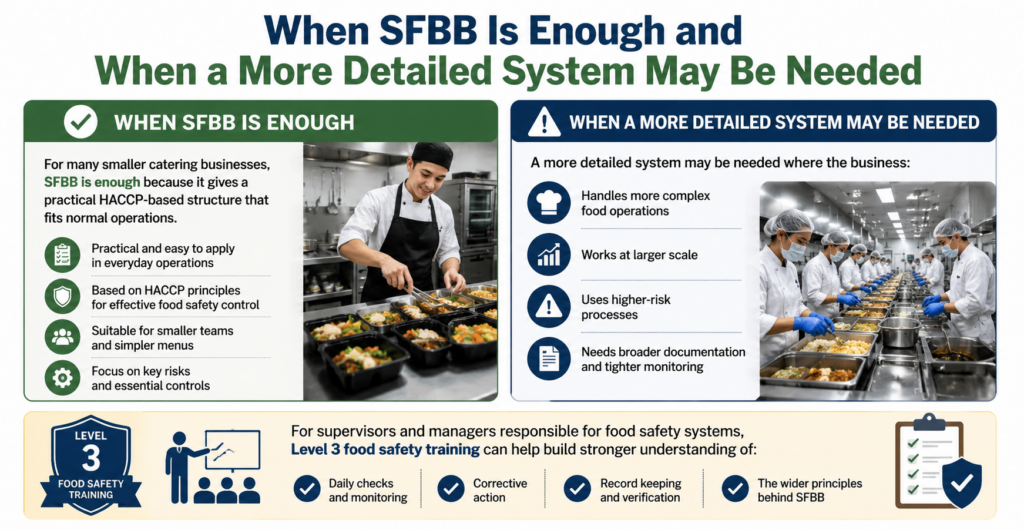
For many smaller catering businesses, SFBB is enough because it gives a practical HACCP-based structure that fits normal operations.

A more detailed system may be needed where the business:

  • ♦  handles more complex food operations
  • ♦  works at larger scale
  • ♦  uses higher-risk processes
  • ♦  needs broader documentation and tighter monitoring.

For supervisors and managers responsible for food safety systems, Level 3 food safety training can help build stronger understanding of daily checks, monitoring, corrective action, and the wider principles behind SFBB.

Conclusion

SFBB helps small catering businesses turn food safety from a loose set of habits into a practical daily system. The diary, opening checks, closing checks, and 4-weekly review all help show that food safety is being managed properly, not assumed.

For small catering businesses, that makes SFBB one of the most practical ways to manage daily food safety checks and show that safe methods are being followed consistently.

FAQs — Safer Food Better Business (SFBB) Explained

1. What is Safer Food Better Business?

It is an FSA food safety management pack for small food businesses, designed to help them manage food safety using practical daily procedures.

2. How do you use the SFBB diary?

Use it to record anything different, especially problems, changes, and the action taken.

3. What are opening checks in SFBB?

They are the checks completed before service to make sure the kitchen is ready to operate safely.

4. What are closing checks in SFBB?

They are the checks completed at the end of the day to confirm that cleaning, storage, waste control, and records have been handled properly.

5. What is the 4-weekly review in SFBB?

It is a regular review used to look at problems, patterns, and whether safe methods or extra checks need updating.

Sam Walker

Article by

Sam Walker

Sam Walker is an education specialist and author at One Education, bringing over 4 years of experience in creating practical resources and strategies to support teachers and enhance student learning.

top
Home Courses Search