The pupil who can’t follow a two-part instruction, struggles to find the right word or goes quiet when asked a question is often the pupil a teaching assistant sits beside. Speech and language training for teaching assistants shows you practical ways to help. These include simplifying the language you use, adding visual supports, pre-teaching vocabulary and delivering activities planned by a speech and language therapist. The training supports your role in school, but it doesn’t qualify you to diagnose difficulties or provide therapy.
This guide covers:
- what the training includes;
- how your role fits alongside therapists;
- the main types of training available in the UK;
- how to choose the right option.
For training aimed at teachers, SENCOs and the wider staff team, see our guide to speech and language support training for school staff.
Support pupils with communication needs
Study online at your own pace and discover practical ways to support pupils with speech, language and communication needs at school.
View the Speech Therapy and SEN Teaching Assistant course
Why speech and language skills matter in the TA role
Speech, language and communication needs (SLCN) include difficulties with:
- producing speech sounds;
- understanding or using language;
- the social side of communication.
Department for Education figures show that SLCN is the most common type of primary need among pupils receiving SEN support in England.
For many of these pupils, the adult they spend most time with is a teaching assistant. You might be the one rephrasing an instruction or running a vocabulary group. You might also be the one who notices that a pupil who chats happily at lunch can’t explain their thinking in class.
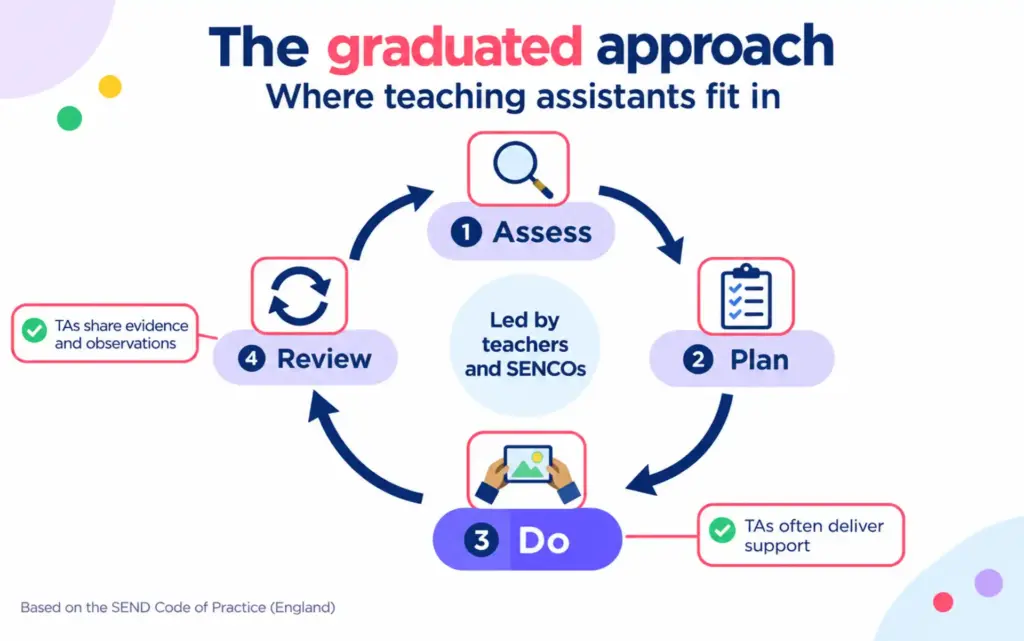
In England, the SEND Code of Practice is statutory guidance. It sets out a “graduated approach” to support: assess, plan, do and review. Teachers and SENCOs lead this cycle.
TAs are often closely involved in the “do” stage and in gathering evidence for reviews. Training helps you carry out your part well and helps you describe what you’re seeing in ways the SENCO and therapist can act on.
What speech and language training for teaching assistants covers
Content varies between courses, but good training usually covers seven areas.
- How speech and language typically develop. This helps you spot when a pupil may be struggling with understanding (receptive language), expressing themselves (expressive language), speech sounds or fluency. Developmental language disorder (DLD) is usually included.
- Adapting your own language. This means shorter instructions given one step at a time, key words emphasised, and enough processing time before you expect a reply.
- Visual supports. These include visual timetables, symbols and real objects, along with an introduction to Makaton and to augmentative and alternative communication (AAC).
- Pre-teaching vocabulary. Pupils meet new topic words before the lesson rather than during it.
- Running interventions. This covers delivering small-group and one-to-one activities and recording progress clearly.
- Working with others. This means following a therapist’s programme, sharing observations with the SENCO and keeping parents informed where your school asks you to.
- Overlapping needs. Communication difficulties often sit alongside autism or attention difficulties. Some TAs add ADHD awareness training or autism training to their CPD.
A quick classroom example
Take a Year 4 pupil with DLD who loses track in science lessons. Before a lesson on the water cycle, you spend ten minutes with them on three words: evaporate, condense and precipitation. You use pictures, act the words out and ask the pupil to use each one in a sentence. In the lesson itself, they can follow more of the explanation and answer a question. That’s the kind of small, planned adjustment training helps you make
What TAs can and can’t do: working alongside speech and language therapists
Speech and language therapists (SLTs) are regulated health professionals. “Speech and language therapist” and “speech therapist” are protected titles, and anyone using them must be registered with the Health and Care Professions Council. TA training doesn’t change this, so it helps to be clear about where each role begins and ends.
Swipe left to see the full table →
| Task | Speech and Language Therapist | Teaching Assistant |
|---|---|---|
| Assess and diagnose difficulties | Yes | No, but shares observations |
| Set targets and plan programmes | Yes | Follows the plan |
| Deliver regular activities | May model or deliver some | Often delivers day to day |
| Adapt classroom language and environment | Advises | Does this throughout the day |
| Track progress | Reviews and updates targets | Records and feeds back |
| Professional registration | HCPC-registered | No professional register |
The two roles work best together. A therapist may only see a pupil occasionally, while you may see them every day. Education Endowment Foundation guidance on teaching assistants found that TAs can make a positive difference when they deliver structured interventions with proper training and support. If a pupil has an education, health and care plan (EHCP), their support is set out in it, and this may include speech and language therapy.
Types of speech and language training available to TAs
Speech and language training for TAs ranges from flexible online CPD to school-based sessions and formal qualifications. The table below compares the main options to help you decide which suits your role.
Swipe left to see the full table →
| Type | What It Involves | Best For | What to Check |
|---|---|---|---|
| Online CPD course | Self-paced study, usually with a certificate of completion | A broad foundation, fitted around work | Whether it’s CPD-accredited, and what the certificate represents |
| Training from an SLT service | Sessions in school from an NHS, local or independent therapy service | Support tailored to specific pupils | Availability varies by area and service |
| Programme-specific training | Training to deliver one structured intervention | TAs running that programme | It covers one programme and age group only |
| Regulated TA qualification | For example, the Level 3 Certificate in Supporting Teaching and Learning | Formal TA career routes | It’s broad, so SLCN may be a small part |
One example of programme-specific training is the Nuffield Early Language Intervention (NELI). This programme for Reception-age children has been evaluated by the Education Endowment Foundation, and it’s often delivered by trained school staff, including TAs. Many TAs combine an online course for general knowledge with in-school training for particular pupils.
10 Speech and Language Activities for Teaching Assistants
Make communication support more practical with 10 ready-to-use classroom activities, illustrated picture cards and printable worksheets for pupils with speech, language and communication needs.
- 10 practical activities
- Printable worksheets
- Picture prompt cards
- 19-page PDF
How to choose the right speech and language training
Before you sign up, check five things:
- Does it suit your setting? Early years, primary, secondary and specialist settings bring different needs.
- Is it practical? Look for classroom strategies and guidance on working with therapists, not just theory.
- What will you receive? Find out whether you’ll get a CPD certificate, a certificate of completion or a regulated qualification.
- What does your school value? Your SENCO can advise on what matches your pupils’ needs and whether the school might fund it.
- Can you fit it around work? Self-paced online study suits many TAs who work school hours.
If you’re looking for a flexible starting point, One Education’s Speech Therapy and SEN Teaching Assistant course is an online course on supporting pupils with speech, language and other SEN in school. Like all training of this kind, it supports your work alongside therapists. It isn’t a route to becoming one.
Flexible training for busy TAs
Fit your training around the school day with flexible online study focused on supporting pupils with SEN and communication needs.
Find out more about the course
How speech and language training can support your TA career
SEN experience is often listed as desirable in teaching assistant job adverts. Speech and language skills are especially relevant in SEN, early years and specialist settings. Training also gives you concrete examples to talk about in applications and interviews, such as a strategy you used, a progress record you kept or a pupil whose confidence grew.
It’s worth being realistic about pay. TA pay is usually set by school or local authority pay scales, and many posts are term-time only, so pay is pro rata. The National Careers Service has current information on typical pay and entry routes.
A certificate alone won’t guarantee a job or a pay rise. However, it can support appraisals and conversations about taking on more responsibility, including working towards higher-level teaching assistant (HLTA) status.
If you’d like to go further into SEN, you could consider broader study such as the Level 5 SEN teaching diploma or the Level 7 SEN teaching course. If you’re still at the start of your TA journey, our guide to becoming an SEN teaching assistant covers the wider route.
Next steps
Speech and language training won’t make you a therapist, and it doesn’t need to. What it does is help you make the small, daily adjustments that let a pupil follow a lesson, join a conversation or answer a question with confidence. A good first step is talking to your SENCO about your pupils’ needs. Then choose training that fits those needs and your working week.
Frequently Asked Questions
Most UK employers ask for GCSEs in English and maths or equivalent qualifications, although requirements vary between schools and roles.
Teaching assistants can take courses in classroom support, childcare, special educational needs, safeguarding, and supporting teaching and learning in schools.
You can apply for speech and language therapy assistant jobs with relevant experience or qualifications in healthcare, education, or social care.
According to the National Careers Service, full-time equivalent salaries for teaching assistants in the UK typically range between £19,000 and £26,000 per year. However, because most TA positions are term-time only and part-time, actual take-home pay is usually calculated on a pro-rata basis.
Becoming a teaching assistant is possible without a degree, but relevant qualifications, experience with children, and strong communication skills can help.
Relevant options include healthcare support courses, health and social care qualifications, apprenticeships, and workplace training, depending on the employer and role.
Related Articles
Get a FREE Course
- Learn useful skills online free
- Get CPD accredited certificate
- Add it to your CV today!