The 11 Most Popular Languages to Learn for Global Success

April 15, 2026 | 13 minutes | 665 Readers

Today’s fast-moving global economy, where remote work and international collaboration are becoming the norm, makes the ability to speak more than one language more than just an advantage—it’s a powerful career asset. As businesses expand across borders and digital communication connects professionals worldwide, language skills are opening doors to new opportunities like never before. Learning a new language can significantly boost your employability, helping you stand out in competitive job markets while also enhancing your ability to work with diverse

rating

Bestselling Course

View Details SAVE 94% NOW
The 11 Most Popular Languages to Learn for Global Success

Today’s fast-moving global economy, where remote work and international collaboration are becoming the norm, makes the ability to speak more than one language more than just an advantage—it’s a powerful career asset. As businesses expand across borders and digital communication connects professionals worldwide, language skills are opening doors to new opportunities like never before.

Learning a new language can significantly boost your employability, helping you stand out in competitive job markets while also enhancing your ability to work with diverse teams. Beyond career growth, it enriches travel experiences, allowing you to connect more deeply with people, cultures, and traditions. It also sharpens your cultural awareness, making you more adaptable and globally minded in both personal and professional settings.

In this guide, we’ll explore the 11 most popular languages to learn for global success, highlighting why each one matters and how it can support your career, travel goals, and personal development.

Why Learning a New Language Matters

Learning a new language is more than just acquiring a communication skill—it is a powerful investment in your future. In today’s globalised world, employers increasingly value multilingual individuals who can work across cultures and markets. Whether you are aiming for international career opportunities or remote roles with global companies, language skills can significantly enhance your employability and set you apart in a competitive job market.

Beyond career benefits, learning a new language supports cognitive and personal development. It improves memory, problem-solving abilities, and mental flexibility while boosting confidence and cultural awareness. Studies suggest that bilingual individuals often demonstrate stronger decision-making skills and greater adaptability, making language learning a valuable tool for both personal growth and lifelong learning.

Additionally, language skills open doors to new business and networking opportunities. Being able to communicate with clients, partners, and colleagues in their native language builds trust and strengthens professional relationships. In fact, research shows that over 70% of employers prefer candidates with foreign language skills, highlighting the growing importance of multilingualism in today’s interconnected world.

How We Selected These Languages

How We Selected These Languages

Choosing the most valuable languages to learn for global success requires more than just popularity. We based our selection on a combination of key factors that ensure each language offers real-world relevance, long-term value, and practical benefits for learners.

Firstly, global demand played a crucial role. Languages widely used in international business, education, and communication were prioritised, as they open doors to broader career opportunities and cross-border collaboration. Closely linked to this is the number of speakers, including both native and non-native users, which reflects how widely a language is used across different regions.

We also considered economic influence, focusing on languages spoken in countries with strong or rapidly growing economies. These languages often provide better access to global markets, job prospects, and business expansion opportunities. In addition, travel and cultural importance were key factors, as some languages significantly enhance travel experiences and cultural understanding.

By combining these criteria, the selection remains balanced, practical, and trustworthy—helping learners choose languages that truly support global success and personal growth.

The 11 Most Popular Languages​

The 11 Most Popular Languages

The 11 Most Popular Languages represent some of the most widely spoken and influential languages in the world, shaping global communication, business, and culture. From English as a universal language of international interaction to Mandarin Chinese driving global trade, each language offers unique advantages. Learning these languages can open doors to career opportunities, enhance cross-cultural understanding, and support personal and professional growth in an increasingly connected world.

1. English

English is the world’s most widely used global language, essential for international communication, business, and education.

  • ♦  Where it’s spoken: UK, USA, Canada, Australia, and widely used worldwide
  • ♦  Career benefits: Key language for global jobs, higher education, and digital industries
  • ♦  Who should learn it: Anyone aiming for international career growth or study abroad opportunities

2. Mandarin Chinese

Mandarin Chinese is the most spoken native language, driven by China’s economic influence.

  • ♦  Where it’s spoken: China, Taiwan, Singapore
  • ♦  Career benefits: Valuable for trade, manufacturing, and global business expansion
  • ♦  Who should learn it: Professionals targeting international business or Asian markets

3. Spanish

Spanish is one of the most widely spoken languages, especially across the Americas and Europe.

  • ♦  Where it’s spoken: Spain, Mexico, Latin America, USA (growing use)
  • ♦  Career benefits: Useful in tourism, healthcare, and international relations
  • ♦  Who should learn it: Travellers, business professionals, and global communicators

4. French

French is a key international language used in diplomacy and global organisations.

  • ♦  Where it’s spoken: France, Canada, parts of Africa, Europe
  • ♦  Career benefits: Important for careers in diplomacy, NGOs, and international law
  • ♦  Who should learn it: Individuals interested in global policy, travel, or culture

5. Arabic

Arabic holds strong cultural and economic importance across the Middle East.

  • ♦  Where it’s spoken: Middle East, North Africa
  • ♦  Career benefits: High demand in energy sectors, international relations, and translation
  • ♦  Who should learn it: Professionals working in global trade, politics, or cultural studies

6. German

German is Europe’s leading business language, especially in engineering and manufacturing.

  • ♦  Where it’s spoken: Germany, Austria, Switzerland
  • ♦  Career benefits: Strong demand in engineering, automotive, and research sectors
  • ♦  Who should learn it: Students and professionals aiming for careers in Europe

Find the Course That Suits You!

We create outstanding professionals in Employability, Business, Health Care, Marketing, Language, and Functional Skills. Whether you're starting or advancing your career, we turn your passion into success as the UK’s most trusted e-learning course provider.
5000+ course

7. Japanese

Japanese is essential for technology, innovation, and global corporate culture.

  • ♦  Where it’s spoken: Japan
  • ♦  Career benefits: Opportunities in tech, gaming, and multinational companies
  • ♦  Who should learn it: Tech enthusiasts and professionals working with Japanese firms

8. Hindi

Hindi is one of the fastest-growing languages due to India’s expanding economy.

  • ♦  Where it’s spoken: India and neighbouring regions
  • ♦  Career benefits: Useful in outsourcing, IT services, and emerging markets
  • ♦  Who should learn it: Business professionals exploring South Asian markets

9. Portuguese

Portuguese connects learners to growing economies in South America and beyond.

  • ♦  Where it’s spoken: Brazil, Portugal, parts of Africa
  • ♦  Career benefits: Valuable in trade, agriculture, and international business
  • ♦  Who should learn it: Entrepreneurs and professionals targeting Brazilian markets

10. Russian

Russian remains important for geopolitical, scientific, and cultural influence.

  • ♦  Where it’s spoken: Russia, Eastern Europe, Central Asia
  • ♦  Career benefits: Useful in energy sectors, diplomacy, and research fields
  • ♦  Who should learn it: Individuals interested in global politics or regional expertise

11. Korean

Korean has gained global popularity through technology, entertainment, and culture.

  • ♦  Where it’s spoken: South Korea, North Korea
  • ♦  Career benefits: Opportunities in tech, entertainment, and international trade
  • ♦  Who should learn it: Fans of Korean culture or professionals working with Korean companies

Comparison Table: The 11 Most Popular Languages for Global Success

The comparison table of the 11 most popular languages for global success provides a clear overview of each language’s global reach, key regions, and practical benefits. It helps learners quickly identify which language aligns with their career goals—whether for international business, travel, diplomacy, or industry-specific opportunities—making it easier to choose the most valuable language to learn.

Language Speakers (Approx.) Key Regions Best For
English 1.5+ billion UK, USA, Canada, Australia, global use International business, education, travel, global communication
Mandarin Chinese 1.1+ billion China, Taiwan, Singapore Trade, manufacturing, global economy, business expansion
Spanish 500+ million Spain, Latin America, USA Travel, international communication, customer-facing roles
French 300+ million France, Canada, Africa, Europe Diplomacy, international relations, global organisations
Arabic 400+ million Middle East, North Africa Oil & gas industry, international trade, diplomacy
German 130+ million Germany, Austria, Switzerland Engineering, automotive industry, EU business
Japanese 125+ million Japan Technology, automotive, innovation sectors
Hindi 600+ million India Emerging markets, business expansion, cultural communication
Portuguese 260+ million Brazil, Portugal, Africa Trade, tourism, business in emerging economies
Russian 260+ million Russia, Eastern Europe, Central Asia Energy sector, geopolitics, regional business
Korean 80+ million South Korea, North Korea Technology, entertainment
How to Choose the Right Language for You

How to Choose the Right Language for You

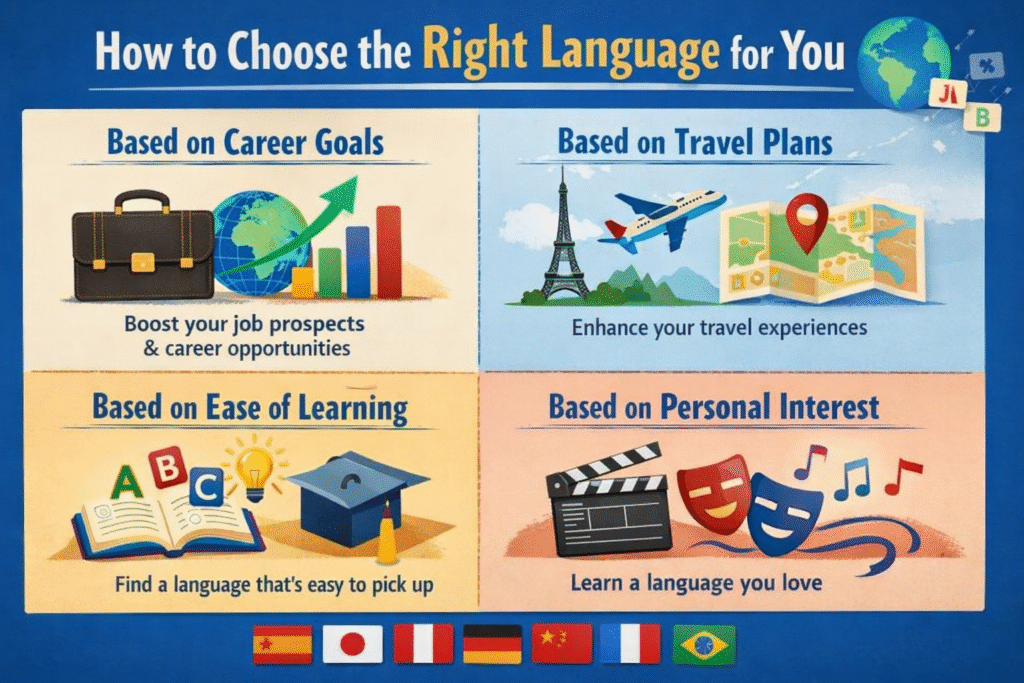
Choosing the right language to learn is an important step that can shape your personal and professional growth. With so many options available, it is essential to focus on what truly aligns with your goals, lifestyle, and interests. By considering a few key factors, you can make a confident and rewarding decision.

Based on Career Goals

Your career ambitions should play a major role in your choice. Certain languages are highly valuable in specific industries—for example, languages used in international business, technology, or diplomacy can open doors to global opportunities. Selecting a language that complements your professional path can enhance your CV and improve your employability.

Based on Travel Plans

If you enjoy travelling or plan to visit specific countries, learning the local language can significantly enrich your experience. It helps you communicate more effectively, understand cultural nuances, and navigate unfamiliar places with ease. Even basic language skills can make your travels more enjoyable and meaningful.

Based on Ease of Learning

Some languages are easier to learn depending on your native language and prior experience. Factors such as similar vocabulary, grammar structure, and pronunciation can make the learning process quicker and less challenging. Choosing a language that matches your current ability level can help you stay motivated and progress steadily.

Based on Personal Interest

Your passion and curiosity are powerful motivators. Whether you are inspired by a culture, music, films, or literature, learning a language you genuinely enjoy will make the journey more engaging and enjoyable. Personal interest often leads to better consistency and long-term success in language learning.

Tips for Learning a Language Faster

Tips for Learning a Language Faster

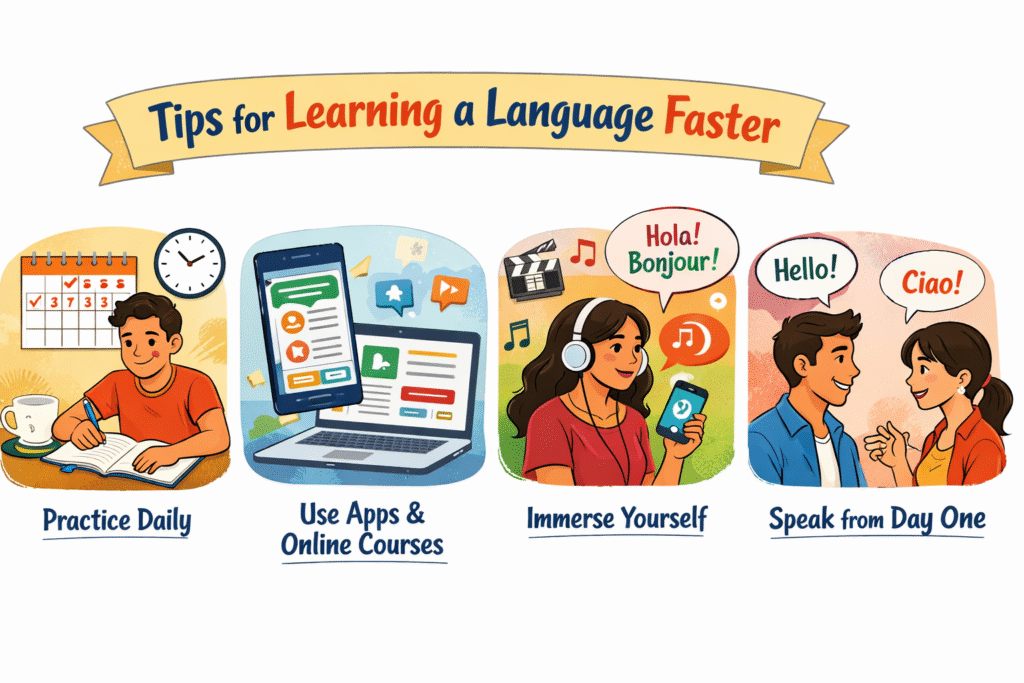
Learning a new language can feel challenging at first, but the right approach can make the process faster, smoother, and far more enjoyable. One of the most effective strategies is daily practice. Even short, consistent sessions help build vocabulary, improve memory, and strengthen your understanding of grammar. Regular exposure keeps the language fresh in your mind and supports long-term retention.

Another powerful method is to use apps and online courses. Digital learning platforms provide structured lessons, interactive exercises, and instant feedback, making it easier to track your progress. These tools are flexible and accessible, allowing you to learn anytime and anywhere while gradually building your skills step by step.

Immersing yourself in the language is equally important. Watching films, listening to podcasts, or following native speakers helps you understand pronunciation, tone, and real-life conversations. This exposure improves listening skills and helps you become familiar with natural speech patterns. At the same time, make it a priority to speak from day one. Practising speaking, even with simple words or phrases, builds confidence quickly and helps you develop fluency without fear of making mistakes.

Career Opportunities with Language Skills

Career Opportunities with Language Skills

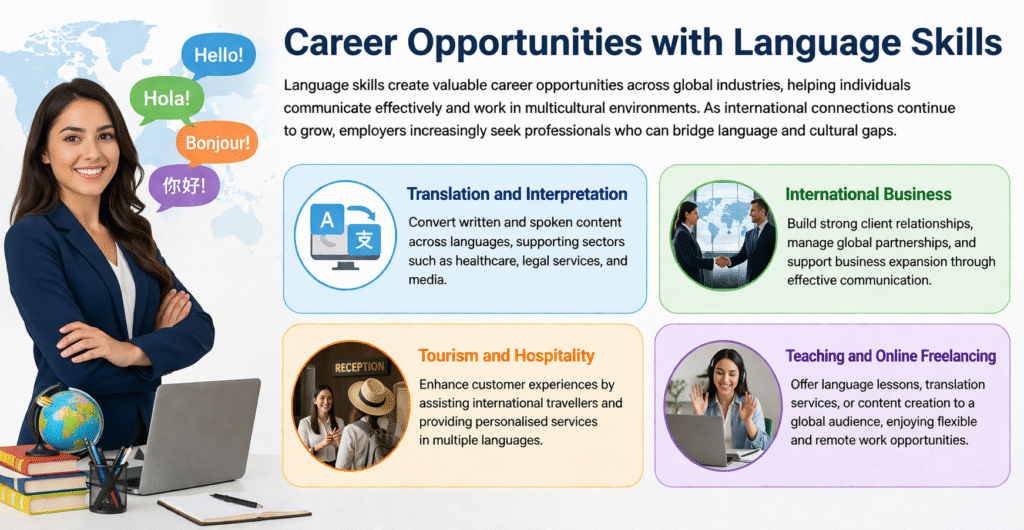
Language skills create valuable career opportunities across global industries, helping individuals communicate effectively and work in multicultural environments. As international connections continue to grow, employers increasingly seek professionals who can bridge language and cultural gaps.

Careers in translation and interpretation allow individuals to convert written and spoken content across languages, supporting sectors such as healthcare, legal services, and media. In international business, language proficiency helps build strong client relationships, manage global partnerships, and support business expansion.

In the tourism and hospitality sector, multilingual professionals enhance customer experiences by assisting international travellers and providing personalised services. Additionally, opportunities in teaching and online freelancing enable individuals to work flexibly, offering language lessons, translation services, or content creation to a global audience.

Conclusion

Multilingual skills play a vital role in achieving global success, opening doors to new career opportunities, cultural understanding, and stronger communication in an increasingly connected world. Learning a new language not only enhances your CV but also builds confidence and adaptability in both personal and professional settings. Now is the perfect time to begin, with flexible learning options making it easier than ever to get started. Take the first step today, stay consistent, and each new word you learn will bring you closer to a broader, more successful future.

FAQs — The 11 Most Popular Languages to Learn for Global Success

1. What is the best language to learn for jobs?
The best language depends on your career goals, but widely востребованные options include English, Mandarin Chinese, Spanish, and German. These languages are highly valued in global business, technology, and international trade sectors.
2. Which language is easiest to learn?
Languages such as Spanish and French are often considered easier for English speakers due to their familiar vocabulary and simpler grammar structures. However, the ease of learning can vary based on your native language and exposure.
3. Is English enough for global success?
While English is the global business language, learning an additional language can significantly boost your career opportunities. Multilingual professionals are often preferred for international roles and cross-cultural communication.
4. How long does it take to learn a new language?
The time required depends on the language’s difficulty and your dedication. On average, it can take a few months for basic conversational skills and up to a year or more for fluency with consistent practice.
5. Which language is most in demand in 2026?
In 2026, languages like Mandarin Chinese, Spanish, Arabic, and German remain in high demand due to their economic and global influence. These languages open doors to expanding markets and international career growth.

Find the Course That Suits You!

We create outstanding professionals in Employability, Business, Health Care, Marketing, Language, and Functional Skills. Whether you're starting or advancing your career, we turn your passion into success as the UK’s most trusted e-learning course provider.
5000+ course
Sam Walker

Article by

Sam Walker

Sam Walker is an education specialist and author at One Education, bringing over 4 years of experience in creating practical resources and strategies to support teachers and enhance student learning.

top

Hear What Our Learners Say About Us

Home Courses Search