Understanding GCSE Grades 2026 9–1 Scale, Pass Marks and Equivalents

April 10, 2026 | 13 minutes | 763 Readers

GCSE results are highly important for students, parents, and future career opportunities, as they influence progression into further education, apprenticeships, and employment. Strong grades can open doors to A-levels and specialised courses, while also demonstrating essential skills to employers. For parents, GCSE outcomes provide a clear understanding of their child’s academic performance and future potential, making them a key milestone in a student’s educational journey. The GCSE grading system has moved from the traditional A*–G scale to the numerical 9–1

rating

Bestselling Course

View Details SAVE 94% NOW
Understanding GCSE Grades 2026 9–1 Scale, Pass Marks and Equivalents

GCSE results are highly important for students, parents, and future career opportunities, as they influence progression into further education, apprenticeships, and employment. Strong grades can open doors to A-levels and specialised courses, while also demonstrating essential skills to employers. For parents, GCSE outcomes provide a clear understanding of their child’s academic performance and future potential, making them a key milestone in a student’s educational journey.

The GCSE grading system has moved from the traditional A*–G scale to the numerical 9–1 system, designed to offer greater differentiation, especially among top-performing students. In this guide, you will learn how the 9–1 grading structure works, what is considered a pass, how the new grades compare to the old system, and what these results mean for future study and career pathways.

What Are GCSE Grades?

GCSE (General Certificate of Secondary Education) grades are academic results awarded to students in the United Kingdom, typically between the ages of 14 and 16, after completing secondary education. These qualifications assess knowledge across core and optional subjects such as English, Maths, and Science, and are usually taken at the end of Year 11.

Students are graded on a numerical scale from 9 to 1, where 9 is the highest and 1 is the lowest. This system replaced the older A*–G grading to provide clearer differentiation of performance. Most students study several GCSE subjects based on their school curriculum and chosen path.

GCSE results play a crucial role in shaping future opportunities. Strong grades are often required for A-Levels, vocational courses, apprenticeships, or college entry. Employers also value GCSEs, particularly in English and Maths, when considering candidates.

Overall, GCSEs form an important foundation for further education and career progression, helping students develop essential knowledge and skills.

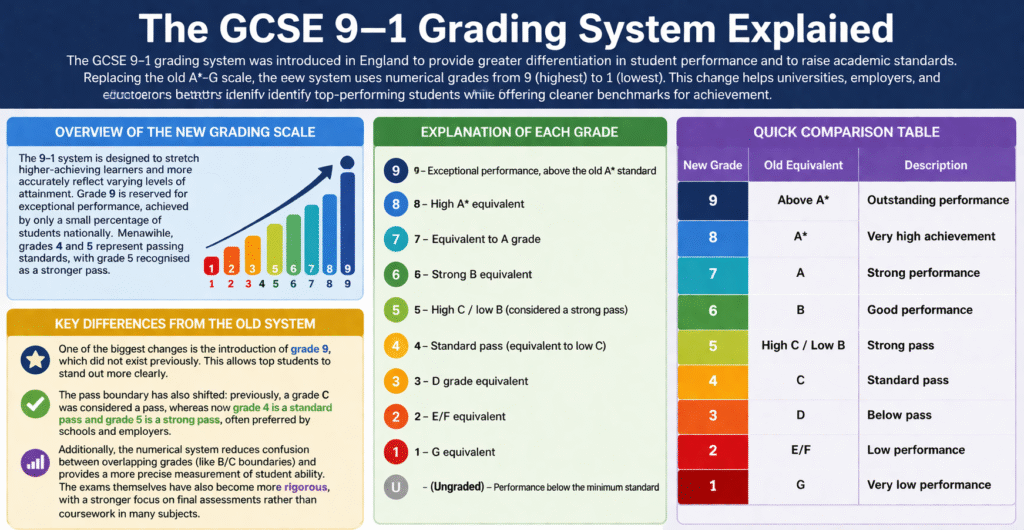
GCSE 9–1 grading system overview

The GCSE 9–1 Grading System Explained

The GCSE 9–1 grading system was introduced in England to provide greater differentiation in student performance and to raise academic standards. Replacing the old A*–G scale, the new system uses numerical grades from 9 (highest) to 1 (lowest). This change helps universities, employers, and educators better identify top-performing students while offering clearer benchmarks for achievement.

Overview of the New Grading Scale

The 9–1 system is designed to stretch higher-achieving learners and more accurately reflect varying levels of attainment. Grade 9 is reserved for exceptional performance, achieved by only a small percentage of students nationally. Meanwhile, grades 4 and 5 represent passing standards, with grade 5 recognised as a stronger pass.

Explanation of Each Grade

  • ♦  Grade 9 – Exceptional performance, above the old A* standard
  • ♦  Grade 8 – High A* equivalent
  • ♦  Grade 7 – Equivalent to A grade
  • ♦  Grade 6 – Strong B equivalent
  • ♦  Grade 5 – High C / low B (considered a strong pass)
  • ♦  Grade 4 – Standard pass (equivalent to low C)
  • ♦  Grade 3 – D grade equivalent
  • ♦  Grade 2 – E/F equivalent
  • ♦  Grade 1 – G equivalent
  • ♦  U (Ungraded) – Performance below the minimum standard

Find the Course That Suits You!

We create outstanding professionals in Employability, Business, Health Care, Marketing, Language, and Functional Skills. Whether you're starting or advancing your career, we turn your passion into success as the UK’s most trusted e-learning course provider.
5000+ course

Key Differences from the Old System

One of the biggest changes is the introduction of grade 9, which did not exist previously. This allows top students to stand out more clearly. The pass boundary has also shifted: previously, a grade C was considered a pass, whereas now grade 4 is a standard pass and grade 5 is a strong pass, often preferred by schools and employers.

Additionally, the numerical system reduces confusion between overlapping grades (like B/C boundaries) and provides a more precise measurement of student ability. The exams themselves have also become more rigorous, with a stronger focus on final assessments rather than coursework in many subjects.

Quick Comparison Table

New Grade Old Equivalent Description
9 Above A* Outstanding performance
8 A* Very high achievement
7 A Strong performance
6 B Good performance
5 High C / Low B Strong pass
4 C Standard pass
3 D Below pass
2 E/F Low performance
1 G Very low performance
GCSE pass grades explained in 2026

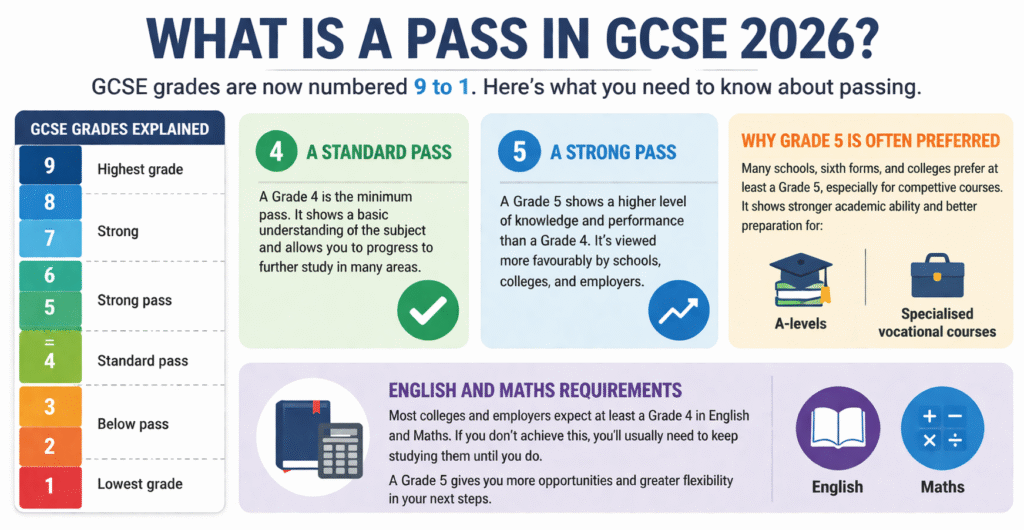
What Is a Pass in GCSE 2026?

In the GCSE grading system, results are measured on a numerical scale from 9 to 1, replacing the old A*–G system. Understanding what counts as a “pass” is essential for students planning further education or career steps in 2026.

GCSE Pass Grades Explained

A Grade 4 is officially recognised as a standard pass. This is the minimum level most students need to demonstrate a basic understanding of the subject. Achieving a Grade 4 allows students to progress to further study in many areas.

A Grade 5 is considered a strong pass. It indicates a higher level of knowledge and performance compared to Grade 4. While both are passes, a Grade 5 shows stronger academic ability and is often viewed more favourably.

Why Grade 5 Is Often Preferred

Many schools, sixth forms, and colleges prefer students to achieve at least a Grade 5, especially in competitive courses. This is because a strong pass suggests better readiness for more advanced study, such as A-levels or specialised vocational programmes. In some cases, institutions may set Grade 5 as their entry requirement.

English and Maths Requirements

Core subjects like English and Maths are particularly important. Most colleges and employers expect a minimum of Grade 4 in these subjects. If students do not achieve this, they are usually required to continue studying English and Maths until they reach the required level. However, achieving a Grade 5 can provide more opportunities and flexibility in further education pathways.

GCSE grade boundaries explained

GCSE Grade Boundaries and Pass Marks

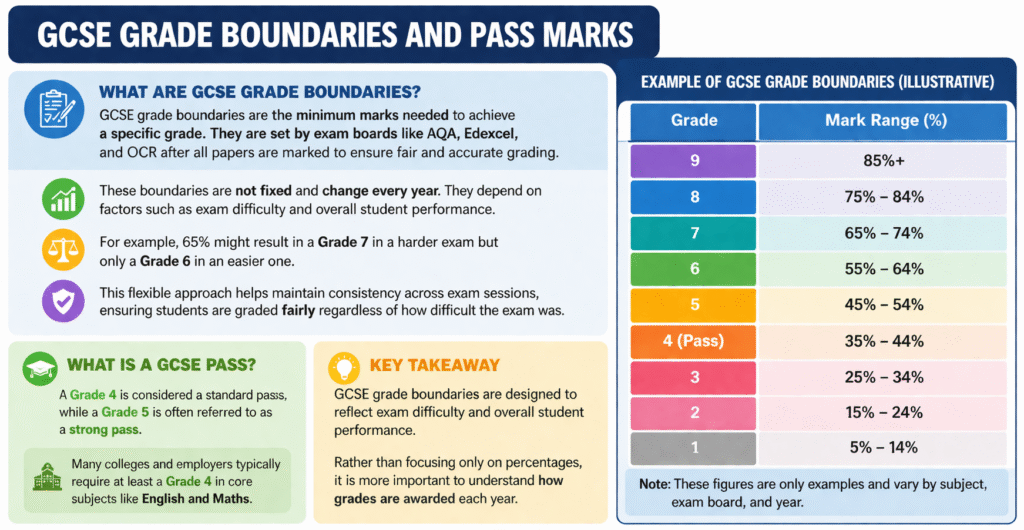
GCSE grade boundaries are the minimum marks needed to achieve a specific grade. They are set by exam boards like AQA, Edexcel, and OCR after all papers are marked to ensure fair and accurate grading.

These boundaries are not fixed and change every year. They depend on factors such as exam difficulty and overall student performance. For example, 65% might result in a Grade 7 in a harder exam but only a Grade 6 in an easier one.

This flexible approach helps maintain consistency across exam sessions, ensuring students are graded fairly regardless of how difficult the exam was.

Example of GCSE Grade Boundaries (Illustrative)

Grade Mark Range (%)
9 85%+
8 75%–84%
7 65%–74%
6 55%–64%
5 45%–54%
4 (Pass) 35%–44%
3 25%–34%
2 15%–24%
1 5%–14%

Note: These figures are only examples and vary by subject, exam board, and year.

What Is a GCSE Pass?

A Grade 4 is considered a standard pass, while a Grade 5 is often referred to as a strong pass. Many colleges and employers typically require at least a Grade 4 in core subjects like English and Maths.

Key Takeaway

GCSE grade boundaries are designed to reflect exam difficulty and overall student performance. Rather than focusing only on percentages, it is more important to understand how grades are awarded each year.

GCSE grading changes_ comparison infographic

GCSE Grades Equivalent to Old System (A–G)

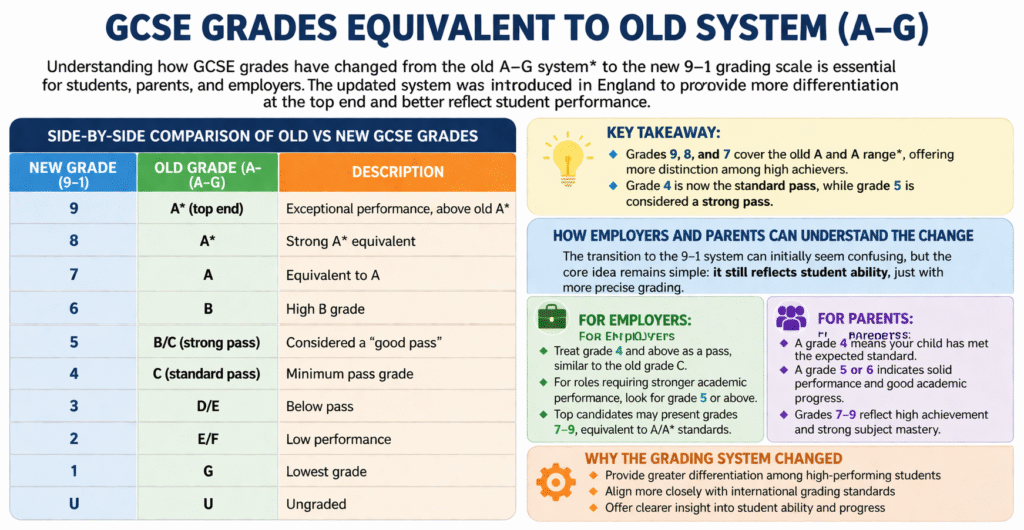
Understanding how GCSE grades have changed from the old A–G system* to the new 9–1 grading scale is essential for students, parents, and employers. The updated system was introduced in England to provide more differentiation at the top end and better reflect student performance.

Side-by-Side Comparison of Old vs New GCSE Grades

New Grade (9–1) Old Grade (A–G)* Description
9 A* (top end) Exceptional performance, above old A*
8 A* Strong A* equivalent
7 A Equivalent to A
6 B High B grade
5 B/C (strong pass) Considered a “good pass”
4 C (standard pass) Minimum pass grade
3 D/E Below pass
2 E/F Low performance
1 G Lowest grade
U U Ungraded

Key Takeaway:

  • ♦  Grades 9, 8, and 7 cover the old A and A range*, offering more distinction among high achievers.
  • ♦  Grade 4 is now the standard pass, while grade 5 is considered a strong pass.

How Employers and Parents Can Understand the Change

The transition to the 9–1 system can initially seem confusing, but the core idea remains simple: it still reflects student ability, just with more precise grading.

For Employers:

  • ♦  Treat grade 4 and above as a pass, similar to the old grade C.
  • ♦  For roles requiring stronger academic performance, look for grade 5 or above.
  • ♦  Top candidates may present grades 7–9, equivalent to A/A* standards.

For Parents:

  • ♦  A grade 4 means your child has met the expected standard.
  • ♦  A grade 5 or 6 indicates solid performance and good academic progress.
  • ♦  Grades 7–9 reflect high achievement and strong subject mastery.

Why the Grading System Changed

The new system was introduced to:

  • ♦  Provide greater differentiation among high-performing students
  • ♦  Align more closely with international grading standards
  • ♦  Offer clearer insight into student ability and progress
Why GCSE grading changed explained

Why the GCSE Grading System Changed

The GCSE grading system in the UK was reformed to provide a clearer and more accurate measure of student performance. One key aim was to better differentiate high-achieving students. Under the old A*–G system, many top performers were grouped together, whereas the 9–1 scale introduces additional top grades to highlight exceptional achievement more effectively.

The reform also helps align GCSEs with international standards, making UK qualifications easier to compare globally. In addition, it addresses grade inflation by introducing more rigorous assessments, ensuring that higher grades genuinely reflect stronger knowledge and skills.

What GCSE Grades Mean for Your Future

GCSE grades are an important foundation for your academic and career journey. They act as early indicators of your abilities and can influence whether you continue studying, begin working, or choose a vocational path.

College and Sixth Form Entry Requirements

Most colleges and sixth forms require at least a Grade 4 in core subjects like English and Maths. More competitive courses often ask for Grades 5 or 6 and above. Strong results provide more subject and institution choices, while lower grades may mean retaking certain subjects.

Apprenticeships and Vocational Routes

GCSE results are also key for apprenticeships and vocational training. Many programmes require a minimum of Grade 4 in English and Maths, while higher-level roles may expect stronger grades. Good results can improve your chances of securing better opportunities.

University Pathway Importance

Although universities mainly focus on A-levels, GCSE grades still matter. Many institutions consider them—especially English and Maths—when reviewing applications. Strong GCSEs reflect consistency and academic ability.

Overall, GCSE grades shape your future opportunities. Good results open more doors, but alternative pathways are always available if needed.

Tips for higher GCSE grades

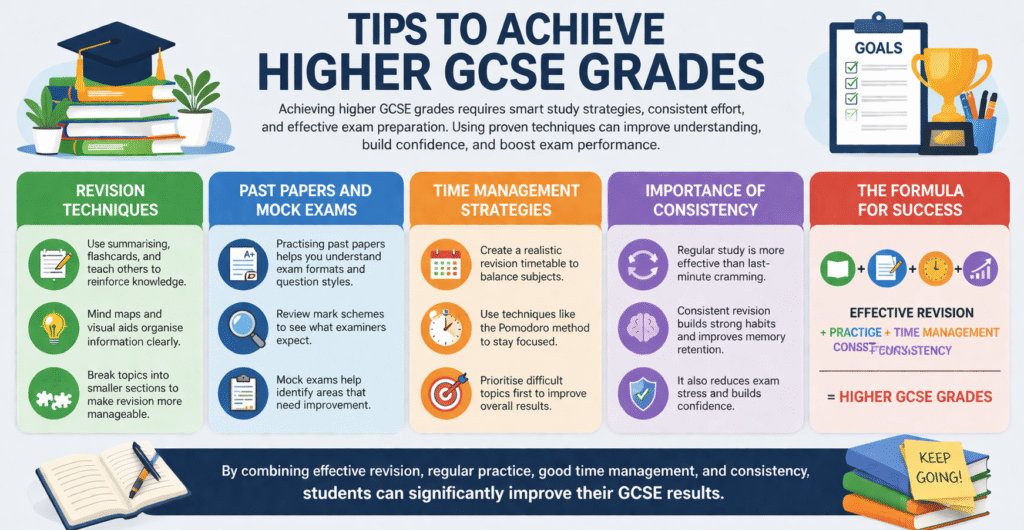
Tips to Achieve Higher GCSE Grades

Achieving higher GCSE grades requires smart study strategies, consistent effort, and effective exam preparation. Using proven techniques can improve understanding, build confidence, and boost exam performance.

Revision Techniques

Active learning methods such as summarising notes, using flashcards, and teaching others help reinforce knowledge. Mind maps and visual aids organise information clearly, while breaking topics into smaller sections makes revision more manageable.

Past Papers and Mock Exams

Practising past papers helps you understand exam formats, question styles, and time management. Reviewing mark schemes shows what examiners expect, and mock exams help identify areas that need improvement.

Time Management Strategies

Creating a realistic revision timetable ensures balanced study across subjects. Techniques like the Pomodoro method improve focus, while prioritising difficult topics first can enhance overall results.

Importance of Consistency

Regular study is more effective than last-minute cramming. Consistent revision builds strong habits, improves memory retention, and reduces exam stress.

By combining effective revision, regular practice, good time management, and consistency, students can significantly improve their GCSE results.

Conclusion

understanding GCSE grades in 2026 using the 9–1 scale, along with pass marks and their equivalents, helps learners set clear academic goals and track their progress effectively. However, achieving strong results goes beyond knowing the grading system. Applying effective revision techniques, practising with past papers and mock exams, and developing strong time management strategies are essential for exam success. Consistency in study habits plays a crucial role in building confidence and retaining knowledge over time. By combining a clear understanding of the grading structure with disciplined preparation, students can maximise their performance and approach their GCSE exams with confidence.

FAQs — Understanding GCSE Grades 2026 9–1 Scale, Pass Marks and Equivalents

1. What is a pass mark in GCSE 2026?

In GCSE 2026, a Grade 4 is considered a standard pass, while a Grade 5 is known as a strong pass. Many schools and employers accept Grade 4, but Grade 5 is often preferred for further study.

2. Is Grade 4 a fail in GCSE?

No, Grade 4 is not a fail. It is officially recognised as a pass. However, some colleges and sixth forms may require a Grade 5 or above for certain courses.

3. What GCSE grade is equivalent to an A?

A Grade 7 is broadly equivalent to an A under the old grading system. Grades 8 and 9 represent even higher achievement, with Grade 9 being the top level.

4. Are GCSE grade boundaries the same every year?

No, GCSE grade boundaries change each year. They depend on factors such as exam difficulty and overall student performance, so the marks needed for each grade may vary annually.

5. What is the highest GCSE grade?

The highest GCSE grade is Grade 9. It is awarded to the top-performing students and represents exceptional academic achievement above the old A* standard.

6. Do universities look at GCSE grades?

Yes, universities do consider GCSE grades, especially in core subjects like English and Maths. While A-levels are more important, strong GCSE results can support your overall application.

Find the Course That Suits You!

We create outstanding professionals in Employability, Business, Health Care, Marketing, Language, and Functional Skills. Whether you're starting or advancing your career, we turn your passion into success as the UK’s most trusted e-learning course provider.
5000+ course
Sam Walker

Article by

Sam Walker

Sam Walker is an education specialist and author at One Education, bringing over 4 years of experience in creating practical resources and strategies to support teachers and enhance student learning.

top

Hear What Our Learners Say About Us

Home Courses Search