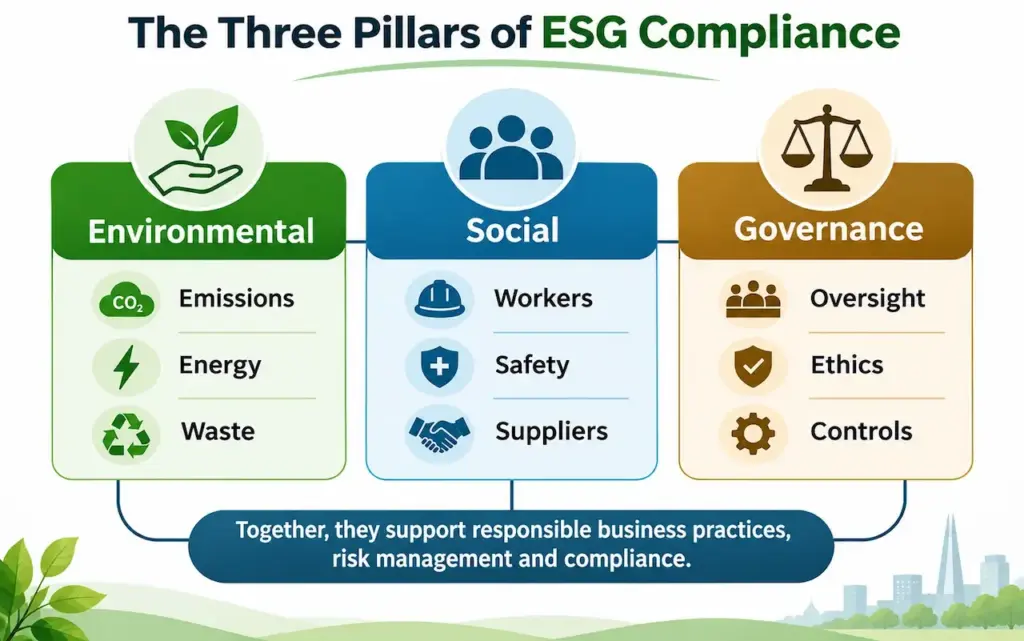
ESG compliance is the process of identifying and meeting the environmental, social and governance responsibilities that apply to an organisation. Those responsibilities may arise from UK legislation, regulatory rules, reporting obligations or commitments a business has chosen to make. ESG is therefore not a single certificate or a universal checklist.
A large company might be required to disclose energy use, while a regulated investment firm has different obligations concerning sustainability claims. A smaller supplier might face customer requests for evidence even when a particular disclosure law does not apply to it. This guide explains the three ESG pillars, the main UK requirements, practical ways to manage them and examples of how responsibilities differ between organisations.
What Is ESG Compliance?
ESG stands for environmental, social and governance. In a compliance context, it concerns how an organisation understands the rules relevant to these areas, assigns responsibility for meeting them and keeps evidence of what it has done. It can also involve regulator rules and contractual commitments.
It helps to distinguish three categories. Legal obligations are enforceable requirements for organisations within their scope. Voluntary standards, such as management system and procurement guidance, offer structured approaches without automatically becoming law. Commercial expectations can arise when lenders, investors or customers ask a company to provide sustainability information. A business needs to know which category it is dealing with before presenting a practice as mandatory.
ESG is related to corporate social responsibility (CSR), although the terms are not interchangeable. CSR often describes a company’s wider approach to acting responsibly, including voluntary initiatives and engagement with communities. ESG is frequently used to examine specific risks, controls, performance measures and disclosures. Readers exploring this broader relationship can refer to Corporate Social Responsibility Training.
Effective ESG compliance is not simply producing an annual report. It requires clear ownership of decisions, reliable records and the ability to explain how stated policies translate into business activities. An ESG statement cannot replace compliance evidence.
What Are the Three Pillars of ESG Compliance?
Environmental Responsibilities
The environmental pillar concerns how business operations affect the natural world. Relevant topics include greenhouse gas emissions, electricity and fuel consumption, pollution prevention, waste management, water use and the use of raw materials. The appropriate controls depend on the organisation’s activities and permits, not merely its stated sustainability ambitions.
For example, a warehouse operator could monitor electricity and vehicle fuel use, check the environmental rules affecting its premises and keep records of changes to energy consumption. Such monitoring might support a reporting duty, an improvement programme or both, depending on its circumstances.
Social Responsibilities
The social pillar concerns people affected by an organisation’s decisions. It covers matters such as fair employment, health and safety, workforce wellbeing, human rights and treatment of workers in supply chains. A business buying goods from overseas may need to examine recruitment practices and labour conditions among its suppliers, rather than assuming that signing a purchasing contract resolves those risks.
An internal supplier policy may require checks that go beyond a specific reporting obligation. What matters is being clear about the source of each responsibility and whether the organisation follows its own policy.
Governance Responsibilities
Governance concerns how a company is directed, controlled and held accountable. Relevant measures include board oversight, ethical conduct, anti-bribery procedures, accurate records, whistleblowing arrangements and internal controls. Governance gives environmental and social commitments a responsible decision-maker and a process for responding when something goes wrong.
A management team, for instance, might assign ownership of emissions data, require an independent review of calculations and record how discrepancies are corrected. That is governance supporting environmental accountability, rather than a separate sustainability activity.
Is ESG Compliance Mandatory in the UK? Key Rules Explained
There is no single UK law requiring every organisation to comply with one identical ESG framework. The relevant requirements depend on factors including company structure, size, listing status, regulated activities and operations. Some duties require disclosure, others require assessments or controls, and several widely used standards remain voluntary.
Climate, Carbon and Energy Reporting Requirements
Under Streamlined Energy and Carbon Reporting (SECR), qualifying UK quoted companies, large unquoted companies and large limited liability partnerships must disclose specified energy and greenhouse gas information. See the GOV.UK environmental reporting guidelines for exemptions and reporting categories.
Separate mandatory climate-related financial disclosure rules apply to certain publicly quoted companies, large private companies and LLPs. These focus on how climate risks and opportunities affect the business, rather than simply reporting a carbon total. See the government’s climate disclosure guidance for the rules.
The Energy Savings Opportunity Scheme (ESOS) is different again: it requires qualifying large undertakings to assess energy use and identify saving opportunities. Under Phase 4, qualification is assessed on 31 December 2026; a large undertaking generally meets the test if it has at least 250 employees, or turnover above £44 million and a balance sheet total above £38 million. The official ESOS guidance covers group rules and the 5 December 2027 notification deadline.
Modern Slavery and Supply-Chain Responsibilities
Section 54 of the Modern Slavery Act 2015 requires certain commercial organisations to publish an annual modern slavery statement. The conditions include supplying goods or services, carrying on business or part of a business in the UK, and having annual turnover of £36 million or more. Group structures may also matter.
The annual statement describes steps taken to address slavery and trafficking risks, or states that none were taken. It cannot guarantee a supply chain is free of exploitation. See the Home Office’s transparency in supply chains guidance.
FCA Sustainability Rules and Responsible Investment
The Financial Conduct Authority (FCA) has specific rules affecting sustainability-related financial products and services. Its anti-greenwashing rule applies to FCA-authorised firms when they make sustainability-related claims about financial products or services. Such claims must be fair, clear and not misleading.
Within the FCA’s Sustainability Disclosure Requirements (SDR) regime, relevant asset managers also face investment product naming, marketing and disclosure requirements. Investment labels are voluntary, with eligibility criteria. These rules are not universal. See FCA SDR guidance. Readers looking to understand how ESG considerations relate to investment choices may find ESG and Impact Investing Training useful background.
UK Sustainability Reporting Standards and the 2027 Changes
The UK published UK Sustainability Reporting Standards (UK SRS) S1 and S2 in February 2026. S1 addresses sustainability-related financial disclosures, while S2 focuses on climate-related disclosures. The government confirms voluntary availability.
Separately, the FCA finalised new comply-or-explain reporting rules for companies with shares in specified UK listing categories, including the commercial companies and transition categories. The rules apply to accounting periods starting on or after 1 January 2027, with first reporting in 2028. Transitional reliefs cover one year for Scope 3 and two years for wider S1 disclosures. See FCA PS26/19. This is not a universal business requirement.
Environmental Claims and Greenwashing
Businesses also need to consider how they describe environmental benefits to customers. The Competition and Markets Authority’s Green Claims Code explains how to make environmental claims consistent with consumer protection law. Claims should be clear, accurate, substantiated and not omit information that would change their meaning. The code provides guidance, not certification.
| Requirement or framework | Who it may apply to | Main responsibility |
|---|---|---|
| SECR | Qualifying quoted companies, large unquoted companies and large LLPs | Disclose specified energy and emissions information |
| Climate-related financial disclosures | Certain publicly quoted companies, large private companies and LLPs | Report relevant climate risks and opportunities |
| ESOS Phase 4 | Qualifying large undertakings and groups | Undertake energy assessments and meet scheme reporting duties |
| Modern Slavery Act, section 54 | In-scope commercial organisations meeting the £36 million turnover test | Publish an annual modern slavery statement |
| FCA SDR | Relevant FCA-authorised firms, asset managers and distributors | Meet applicable sustainability-claim and investment product rules |
| UK SRS listed-company rules | Issuers within specified FCA listing categories | Report on a comply-or-explain basis from relevant 2027 accounting periods |
Want to understand how ESG reporting, carbon accounting, environmental management and auditing connect? Explore One Education’s ESG Compliance & Sustainability Management Bundle for a broader introduction to these subjects.
How Can UK Businesses Put ESG Compliance into Practice?
Start with the organisation’s obligations, not a generic reporting template.
Step 1: Identify Applicable ESG Requirements
Start with a register of relevant laws, regulator rules, permits, reporting obligations, contracts and voluntary commitments. Check the company’s legal structure, employee numbers, financial thresholds, operating locations and regulated activities. Record the source of each obligation, the person responsible, the reporting period and the evidence needed to demonstrate compliance.
Check group-level tests for subsidiaries, and assign responsibility for monitoring changes.
Step 2: Assess ESG Risks and Priorities
Identify where the business could cause harm, fail to meet an obligation or face significant disruption. This may involve environmental aspects of operations, worker safety, supplier risks, governance weaknesses and stakeholder concerns. Review incident records, contracts and past audit findings.
Prioritisation should reflect the organisation’s actual activities. A company operating industrial sites will face different environmental exposures from an office-based consultancy. Materiality assessments can help decide which issues merit attention, but the applicable reporting framework determines how materiality must be judged when formal disclosure rules apply.
Step 3: Collect and Verify ESG Performance Data
Collect information that can be traced back to an identifiable source, such as energy bills, meter readings, fuel records, procurement systems or workplace incident logs. Define who gathers each dataset, the period it covers and how estimates are documented. A figure presented without its calculation method is difficult to verify or compare.
For greenhouse gases, Scope 1 covers direct emissions from sources owned or controlled by the organisation; Scope 2 covers indirect emissions from purchased electricity, steam, heating and cooling; and Scope 3 concerns other indirect emissions across the value chain. The GHG Protocol Corporate Standard provides the basis for company-level inventories, while its Scope 3 Standard gives dedicated value-chain guidance. Those exploring the principles behind such measurements can consult Carbon Accounting Training.
Build review checks into the process. Reconcile reported totals with underlying records, flag missing supplier information and document any assumptions. Qualitative controls and records matter alongside metrics.
Step 4: Strengthen Environmental Management and Procurement
An environmental management system gives a business a structured way to identify impacts, set objectives, allocate responsibilities and review results. ISO 14001:2026, the current edition of the international environmental management systems standard, provides requirements and guidance for such a system. Organisations should distinguish following its principles from obtaining certification and from meeting every law that affects their operations.
Procurement decisions also affect sustainability performance. ISO 20400:2017 provides voluntary guidance on integrating sustainability into purchasing. In practice, a buyer might assess supplier labour practices, product durability or environmental information before awarding a contract. Requirements should match risks and verifiable information.
Step 5: Use Internal Audits and Management Reviews
Internal audits test whether established processes are being followed and whether records support reported results. An auditor might sample invoices used in emissions calculations, review supplier assessment files or check whether a corrective action was completed. Record each finding, owner and corrective deadline.
Management reviews then consider significant findings, changing risks and resources needed to improve controls. Internal audits are not equivalent to external assurance, and neither should automatically be described as ISO certification. Each has a different purpose, scope and basis for its conclusion.
Step 6: Report Accurately and Review Performance
Prepare each disclosure against the relevant rules, including required reporting boundaries, metrics, explanations and approvals. State limitations where data is incomplete and avoid making broad claims from narrow evidence. For instance, a reduction in emissions at one site should not be described as a company-wide improvement unless the reported boundary supports that conclusion.
Review evidence before deadlines and when operations change.
ESG Compliance Examples in UK Organisations
The following scenarios are hypothetical. They illustrate different responsibilities, not real company case studies or proof that a particular business has met every applicable law.
Example 1: A UK Manufacturing Business
A manufacturer runs production equipment, owns delivery vehicles and uses substantial electricity. Its finance and environmental teams first establish whether the business falls within SECR, ESOS or climate-related disclosure rules. They collect meter readings, fuel invoices and organisational records before preparing any required returns. A site manager also tracks waste handling and environmental permit conditions separately from corporate reporting.
If discrepancies appear between utility records and the emissions calculation, the team documents and investigates them before publication. The lesson is to establish scope and maintain an audit trail.
Example 2: A Retail Business Managing Suppliers
A retailer sources clothing and household products from multiple suppliers. Its procurement team examines recruitment practices and supplier documentation, while its legal team checks whether Section 54’s reporting conditions apply. The marketing team separately reviews claims such as “environmentally friendly” against the available evidence.
Even if the retailer is outside one statutory reporting threshold, its customers or commercial partners may still ask for credible labour and sourcing information. Reporting duties and wider risk management should be distinguished.
Example 3: A Financial Services Firm
An FCA-authorised asset manager plans to describe a retail investment product using sustainability-related wording. Its product and compliance teams check the relevant SDR naming and disclosure rules, determine whether a voluntary label is appropriate and confirm that claims about the product are substantiated.
They also examine how information is presented to retail investors, including any limitations or qualifying statements. Product rules require attention to specific claims and scope.
Common ESG Compliance Mistakes to Avoid
One common error is treating a voluntary framework as though it were legislation. This can mislead management about what is required, while distracting attention from an obligation that actually applies. Another is copying a larger company’s ESG report without checking whether the same disclosure rules fit the organisation’s circumstances.
Poor evidence creates a different risk. If supplier information is incomplete, emissions estimates are unexplained or environmental marketing claims lack support, confident public statements may be difficult to defend. Certification can demonstrate conformity with a particular standard within its scope; it does not prove compliance with every relevant law.
Finally, businesses sometimes assign ESG reporting to one department without giving it access to operational records or decision-makers. Weak coordination leaves gaps between policies, data and action. Regulatory reviews, clear accountability and proportionate internal checks are more useful than an impressive document unsupported by everyday practice.
Conclusion
ESG compliance in the UK is best understood as a set of responsibilities shaped by an organisation’s activities, rather than a single standard that every business must follow. Environmental, social and governance issues overlap, but the applicable duties and evidence requirements can differ substantially. Understanding the scope of each rule is the starting point for credible reporting and responsible decisions.
Businesses can then prioritise relevant risks, maintain dependable records and review whether their controls work. Where legal or regulatory requirements are uncertain, current official guidance and appropriate professional advice remain more reliable than assumptions based on another organisation’s ESG report.
Related Articles