Missed deadlines, budget overruns, poor communication, and unclear responsibilities are some of the most common reasons projects fail. Regardless of the industry, organisations often face challenges in keeping projects on track, managing risks effectively, and ensuring that everyone involved understands their role and responsibilities.
According to industry studies, many projects struggle with delays, rising costs, and changing requirements throughout their lifecycle. Successful organisations recognise that delivering a project requires more than technical expertise—it demands a structured approach to planning, governance, risk management, and stakeholder communication.

This is where PRINCE2 comes in. PRINCE2 (Projects IN Controlled Environments) is one of the world’s most widely recognised project management methodologies, providing a proven framework for managing projects of all sizes and complexities. By offering clear processes, defined roles, and a focus on business value, PRINCE2 helps organisations improve project success rates, minimise risks, and achieve their objectives more efficiently. In this article, we will explore what PRINCE2 is and why it plays such an important role in modern project management.
What Is PRINCE2?
PRINCE2 (Projects IN Controlled Environments) is a globally recognised project management framework that provides a structured approach to planning, managing, and delivering projects. Originally developed by the UK government, it has evolved into one of the most widely adopted project management approaches across industries and countries.
Designed to support projects of all sizes and complexities, PRINCE2 offers a clear framework that guides teams through every stage of a project, from initial planning and business justification to execution, monitoring, and final delivery. Its structured processes, defined roles, and focus on accountability help organisations maintain consistency and improve project outcomes.
Unlike traditional project management approaches that are often described as methodologies, PRINCE2 can be viewed as a decision-making framework. It enables organisations to maintain control throughout the project lifecycle while ensuring that activities remain aligned with business objectives and deliver measurable value.
Because of its flexibility and scalability, PRINCE2 can be tailored to suit a wide range of sectors, including IT, construction, healthcare, finance, education, and public services. This adaptability has made it a trusted choice for organisations seeking a reliable framework for successful project delivery.
Why Was PRINCE2 Developed?
PRINCE2 was developed to address the increasing complexity of projects and provide organisations with a structured approach to project management. As projects grew larger, businesses needed a reliable method to manage risks, control resources, and achieve successful outcomes.
It was also created to establish standardised project governance, ensuring projects followed consistent processes, clear roles, and effective controls. Additionally, organisations required greater accountability and measurable results, making it easier to track progress, justify investments, and deliver value to stakeholders.
PRINCE2 Development Timeline
| Year | Development |
|---|---|
| 1989 | PRINCE was introduced for UK government IT projects. |
| 1996 | PRINCE2 was launched for use across all industries. |
| Today | PRINCE2 is used worldwide in public and private sectors. |
If you’d like to strengthen your project management knowledge and earn a globally recognised qualification, consider enrolling in the PRINCE2® 7 Foundation (with Official Exam and Re-sit) course. This comprehensive programme will help you understand the PRINCE2® methodology and prepare confidently for the official certification exam. Start your learning journey today with One Education.
The Core Philosophy Behind PRINCE2
At its core, PRINCE2 is built around a simple question: “Does this project still provide value to the organisation?” Every major decision is guided by ongoing business justification, ensuring that projects remain worthwhile and aligned with organisational goals.
The methodology focuses on business value by requiring a clear business case throughout the project lifecycle. It also promotes controlled delivery through structured stages, allowing progress to be monitored and managed effectively.
PRINCE2 places strong emphasis on risk awareness, helping teams identify and manage potential issues before they affect project outcomes. Clear roles and responsibilities ensure accountability, while regular assessments support continuous review of costs, benefits, risks, and progress.
By combining these principles, PRINCE2 helps organisations deliver projects successfully while maintaining control and maximising value.
The Seven Principles of PRINCE2
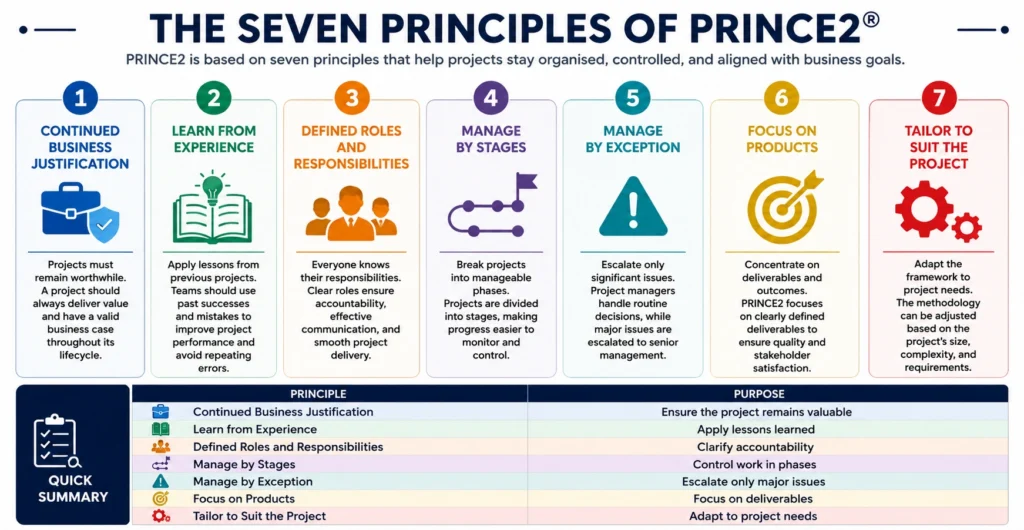
PRINCE2 is based on seven principles that help projects stay organised, controlled, and aligned with business goals.
💼 1. Continued Business Justification
Projects must remain worthwhile.
A project should always deliver value and have a valid business case throughout its lifecycle.
📚 2. Learn from Experience
Apply lessons from previous projects.
Teams should use past successes and mistakes to improve project performance and avoid repeating errors.
👥 3. Defined Roles and Responsibilities
Everyone knows their responsibilities.
Clear roles ensure accountability, effective communication, and smooth project delivery.
🛤️ 4. Manage by Stages
Break projects into manageable phases.
Projects are divided into stages, making progress easier to monitor and control.
⚠️ 5. Manage by Exception
Escalate only significant issues.
Project managers handle routine decisions, while major issues are escalated to senior management.
🎯 6. Focus on Products
Concentrate on deliverables and outcomes.
PRINCE2 focuses on clearly defined deliverables to ensure quality and stakeholder satisfaction.
🔧 7. Tailor to Suit the Project
Adapt the framework to project needs.
The methodology can be adjusted based on the project’s size, complexity, and requirements.
Quick Summary
| Principle | Purpose |
|---|---|
| 💼 Continued Business Justification | Ensure the project remains valuable |
| 📚 Learn from Experience | Apply lessons learned |
| 👥 Defined Roles and Responsibilities | Clarify accountability |
| 🛤️ Manage by Stages | Control work in phases |
| ⚠️ Manage by Exception | Escalate only major issues |
| 🎯 Focus on Products | Focus on deliverables |
| 🔧 Tailor to Suit the Project | Adapt to project needs |
Why Is PRINCE2 Important in Project Management?
PRINCE2 is an effective project management methodology that provides a structured approach to planning, managing, and delivering projects successfully. It helps organisations maintain control, reduce risks, and achieve project objectives efficiently.
One of its key benefits is better project control. By dividing projects into manageable stages, PRINCE2 makes it easier to monitor progress, identify issues early, and keep projects on track.
PRINCE2 also supports stronger risk management by helping teams identify and address potential problems before they become costly issues. This proactive approach reduces uncertainty and improves project outcomes.
The framework promotes improved communication through clearly defined roles, responsibilities, and reporting structures. This reduces confusion and keeps stakeholders informed throughout the project lifecycle.
In addition, PRINCE2 enables better resource management, ensuring that time, budgets, and personnel are used effectively. Regular reviews help organisations allocate resources where they are needed most.
Another major advantage is increased stakeholder confidence. Regular updates and control points provide decision-makers with greater visibility into project progress and performance.
Ultimately, PRINCE2 contributes to higher project success rates by ensuring teams work towards clearly defined objectives, deliverables, and business goals. This structured approach helps organisations deliver projects more consistently and successfully.
How PRINCE2 Works in Practice
A practical example helps demonstrate how PRINCE2 is applied in real-world projects. Imagine an organisation implementing a new Customer Relationship Management (CRM) system to improve customer service, sales tracking, and communication.
Define Clear Objectives
The project starts by identifying clear goals, such as improving customer data management, increasing sales efficiency, and enhancing customer service. PRINCE2 ensures these objectives are supported by a strong business case.
Assign Responsibilities
PRINCE2 defines who is responsible for what. A Project Board provides oversight, the Project Manager handles daily activities, and team members carry out specific tasks. This creates accountability and clear communication.
Assess Risks
Potential risks, such as data migration issues, budget overruns, or staff resistance to change, are identified early. PRINCE2 encourages proactive risk management to minimise disruptions.
Approve Each Stage
The project is divided into manageable stages, such as planning, system configuration, testing, training, and deployment. At the end of each stage, progress is reviewed before moving forward.
Monitor Progress
Regular reporting helps track performance, costs, timelines, and risks. This allows issues to be addressed quickly and keeps the project under control.
Deliver Measurable Benefits
Once the CRM system is implemented, the organisation measures outcomes such as improved customer satisfaction, better sales reporting, and increased efficiency to ensure the project delivers real value.
This example shows how PRINCE2 provides a structured framework that helps organisations manage projects effectively while maintaining control, reducing risks, and achieving measurable results.
PRINCE2 vs Traditional Project Management
When comparing PRINCE2 with traditional project management approaches, the key difference lies in structure, governance, and accountability. While traditional project management can be effective for smaller or less complex projects, PRINCE2 provides a proven framework designed to improve control, consistency, and project success.
| Traditional Project Management | PRINCE2 |
|---|---|
| Often informal and flexible | Highly structured and process-driven |
| Limited governance and oversight | Strong governance throughout the project lifecycle |
| Reactive approach to managing risks | Proactive risk identification and management |
| Roles and responsibilities may be unclear | Clearly defined roles and accountabilities |
| Success can be difficult to measure | Focuses on benefits, outcomes, and measurable success |
Why Many Organisations Prefer PRINCE2
PRINCE2 provides a clear framework for managing projects from start to finish. It defines responsibilities, supports regular monitoring, and ensures projects remain aligned with business goals and expected benefits.
Unlike traditional project management approaches, which often rely on individual experience and internal practices, PRINCE2 offers a consistent and structured methodology. This helps organisations achieve greater control, accountability, and project success.
PRINCE2 vs Agile: Which Is Better?
PRINCE2 and Agile are often compared, but they are not direct competitors. They focus on different aspects of project management and can work effectively together.
Agile focuses on flexible delivery, continuous improvement, and adapting to changing requirements. It is ideal for projects that need quick responses to feedback and change.
PRINCE2 focuses on governance, planning, risk management, and control. It provides a structured framework to keep projects aligned with business objectives.
Many organisations combine both approaches to gain the benefits of strong governance and flexible delivery. This allows teams to maintain control while remaining adaptable.
Rather than asking which is better, it is more useful to consider which approach—or combination of approaches—best suits your project’s needs.
Industries That Use PRINCE2
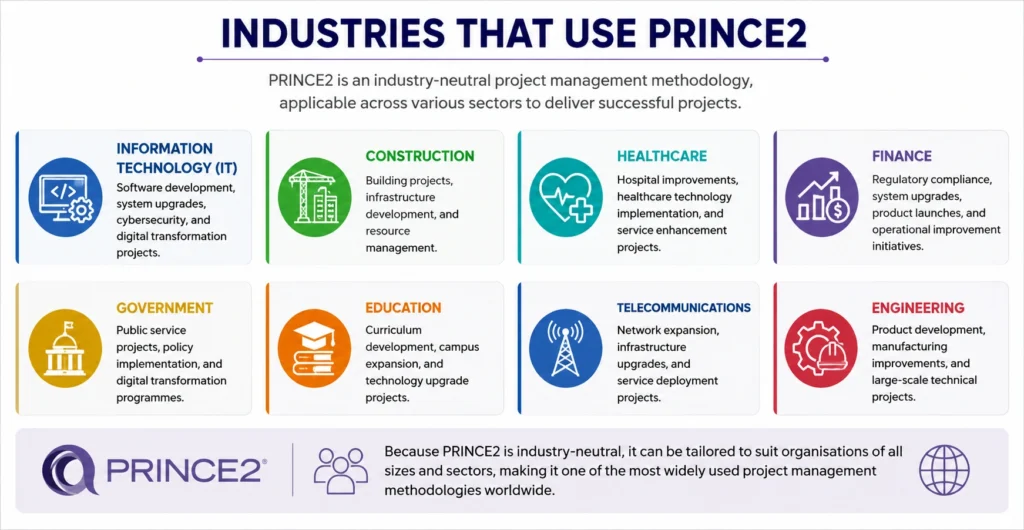
PRINCE2 is an industry-neutral project management methodology, meaning it can be applied to projects across various sectors. Its flexible and structured approach helps organisations manage projects efficiently, regardless of industry.
- ♦ Information Technology (IT): Software development, system upgrades, cybersecurity, and digital transformation projects.
- ♦ Construction: Building projects, infrastructure development, and resource management.
- ♦ Healthcare: Hospital improvements, healthcare technology implementation, and service enhancement projects.
- ♦ Finance: Regulatory compliance, system upgrades, product launches, and operational improvement initiatives.
- ♦ Government: Public service projects, policy implementation, and digital transformation programmes.
- ♦ Education: Curriculum development, campus expansion, and technology upgrade projects.
- ♦ Telecommunications: Network expansion, infrastructure upgrades, and service deployment projects.
- ♦ Engineering: Product development, manufacturing improvements, and large-scale technical projects.
Because PRINCE2 is industry-neutral, it can be tailored to suit organisations of all sizes and sectors, making it one of the most widely used project management methodologies worldwide.
Who Should Learn PRINCE2?
PRINCE2 is ideal for professionals who want to develop project management skills and improve project success across various industries.
- ♦ Project Managers – Enhance project planning, risk management, and delivery capabilities.
- ♦ Team Leaders – Improve team coordination, communication, and project execution.
- ♦ Business Analysts – Better align project outcomes with business requirements and stakeholder needs.
- ♦ Programme Managers – Manage multiple projects with greater consistency and control.
- ♦ Operations Managers – Successfully oversee change initiatives and process improvement projects.
- ♦ IT Professionals – Apply structured project management practices to technology and digital projects.
- ♦ Consultants – Strengthen project delivery skills and professional credibility with clients.
- ♦ Aspiring Project Professionals – Build a strong foundation for a career in project management and gain recognised industry knowledge.
Career Benefits of PRINCE2 Certification
A PRINCE2® certification can significantly enhance your career prospects by equipping you with globally recognised project management skills. It demonstrates your ability to manage projects in a structured, efficient, and controlled manner, making you a valuable asset to employers across various industries. With this certification, you can access better job opportunities, higher earning potential, and increased job security. It also strengthens your leadership, planning, and risk management abilities, helping you confidently handle complex projects and advance into senior management roles.
International Recognition
PRINCE2 is a globally recognised project management methodology used across a wide range of industries. Certification demonstrates your ability to apply a structured approach to project delivery and can support opportunities in different countries and sectors.
Strong Project Management Foundation
PRINCE2 provides a clear framework for planning, managing, and controlling projects. It helps professionals develop essential skills in governance, risk management, and project delivery.
Better Career Prospects
Many employers value recognised project management qualifications. PRINCE2 certification can strengthen your CV and help you stand out when applying for project-related roles.
Increased Credibility
A PRINCE2 certification demonstrates your knowledge of established project management practices, enhancing your professional reputation and employer confidence.
Improved Leadership Skills
PRINCE2 promotes effective communication, stakeholder management, and team coordination, helping professionals become more confident and capable leaders.
Long-Term Professional Growth
The practical skills gained through PRINCE2 can support ongoing career development and prepare professionals for greater project responsibilities in the future.
The Future of PRINCE2
PRINCE2 continues to evolve alongside modern project management trends, making it a valuable methodology for today’s organisations.
Hybrid Project Management
Many organisations now combine PRINCE2’s governance framework with Agile delivery methods. This hybrid approach provides strong project control while allowing teams to remain flexible and responsive to change.
AI-Assisted Project Management
Artificial intelligence is becoming increasingly important in project management. Project managers use AI tools for reporting, risk analysis, and resource forecasting, helping them make faster and more informed decisions.
Greater Focus on Business Value
Modern organisations prioritise measurable outcomes over simply completing tasks. PRINCE2’s business-case-driven approach ensures projects remain aligned with organisational goals and deliver real value.
Looking Ahead
With its ability to support hybrid working, integrate AI technologies, and focus on business benefits, PRINCE2 is well-positioned to remain relevant in the future of project management.
Conclusion
PRINCE2 is a structured and widely recognised project management methodology that provides organisations with a clear framework for planning, managing, and delivering projects successfully. Its focus on defined roles, controlled processes, risk management, and continuous business justification helps teams maintain efficiency, accountability, and alignment with project objectives. By improving communication, reducing uncertainty, and supporting better decision-making throughout the project lifecycle, PRINCE2 enables organisations to achieve consistent results and maximise the value of their projects, making it an essential approach for effective project management across a wide range of industries.
FAQs — What Is PRINCE2 and Why Is It Important in Project Management?
1. What is PRINCE2?
PRINCE2 (Projects IN Controlled Environments) is a structured project management methodology that provides a clear framework for planning, managing, and delivering projects successfully.
2. What does PRINCE2 stand for?
PRINCE2 stands for “Projects IN Controlled Environments.”
3. Why is PRINCE2 important in project management?
PRINCE2 helps organisations manage projects efficiently by improving planning, controlling risks, defining responsibilities, and ensuring projects stay aligned with business objectives.
4. What are the main benefits of using PRINCE2?
Key benefits include better project control, improved communication, effective risk management, clear accountability, and a higher likelihood of project success.
5. Is PRINCE2 suitable for all types of projects?
Yes. PRINCE2 is highly flexible and can be tailored to suit projects of different sizes, industries, and levels of complexity.
Article by
Sam Walker is an education specialist and author at One Education, bringing over 4 years of experience in creating practical resources and strategies to support teachers and enhance student learning.
Related Articles
Get a FREE Course
- Learn useful skills online free
- Get CPD accredited certificate
- Add it to your CV today!

Jul, 03, 2026