Why Temperature Control Is Everything in Food Safety

May 17, 2026 | 17 minutes | 36 Readers

In the fast-paced world of UK catering, temperature control is the invisible thread that holds a successful business together. Whether you are running a high-end restaurant in London, a school canteen, or a weekend street food stall, mastering food temperatures is not just about culinary excellence—it is a critical legal and safety requirement. Failure to manage these “critical control points” can lead to more than just a ruined batch of food. It can result in a “0” Food Hygiene Rating,

In the fast-paced world of UK catering, temperature control is the invisible thread that holds a successful business together. Whether you are running a high-end restaurant in London, a school canteen, or a weekend street food stall, mastering food temperatures is not just about culinary excellence—it is a critical legal and safety requirement.

Failure to manage these “critical control points” can lead to more than just a ruined batch of food. It can result in a “0” Food Hygiene Rating, heavy fines under the Food Safety Act 1990, or, in the worst-case scenario, serious outbreaks of foodborne illness. This guide provides a comprehensive breakdown of the UK’s temperature standards to keep your customers safe and your business compliant.

Why Food Temperature Control Matters in the UK

The primary goal of temperature control is to manage the growth of harmful pathogens. In the UK, food poisoning affects millions of people each year, often due to improper storage or undercooking. Every year, the Food Standards Agency estimates around 2.4 million cases of foodborne illness occur in the UK—the majority linked to improper food handling.

  • ♦  The Link Between Temperature and Foodborne Illness: Bacteria such as Salmonella, Campylobacter, and E. coli are living organisms that require specific conditions to thrive.
  • ♦  Rapid Multiplication: When food is left at ambient temperatures, these bacteria can multiply every 20 minutes, turning a minor oversight into a serious public health risk.
  • ♦  Breaking the Cycle: By strictly controlling temperatures—either by chilling food to keep bacteria dormant or cooking it to kill them—you break the cycle of contamination.
  • ♦  Legal Framework: UK food businesses are legally required under the Food Safety Act 1990 and the Food Hygiene Regulations 2006 to implement HACCP-based food safety management systems, with temperature control at their core.
  • ♦  Due Diligence: These regulations mandate that all food businesses implement a food safety management system based on HACCP principles, which includes keeping accurate temperature records as proof of “due diligence.”

Getting this right is not just best practice—it is the law. For those in supervisory roles, mastering these principles is a fundamental requirement for ensuring full compliance and maintaining high kitchen hygiene standards.

What is the Food Safety "Danger Zone" in the UK?

The food temperature danger zone in the UK is between 8°C and 63°C. This is the range of temperatures at which bacteria found in or on food can multiply rapidly, potentially to levels that can cause illness.

The 8°C to 63°C Danger Zone Explained

This is the temperature range where bacteria grow most quickly.

  • ♦  Below 8°C → bacterial growth slows significantly, which is why refrigeration is so effective at extending the shelf life of food.
  • ♦  Above 63°C → most bacteria stop multiplying, which is why hot holding food above this temperature during service is a legal requirement.

Keeping food out of this range is essential for safety.

The danger zone is not absolute: some bacteria such as Listeria monocytogenes can grow at temperatures as low as 0°C, and some bacterial toxins (such as those produced by Staphylococcus aureus) remain heat-stable even after cooking. However, keeping food out of the 8°C–63°C range remains the cornerstone of safe food temperature management.

UK Food Safety Temperature Chart

UK Food Safety Temperature Chart

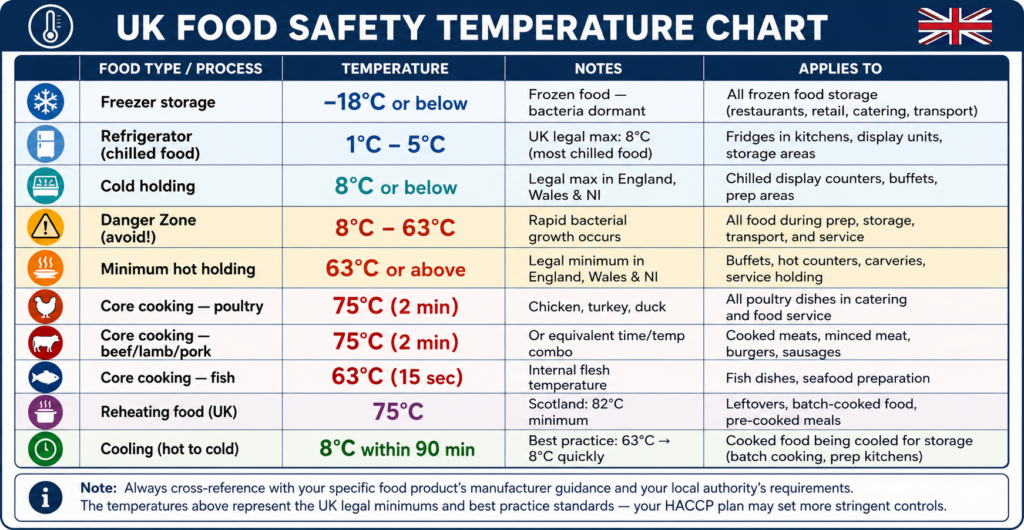
The table below provides a comprehensive reference for all key food safety temperatures required in UK food businesses. This chart is aligned with Food Standards Agency guidance and is suitable for use in training materials, HACCP documentation, and staff briefings. 

Food Type / Process Temperature Notes Applies To
Freezer storage −18°C or below Frozen food — bacteria dormant All frozen food storage (restaurants, retail, catering, transport)
Refrigerator (chilled food) 1°C – 5°C UK legal max: 8°C (most chilled food) Fridges in kitchens, display units, storage areas
Cold holding 8°C or below Legal max in England, Wales & NI Chilled display counters, buffets, prep areas
Danger Zone (avoid!) 8°C – 63°C Rapid bacterial growth occurs All food during prep, storage, transport, and service
Minimum hot holding 63°C or above Legal minimum in England, Wales & NI Buffets, hot counters, carveries, service holding
Core cooking — poultry 75°C (2 min) Chicken, turkey, duck All poultry dishes in catering and food service
Core cooking — beef/lamb/pork 75°C (2 min) Or equivalent time/temp combo Cooked meats, minced meat, burgers, sausages
Core cooking — fish 63°C (15 sec) Internal flesh temperature Fish dishes, seafood preparation
Reheating food (UK) 75°C Scotland: 82°C minimum Leftovers, batch-cooked food, pre-cooked meals
Cooling (hot to cold) 8°C within 90 min Best practice: 63°C → 8°C quickly Cooked food being cooled for storage (batch cooking, prep kitchens)

Note: Always cross-reference with your specific food product’s manufacturer guidance and your local authority’s requirements. The temperatures above represent the UK legal minimums and best practice standards — your HACCP plan may set more stringent controls.

Cooking Temperatures for Common Foods

Cooking Temperatures for Common Foods

While the “75°C for 30 seconds” rule is a universal benchmark, food industry professionals must understand that different ingredients carry unique biological risks. Achieving the correct core temperature is the only way to balance culinary quality with the rigorous safety standards required in the UK.

Poultry (Chicken, Turkey, Duck)

Poultry is high-risk due to the prevalence of Salmonella and Campylobacter.

  • ♦  The Standard: All poultry must be cooked to a core temperature of 75°C.
  • ♦  The Professional Check: There is no “rare” option for poultry in a professional setting. Juices must run clear, and the meat must show no signs of pinkness to be considered safe for service.

Beef, Lamb & Pork

The safety requirements for red meat vary based on the preparation method, a distinction every food handler must master.

  • ♦  Whole Cuts (Steaks & Roasts): Because bacteria usually live on the surface of the meat, a steak can be served rare provided the exterior is fully seared to kill surface pathogens.
  • ♦  Minced Meat & Burgers: The grinding process spreads surface bacteria throughout the meat. Therefore, burgers, sausages, and meatballs must reach 75°C at the core. Serving rare burgers requires specific, high-level validated processes approved by an Environmental Health Officer (EHO).

Fish & Seafood

Most seafood reaches safety at a core temperature of 70°C for 2 minutes. However, professional handling requires extra vigilance:

  • ♦  Shellfish: Mussels, clams, and oysters must be cooked until the shells open; any that remain closed are unsafe and must be discarded.
  • ♦  Raw Service: If your role involves serving raw fish (sushi/sashimi), the product must have undergone a specific freezing treatment (typically -20°C for 24 hours) to kill parasites—a key check in any professional food safety system.

Vegetarian & Vegan Dishes

It is a common error in the industry to assume plant-based foods are “low risk.”

  • ♦  Rice & Pulses: These items can carry Bacillus cereus spores that survive the initial cooking process.
  • ♦  The Standard: Vegetarian dishes should still reach a core temperature of 75°C.
  • ♦  Handling Starch: If not served immediately, high-starch foods like rice must be cooled to below 8°C within one hour to prevent spores from germinating into active bacteria.
Cold Storage Temperature Requirements

Cold Storage Temperature Requirements

Maintaining the “cold chain” is one of the most significant challenges for any food industry professional. Cold storage doesn’t kill bacteria, but it does significantly slow their growth, buying you the time needed to manage inventory safely.

Fridge Temperatures (UK Law vs. Best Practice)

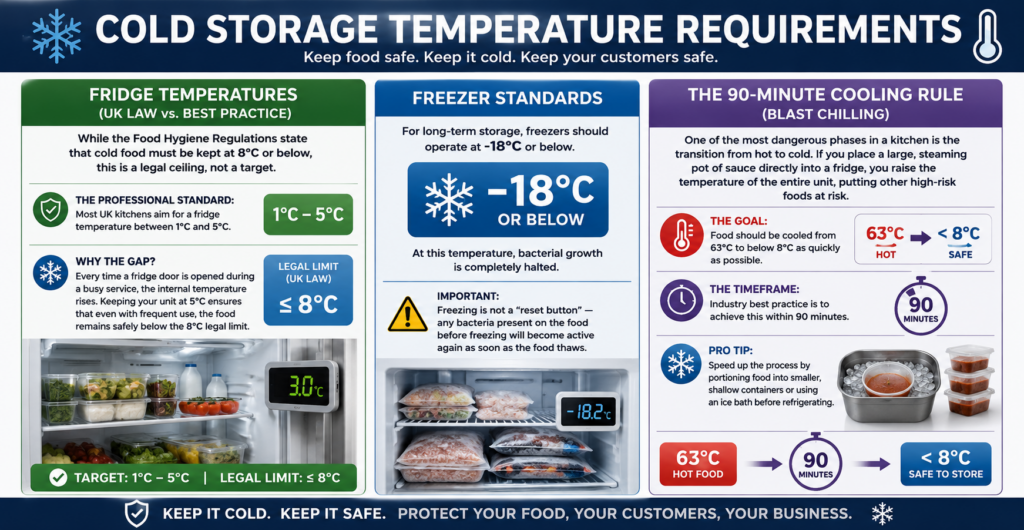
While the Food Hygiene Regulations state that cold food must be kept at 8°C or below, this is a legal ceiling, not a target.

  • ♦  The Professional Standard: Most UK kitchens aim for a fridge temperature between 1°C and 5°C.
  • ♦  Why the gap? Every time a fridge door is opened during a busy service, the internal temperature rises. Keeping your unit at 5°C ensures that even with frequent use, the food remains safely below the 8°C legal limit.

Freezer Standards

For long-term storage, freezers should operate at -18°C or below. At this temperature, bacterial growth is completely halted. However, professionals must remember that freezing is not a “reset button”—any bacteria present on the food before freezing will become active again as soon as the food thaws.

The 90-Minute Cooling Rule (Blast Chilling)

One of the most dangerous phases in a kitchen is the transition from hot to cold. If you place a large, steaming pot of sauce directly into a fridge, you raise the temperature of the entire unit, putting other high-risk foods at risk.

  • ♦  The Goal: Food should be cooled from 63°C to below 8°C as quickly as possible.
  • ♦  The Timeframe: Industry best practice is to achieve this within 90 minutes.
  • ♦  Pro Tip: Speed up the process by portioning food into smaller, shallow containers or using an ice bath before refrigerating.
Hot Holding Temperature Rules for UK Caterers

Hot Holding Temperature Rules for UK Caterers

Hot holding is the practice of keeping cooked food hot before it is served. This is common in buffets, carveries, and takeaway heated displays. Because the food is already cooked, the goal here is to prevent any surviving spores from germinating.

The Legal Minimum (63°C)

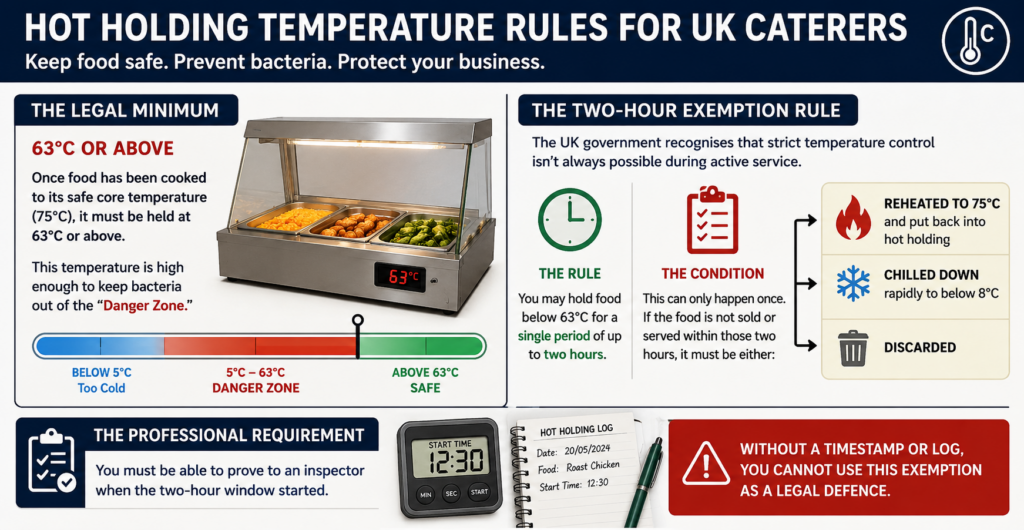
In the UK, once food has been cooked to its safe core temperature (75°C), it must be held at 63°C or above. This temperature is high enough to keep bacteria out of the “Danger Zone.”

The Two-Hour Exemption Rule

The UK government recognises that strict temperature control isn’t always possible during active service. This is why the two-hour exemption exists:

  • ♦  The Rule: You may hold food below 63°C for a single period of up to two hours.
  • ♦  The Condition: This can only happen once. If the food is not sold or served within those two hours, it must be either reheated to 75°C and put back into hot holding, chilled down rapidly to below 8°C, or discarded.
  • ♦  The Professional Requirement: You must be able to prove to an inspector when the two-hour window started. Without a timestamp or log, you cannot use this exemption as a legal defence.
How to Monitor Food Temperatures Accurately

How to Monitor Food Temperatures Accurately

Even the most rigorous temperature standards are useless if your measurements are inaccurate. For food industry professionals, mastering the “art of the probe” is essential for maintaining safety and proving compliance during an unannounced inspection.

Using a Probe Thermometer Correctly

A digital probe is the industry standard for checking the core temperature of food.

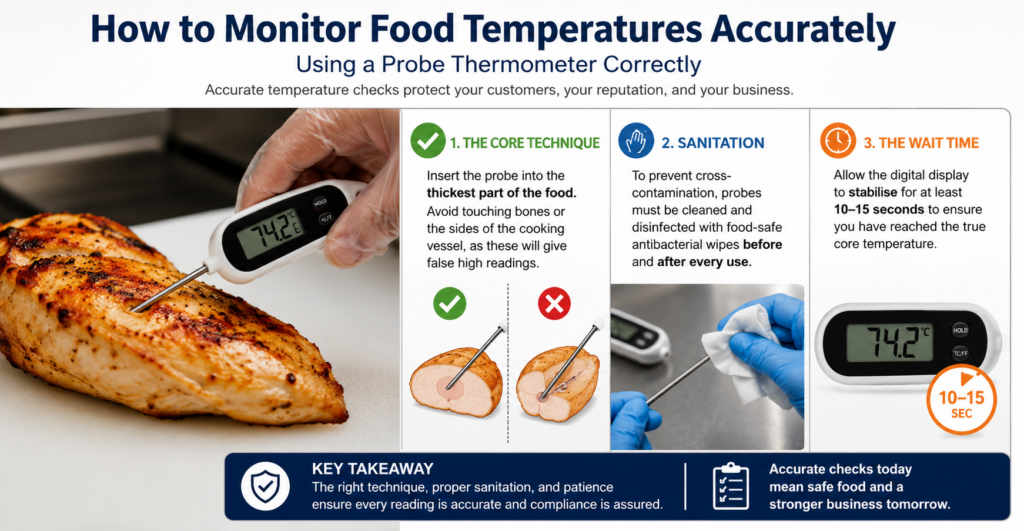
  • ♦  The Core Technique: Always insert the probe into the thickest part of the food (e.g., the center of a chicken breast or the middle of a large pot of stew). Avoid touching bones or the sides of the cooking vessel, as these will give false high readings.
  • ♦  Sanitation: To prevent cross-contamination, probes must be cleaned and disinfected with food-safe antibacterial wipes before and after every single use.
  • ♦  The Wait Time: Allow the digital display to stabilise for at least 10–15 seconds to ensure you have reached the true core temperature.

Monthly Calibration

Thermometers can “drift” over time due to being dropped or general wear and tear. To maintain your HACCP-based food safety management system, you should calibrate your probes monthly using two simple methods:

1. The Ice Point Method: Place the probe in a glass of crushed ice and water. It should read between -1°C and 1°C.

2. The Boiling Point Method: Place the probe in boiling water. It should read between 99°C and 101°C. If your probe is out by more than 1°C, it must be serviced or replaced immediately.

HACCP Record-Keeping

In the eyes of the law, “if it isn’t written down, it didn’t happen.” Accurate record-keeping is your “due diligence” defence. Professionals should maintain daily logs for:

  • ♦  Fridge and Freezer Units: Recorded at least once (ideally twice) per day.
  • ♦  Cooking and Reheating: Logging the core temperature of high-risk batches.
  • ♦  Hot Holding: Ensuring food remains above 63°C throughout service.
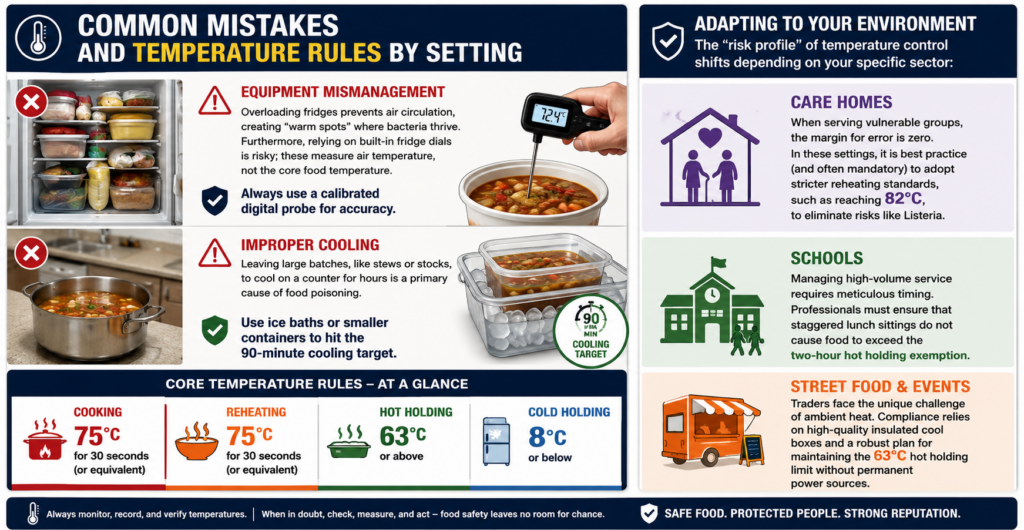
Common Mistakes and Temperature Rules by Setting Even for seasoned food industry professionals, certain oversights can compromise an otherwise perfect safety record. Avoiding these common pitfalls is essential for maintaining a high-standard kitchen: ♦ Equipment Mismanagement: Overloading fridges prevents air circulation, creating “warm spots” where bacteria thrive. Furthermore, relying on built-in fridge dials is risky; these measure air temperature, not the core food temperature. Always use a calibrated digital probe for accuracy. ♦ Improper Cooling: Leaving large batches, like stews or stocks, to cool on a counter for hours is a primary cause of food poisoning. Use ice baths or smaller containers to hit the 90-minute cooling target. Adapting to Your Environment The “risk profile” of temperature control shifts depending on your specific sector: ♦ Care Homes: When serving vulnerable groups, the margin for error is zero. In these settings, it is best practice (and often mandatory) to adopt stricter reheating standards, such as reaching 82°C, to eliminate risks like Listeria. ♦ Schools: Managing high-volume service requires meticulous timing. Professionals must ensure that staggered lunch sittings do not cause food to exceed the two-hour hot holding exemption. ♦ Street Food & Events: Traders face the unique challenge of ambient heat. Compliance relies on high-quality insulated cool boxes and a robust plan for maintaining the 63°C hot holding limit without permanent power sources.

Common Mistakes and Temperature Rules by Setting

Even for seasoned food industry professionals, certain oversights can compromise an otherwise perfect safety record. Avoiding these common pitfalls is essential for maintaining a high-standard kitchen:

  • ♦  Equipment Mismanagement: Overloading fridges prevents air circulation, creating “warm spots” where bacteria thrive. Furthermore, relying on built-in fridge dials is risky; these measure air temperature, not the core food temperature. Always use a calibrated digital probe for accuracy.
  • ♦  Improper Cooling: Leaving large batches, like stews or stocks, to cool on a counter for hours is a primary cause of food poisoning. Use ice baths or smaller containers to hit the 90-minute cooling target.

Adapting to Your Environment

The “risk profile” of temperature control shifts depending on your specific sector:

  • ♦  Care Homes: When serving vulnerable groups, the margin for error is zero. In these settings, it is best practice (and often mandatory) to adopt stricter reheating standards, such as reaching 82°C, to eliminate risks like Listeria.
  • ♦  Schools: Managing high-volume service requires meticulous timing. Professionals must ensure that staggered lunch sittings do not cause food to exceed the two-hour hot holding exemption.
  • ♦  Street Food & Events: Traders face the unique challenge of ambient heat. Compliance relies on high-quality insulated cool boxes and a robust plan for maintaining the 63°C hot holding limit without permanent power sources.

Why Mastery Matters

In the UK hospitality sector, temperature control is the line between a thriving business and a legal disaster. By mastering the Danger Zone, maintaining accurate HACCP logs, and understanding setting-specific risks, you protect both your customers and your professional reputation.

However, knowing the numbers is only the first step. True safety requires the ability to lead a team and manage “Due Diligence” across an entire operation.

Take the Next Step in Your Career

For those responsible for supervising staff or managing safety policies, our Food Safety and Hygiene Level 3 Course provides the definitive training required. This CPD-accredited course covers everything from HACCP Implementation to Advanced Temperature Recording, giving you the expertise to manage a safe, compliant UK kitchen.

FAQs — Why Temperature Control Is Everything in Food Safety

Q: Can I reheat food more than once? 

A: It is strongly recommended to only reheat food once. Repeated cooling and heating cycles increase the risk of bacterial growth and diminish food quality.

Q: What if my fridge reaches 9°C during a busy shift? 

A: You must take immediate action. Check for overloading or open doors; if the temperature doesn’t drop quickly to below 8°C, food must be moved to a functional unit to remain legal.

Q: Is the 75°C rule the only way to cook safely? 

A: No. You can use validated “time-temperature combinations,” such as 70°C for 2 minutes or 80°C for 6 seconds, to achieve the same level of safety.

Q: What temperature can you refuse to work in a kitchen in the UK? 

A: There is no legal maximum temperature. However, employers must provide a “reasonable” environment. If heat poses a health risk, it becomes a health and safety compliance issue.

Q: What is the 2-2-2 rule for food? 

A: It’s a safety mnemonic: Don’t leave food out for more than 2 hours, store in containers 2 inches deep, and use within 2 days.

Q: Is chicken safe at 70°C? 

A: Yes, provided the core temperature of 70°C is maintained for at least 2 minutes. Otherwise, you must hit the instant-kill point of 75°C.

Q: Is 44 degrees cold enough for food? 

A: If 44°F (6.6°C), it is technically legal but above the 5°C best-practice target. If 44°C, it is highly dangerous as it sits directly in the Danger Zone.

Sam Walker

Article by

Sam Walker

Sam Walker is an education specialist and author at One Education, bringing over 4 years of experience in creating practical resources and strategies to support teachers and enhance student learning.

top
Home Courses Search