Workplace safety training starts with understanding the work people actually do. A warehouse picker faces different hazards from an office administrator. Supervisors need another perspective, including instructions, monitoring and escalation. Choosing suitable learning therefore requires more than comparing course titles.
Perhaps you are reviewing induction arrangements for new employees. You might manage teams using chemicals, equipment or lifting aids. Alternatively, you could be exploring workplace responsibilities before changing careers. Each situation calls for a different learning plan.
This guide explains training duties, common topics and delivery options. It also separates awareness learning from practical instruction and qualifications. You will find questions for comparing courses and planning follow-up. Finally, consider One Education’s Workplace Safety Training Bundle against your needs. Start with relevant hazards, rather than collecting certificates without clear purpose.
What Is Workplace Safety Training?
Workplace safety training explains hazards, precautions and relevant working procedures. It can include induction, demonstrations, supervised practice and refresher learning. Its content should reflect the work and people involved. HSE
Awareness learning introduces concepts such as hazards, risks and controls. Practical instruction connects those concepts with actual tasks and equipment. Supervised practice then provides opportunities for observation and feedback. These elements are related, but they are not interchangeable. HSE
For example, a video might explain equipment safety principles. It cannot independently demonstrate someone’s ability with your particular machine. A course completion record also differs from employer authorisation. Select training around the activity, existing experience and necessary supervision. HSE
Why Workplace Safety Training Matters
Workplace risks affect health as well as immediate physical safety. Relevant learning should therefore extend beyond dramatic accidents. Consider everyday exposure, repetitive tasks and working arrangements too. press.hse.gov.uk
HSE’s 2024/25 figures provide important context for Great Britain. An estimated 1.9 million workers experienced work-related ill health. Workers also reported an estimated 680,000 non-fatal workplace injuries. Injuries and ill health caused 40.1 million lost working days. These figures come from different measures, not one incident register. press.hse.gov.uk
Separately, provisional 2025/26 figures record 126 worker fatalities. That fatality figure covers a different reporting period. Neither dataset represents the whole United Kingdom. These HSE statistics cover England, Scotland and Wales. press.hse.gov.uk
These statistics establish context, not a prediction for your organisation. They cannot demonstrate that purchasing any course prevents an accident. Your training priorities should instead follow your own risk assessments.
Is Workplace Safety Training Mandatory in the UK?
Employers have duties to provide suitable information, instruction and training. Appropriate supervision matters alongside those requirements. However, legislation does not prescribe one universal online course bundle. HSE
Great Britain: Training Duties
The 1974 Health and Safety at Work Act establishes employer duties. Section 2 includes necessary information, instruction, training and supervision. The 1999 Management Regulations add requirements concerning capabilities and training. Regulation 13 addresses recruitment and exposure to new risks. HSE
Changes in responsibilities, equipment or working methods can trigger training. Learning must adapt when relevant risks change. Required health and safety training should not cost employees money. It should take place during working hours. HSE
Employees also have responsibilities within these arrangements. They should follow relevant instructions and report safety concerns. Employers should not treat course completion as replacing risk management. Acas
Northern Ireland and Fire Safety
Northern Ireland has a separate occupational health and safety framework. This includes the 1978 Order and 2000 Management Regulations. HSENI provides guidance on relevant training responsibilities. HSENI
Fire safety legislation also differs across the UK. England and Wales use the Regulatory Reform (Fire Safety) Order 2005. Scotland has separate legislation, including the Fire (Scotland) Act 2005. Northern Ireland applies its 2006 Order and 2010 Regulations. Check the guidance relevant to your premises and responsibilities. GOV.UK
Essential Workplace Safety Training Topics
Use risk assessments to decide which topics deserve attention. The following areas provide a starting point, not universal requirements. Add specialist training where your activities demand it. HSE
Risk Assessment and Hazard Awareness
A hazard can cause harm. Risk considers how likely and serious that harm might be. Training should connect this distinction with recognisable workplace situations. HSE
Consider an illustrative example involving deliveries near a pedestrian entrance. Ask who could be harmed and how movements interact. Then consider controls before deciding what instructions people need. Training alone should not substitute for removing or controlling hazards. HSE
One Education’s Risk Assessment Training covers assessment principles and risk management. Its published curriculum also includes a risk assessment toolkit. Compare those topics with your organisation’s assessment arrangements.
COSHH and Hazardous Substances
COSHH means Control of Substances Hazardous to Health. Relevant learning should address substances actually encountered during work. Cleaning products, dusts and process fumes may require different precautions. Workers need information about exposure, controls and emergency arrangements. HSE
A safety data sheet supplies useful information about a product. It does not replace an assessment of its actual use. Consider quantities, exposure routes and existing controls within your workplace. HSE
One Education lists COSHH Assessor Training. Its curriculum covers hazardous substances, assessments and control measures. The page displays updated and older curriculum versions separately. Check which version applies before planning study.
Manual Handling
Manual handling includes lifting, lowering, carrying, pushing and pulling. Appropriate arrangements begin by avoiding hazardous handling where reasonably practicable. Assess unavoidable tasks and reduce the remaining risks. HSE
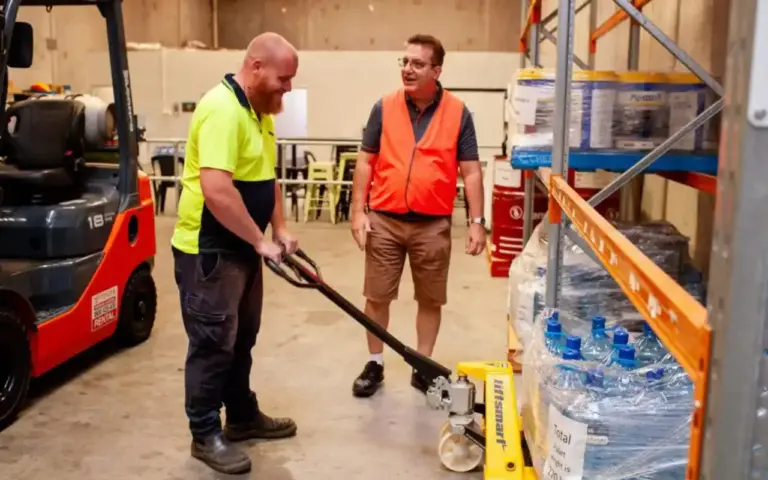
HSE states that training alone cannot ensure safe manual handling. Work design, suitable equipment and task-specific instruction also matter. Practical demonstrations should reflect the loads and environment involved. HSE
Imagine a team repeatedly moving supplies between different floor levels. Reviewing storage arrangements could matter more than repeating lifting advice. Use that discussion to identify both operational changes and training.
Fire Safety and Evacuation
Fire safety training should explain your workplace’s emergency arrangements. Staff need relevant instructions about alarms, evacuation and assembly points. Arrangements should account for people requiring assistance. Generic fire awareness cannot explain every building’s routes and procedures. GOV.UK
One Education’s Fire Warden Training explores fire risks and evacuation topics. Its curriculum includes personal emergency evacuation plans. Review these subjects alongside your premises-specific arrangements and responsibilities. Completing general learning does not automatically appoint someone as warden.
Equipment Safety and PPE
Equipment instruction should reflect the particular machine and associated risks. Operators, supervisors and managers may need different training. Protective equipment also requires appropriate selection, use and maintenance. HSE
For an illustrative example, consider introducing a different production machine. Previous experience does not establish familiarity with its specific controls. Review instructions, supervision and any necessary practical assessment before use. HSE
Avoid confusing protective equipment with removing hazards at source. PPE is one part of risk management, not its replacement. Training should explain its limitations as well as correct use. HSE
Incident Reporting and Learning
Workers need to know how to raise concerns internally. Reporting routes should cover injuries, hazards and relevant near misses. Discuss who receives reports and how concerns are followed up. Acas
RIDDOR creates separate reporting duties for specified incidents and conditions. Not every workplace accident requires a RIDDOR report. The responsible person should check the applicable criteria and deadlines. Employees’ internal reporting does not replace the organisation’s statutory obligations. HSE
Use incident reviews to identify practical lessons and training gaps. Focus discussions on what happened and what needs attention.
Who Needs Workplace Safety Training?
Training needs follow responsibilities and exposure, rather than job titles alone. New starters need relevant induction and an explanation of arrangements. Existing staff may need updates when their work changes. HSE
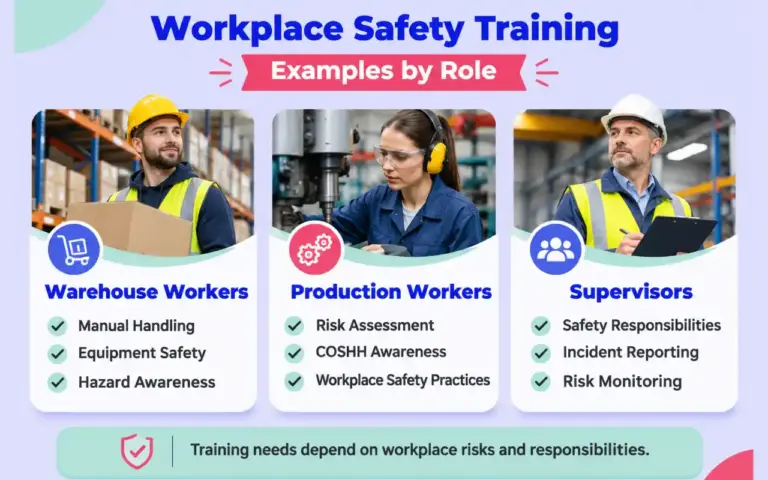
For a suggested planning exercise, compare three typical roles. An office administrator might need workstation and emergency information. A warehouse operative might need handling and vehicle-separation instruction. A supervisor might need monitoring and incident-escalation knowledge. Treat these examples as prompts, not fixed training packages.
Consider temporary staff and contractors within your planning. Young or inexperienced workers may need additional support and supervision. Check language, literacy and accessibility needs when arranging instruction. Confirm understanding rather than relying only on attendance. HSE
A Practical Workplace Training Approach
Awareness
Understand key hazards and workplace safety risks.
Instruction
Learn the correct procedures and safe working methods.
Supervised Practice
Apply the learning with guidance and feedback.
Competence Review
Check understanding and confirm safe, practical use.
Online Versus Classroom Workplace Safety Training
Choose delivery methods according to the learning and practical requirements. Online awareness can introduce terminology, hazards and relevant procedures. Classroom discussion can explore questions, scenarios and workplace experiences. Practical instruction addresses the tasks people must actually perform. HSE
Compare the evidence each approach provides. A quiz records answers to questions. An observed demonstration records performance during a particular task. Neither should be described as covering everything automatically.
Some subjects need especially careful distinctions. HSE recognises suitable e-learning for asbestos awareness. However, awareness training does not prepare workers to disturb asbestos. Further job-specific instruction and training are needed for that work. HSE
First-aid provision also follows a workplace needs assessment. Check whether the proposed course meets the required training standard. Do not assume awareness learning establishes workplace first-aider competence. HSE
How to Choose Suitable Safety Training
Start With Tasks, Not Course Quantity
List the activities your team performs and the hazards involved. Compare existing knowledge with the information and skills needed. Use that comparison to identify learning gaps. A larger course collection is not automatically a better match. HSENI
Read the Actual Curriculum
Look beyond a course title or promotional badge. Check learning topics, examples, assessment methods and intended audience. Identify practical requirements the course does not address. Ask whether the content concerns your jurisdiction and working environment.
Compare overlapping modules before buying several related courses. Repetition may reinforce learning, but should not disguise missing subjects. Prioritise relevance over the number of certificates advertised.
Check Delivery and Completion Terms
Confirm access periods, device requirements, support and assessment arrangements. Establish whether certificates require additional payment. Ask what the certificate records and who issues it. Separate course completion evidence from regulated qualification claims.
For example, some One Education course pages list certificate charges. Standalone course terms do not establish a bundle’s entitlements. Confirm the package-specific arrangements before purchasing.
Plan Workplace Follow-Up
Decide who explains local procedures after the online learning. Allocate time for questions, demonstrations and checks of understanding. Record any remaining development needs and agree the next steps. Training should connect with everyday working arrangements, not sit separately. HSE
Refreshers, Records and Training Reviews
There is no single renewal interval for every safety course. Relevant risks, changing work and specific requirements determine review needs. Changes in equipment or duties may require additional instruction. Reduced familiarity or identified knowledge gaps also deserve attention. HSE
For an illustrative record, include the learner, date and subject. Add the course version and assessment evidence where available. Record workplace demonstrations separately from online completion. Include any restrictions, follow-up actions and planned review dates. This suggested format is not a universal statutory template.
Keep records useful rather than treating them as automatic compliance. Review whether people can follow the procedures their work requires.
Explore One Education’s Workplace Safety Training Bundle
One Education’s Workplace Safety Training Bundle brings together 14 related online courses. Subjects include risk assessment, COSHH, manual handling and fire safety. Other topics cover PPE, equipment safety, first aid and accident investigation.
The bundle includes reading materials, online assessments and digital completion certificates. Learners also receive 12 months’ access with support.
Online learning introduces relevant workplace safety principles and responsibilities. However, practical instruction and workplace-specific training may still be necessary. Employers should assess training against actual workplace risks.
Choose Learning That Fits the Work
Useful workplace safety training begins with relevant questions. What could cause harm, and what must people do differently? Which lessons need workplace demonstrations, supervision or specialist assessment?
Compare the answers with course content before enrolling. Keep general awareness separate from practical competence and regulated qualifications. Use the Workplace Safety Training Bundle as a comparison option. Confirm its current contents and terms with One Education.
Frequently Asked Questions
Employers must provide training appropriate to employees’ work and risks. This does not prescribe an identical course for everyone.
Employers must not charge employees for required health and safety training. Such training should take place during working hours
Review training when risks, duties, equipment or working methods change. Consider knowledge gaps and any subject-specific requirements too. Avoid assuming every certificate requires annual renewal.
Not where practical instruction or assessment is needed. Match the delivery method to the work and risks.
Not by itself. Competence also involves relevant knowledge, skills and experience. Employers still need to assess suitability for the actual work.
Start with the hazards and responsibilities relevant to your role. Then compare introductory curricula with your employer’s training expectations.
Related Articles