Average IQ in the UK Showing Trends, Patterns, and Influencing Factors

May 10, 2026 | 15 minutes | 0 Readers

Does IQ really measure intelligence, or just a narrow slice of it? This question has sparked debate for decades, especially as societies increasingly rely on measurable indicators to assess human potential. IQ, or Intelligence Quotient, is a standardised score derived from tests designed to evaluate cognitive abilities such as reasoning, problem-solving, memory, and logical thinking. While it offers a structured way to compare certain mental skills, it does not fully capture creativity, emotional intelligence, or practical knowledge. Despite its limitations,

rating

Bestselling Course

View Details SAVE 94% NOW
Average IQ in the UK Showing Trends, Patterns, and Influencing Factors

Does IQ really measure intelligence, or just a narrow slice of it? This question has sparked debate for decades, especially as societies increasingly rely on measurable indicators to assess human potential. IQ, or Intelligence Quotient, is a standardised score derived from tests designed to evaluate cognitive abilities such as reasoning, problem-solving, memory, and logical thinking. While it offers a structured way to compare certain mental skills, it does not fully capture creativity, emotional intelligence, or practical knowledge.

Despite its limitations, IQ continues to attract attention—particularly when examined at a national level. Average IQ scores are often used to inform discussions around education systems, workforce capabilities, and even public policy decisions. Governments, researchers, and organisations look at these figures to identify trends, address inequalities, and plan for future development.

This article takes a closer look at the average IQ in the UK, exploring key trends and patterns over time while examining the various factors that influence these scores. From education and environment to socio-economic conditions, it aims to provide a balanced and insightful perspective on what IQ really represents in today’s context.

What Is the Average IQ in the UK?

What Is the Average IQ in the UK?

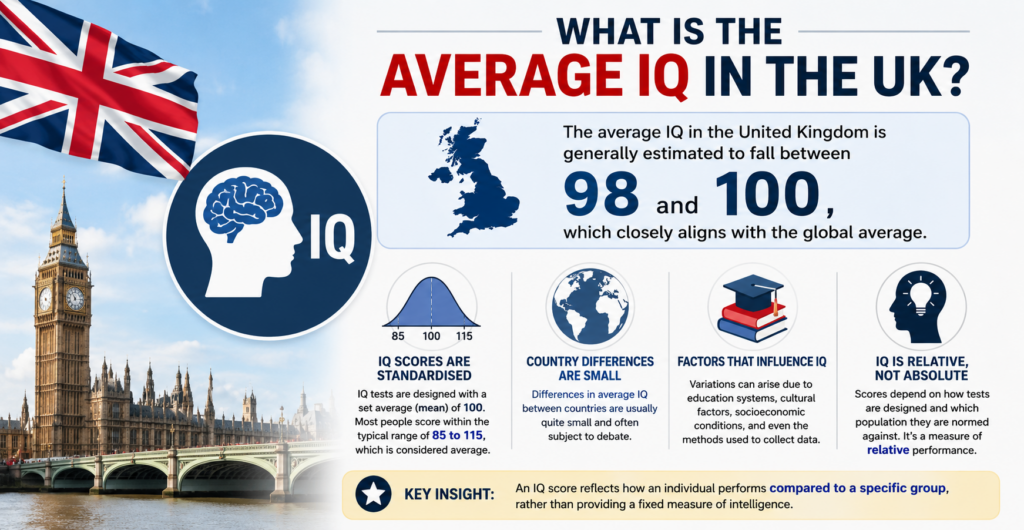
The average IQ in the United Kingdom is generally estimated to fall between 98 and 100, which closely aligns with the global average. This means that, overall, cognitive performance in the UK sits right around the international norm rather than significantly above or below it.

IQ scores are designed to be standardised, with a set average (mean) of 100. This standardisation ensures that scores are distributed consistently across populations, allowing for comparison. Most people score within a typical range of 85 to 115, which is considered average.

It’s important to note that differences in average IQ between countries are usually quite small and often subject to debate. Variations can arise due to differences in education systems, cultural factors, socioeconomic conditions, and even the methods used to collect data.

A key insight to understand is that IQ is relative, not absolute. Scores depend heavily on how tests are designed and which population they are normed against. In other words, an IQ score reflects how an individual performs compared to a specific group, rather than providing a fixed measure of intelligence.

Historical Trends: Has IQ in the UK Changed Over Time?

The idea of changing IQ levels over time is closely linked to the Flynn Effect, which describes the steady rise in IQ scores during the 20th century. In the UK and other developed countries, average IQ increased by around 2–3 points per decade. This growth was largely driven by improvements in education, nutrition, healthcare, and greater exposure to complex thinking in everyday life.

However, recent research suggests this trend has slowed or even reversed in some developed nations, including the UK. Instead of continuing to rise, IQ scores appear to have reached a plateau, with slight declines reported in certain groups.

A key explanation lies in modern lifestyle changes. Increased screen time and digital consumption may reduce attention span and deep thinking. Changes in diet, particularly higher intake of processed foods, can also affect brain health. Additionally, shifts in education systems and the growing reliance on technology may limit everyday cognitive challenges.

Overall, while the 20th century saw clear gains in IQ due to better living conditions, recent patterns suggest that modern habits and environments now play a crucial role in shaping cognitive performance.

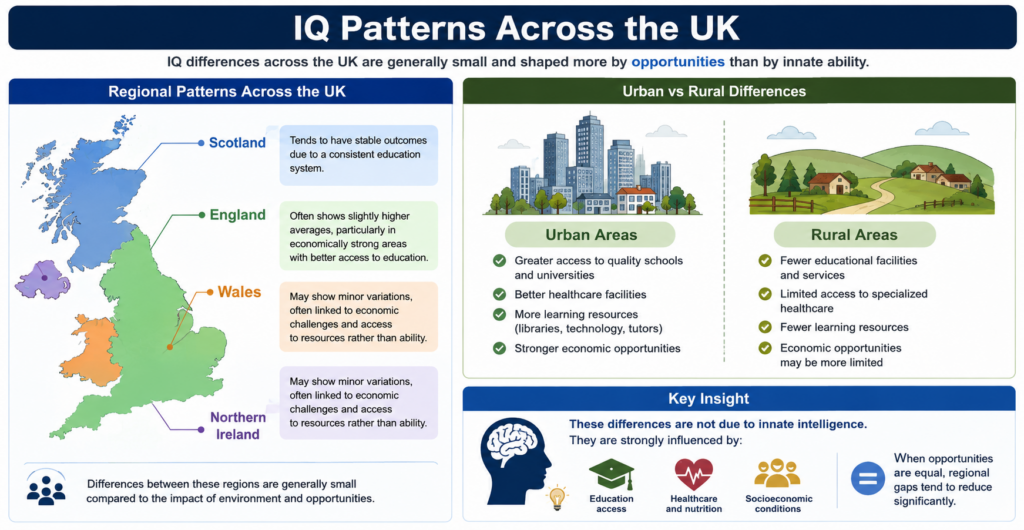
Regional Patterns Across the UK Regional differences in IQ across the UK are generally small, but some patterns can be observed when comparing England, Scotland, Wales, and Northern Ireland. England often shows slightly higher averages, particularly in economically strong areas with better access to education. Scotland tends to have stable outcomes due to a consistent education system. Wales and Northern Ireland may show minor variations, often linked to economic challenges and access to resources rather than ability. Urban vs Rural Differences A more noticeable contrast exists between urban and rural areas: Urban areas usually perform better due to greater access to schools, universities, healthcare, and learning resources. Rural areas may face limitations such as fewer educational facilities and services, which can affect outcomes. Key Insight These differences are not due to innate intelligence. Instead, they are strongly influenced by: Education access Healthcare and nutrition Socioeconomic conditions Overall, when opportunities are equal, regional gaps tend to reduce significantly.

Regional Patterns Across the UK

Regional differences in IQ across the UK are generally small, but some patterns can be observed when comparing England, Scotland, Wales, and Northern Ireland.

  • ♦  England often shows slightly higher averages, particularly in economically strong areas with better access to education.
  • ♦  Scotland tends to have stable outcomes due to a consistent education system.
  • ♦  Wales and Northern Ireland may show minor variations, often linked to economic challenges and access to resources rather than ability.

Urban vs Rural Differences

A more noticeable contrast exists between urban and rural areas:

  • ♦  Urban areas usually perform better due to greater access to schools, universities, healthcare, and learning resources.
  • ♦  Rural areas may face limitations such as fewer educational facilities and services, which can affect outcomes.

Key Insight

These differences are not due to innate intelligence. Instead, they are strongly influenced by:

  • ♦  Education access
  • ♦  Healthcare and nutrition
  • ♦  Socioeconomic conditions

Overall, when opportunities are equal, regional gaps tend to reduce significantly.

Key Factors That Influence IQ in the UK​

Key Factors That Influence IQ in the UK

IQ levels in the UK are shaped by a combination of educational, social, biological, and environmental influences. These factors work together to affect how individuals develop cognitive skills over time.

Education System

The quality of education, especially in early childhood, plays a crucial role in cognitive development. Strong schooling helps build essential skills like literacy and numeracy, while encouraging critical thinking and problem-solving. Access to well-resourced schools and stimulating learning environments significantly supports higher IQ outcomes.

Socioeconomic Status

Socioeconomic conditions directly impact access to opportunities and resources. Income inequality can limit access to quality education, books, tutoring, and proper nutrition. Children from more stable financial backgrounds often benefit from environments that better support intellectual growth.

Nutrition and Health

Good nutrition is vital for brain development, particularly during early years. A balanced diet supports memory and concentration, while deficiencies in nutrients such as iron and iodine can negatively affect cognitive performance. Overall health and access to healthcare also contribute to maintaining cognitive ability.

Environment and Lifestyle

Living conditions and daily habits influence IQ development. Exposure to pollution, stress, and poor housing can hinder cognitive growth, whereas safe and stimulating environments support it. Additionally, excessive non-educational screen time may reduce focus, while activities like reading and problem-solving enhance cognitive skills.

Genetics vs Environment Debate

Both genetics and environment play a role in determining IQ. However, environmental factors—such as education, lifestyle, and access to resources—are highly influential in shaping how intellectual potential is developed in real-life situations.

Does IQ Really Reflect Intelligence?​

Does IQ Really Reflect Intelligence?

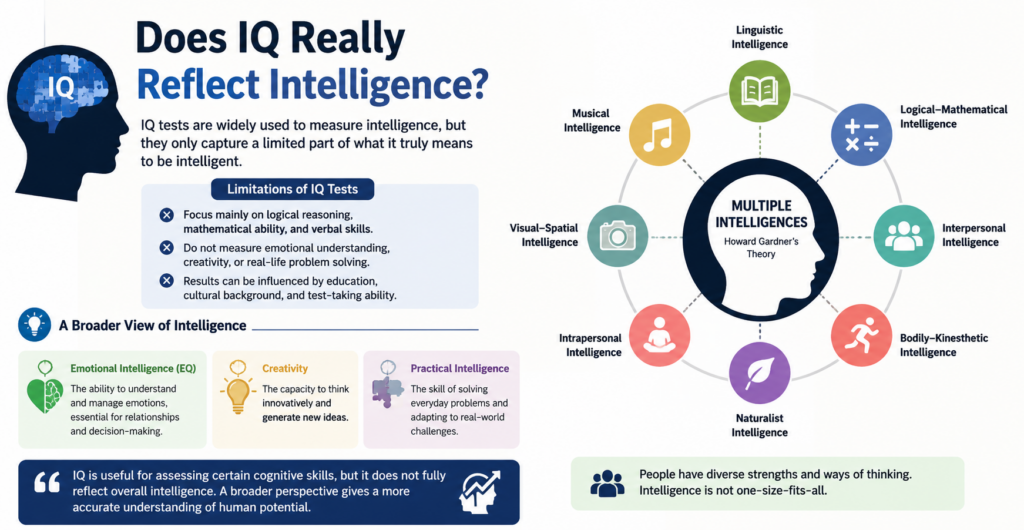
IQ tests are widely used to measure intelligence, but they only capture a limited part of what it truly means to be intelligent. These tests mainly focus on logical reasoning, mathematical ability, and verbal skills. While important, they overlook many other valuable human capabilities.

One key limitation is that IQ tests do not measure how people handle emotions, think creatively, or deal with real-life situations. Factors like education, cultural background, and test-taking ability can also influence results, making them less comprehensive.

To understand intelligence more fully, it’s important to consider broader concepts:

  • ♦  Emotional Intelligence (EQ): The ability to understand and manage emotions, which is essential for relationships and decision-making.
  • ♦  Creativity: The capacity to think innovatively and generate new ideas.
  • ♦  Practical Intelligence: The skill of solving everyday problems and adapting to real-world challenges.

Psychologist Howard Gardner introduced the Multiple Intelligences Theory, which argues that intelligence is not a single ability but a combination of different types, such as linguistic, logical, interpersonal, and more. This highlights that people have diverse strengths that cannot be measured by IQ alone.

In summary, IQ is useful for assessing certain cognitive skills, but it does not fully reflect overall intelligence. A broader perspective gives a more accurate understanding of human potential.

The Role of Immigration and Diversity

The Role of Immigration and Diversity

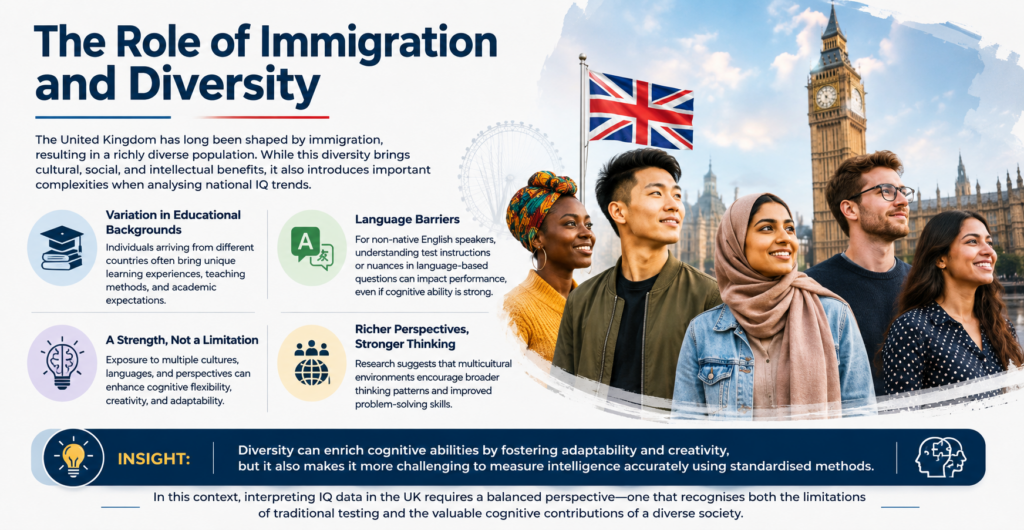
The United Kingdom has long been shaped by immigration, resulting in a richly diverse population. While this diversity brings cultural, social, and intellectual benefits, it also introduces important complexities when analysing national IQ trends.

One key factor is the variation in educational backgrounds. Individuals arriving from different countries often bring unique learning experiences, teaching methods, and academic expectations. These differences can influence how people approach problem-solving and respond to standardised IQ tests, which are typically designed within a specific cultural framework.

Language also plays a significant role. For non-native English speakers, understanding test instructions or nuances in language-based questions can impact performance, even if their cognitive ability is strong. This can lead to results that may not fully reflect an individual’s true intellectual capacity.

However, diversity is not a limitation—it is a strength. Exposure to multiple cultures, languages, and perspectives can enhance cognitive flexibility, creativity, and adaptability. Research suggests that multicultural environments encourage broader thinking patterns and improved problem-solving skills.

👉 Insight:
Diversity can enrich cognitive abilities by fostering adaptability and creativity, but it also makes it more challenging to measure intelligence accurately using standardised methods.

In this context, interpreting IQ data in the UK requires a balanced perspective—one that recognises both the limitations of traditional testing and the valuable cognitive contributions of a diverse society.

How the UK Compares Globally​

How the UK Compares Globally

The United Kingdom’s average IQ is broadly in line with other developed nations, particularly across Europe. Countries such as Germany, the Netherlands, and Sweden may report slightly higher figures, while others are very similar to the UK. However, these differences are usually minimal—often just a few points—and are influenced by factors like education systems, socio-economic conditions, and testing methods.

Compared to global averages, the UK generally performs above the worldwide mean. This is largely due to strong access to education, healthcare, and stable living conditions. At the same time, many countries are improving rapidly, which is gradually reducing the gap.

  • ♦  European countries: The UK is closely aligned with most European nations, with only slight variations that are not significant in practical terms.
  • ♦  Global averages: The UK typically scores above the global average, though differences are becoming smaller over time.

Rather than focusing on rankings, it’s important to understand that these differences are often marginal. IQ should be viewed in context, where environmental and social factors play a far greater role than small numerical gaps.

Why IQ Trends Matter (and When They Don’t)

Why IQ Trends Matter (and When They Don’t)

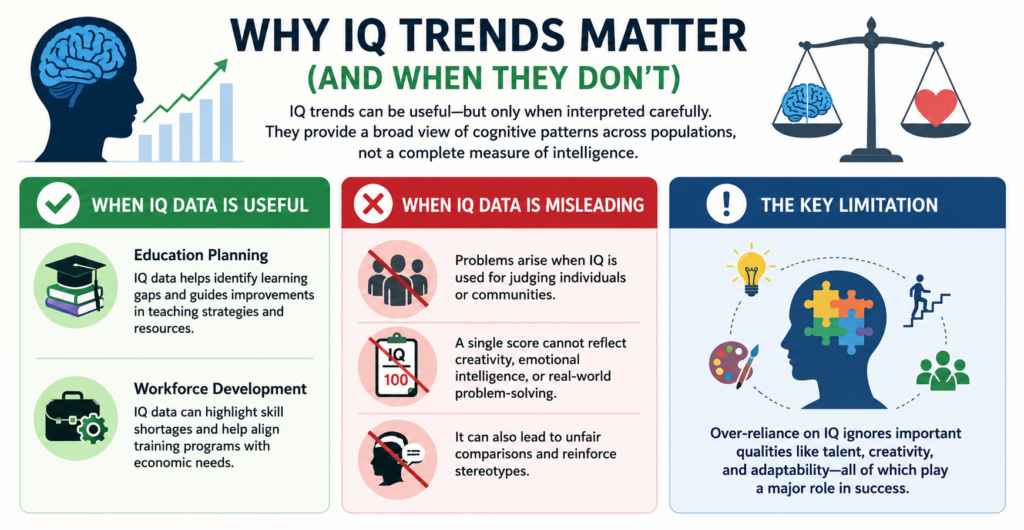
IQ trends can be useful—but only when interpreted carefully. They provide a broad view of cognitive patterns across populations, not a complete measure of intelligence.

When IQ Data Is Useful

IQ data supports education planning by helping identify learning gaps and guiding improvements in teaching strategies and resources. It is also valuable in workforce development, where it can highlight skill shortages and help align training with economic needs.

When IQ Data Is Misleading

Problems arise when IQ is used for judging individuals or communities. A single score cannot reflect creativity, emotional intelligence, or real-world problem-solving. It can also lead to unfair comparisons and reinforce stereotypes.

The Key Limitation

Over-reliance on IQ ignores important qualities like talent, creativity, and adaptability—all of which play a major role in success.

Future Outlook: What Might Shape IQ in the UK?

Future Outlook: What Might Shape IQ in the UK?

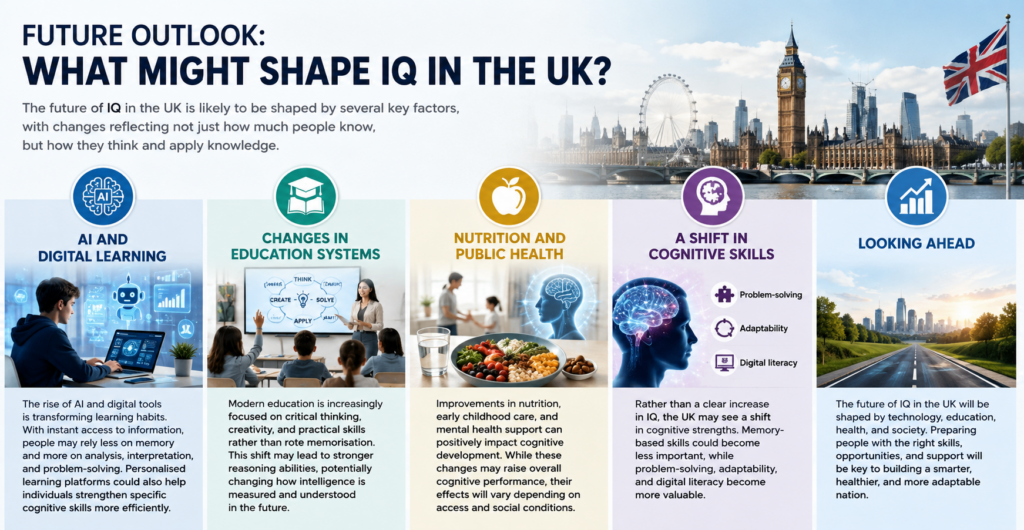
The future of IQ in the UK is likely to be shaped by several key factors, with changes reflecting not just how much people know, but how they think and apply knowledge.

AI and Digital Learning

The rise of AI and digital tools is transforming learning habits. With instant access to information, people may rely less on memory and more on analysis, interpretation, and problem-solving. Personalised learning platforms could also help individuals strengthen specific cognitive skills more efficiently.

Changes in Education Systems

Modern education is increasingly focused on critical thinking, creativity, and practical skills rather than rote memorisation. This shift may lead to stronger reasoning abilities, potentially changing how intelligence is measured and understood in the future.

Nutrition and Public Health

Improvements in nutrition, early childhood care, and mental health support can positively impact cognitive development. While these changes may raise overall cognitive performance, their effects will vary depending on access and social conditions.

A Shift in Cognitive Skills

Rather than a clear increase in IQ, the UK may see a shift in cognitive strengths. Memory-based skills could become less important, while problem-solving, adaptability, and digital literacy become more valuable.

Conclusion

While examining the average IQ in the UK offers interesting insights into trends, patterns, and influencing factors, it is important to recognise that IQ represents only one dimension of human ability. True progress lies not merely in numerical scores but in fostering a society that values education, supports mental and physical wellbeing, and ensures equal opportunities for all individuals to thrive. A broader, more inclusive approach to development ultimately contributes far more to national growth and personal fulfilment than IQ alone. The real question isn’t how high the UK’s IQ is—but how well it nurtures human potential.

FAQs — Average IQ in the UK Showing Trends, Patterns, and Influencing Factors

1. What is the average IQ in the UK?

The average IQ in the UK is generally around 100, which aligns with the global average used in standardised IQ testing.

2. Has the average IQ in the UK changed over time?

Yes, IQ scores have shown gradual changes over time. Historically, there was an increase known as the Flynn Effect, but recent studies suggest this growth may be slowing or slightly declining.

3. What is the Flynn Effect?

The Flynn Effect refers to the steady rise in IQ scores observed across many countries, including the UK, over several decades due to improved living conditions and education.

4. Are there regional differences in IQ across the UK?

Yes, some studies suggest slight regional variations. These differences are often linked to factors such as education quality, income levels, and access to resources rather than innate ability.

5. Does education affect IQ levels in the UK?

Education plays a significant role. Better access to quality education can improve cognitive skills, problem-solving abilities, and overall IQ test performance.

Sam Walker

Article by

Sam Walker

Sam Walker is an education specialist and author at One Education, bringing over 4 years of experience in creating practical resources and strategies to support teachers and enhance student learning.

top

Hear What Our Learners Say About Us

Home Courses Search