Essential Lesson Planning Skills for New Trainers

August 04, 2026 | 9 minutes | 43 Readers

Knowing the subject is only half the job. Many first-time trainers spend hours learning the content but very little time planning how to teach it. Questions like what to cover first, how long each activity should take, and how to measure understanding all come down to one skill: lesson planning.  If you’re new to delivering training in Further Education or the workplace, lesson planning can make the difference between a session that flows naturally and one that feels like a

Knowing the subject is only half the job. Many first-time trainers spend hours learning the content but very little time planning how to teach it. Questions like what to cover first, how long each activity should take, and how to measure understanding all come down to one skill: lesson planning. 

If you’re new to delivering training in Further Education or the workplace, lesson planning can make the difference between a session that flows naturally and one that feels like a list of topics rather than a learning experience. 

This article explores the essentials that help you plan sessions learners can follow, engage with and benefit from.

A Lesson Plan Is a Decision Made in Advance, Not a Script

A lesson plan isn’t just a document to complete before a session. It’s a series of decisions made in advance, so you don’t have to make them while you’re teaching.

  • ♦  Where should the session start? 
  • ♦  How long does each part actually need? 
  • ♦  What happens if a section runs short, or long?  

A lesson plan answers these questions before learners walk through the door. Without one, a trainer ends up making these calls on the spot, under pressure, usually while also trying to explain the material itself.

That’s what separates a lesson plan from a simple list of topics. A list of topics to cover is not a lesson plan. 

  • ♦  A list tells you what
  • ♦  A plan tells you how and in what order, with some sense of how long.

What a Session Plan Actually Needs to Answer

Before You Teach, Answer These Three Questions

A useful lesson plan doesn’t need to cover everything. It just needs to answer three important questions, at minimum.

What should learners be able to do by the end?

Avoid outcomes like “understand the topic”—they’re too vague to measure. Instead, define something learners can actually do, such as logging a complaint correctly, identifying the three main hazard categories, or explaining the first step in an evacuation procedure. If you can’t clearly picture what success looks like, the outcome probably needs refining. 

How is the time going to be used?

New trainers often underestimate how quickly time disappears. A simple breakdown for each section, even a rough split — ten minutes here, twenty there — prevents one of the most common new-trainer problems: running out of time for the most important part because the introduction ran long. 

How will you know learners are following? 

This doesn’t need to be formal. A quick question, a show of hands, a moment where learners try the task themselves. The point is deciding in advance how you’ll check understanding, rather than assuming it from silence. 

This overlaps closely with assessment skill more broadly — worth exploring further if you haven’t already looked at how assessment works alongside planning.

Structuring a Session So It Flows Naturally

Structuring a Session So It Flows Naturally

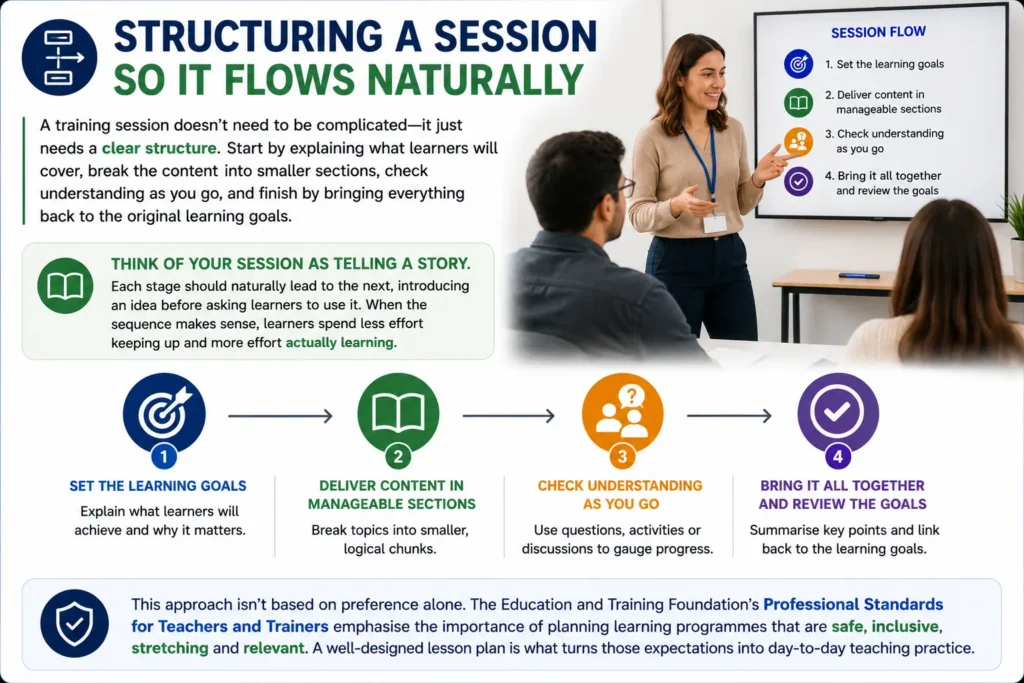
A training session doesn’t need to be complicated—it just needs a clear structure. Start by explaining what learners will cover, break the content into smaller sections, check understanding as you go, and finish by bringing everything back to the original learning goals. 

Think of your session as telling a story. Each stage should naturally lead to the next, introducing an idea before asking learners to use it. When the sequence makes sense, learners spend less effort keeping up and more effort actually learning. 

This approach isn’t based on preference alone. The Education and Training Foundation’s Professional Standards for Teachers and Trainers emphasise the importance of planning learning programmes that are safe, inclusive, stretching and relevant. A well-designed lesson plan is what turns those expectations into day-to-day teaching practice. 

Expect to Adapt Once the Session Begins

The moment learners walk into the room, your plan may need to change. That’s not a sign the plan has failed—it’s a sign you’re responding to the people in front of you. The key is having a well-structured plan that gives you a solid foundation to adapt with confidence.  

Getting Better at Planning Over Time

Getting Better at Planning Over Time

No one becomes an effective lesson planner overnight. The skill develops through experience, reviewing what worked, identifying what didn’t and learning from more experienced colleagues.

A structured qualification can give you a head start. The ATHE Level 3 Award in Education and Training covers the fundamentals of planning and delivering lessons, as well as assessment and feedback. While real teaching experience remains essential, the course helps you develop those skills with greater confidence from the outset.

FAQs — Essential Lesson Planning Skills for New Trainers

Is there an official Ofsted lesson plan template?

No — Ofsted doesn’t publish or require a specific lesson plan format. Inspectors are guided not to favour one planning method over another; providers decide their own approach, and inspectors focus on whether a session is planned effectively, not on the format the plan takes.

What does lesson planning look like in practice in Further Education?

There’s no single fixed format, but most FE session plans share the same core elements covered above: a clear, observable outcome, a rough timing structure for each part of the session, and a defined point for checking understanding. Providers and awarding bodies often have their own template, but the underlying structure — outcome, timing, structure, check — tends to stay consistent across FE settings.

What do you mean by lesson planning?

Lesson planning is the process of deciding, before a session starts, what learners should be able to do by the end, how the available time will be used, and how you’ll check whether the session has worked — rather than making those decisions on the spot while delivering the content itself.

Why is lesson planning important for new trainers? 

Without a plan, decisions about timing, order, and pacing get made on the spot — usually while also trying to deliver the content itself. Planning moves those decisions earlier, when there’s time to think them through properly.

How detailed should a training session plan be? 

Detailed enough to guide you without needing constant reference to it. Clear timings and a defined outcome matter more than a script written word for word.

What’s the difference between a lesson plan and a scheme of work? 

A lesson plan covers a single session in detail. A scheme of work maps out a whole course or unit — the order topics are covered in, and how sessions build toward the overall outcome. A lesson plan sits inside a scheme of work, not instead of it.

Sam Walker

Article by

Sam Walker

Sam Walker is an education specialist and author at One Education, bringing over 4 years of experience in creating practical resources and strategies to support teachers and enhance student learning.

top
Home Courses Search