HACCP Explained for UK Catering: How to Identify Hazards and Control Critical Points

May 11, 2026 | 12 minutes | 92 Readers

Running a catering business in the UK? HACCP isn’t just jargon—it’s your behind-the-scenes system for spotting food safety risks before they happen and keeping everything under control. That’s why understanding hazards and critical control points is essential for anyone managing food operations.  What HACCP Means in UK Catering HACCP stands for Hazard Analysis and Critical Control Point. In catering, it is a food safety system used to identify risks in food handling, preparation, storage, and service, then control those risks

rating

Bestselling Course

View Details SAVE 94% NOW

Running a catering business in the UK? HACCP isn’t just jargon—it’s your behind-the-scenes system for spotting food safety risks before they happen and keeping everything under control. That’s why understanding hazards and critical control points is essential for anyone managing food operations. 

What HACCP Means in UK Catering

HACCP stands for Hazard Analysis and Critical Control Point. In catering, it is a food safety system used to identify risks in food handling, preparation, storage, and service, then control those risks at the right stages.

For UK catering businesses, HACCP is not just for large-scale production. It applies to restaurants, cafés, takeaways, pubs serving food, outside caterers, and other food operations. The principle is simple: look at how food moves through the business, identify hazards, and decide where control is essential. 

Why HACCP Matters for Catering Businesses

HACCP matters because catering businesses handle food in ways that create real risks. Deliveries, chilled storage, prep, cooking, hot holding, reheating, allergen management, cleaning, and service all create points where food can become unsafe if controls fail.

It also matters because UK food businesses are expected to have food safety management procedures based on HACCP principles. For smaller businesses, the Food Standards Agency often directs caterers to Safer Food Better Business (SFBB) as a practical way to apply HACCP-based controls in everyday operations. 

The Types of Hazards HACCP Helps You Identify

The Types of Hazards HACCP Helps You Identify

HACCP focuses on identifying hazards that could make food unsafe. In catering, these usually fall into three main categories.

Biological Hazards

Biological hazards include harmful bacteria, viruses, moulds, and other microorganisms. In catering, these are often linked to poor temperature control, undercooking, poor chilling, cross-contamination, or unsafe handling of high-risk foods such as meat, dairy, and ready-to-eat items.

A simple example would be raw chicken stored badly in a fridge, or cooked food left too long at unsafe temperatures.

Chemical Hazards

Chemical hazards include cleaning chemicals, pest-control substances, allergens, and other harmful materials that could contaminate food. In a catering setting, this might mean cleaning chemicals stored badly, sanitiser residue left on a surface, or allergen controls being handled poorly.

These hazards are often less visible than biological risks, but they can still cause serious food safety failures.

Physical Hazards

Physical hazards include foreign objects such as glass, metal, plastic, packaging fragments, or other materials that could end up in food. These risks often come from damaged equipment, poor storage, careless handling, or weak checking procedures.

A broken utensil, loose packaging, or chipped container can all create this type of hazard in a working kitchen.

How to Identify Food Safety Hazards in a Catering Operation

How to Identify Food Safety Hazards in a Catering Operation

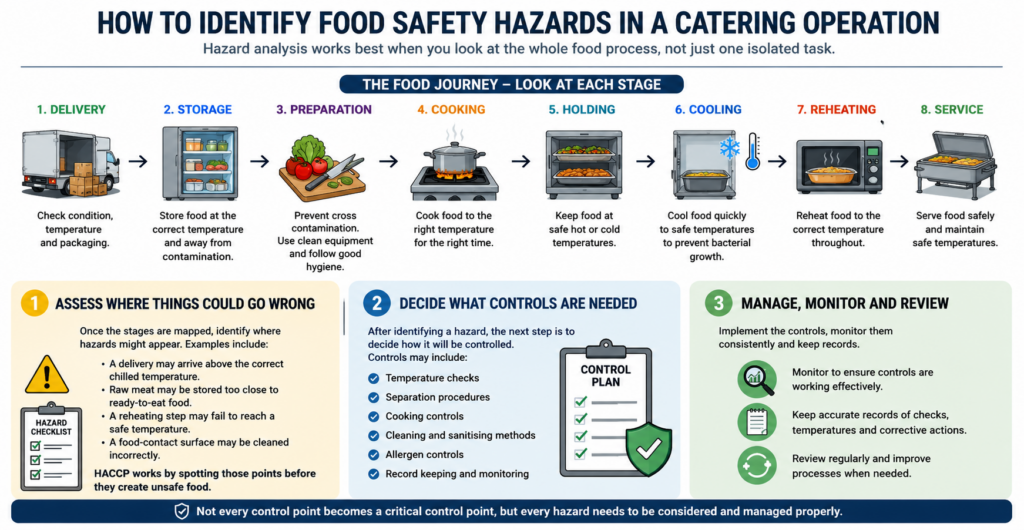
Hazard analysis works best when you look at the whole food process, not just one isolated task.

Look at Each Stage of Food Handling

Start by following the food journey through the business:

  • ♦  delivery
  • ♦  storage
  • ♦  preparation
  • ♦  cooking
  • ♦  holding
  • ♦  cooling
  • ♦  reheating
  • ♦  service

At each stage, ask what could make the food unsafe.

Assess Where Things Could Go Wrong

Once the stages are mapped, identify where hazards might appear. A delivery may arrive above the correct chilled temperature. Raw meat may be stored too close to ready-to-eat food. A reheating step may fail to reach a safe temperature. A food-contact surface may be cleaned incorrectly.

HACCP works by spotting those points before they create unsafe food.

Decide What Controls Are Needed

After identifying a hazard, the next step is to decide how it will be controlled. That could mean temperature checks, separation procedures, cooking controls, cleaning methods, allergen controls, or record keeping.

Not every control point becomes a critical control point, but every hazard needs to be considered and managed properly.

What a Critical Control Point (CCP) Actually Is

A critical control point, or CCP, is a stage in the process where control is essential to prevent, remove, or reduce a food safety hazard to an acceptable level.

In simple terms, it is a point where failure could directly make food unsafe.

Not every food safety step is a CCP. Some controls are important general hygiene measures, while CCPs are the specific points where a hazard must be controlled decisively. That is why critical control points in catering are often linked to temperature and contamination controls rather than every routine kitchen task.

Common Critical Control Points in UK Catering

Common Critical Control Points in UK Catering

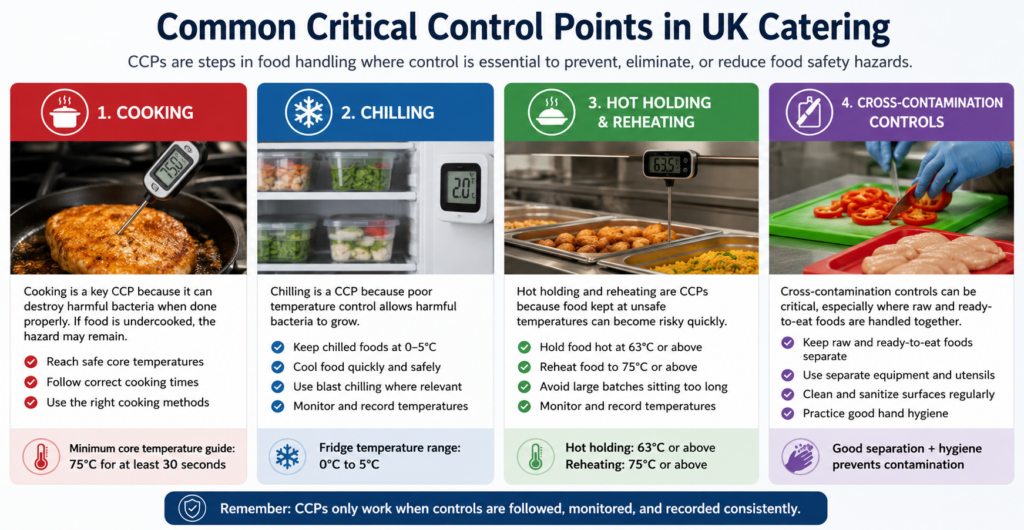
Common Critical Control Points in UK catering help maintain food safety and prevent contamination during food preparation and service. These points include proper food storage, cooking at safe temperatures, avoiding cross-contamination, maintaining personal hygiene, and ensuring regular cleaning of equipment and surfaces. Following these control measures is essential for meeting UK food safety standards and protecting customer health.

Cooking

Cooking is one of the clearest CCPs because it can destroy harmful bacteria when done properly. If food is undercooked, the hazard may remain.

That is why cooking temperatures, cooking times, and correct methods matter so much in catering.

Chilling

Chilling can also be a CCP because poor temperature control allows harmful bacteria to grow. Chilled storage, blast chilling where relevant, and safe cooling practices all matter in kitchens handling high-risk foods.

A fridge that is too warm or a cooling process that is too slow can quickly turn into a food safety problem.

Hot Holding and Reheating

Hot holding and reheating are common CCPs in catering because food kept at unsafe temperatures can become risky quite quickly. Businesses need clear controls for holding food hot enough and reheating it safely before service.

Buffet service, hot counters, and batch cooking are common settings where this becomes especially important.

Cross-Contamination Controls

Some contamination controls can also operate as critical points, especially where raw and ready-to-eat foods are handled in the same environment. If separation, cleaning, or handling controls break down, the risk can be immediate.

This is often relevant in mixed-use prep areas, smaller kitchens, and busy service periods where staff move quickly between tasks.

How HACCP and the 4Cs Work Together

The 4Cs of food hygiene — cleaning, cooking, chilling, and cross-contamination prevention — are practical food safety controls used by the FSA. They work closely with HACCP thinking.

HACCP gives the system for analysing hazards and deciding where control matters most. The 4Cs give businesses practical day-to-day areas where those controls are often applied.

That is why HACCP should not feel separate from kitchen management. If a supervisor is checking cleaning standards, cooking temperatures, chilled storage, and contamination controls, they are already working with the practical side of HACCP.

How Smaller Catering Businesses Use HACCP in Practice

How Smaller Catering Businesses Use HACCP in Practice

Small catering businesses use the HACCP system to keep food safe and maintain hygiene standards in their daily operations. They identify possible food safety risks, such as improper storage or undercooked food, and take preventive steps to control them. By monitoring food temperatures, cleaning procedures, and staff hygiene, catering businesses can reduce contamination risks and provide safe, high-quality food to customers.

Using Safer Food Better Business

For many smaller catering businesses, HACCP is applied through Safer Food Better Business (SFBB). SFBB gives smaller businesses a practical way to manage food safety using HACCP-based procedures without building a more complex system from scratch.

It focuses on the key controls that many smaller catering businesses need every day, including safe methods, checks, cleaning, chilling, cooking, and contamination control.

When a More Detailed HACCP System May Be Needed

A more detailed HACCP system may be needed where the business is larger, handles more complex food operations, produces food in higher volume, or uses processes that carry more specialised risk.

In those settings, broader documentation, tighter monitoring, and more detailed hazard analysis may be necessary. The right level of detail depends on the type of business and the level of food safety risk involved.

For supervisors and managers responsible for food safety systems, a structured Food Safety and Hygiene Level 3 course can help build stronger practical understanding of HACCP, hazard control, monitoring, and corrective action in UK catering settings.

Common HACCP Mistakes in Catering Businesses

Some of the most common HACCP mistakes in catering include:

  • ♦  treating HACCP as paperwork rather than a working system
  • ♦  failing to identify realistic hazards at each stage
  • ♦  recording checks without acting on problems
  • ♦  confusing general hygiene measures with actual CCPs
  • ♦  not reviewing the system when menus, equipment, or processes change
  • ♦  assuming small businesses do not need HACCP-based controls at all

In practice, HACCP only works when it reflects how the kitchen actually operates. If the system looks good on paper but does not match daily food handling, it will not control risk properly.

Conclusion

HACCP gives UK catering businesses a structured way to identify hazards, recognise critical control points, and manage food safety more effectively.

For catering supervisors, managers, and business owners, understanding HACCP means understanding where food safety failures can happen and how to control them in day-to-day operations.

FAQs — HACCP Explained for UK Catering

1. What is HACCP in catering?
HACCP is a food safety system used to identify, control, and monitor hazards in food handling, storage, preparation, and service. In UK catering, food safety procedures should be based on HACCP principles.
2. Is HACCP a legal requirement for catering businesses in the UK?
UK food businesses are expected to have food safety management procedures based on HACCP principles. Smaller catering businesses often use SFBB as a practical way to meet that requirement.
3. What are the three types of hazards in HACCP?
The three main hazard types are:
♦  biological
♦  chemical
♦  physical
4. What is a critical control point in food safety?
A critical control point is a stage where control is essential to prevent, remove, or reduce a food safety hazard to an acceptable level.
5. What is the difference between HACCP and SFBB?
HACCP is the underlying food safety system and set of principles. SFBB is an FSA tool that helps smaller food businesses apply HACCP-based food safety management in practice.

Sam Walker

Article by

Sam Walker

Sam Walker is an education specialist and author at One Education, bringing over 4 years of experience in creating practical resources and strategies to support teachers and enhance student learning.

top
Home Courses Search