How Employers Can Achieve Food Safety Compliance in UK Catering Businesses 

May 20, 2026 | 14 minutes | 0 Readers

In UK hospitality, food safety compliance is rarely determined by isolated kitchen errors. It is increasingly judged as a reflection of leadership, operational discipline, and employer accountability. From independent cafés and high-volume takeaways to delivery-led kitchens, food safety law now shapes how teams are trained, supervised, and supported in daily service.  Employer responsibility sits at the centre of this framework. Regulators increasingly assess how employers design systems, monitor performance, and respond to risk — not just how frontline staff perform

rating

Bestselling Course

View Details SAVE 94% NOW

In UK hospitality, food safety compliance is rarely determined by isolated kitchen errors. It is increasingly judged as a reflection of leadership, operational discipline, and employer accountability. From independent cafés and high-volume takeaways to delivery-led kitchens, food safety law now shapes how teams are trained, supervised, and supported in daily service. 

Employer responsibility sits at the centre of this framework. Regulators increasingly assess how employers design systems, monitor performance, and respond to risk — not just how frontline staff perform individual tasks. In practice, compliance is judged not by written policy but by how consistently safe behaviour is maintained when kitchens are busy, understaffed, or under time pressure. 

Employer Accountability in UK Food Safety Law

Under UK food safety law, employers are legally responsible for ensuring that food handled, prepared, and served within their business is safe for consumers. This includes providing proper staff training, maintaining hygiene standards, carrying out risk assessments, and following regulations such as the Food Safety Act 1990 and HACCP principles. Employers must also ensure that employees understand food safety procedures and that any risks of contamination are effectively controlled to protect public health.

Who Is Legally Responsible as the Food Business Operator?

Under UK food safety law, primary responsibility rests with the food business operator — typically the employer or business owner. This principle recognises that organisational decisions about staffing, training, procurement, and workflow design directly influence whether food safety risks are managed effectively.

Employers must ensure that food sold or supplied is safe to consume, accurately described, and handled in accordance with hygiene regulations. While staff carry out daily hygiene tasks, accountability for how those tasks are structured, supervised, and reinforced remains with the employer. Compliance today reflects system design, not individual effort. 

Can Employers Delegate Food Safety Responsibility to Frontline Staff?

Although frontline staff carry out many hygiene tasks, legal responsibility for food safety cannot be fully delegated. Employers are expected to design systems, provide resources, and maintain oversight to ensure safe food handling is consistently achieved. Where compliance failures occur, regulators typically examine management structures rather than focusing solely on individual employee actions.

How Enforcement Trends Have Shifted Toward Management Accountability

Over recent years, regulators have placed greater emphasis on management responsibility when assessing compliance. Inspection outcomes often reflect not only environmental conditions but also the strength of organisational systems supporting safe food handling.

Across the sector, food safety is now judged as a leadership capability rather than a technical checklist. Employers who recognise this shift tend to perform more consistently during inspections and respond more effectively to operational risk. 

The UK Food Safety Rulebook

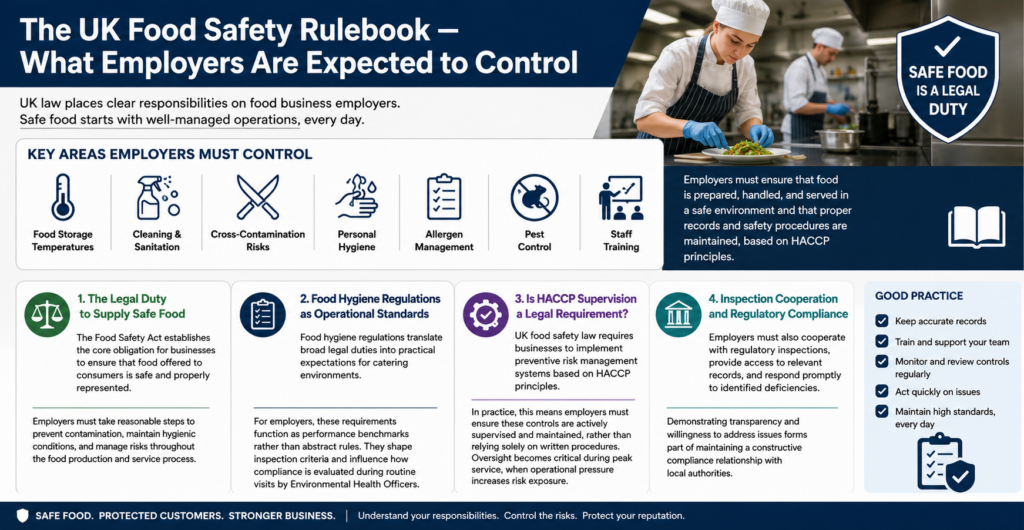
The UK Food Safety Rulebook — What Employers Are Expected to Control

The UK food safety rulebook sets out the legal responsibilities employers must follow to keep food safe for consumers. Under food hygiene regulations, businesses are expected to control key areas such as food storage temperatures, cleaning and sanitation, cross-contamination risks, personal hygiene, allergen management, pest control, and staff training. Employers must also ensure that food is prepared, handled, and served in a safe environment while maintaining proper records and safety procedures, often based on HACCP principles.

The Legal Duty to Supply Safe Food

The Food Safety Act establishes the core obligation for businesses to ensure that food offered to consumers is safe and properly represented. In practice, this means employers must take reasonable steps to prevent contamination, maintain hygienic conditions, and manage risks throughout the food production and service process.

Food Hygiene Regulations as Operational Standards

Food hygiene regulations translate broad legal duties into practical expectations for catering environments. They shape how kitchens are organised, how risks are controlled, and how compliance is measured during inspection.

For employers, these requirements function as performance benchmarks rather than abstract rules. They shape inspection criteria and influence how compliance is evaluated during routine visits by Environmental Health Officers.

Is HACCP Supervision a Legal Requirement for Employers?

UK food safety law requires businesses to implement preventive risk management systems based on HACCP principles. In practice, this means employers must ensure these controls are actively supervised and maintained, rather than relying solely on written procedures.Oversight becomes critical during peak service, when operational pressure increases risk exposure. 

Inspection Cooperation and Regulatory Compliance

Employers must also cooperate with regulatory inspections, provide access to relevant records, and respond promptly to identified deficiencies. Demonstrating transparency and willingness to address issues forms part of maintaining a constructive compliance relationship with local authorities.

Staff Training Responsibilities

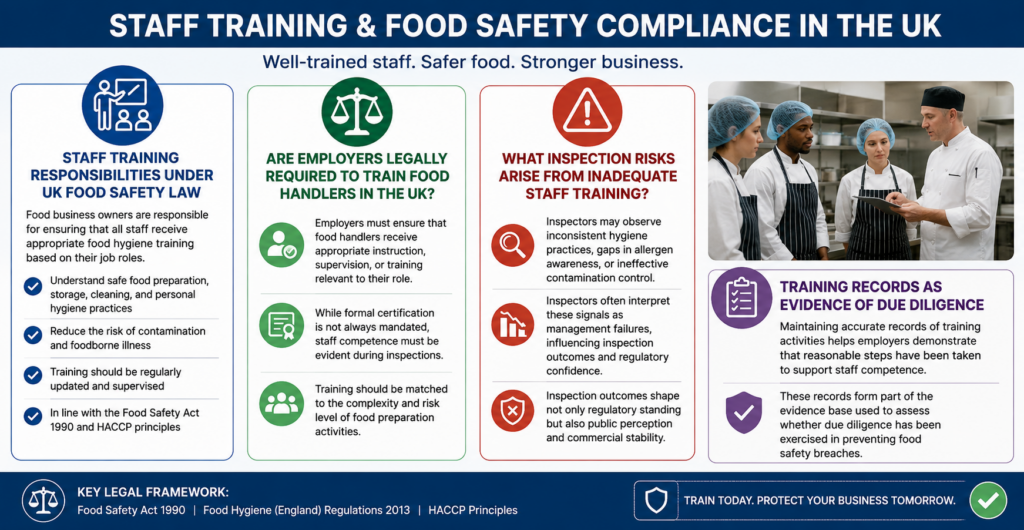
Staff Training Responsibilities Under UK Food Safety Law

Under UK food safety law, food business owners are responsible for ensuring that all staff receive appropriate food hygiene training based on their job roles. Employees who handle food must understand safe food preparation, storage, cleaning, and personal hygiene practices to reduce the risk of contamination and foodborne illness. Training should be regularly updated and supervised to make sure staff follow legal food safety procedures in line with regulations such as the Food Safety Act 1990 and HACCP principles.

Are Employers Legally Required to Train Food Handlers in the UK?

Employers must ensure that food handlers receive appropriate instruction, supervision, or training relevant to their role. While formal certification is not always mandated, staff competence must be evident during inspections. This places responsibility on employers to match training provision with the complexity and risk level of food preparation activities. 

In many inspections, weaknesses in staff knowledge are interpreted not as isolated errors but as signals of broader management gaps. 

What Inspection Risks Arise from Inadequate Staff Training?

Where staff lack adequate food safety knowledge, inspectors may observe inconsistent hygiene practices, gaps in allergen awareness, or ineffective contamination control. Inspectors often interpret these signals as management failures, influencing both inspection outcomes and regulatory confidence. 

For many businesses, inspection outcomes shape not only regulatory standing but also public perception and commercial stability. 

Training Records as Evidence of Due Diligence

Maintaining accurate records of training activities helps employers demonstrate that reasonable steps have been taken to support staff competence. These records form part of the evidence base used to assess whether due diligence has been exercised in preventing food safety breaches.

Overlooked Food Safety Control

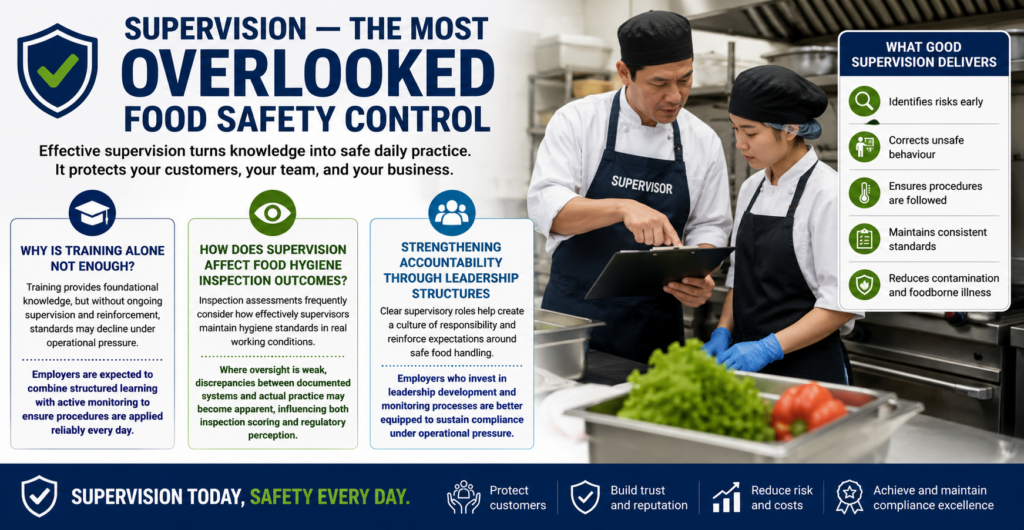
Supervision — The Most Overlooked Food Safety Control

Supervision is one of the most overlooked yet essential food safety controls in any food business. Even with proper training, policies, and equipment in place, mistakes can still happen if staff are not regularly monitored and guided. Effective supervision helps ensure that hygiene practices, temperature checks, cleaning routines, and food handling procedures are followed correctly every day. Strong supervisors can quickly identify risks, correct unsafe behaviour, and maintain high food safety standards, reducing the chance of contamination and foodborne illness.

Why Is Training Alone Not Enough to Ensure Food Safety Compliance?

Training provides foundational knowledge, but without ongoing supervision and reinforcement, standards may decline under operational pressure. Employers are therefore expected to combine structured learning with active monitoring to ensure procedures are applied reliably during everyday service.

In high-pressure kitchens, supervision separates written compliance from safe real-time decision-making. 

How Does Supervision Affect Food Hygiene Inspection Outcomes?

Inspection assessments frequently consider how effectively supervisors maintain hygiene standards in real working conditions. Where oversight is weak, discrepancies between documented systems and actual practice may become apparent, influencing both inspection scoring and regulatory perception.

Strengthening Accountability Through Leadership Structures

Clear supervisory roles help create a culture of responsibility and reinforce expectations around safe food handling. Employers who invest in leadership development and monitoring processes are better equipped to sustain compliance under operational pressure.

Due Diligence and Employer Defence in Food Safety Enforcement

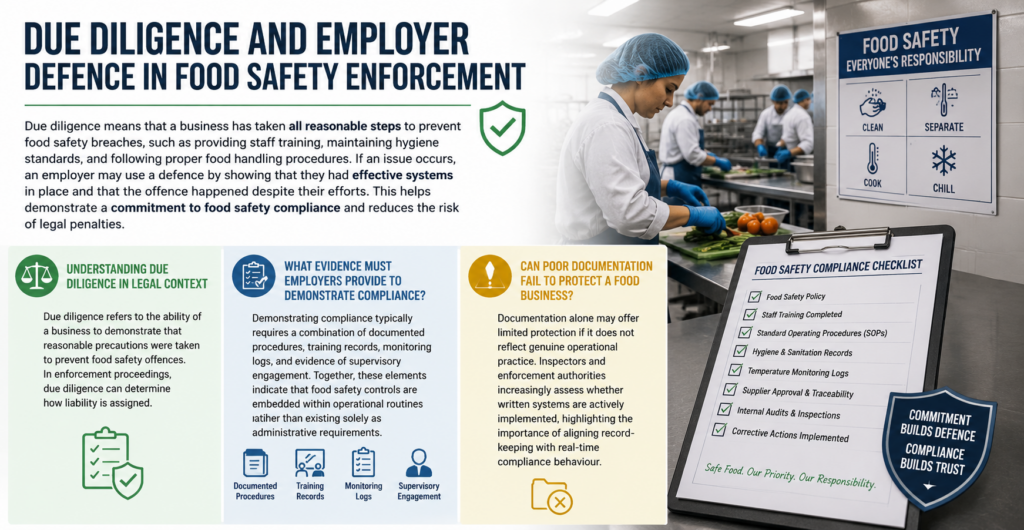
Due Diligence and Employer Defence in Food Safety Enforcement

Due diligence and employer defence are important legal concepts in food safety enforcement. Due diligence means that a business has taken all reasonable steps to prevent food safety breaches, such as providing staff training, maintaining hygiene standards, and following proper food handling procedures. If an issue occurs, an employer may use a defence by showing that they had effective systems in place and that the offence happened despite their efforts. This helps demonstrate a commitment to food safety compliance and reduces the risk of legal penalties.

Understanding Due Diligence in Legal Context

Due diligence refers to the ability of a business to demonstrate that reasonable precautions were taken to prevent food safety offences. In enforcement proceedings, due diligence can determine how liability is assigned. 

What Evidence Must Employers Provide to Demonstrate Compliance?

Demonstrating compliance typically requires a combination of documented procedures, training records, monitoring logs, and evidence of supervisory engagement. Together, these elements indicate that food safety controls are embedded within operational routines rather than existing solely as administrative requirements.

Can Poor Documentation Fail to Protect a Food Business?

Documentation alone may offer limited protection if it does not reflect genuine operational practice. Inspectors and enforcement authorities increasingly assess whether written systems are actively implemented, highlighting the importance of aligning record-keeping with real-time compliance behaviour.

Inspection Reality

Inspection Reality — How Employer Decisions Influence Hygiene Ratings

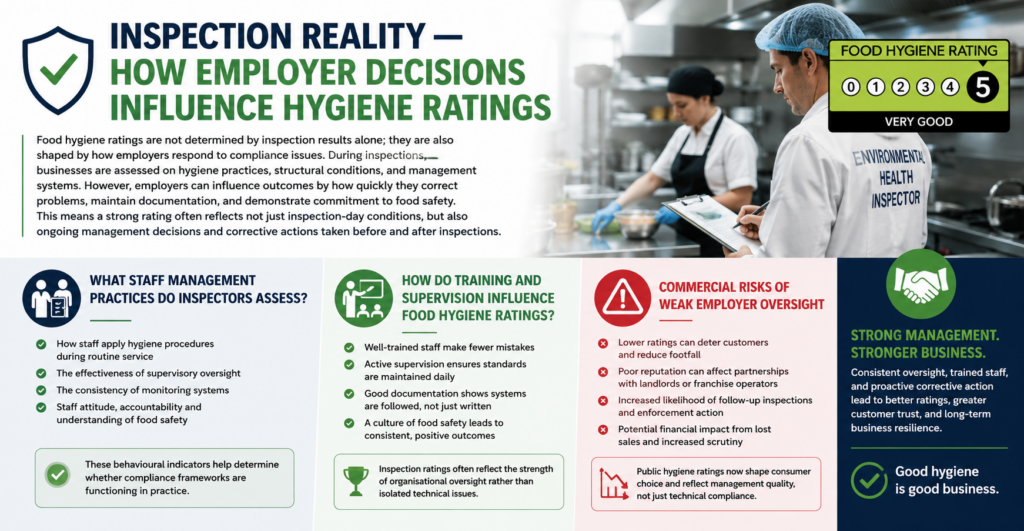
Food hygiene ratings are not determined by inspection results alone; they are also shaped by how employers respond to compliance issues. During inspections, businesses are assessed on hygiene practices, structural conditions, and management systems. However, employers can influence outcomes by how quickly they correct problems, maintain documentation, and demonstrate commitment to food safety. This means a strong rating often reflects not just inspection-day conditions, but also ongoing management decisions and corrective actions taken before and after inspections.

What Staff Management Practices Do Inspectors Assess?

Inspectors evaluate how staff apply hygiene procedures during routine service, the effectiveness of supervisory oversight, and the consistency of monitoring systems. These behavioural indicators help determine whether compliance frameworks are functioning in practice.

How Do Training and Supervision Influence Food Hygiene Ratings?

Inspection ratings often reflect the strength of organisational oversight rather than isolated technical issues. Businesses where staff demonstrate clear understanding of hygiene expectations and where supervision is visibly active are more likely to achieve stable and favourable outcomes.

Commercial Risks of Weak Employer Oversight

Inspection ratings increasingly function as a public signal of management quality rather than a purely technical assessment. Public hygiene ratings now shape consumer choice, especially in competitive local markets. 

Poor compliance outcomes may also create wider operational pressures, including reputational challenges, increased scrutiny from landlords or franchise partners, and potential financial impact linked to reduced customer confidence. For employers, maintaining robust oversight is therefore closely linked to long-term business resilience.

Developing a Sustainable Employer Compliance Strategy

Developing a Sustainable Employer Compliance Strategy

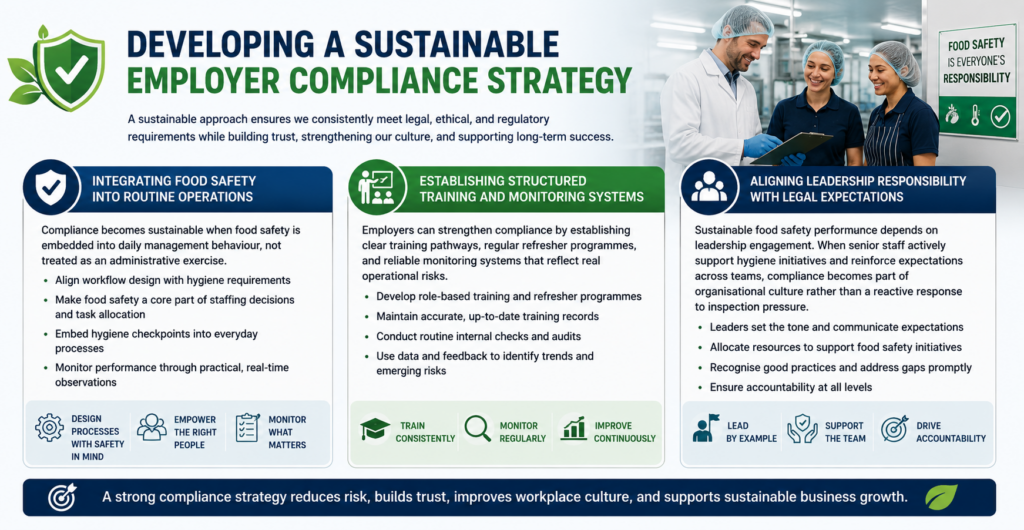
Developing a Sustainable Employer Compliance Strategy involves creating a long-term framework that ensures an organisation consistently meets legal, ethical, and regulatory requirements. It focuses on embedding compliance into everyday business operations rather than treating it as a one-time task. This includes clear policies, regular staff training, ongoing risk assessments, and continuous monitoring to adapt to changing laws and industry standards. A strong strategy not only reduces the risk of penalties and legal issues but also builds trust, improves workplace culture, and supports sustainable business growth.

Integrating Food Safety into Routine Operations

Compliance becomes sustainable when food safety is embedded into daily management behaviour, not treated as an administrative exercise. This includes aligning workflow design, staffing decisions, and performance monitoring with hygiene requirements.

Establishing Structured Training and Monitoring Systems

Employers can strengthen compliance by establishing clear training pathways, regular refresher programmes, and reliable monitoring systems that reflect real operational risks. Consistent documentation and periodic internal reviews help identify emerging issues before they escalate.

Aligning Leadership Responsibility with Legal Expectations

Sustainable food safety performance depends on leadership engagement. When senior staff actively support hygiene initiatives and reinforce expectations across teams, compliance becomes part of organisational culture rather than a reactive response to inspection pressure.

Food Safety Leadership as a Defining Standard in Modern Hospitality

Food safety compliance increasingly functions as a benchmark for professional management within the hospitality sector. Employers who prioritise structured training, effective supervision, and proactive risk management are better positioned to maintain operational stability and protect customer trust.

As hospitality operations grow more complex and regulatory scrutiny continues to evolve, employer leadership will remain central to maintaining safe and resilient food businesses. In modern hospitality, food safety competence is becoming a defining mark of professional leadership. 

Sam Walker

Article by

Sam Walker

Sam Walker is an education specialist and author at One Education, bringing over 4 years of experience in creating practical resources and strategies to support teachers and enhance student learning.

top
Home Courses Search