Phlebotomist Salary in the UK: What Can You Really Earn in 2026?

May 19, 2026 | 14 minutes | 89 Readers

If you have ever searched “phlebotomist salary UK” online, you have probably come away more confused than when you started. One site quotes Band 2. Another claims £30,000 or more. An agency advert lists an impressive hourly rate with no mention of what that actually means across a full year. The figures seem to contradict each other at every turn. The reality is that phlebotomist salary in the UK is not random — it simply depends on several factors that

If you have ever searched “phlebotomist salary UK” online, you have probably come away more confused than when you started. One site quotes Band 2. Another claims £30,000 or more. An agency advert lists an impressive hourly rate with no mention of what that actually means across a full year. The figures seem to contradict each other at every turn.

The reality is that phlebotomist salary in the UK is not random — it simply depends on several factors that most salary pages fail to explain properly. Whether you are considering phlebotomy as a career, looking to negotiate a pay rise, or simply curious about earning potential, this guide cuts through the noise. We break down exactly what phlebotomists earn in 2026 across the NHS, private clinics, agency work, and freelance practice — with real figures, honest comparisons, and a clear picture of how to progress. 

At a Glance: What Do Phlebotomists Earn in 2026?

If you’re looking for a quick answer regarding the Phlebotomist Salary UK, here’s what phlebotomists typically earn in the UK. The table below gives you a reliable overview of the current earning potential before we break each career route down in detail.  

Employment Type Typical Annual Salary Key Variable
NHS Band 2 (Entry Level) £25,272 Flat rate — no steps
NHS Band 3 (Senior) £25,760 – £26,598 Progresses after 2 years
NHS Band 4 (Lead/Supervisor) £27,000+ Management responsibility
Private Clinic £22,000 – £30,000+ Employer-set rates
Agency / Bank (hourly) £12.36 – £13.96/hr No guaranteed hours
Freelance / Mobile £30,000 – £40,000+ Gross before expenses

In most cases, the average phlebotomist salary in the UK sits between £25,000 and £27,000, with higher earning potential as you gain experience or move into private and freelance work.  

In May 2026, the government confirmed a 3.6% Agenda for Change pay uplift for all NHS staff, backdated to April 2026 — the second above-inflation rise in consecutive years.

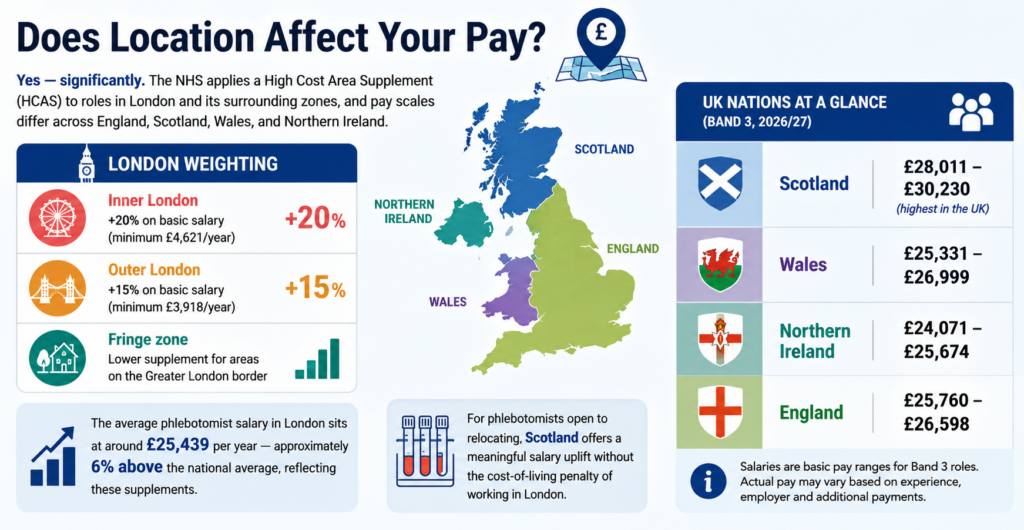
Does Location Affect Your Pay? Yes — significantly. The NHS applies a High Cost Area Supplement (HCAS) to roles in London and its surrounding zones, and pay scales differ across England, Scotland, Wales, and Northern Ireland. London weighting ♦ Inner London: +20% on basic salary (minimum £4,621/year) ♦ Outer London: +15% on basic salary (minimum £3,918/year) ♦ Fringe zone: lower supplement for areas on the Greater London border The average phlebotomist salary in London sits at around £25,439 per year — approximately 6% above the national average, reflecting these supplements. UK nations at a glance (Band 3, 2026/27) ♦ Scotland: £28,011 – £30,230 (highest in the UK) ♦ Wales: £25,331 – £26,999 ♦ Northern Ireland: £24,071 – £25,674 ♦ England: £25,760 – £26,598 For phlebotomists open to relocating, Scotland offers a meaningful salary uplift without the cost-of-living penalty of working in London.

NHS Phlebotomist Salary in 2026: Understanding Pay Bands

The majority of phlebotomists in the UK work within the NHS, and their pay is governed by the Agenda for Change framework — a nationally standardised pay structure that applies to virtually all non-medical NHS staff. Your band determines your salary, your progression, and your access to pay increments. Most phlebotomists sit at Band 2 or Band 3. 

Band 2 · Entry level

  • ♦  £25,272
  • ♦  England · Flat rate, no steps

Band 3 · Senior

  • ♦  £25,760
  • ♦  Rising to £26,598 after 2 yrs

Band 4 · Lead

  • ♦  £27,000+
  • ♦  Team oversight & management

Band 2 — The starting point

Band 2 covers supervised blood collection in hospital outpatient and GP-linked settings. The salary is a single flat rate with no incremental progression — your pay only increases when you move to a higher band. This is a critical point most phlebotomists are not told at the start of their career.

Band 3 — Autonomy and progression

Band 3 applies to phlebotomists working independently, covering wider clinical tasks, specialist sampling, and often contributing to the training of junior colleagues. Unlike Band 2, it includes two pay points — entry and top — with progression after approximately two years in post.

Band 4 — Leadership roles

Band 4 covers lead phlebotomists managing teams and departmental functions. It is not the destination for every phlebotomist, but it is a well-defined step for those who move into service management without leaving clinical work behind.

What is Agenda for Change?

Agenda for Change, often abbreviated to AfC, is the pay framework that covers the vast majority of NHS employees in the United Kingdom. Rather than salary being negotiated individually or set by each hospital trust, AfC assigns every role to a band based on a nationally standardised job evaluation process. That band then determines your starting pay, your incremental progression, and how your annual pay award applies.

Each April, the NHS Pay Review Body recommends a pay uplift, which the government either accepts or modifies before it takes effect. For 2026/27, a 3.6% uplift was confirmed — the second consecutive year of above-inflation increases for NHS staff following a 5.5% rise in 2025/26.

For phlebotomists, this means you won’t negotiate your salary in the traditional sense — but it is transparent, consistent, and comes with the full suite of NHS employment benefits that private roles rarely match.

Does Location Affect Your Pay

Does Location Affect Your Pay?

Yes — significantly. The NHS applies a High Cost Area Supplement (HCAS) to roles in London and its surrounding zones, and pay scales differ across England, Scotland, Wales, and Northern Ireland.

London weighting

  • ♦  Inner London: +20% on basic salary (minimum £4,621/year)
  • ♦  Outer London: +15% on basic salary (minimum £3,918/year)
  • ♦  Fringe zone: lower supplement for areas on the Greater London border

The average phlebotomist salary in London sits at around £25,439 per year — approximately 6% above the national average, reflecting these supplements.

UK nations at a glance (Band 3, 2026/27)

  • ♦  Scotland: £28,011 – £30,230 (highest in the UK)
  • ♦  Wales: £25,331 – £26,999
  • ♦  Northern Ireland: £24,071 – £25,674
  • ♦  England: £25,760 – £26,598

For phlebotomists open to relocating, Scotland offers a meaningful salary uplift without the cost-of-living penalty of working in London.

NHS, Private, Agency, or Freelance

NHS, Private, Agency, or Freelance — Which Pays More?

This is the question most aspiring phlebotomists eventually arrive at, and the honest answer is that it depends entirely on what you value beyond the headline salary figure. Each employment type has a distinct pay structure, risk profile, and total reward package.

NHS Employment — Stable but Structured

The NHS offers the most predictable and transparent salary of all the options. You know exactly what band you are on, how your pay will progress, and what uplift to expect each April. The NHS offers predictable, nationally published pay with the full Agenda for Change benefits package. That includes:

  • ♦  NHS Pension Scheme (6.1% employee / ~20.6% employer contribution)
  • ♦  Generous annual leave entitlement
  • ♦  Occupational sick pay
  • ♦  Structured band progression pathway

When you factor in the pension alone, the total value of an NHS position frequently exceeds what a higher private hourly rate suggests on paper. For anyone entering the profession, the NHS remains the most secure and professionally supported route.

Private Clinic Roles

Private clinics, GP-commissioned services, and independent healthcare providers set their own pay rates outside the Agenda for Change framework. This means salaries can vary widely — some private employers pay comparably to the NHS, while others offer higher rates to attract experienced staff, particularly in areas with competitive local labour markets.

Typical private clinic salaries range from around £22,000 to £30,000 per year, though the upper end usually reflects senior or specialist experience. The trade-off: no NHS pension, and employment terms such as sick pay and annual leave may be less favourable. Always assess the full package, not just the headline figure. 

Agency & Bank Phlebotomy

Bank and agency shifts pay between £12.36 and £13.96 per hour in 2025/26 — flexible, but with no guaranteed hours, no employer pension, and no paid leave. Most phlebotomists use this route to supplement a permanent part-time position rather than as a primary income. 

The appeal of agency work is the flexibility and, often, a higher effective hourly rate. 

Freelance & Mobile Phlebotomy

Freelance and mobile phlebotomy represents the highest earning potential in the sector. Mobile phlebotomists travel to clients’ homes, workplaces, or private health facilities to carry out blood draws, often serving corporate wellness programmes, private GP services, or health screening companies.

Experienced freelance and mobile phlebotomists regularly earn above £40,000 per year, with top earners building client books that generate income well beyond standard NHS band salaries. 

The trade-off, as with all self-employment, is that this income is gross before expenses — you are responsible for your own insurance, equipment, travel costs, tax, pension, and periods of low demand.

Best suited to experienced practitioners with an established professional network. It is generally not recommended as a starting point for those new to the profession.

How to Increase Your Phlebotomist Salary in the UK

How to Increase Your Phlebotomist Salary in the UK

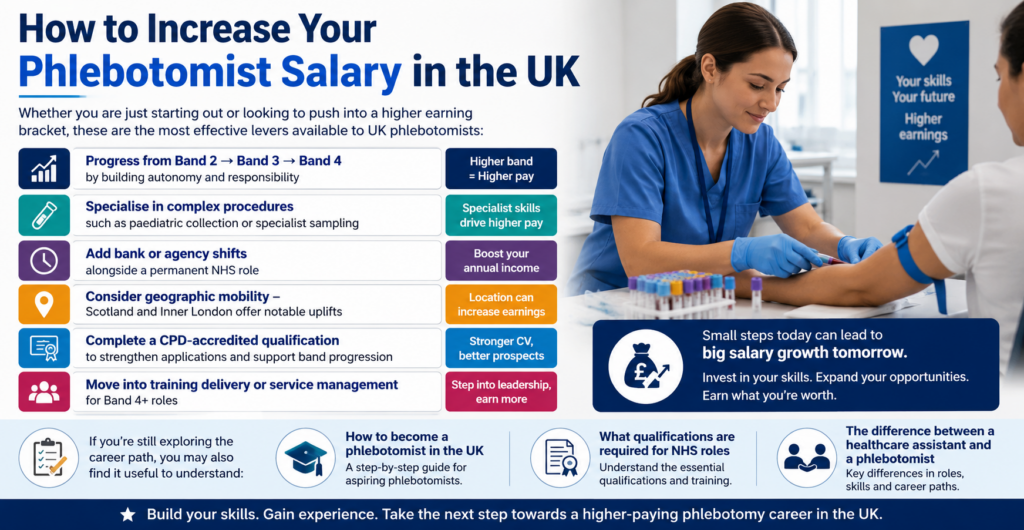
Whether you are just starting out or looking to push into a higher earning bracket, these are the most effective levers available to UK phlebotomists:

  • ♦  Progress from Band 2 → Band 3 → Band 4 by building autonomy and responsibility
  • ♦  Specialise in complex procedures such as paediatric collection or specialist sampling
  • ♦  Add bank or agency shifts alongside a permanent NHS role
  • ♦  Consider geographic mobility — Scotland and Inner London offer notable uplifts
  • ♦  Complete a CPD-accredited qualification to strengthen applications and support band progression
  • ♦  Move into training delivery or service management for Band 4+ roles

For most beginners, the fastest way to move beyond entry-level pay is to start with structured training. A recognised course not only builds confidence but also makes your CV far more competitive when applying for NHS and private roles.

If you’re still exploring the career path, you may also find it useful to understand:

  • ♦  How to become a phlebotomist in the UK
  • ♦  What qualifications are required for NHS roles
  • ♦  The difference between a healthcare assistant and a phlebotomist

These topics can help you map out your next steps more clearly before committing to training or job applications.

Is Phlebotomy a Well-Paid Career

Is Phlebotomy a Well-Paid Career? The Honest Answer

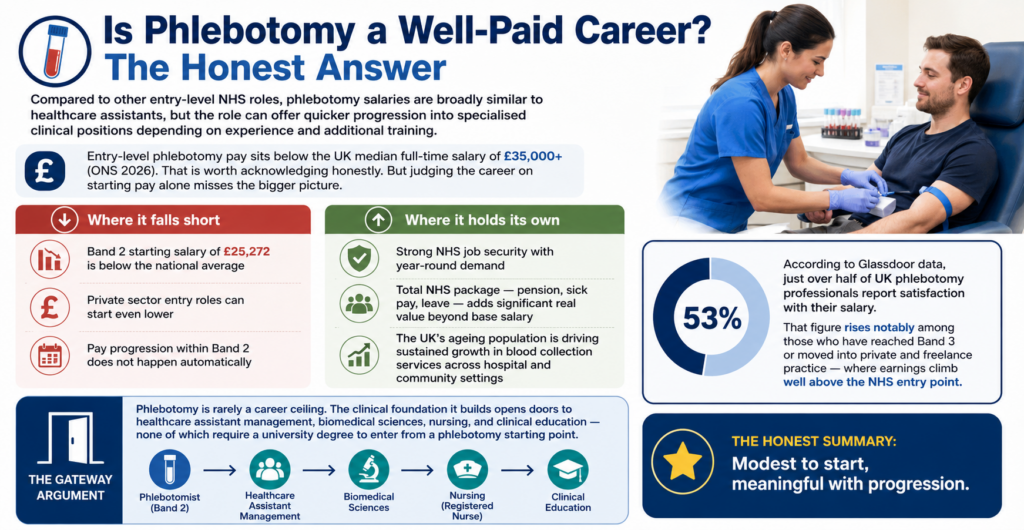
Compared to other entry-level NHS roles, phlebotomy salaries are broadly similar to healthcare assistants, but the role can offer quicker progression into specialised clinical positions depending on experience and additional training.

Entry-level phlebotomy pay sits below the UK median full-time salary of £35,000+ (ONS 2026). That is worth acknowledging honestly. But judging the career on starting pay alone misses the bigger picture.

Where it falls short:

  • ♦  Band 2 starting salary of £25,272 is below the national average
  • ♦  Private sector entry roles can start even lower
  • ♦  Pay progression within Band 2 does not happen automatically

Where it holds its own:

  • ♦  Strong NHS job security with year-round demand
  • ♦  Total NHS package — pension, sick pay, leave — adds significant real value beyond base salary
  • ♦  The UK’s ageing population is driving sustained growth in blood collection services across hospital and community settings

The gateway argument: Phlebotomy is rarely a career ceiling. The clinical foundation it builds opens doors to healthcare assistant management, biomedical sciences, nursing, and clinical education — none of which require a university degree to enter from a phlebotomy starting point.

According to Glassdoor data, just over half of UK phlebotomy professionals report satisfaction with their salary. That figure rises notably among those who have reached Band 3 or moved into private and freelance practice — where earnings climb well above the NHS entry point.

The honest summary: modest to start, meaningful with progression. 

Ready to Start Your Phlebotomy Career? Here's How to Get Qualified

You do not need a degree to become a phlebotomist in the UK. What employers — both NHS and private — look for is evidence of proper training, an understanding of core clinical procedures, and where possible, a recognised and accredited qualification to verify your competency. 

Our CPD-accredited Phlebotomist Training course covers all core competencies across 9 modules — from routine venipuncture and phlebotomy equipment to infection control, quality management, and specialist blood collection. Completed entirely online in around 5 hours, with a mock exam, final assessment, and an accredited certificate you can order directly on completion.

Explore the course ↗ 

FAQs — Phlebotomist Salary in the UK: What Can You Really Earn in 2025?

1. What is the starting salary for a phlebotomist in the UK?

In the NHS, the entry-level Band 2 salary is £25,272 in England for 2026/27. Scotland, Wales, and Northern Ireland operate their own pay scales, with Scotland offering the highest rates.

2. Do NHS phlebotomists get a pension?

Yes. NHS phlebotomists are enrolled in the NHS Pension Scheme — a defined benefit pension with a 6.1% employee contribution and approximately 20.6% employer contribution. It is one of the most valuable public sector pensions in the UK.

3. Can I become a phlebotomist without a degree?

Yes. A university degree is not required. Most employers look for secondary education, a recognised phlebotomy training course, and demonstrated competency. A CPD-accredited certificate is widely accepted as a credible entry-level qualification.

4. What band is a phlebotomist on in the NHS?

Most NHS phlebotomists are employed at Band 2 (entry-level, supervised) or Band 3 (autonomous, wider responsibilities). Lead phlebotomists in management roles may sit at Band 4.

5. Is phlebotomy in demand in the UK? 

Yes. NHS demand for phlebotomy services is consistent year-round, supported by an ageing population, rising chronic disease management, and growth in private health screening. NHS Jobs listings for phlebotomist roles are active across all regions of the UK.

6. How much do NHS phlebotomists earn per hour?

Most NHS phlebotomists earn between £12 and £14 per hour depending on banding and experience.

7. Is phlebotomy a good career in the UK? 

Phlebotomy is a stable entry-level healthcare career with strong demand across the NHS and private sector. While starting salaries are modest, progression into higher-paying clinical roles is common.

8. Can you become a phlebotomist with no experience? 

Yes. Many entry-level roles accept beginners, but completing a recognised training course can significantly improve your chances of getting hired.

Sam Walker

Article by

Sam Walker

Sam Walker is an education specialist and author at One Education, bringing over 4 years of experience in creating practical resources and strategies to support teachers and enhance student learning.

top
Home Courses Search