Entry-Level IT Jobs You Can Get in 2026 Without a Degree

July 01, 2026 | 13 minutes | 8 Readers

Ten years ago, a university degree was considered essential for most IT careers. In 2026, however, the technology industry is embracing a skills-first approach, with many employers placing greater value on practical abilities, professional certifications, and hands-on experience than formal qualifications. The rise of remote work has also opened up more opportunities for aspiring IT professionals, allowing companies to hire talent based on capability rather than location or academic background. At the same time, rapid advancements in artificial intelligence and

Ten years ago, a university degree was considered essential for most IT careers. In 2026, however, the technology industry is embracing a skills-first approach, with many employers placing greater value on practical abilities, professional certifications, and hands-on experience than formal qualifications. The rise of remote work has also opened up more opportunities for aspiring IT professionals, allowing companies to hire talent based on capability rather than location or academic background.

At the same time, rapid advancements in artificial intelligence and ongoing digital transformation have increased the demand for skilled tech workers across a wide range of industries. The good news is that you do not need a computer science degree to break into the field. Through self-learning, industry-recognised certifications, and real-world projects, you can develop the skills needed to secure an entry-level IT role and begin building a successful career in technology.

Why IT Employers Care More About Skills Than Degrees in 2026

In 2026, IT employers are placing greater emphasis on practical skills than traditional degrees. With technology evolving rapidly, companies need professionals who can demonstrate real-world abilities in areas such as cloud computing, cybersecurity, data analysis, and software development. Industry certifications, hands-on projects, and proven experience often provide stronger evidence of job readiness than academic qualifications alone. As a result, employers increasingly value candidates who can solve problems, adapt to new technologies, and contribute from day one, regardless of their educational background.

Skills-Based Hiring Is Growing

In 2026, many IT employers are prioritising skills over degrees. Businesses need professionals who can solve problems quickly and contribute from day one. Certifications often demonstrate job-ready skills, while portfolios and real-world projects can provide stronger evidence of ability than academic transcripts.

AI Has Changed Entry-Level Work

Artificial intelligence is automating many basic IT tasks, changing what employers look for in candidates. Companies increasingly value people who can:

  • ♦  Use AI tools effectively
  • ♦  Troubleshoot technical issues
  • ♦  Communicate with users
  • ♦  Think critically and solve problems

As a result, practical skills and hands-on experience are becoming more important than academic credentials alone. Candidates who can demonstrate real-world ability often have a stronger advantage in today’s IT job market.

10 Entry-Level IT Jobs You Can Get Without a Degree

10 Entry-Level IT Jobs You Can Get Without a Degree

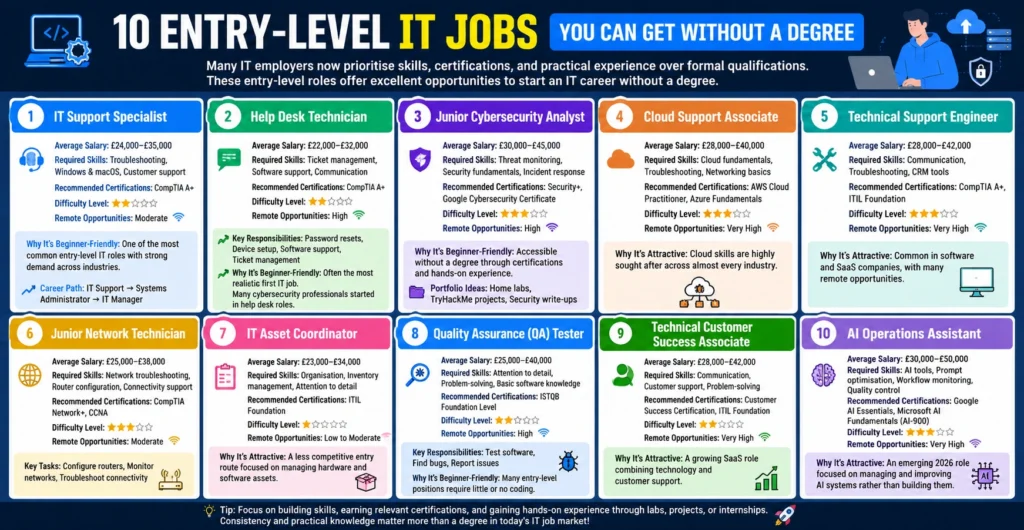
Many IT employers now prioritise skills, certifications, and practical experience over formal qualifications. These entry-level roles offer excellent opportunities to start an IT career without a degree.

1. IT Support Specialist

Average Salary: £24,000–£35,000

Required Skills: Troubleshooting, Windows & macOS, Customer support

Recommended Certifications: CompTIA A+

Difficulty Level: ⭐⭐☆☆☆

Remote Opportunities: Moderate

Why It’s Beginner-Friendly: One of the most common entry-level IT roles with strong demand across industries.

Career Path: IT Support → Systems Administrator → IT Manager

2. Help Desk Technician

Average Salary: £22,000–£32,000

Required Skills: Ticket management, Software support, Communication

Recommended Certifications: CompTIA A+

Difficulty Level: ⭐⭐☆☆☆

Remote Opportunities: High

Key Responsibilities: Password resets, Device setup, Software support, Ticket management

Why It’s Beginner-Friendly: Often the most realistic first IT job. Many cybersecurity professionals started in help desk roles.

3. Junior Cybersecurity Analyst

Average Salary: £30,000–£45,000

Required Skills: Threat monitoring, Security fundamentals, Incident response

Recommended Certifications: Security+, Google Cybersecurity Certificate

Difficulty Level: ⭐⭐⭐☆☆

Remote Opportunities: High

Why It’s Beginner-Friendly: Accessible without a degree through certifications and hands-on experience.

Portfolio Ideas: Home labs, TryHackMe projects, Security write-ups

4. Cloud Support Associate

Average Salary: £28,000–£40,000

Required Skills: Cloud fundamentals, Troubleshooting, Networking basics

Recommended Certifications: AWS Cloud Practitioner, Azure Fundamentals

Difficulty Level: ⭐⭐⭐☆☆

Remote Opportunities: Very High

Why It’s Attractive: Cloud skills are highly sought after across almost every industry.

5. Technical Support Engineer

Average Salary: £28,000–£42,000

Required Skills: Communication, Troubleshooting, CRM tools

Recommended Certifications: CompTIA A+, ITIL Foundation

Difficulty Level: ⭐⭐⭐☆☆

Remote Opportunities: Very High

Why It’s Attractive: Common in software and SaaS companies, with many remote opportunities.

6. Junior Network Technician

Average Salary: £25,000–£38,000

Required Skills: Network troubleshooting, Router configuration, Connectivity support

Recommended Certifications: CompTIA Network+, CCNA

Difficulty Level: ⭐⭐⭐☆☆

Remote Opportunities: Moderate

Key Tasks: Configure routers, Monitor networks, Troubleshoot connectivity

7. IT Asset Coordinator

Average Salary: £23,000–£34,000

Required Skills: Organisation, Inventory management, Attention to detail

Recommended Certifications: ITIL Foundation

Difficulty Level: ⭐☆☆☆☆

Remote Opportunities: Low to Moderate

Why It’s Attractive: A less competitive entry route focused on managing hardware and software assets.

8. Quality Assurance (QA) Tester

Average Salary: £25,000–£40,000

Required Skills: Attention to detail, Problem-solving, Basic software knowledge

Recommended Certifications: ISTQB Foundation Level

Difficulty Level: ⭐⭐☆☆☆

Remote Opportunities: High

Key Responsibilities: Test software, Find bugs, Report issues

Why It’s Beginner-Friendly: Many entry-level positions require little or no coding.

9. Technical Customer Success Associate

Average Salary: £28,000–£42,000

Required Skills: Communication, Customer support, Problem-solving

Recommended Certifications: Customer Success Certification, ITIL Foundation

Difficulty Level: ⭐⭐☆☆☆

Remote Opportunities: Very High

Why It’s Attractive: A growing SaaS role combining technology and customer support.

10. AI Operations Assistant

Average Salary: £30,000–£50,000

Required Skills: AI tools, Prompt optimisation, Workflow monitoring, Quality control

Recommended Certifications: Google AI Essentials, Microsoft AI Fundamentals (AI-900)

Difficulty Level: ⭐⭐⭐☆☆

Remote Opportunities: Very High

Why It’s Attractive: An emerging 2026 role focused on managing and improving AI systems rather than building them.

If you’re looking to build your expertise in IT service management and earn a recognised industry qualification, consider enrolling in the ITIL® 4 Specialist: Monitor, Support, and Fulfil Certification Course. This course covers essential practices for service monitoring, user support, incident management, and service fulfilment, helping you prepare for certification and enhance your professional capabilities. Start your learning journey today with One Education.

The Fastest Way to Get Hired Without a Degree

The Fastest Way to Get Hired Without a Degree

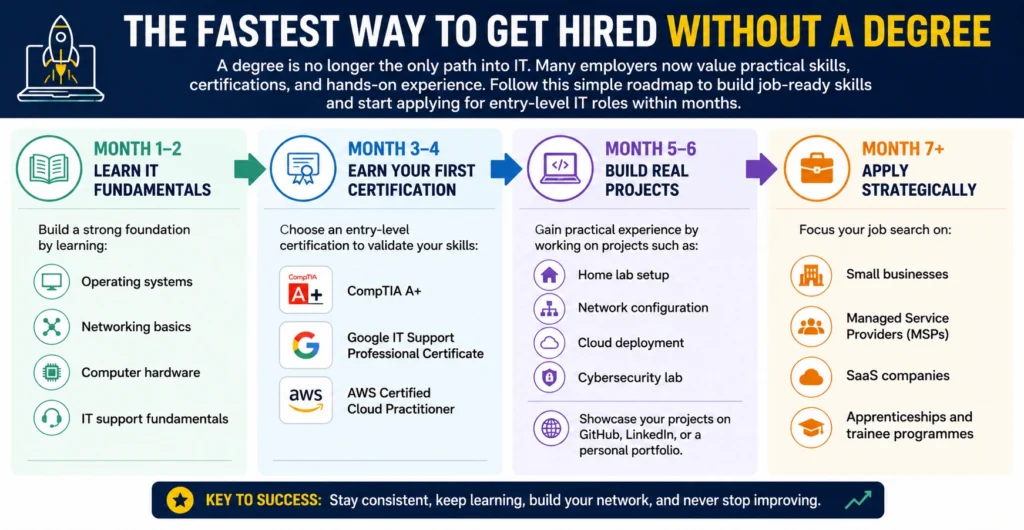
A degree is no longer the only path into IT. Many employers now value practical skills, certifications, and hands-on experience. Follow this simple roadmap to build job-ready skills and start applying for entry-level IT roles within months.

Month 1–2: Learn IT Fundamentals

Build a strong foundation by learning:

  • ♦  Operating systems
  • ♦  Networking basics
  • ♦  Computer hardware
  • ♦  IT support fundamentals

Month 3–4: Earn Your First Certification

Choose an entry-level certification to validate your skills:

  • ♦  CompTIA A+
  • ♦  Google IT Support Professional Certificate
  • ♦  AWS Certified Cloud Practitioner

Month 5–6: Build Real Projects

Gain practical experience by working on projects such as:

  • ♦  Home lab setup
  • ♦  Network configuration
  • ♦  Cloud deployment
  • ♦  Cybersecurity lab

Showcase your projects on GitHub, LinkedIn, or a personal portfolio.

Month 7+: Apply Strategically

Focus your job search on:

  • ♦  Small businesses
  • ♦  Managed Service Providers (MSPs)
  • ♦  SaaS companies
  • ♦  Apprenticeships and trainee programmes
Mistakes That Stop Beginners From Getting Hired

Mistakes That Stop Beginners From Getting Hired

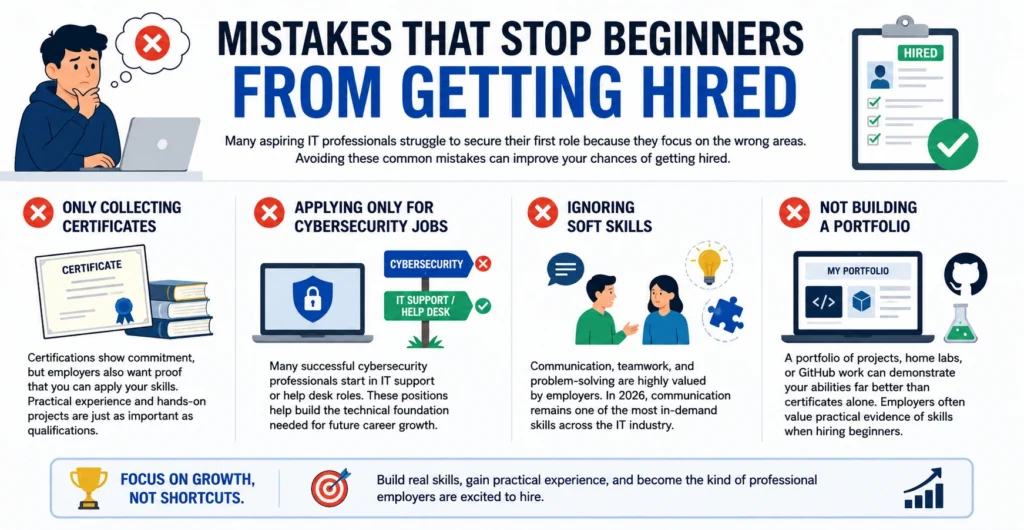
Many aspiring IT professionals struggle to secure their first role because they focus on the wrong areas. Avoiding these common mistakes can improve your chances of getting hired.

Only Collecting Certificates

Certifications show commitment, but employers also want proof that you can apply your skills. Practical experience and hands-on projects are just as important as qualifications.

Applying Only for Cybersecurity Jobs

Many successful cybersecurity professionals start in IT support or help desk roles. These positions help build the technical foundation needed for future career growth.

Ignoring Soft Skills

Communication, teamwork, and problem-solving are highly valued by employers. In 2026, communication remains one of the most in-demand skills across the IT industry.

Not Building a Portfolio

A portfolio of projects, home labs, or GitHub work can demonstrate your abilities far better than certificates alone. Employers often value practical evidence of skills when hiring beginners.

Which Entry-Level IT Job Is Best for You

Which Entry-Level IT Job Is Best for You?

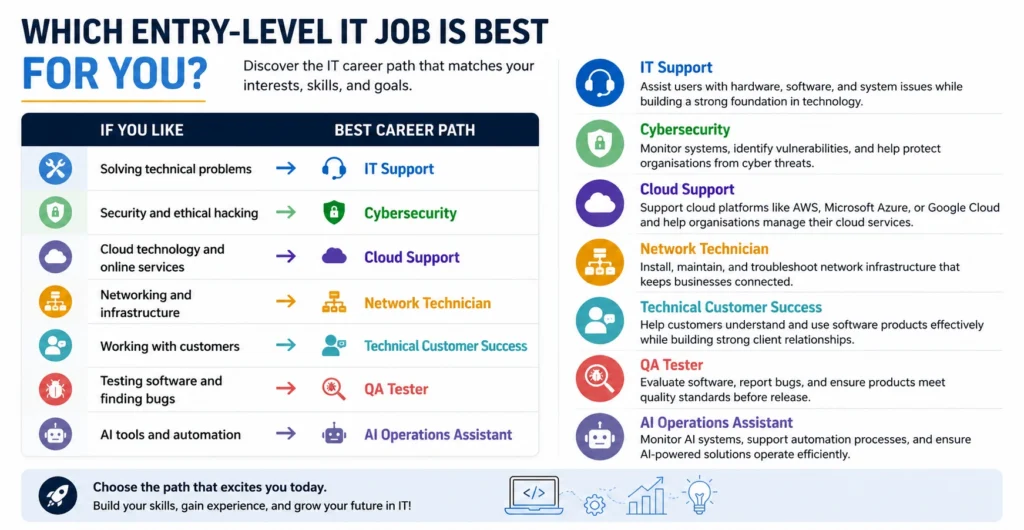
One of the biggest advantages of starting a career in IT is the variety of entry-level roles available. Whether you enjoy solving technical issues, working with people, or exploring emerging technologies, there is a pathway that can match your interests and strengths. The table below can help you identify which IT career may be the best fit for you.

If You Like Best Career Path
Solving technical problems IT Support
Security and ethical hacking Cybersecurity
Cloud technology and online services Cloud Support
Networking and infrastructure Network Technician
Working with customers Technical Customer Success
Testing software and finding bugs QA Tester
AI tools and automation AI Operations Assistant

IT Support

If you enjoy troubleshooting issues and helping people solve technical problems, IT Support could be an excellent starting point. IT support professionals assist users with hardware, software, and system-related issues while developing a strong foundation in technology.

Cybersecurity

For those fascinated by digital security, ethical hacking, and protecting systems from cyber threats, a career in Cybersecurity offers exciting opportunities. Entry-level roles often involve monitoring systems, identifying vulnerabilities, and supporting security operations.

Cloud Support

Cloud computing continues to transform how organisations manage data and applications. If you are interested in platforms such as AWS, Microsoft Azure, or Google Cloud, Cloud Support roles can provide a strong entry point into one of the fastest-growing areas of IT.

Network Technician

If you are curious about how devices, servers, and systems communicate, a Network Technician role may suit you. These professionals help install, maintain, and troubleshoot network infrastructure that keeps businesses connected.

Technical Customer Success

People who enjoy combining technology with communication skills may thrive in Technical Customer Success roles. These professionals help customers understand and use software products effectively while building strong client relationships.

QA Tester

If you have a keen eye for detail and enjoy identifying problems before others do, Quality Assurance (QA) Testing could be a great fit. QA Testers evaluate software applications, report bugs, and help ensure products meet quality standards before release.

AI Operations Assistant

As artificial intelligence becomes more widely adopted, organisations increasingly need professionals to manage AI tools and workflows. AI Operations Assistants help monitor AI systems, support automation processes, and ensure AI-powered solutions operate efficiently.

The best IT career path is ultimately the one that aligns with your interests, strengths, and long-term goals. By choosing a role that matches what you enjoy, you can build valuable skills and create a strong foundation for future career growth in the technology sector.

Conclusion

In 2026, a university degree is no longer the only pathway into the technology sector. With growing demand for skilled professionals, many entry-level IT roles now prioritise practical abilities, industry certifications, hands-on experience, and a willingness to learn over formal academic qualifications. Whether you are interested in technical support, cybersecurity, software development, data analysis, cloud computing, or IT service management, there are numerous opportunities to start and grow a successful career in IT. By building relevant skills, earning recognised certifications, and gaining real-world experience through projects, internships, or freelance work, aspiring professionals can confidently enter the industry and create a strong foundation for long-term career success.

FAQs — Entry-Level IT Jobs You Can Get in 2026 Without a Degree

1. Can I get an IT job without a university degree in 2026?
Yes. Many entry-level IT roles focus on practical skills, certifications, and hands-on experience rather than a university degree.
2. Which IT jobs are easiest to enter without a degree?
IT Support Technician, Help Desk Analyst, Technical Support Specialist, Junior Web Developer, and Cybersecurity Analyst are among the most accessible roles.
3. What skills do employers look for in entry-level IT candidates?
Employers typically look for problem-solving abilities, technical knowledge, communication skills, and familiarity with IT tools and systems.
4. Do IT certifications help me get hired?
Yes. Industry-recognised certifications can demonstrate your knowledge and improve your chances of securing an entry-level IT position.
5. Can I learn IT skills online?
Yes. Online courses, tutorials, virtual labs, and certification programmes provide flexible ways to develop IT skills from home.
6. Is coding required for all entry-level IT jobs?
No. Many roles, such as IT support and help desk positions, require little or no coding knowledge.

Sam Walker

Article by

Sam Walker

Sam Walker is an education specialist and author at One Education, bringing over 4 years of experience in creating practical resources and strategies to support teachers and enhance student learning.

top
Home Courses Search