How to Become an IT Service Manager

June 30, 2026 | 17 minutes | 18 Readers

Modern organisations rely heavily on technology to deliver services, support customers, and maintain daily operations, making effective IT service management more important than ever. As businesses continue to adopt digital solutions and invest in technological innovation, the demand for skilled IT Service Managers is growing across industries. These professionals play a crucial role in ensuring IT services run efficiently, align with business objectives, and provide a positive experience for users. With strong demand, excellent career progression opportunities, and competitive salaries,

Modern organisations rely heavily on technology to deliver services, support customers, and maintain daily operations, making effective IT service management more important than ever. As businesses continue to adopt digital solutions and invest in technological innovation, the demand for skilled IT Service Managers is growing across industries. These professionals play a crucial role in ensuring IT services run efficiently, align with business objectives, and provide a positive experience for users. With strong demand, excellent career progression opportunities, and competitive salaries, IT Service Management has become an attractive career path for IT professionals seeking leadership roles.

If you are considering a career as an IT Service Manager, understanding the required skills, qualifications, and career steps is essential. This guide will explore the responsibilities of the role, the certifications and training that can help you stand out, and the practical experience needed to succeed. By the end, you will have a clear understanding of how to start and develop a successful career in IT Service Management.

What Does an IT Service Manager Do?

An IT Service Manager ensures that IT services are delivered efficiently, reliably, and in line with business needs. They oversee service performance, support teams, and service improvement to ensure users receive high-quality IT support.

Key Responsibilities

Managing IT Service Delivery

Oversee the delivery of IT services, ensuring they meet business requirements and quality standards.

Ensuring Service Availability and Performance

Monitor systems and services to minimise downtime and maintain reliable performance.

Handling Incidents and Service Disruptions

Coordinate the resolution of technical issues and ensure services are restored quickly.

Managing Service Level Agreements (SLAs)

Track and manage SLAs to ensure agreed service targets are consistently achieved.

Leading IT Support Teams

Guide and support IT teams, helping them deliver excellent customer service and technical support.

Driving Continual Service Improvement

Identify opportunities to improve processes, service quality, and user satisfaction.

A Day in the Life of an IT Service Manager

A typical day often includes:

  • ♦  Morning service review meetings to assess system performance and ongoing issues.
  • ♦  Incident management to coordinate responses to service disruptions.
  • ♦  Stakeholder communication with business leaders, users, and service providers.
  • ♦  Performance reporting to review KPIs and SLA compliance.
  • ♦  Improvement planning to enhance services and address future needs.

The Modern IT Service Manager

Modern IT Service Managers spend less time fixing technology and more time managing services, people, and business expectations. Their focus is on delivering value, improving user experiences, and ensuring IT supports organisational goals.

Why Choose a Career in IT Service Management

Why Choose a Career in IT Service Management?

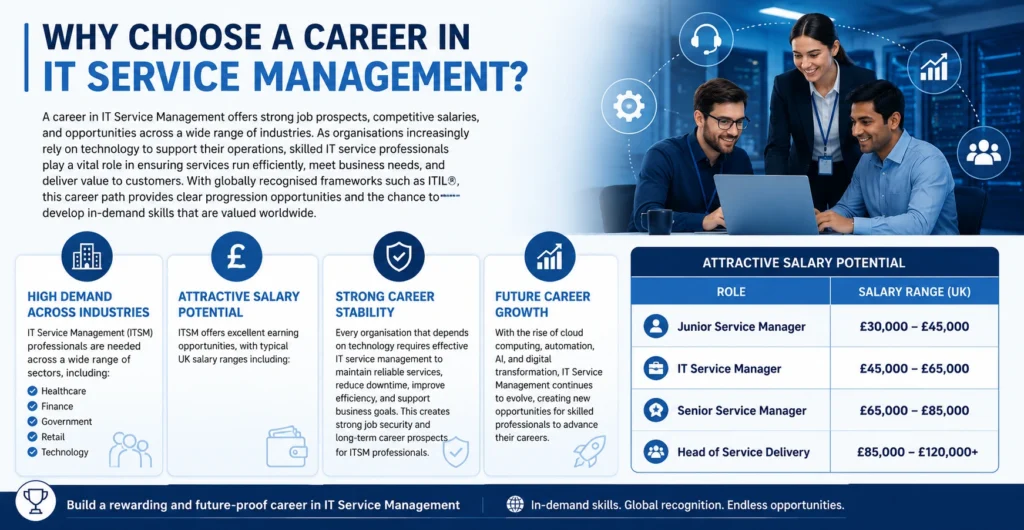
A career in IT Service Management offers strong job prospects, competitive salaries, and opportunities across a wide range of industries. As organisations increasingly rely on technology to support their operations, skilled IT service professionals play a vital role in ensuring services run efficiently, meet business needs, and deliver value to customers. With globally recognised frameworks such as ITIL®, this career path provides clear progression opportunities and the chance to develop in-demand skills that are valued worldwide.

High Demand Across Industries

IT Service Management (ITSM) professionals are needed across a wide range of sectors, including:

  • ♦  Healthcare
  • ♦  Finance
  • ♦  Government
  • ♦  Retail
  • ♦  Technology

As organisations continue to rely on technology, the demand for skilled ITSM professionals remains strong.

Attractive Salary Potential

ITSM offers excellent earning opportunities, with typical UK salary ranges including:

Role Salary Range
Junior Service Manager £30,000 – £45,000
IT Service Manager £45,000 – £65,000
Senior Service Manager £65,000 – £85,000
Head of Service Delivery £85,000 – £120,000+

Strong Career Stability

Every organisation that depends on technology requires effective IT service management to maintain reliable services, reduce downtime, improve efficiency, and support business goals. This creates strong job security and long-term career prospects for ITSM professionals.

Future Career Growth

With the rise of cloud computing, automation, AI, and digital transformation, IT Service Management continues to evolve, creating new opportunities for skilled professionals to advance their careers.

If you’re interested in developing advanced IT service management skills and gaining a respected industry qualification, consider enrolling in the ITIL® 4 Strategist: Direct, Plan, and Improve Certification Course. This course helps you understand strategic planning, governance, continual improvement, and organisational change, while preparing you for the official certification exam. Take the next step in your professional development with One Education.

Skills Required to Become an IT Service Manager

Skills Required to Become an IT Service Manager

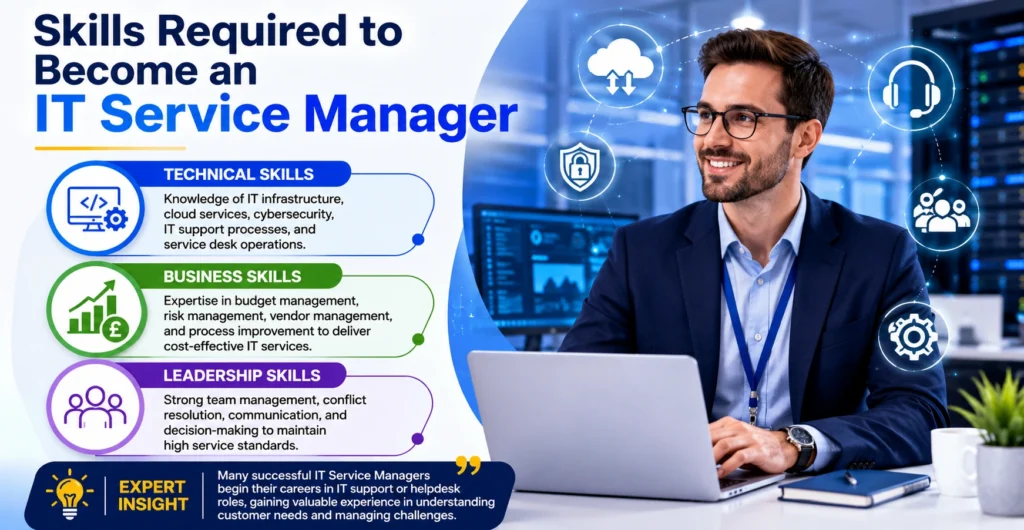
To succeed as an IT Service Manager, you need a combination of technical knowledge, business understanding, and leadership abilities.

Technical Skills

A strong understanding of IT infrastructure fundamentals, cloud services, cybersecurity awareness, IT support processes, and service desk operations is essential for managing reliable and secure IT services.

Business Skills

IT Service Managers should be skilled in budget management, risk management, vendor management, and process improvement to ensure services remain cost-effective and aligned with business goals.

Leadership Skills

Effective team management, conflict resolution, communication, and decision-making skills are crucial for leading teams, resolving issues, and maintaining high service standards.

Expert Insight

Many successful IT Service Managers begin their careers in IT support or helpdesk roles, as these positions provide valuable experience in understanding customer needs and managing operational challenges.

Educational Requirements

Educational Requirements

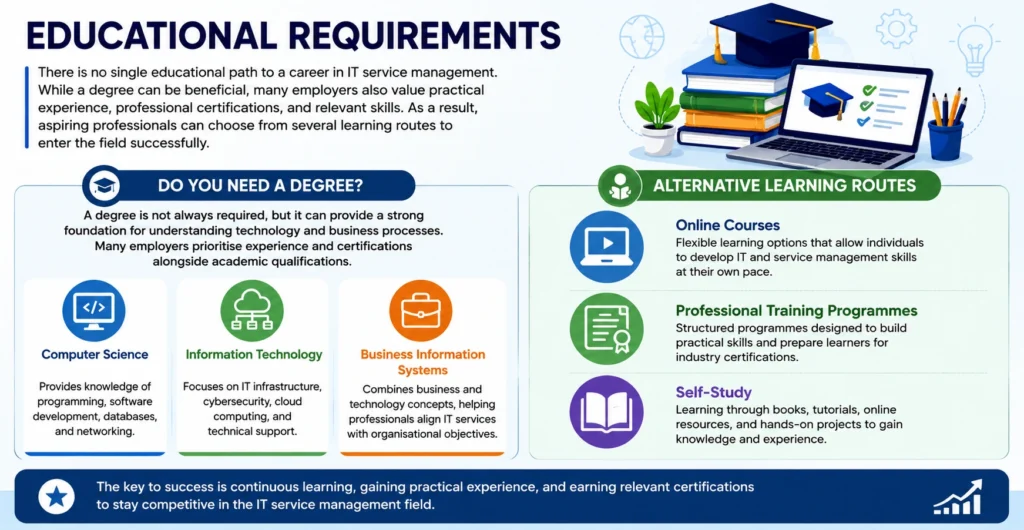
There is no single educational path to a career in IT service management. While a degree can be beneficial, many employers also value practical experience, professional certifications, and relevant skills. As a result, aspiring professionals can choose from several learning routes to enter the field successfully.

Do You Need a Degree?

A degree is not always required, but it can provide a strong foundation for understanding technology and business processes. Many employers prioritise experience and certifications alongside academic qualifications.

Computer Science

Provides knowledge of programming, software development, databases, and networking.

Information Technology

Focuses on IT infrastructure, cybersecurity, cloud computing, and technical support.

Business Information Systems

Combines business and technology concepts, helping professionals align IT services with organisational objectives.

Alternative Learning Routes

Online Courses

Flexible learning options that allow individuals to develop IT and service management skills at their own pace.

Professional Training Programmes

Structured programmes designed to build practical skills and prepare learners for industry certifications.

Self-Study

Learning through books, tutorials, online resources, and hands-on projects to gain knowledge and experience.

Essential Certifications for IT Service Managers

Essential Certifications for IT Service Managers

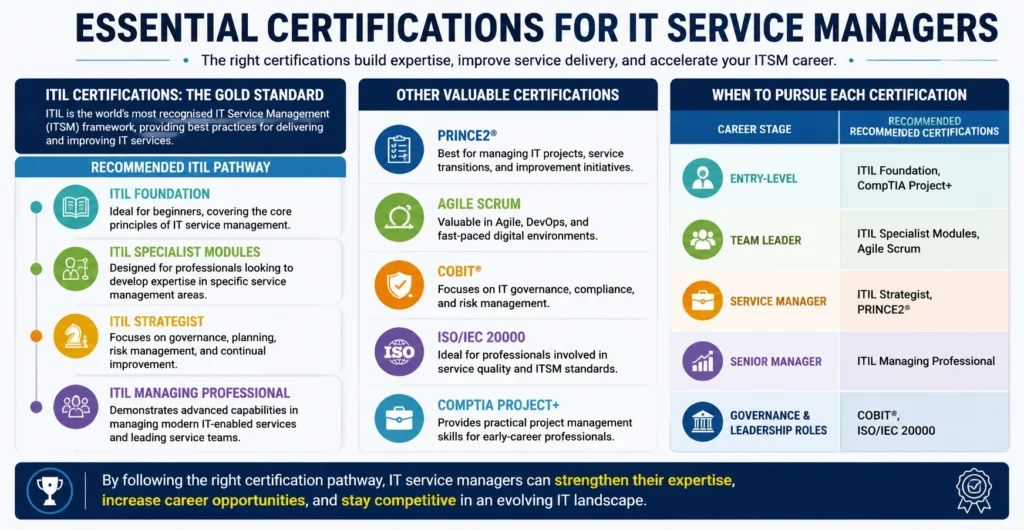
Professional certifications help IT service managers build expertise, improve service delivery, and progress their careers. The most valuable certifications often depend on your career stage and responsibilities.

ITIL Certifications: The Gold Standard

ITIL remains the most recognised IT Service Management (ITSM) framework globally, providing best practices for delivering and improving IT services.

Recommended ITIL Pathway:

  • ♦  ITIL Foundation – Ideal for beginners, covering the core principles of IT service management.

  • ♦  ITIL Specialist Modules – Designed for professionals looking to develop expertise in specific service management areas.

  • ♦  ITIL Strategist – Focuses on governance, planning, risk management, and continual improvement.

  • ♦  ITIL Managing Professional – Demonstrates advanced capabilities in managing modern IT-enabled services and leading service teams.

Other Valuable Certifications

  • ♦  PRINCE2 – Best for managing IT projects, service transitions, and improvement initiatives.
  • ♦  Agile Scrum – Valuable in Agile, DevOps, and fast-paced digital environments.
  • ♦  COBIT – Focuses on IT governance, compliance, and risk management.
  • ♦  ISO 20000 – Ideal for professionals involved in service quality and ITSM standards.
  • ♦  CompTIA Project+ – Provides practical project management skills for early-career professionals.

When to Pursue Each Certification

Career Stage Recommended Certifications
Entry-Level ITIL Foundation, CompTIA Project+
Team Leader ITIL Specialist Modules, Agile Scrum
Service Manager ITIL Strategist, PRINCE2
Senior Manager ITIL Managing Professional
Governance & Leadership Roles COBIT, ISO 20000

By following the right certification pathway, IT service managers can strengthen their expertise, increase career opportunities, and stay competitive in an evolving IT landscape.

Step-by-Step Guide to Becoming an IT Service Manager

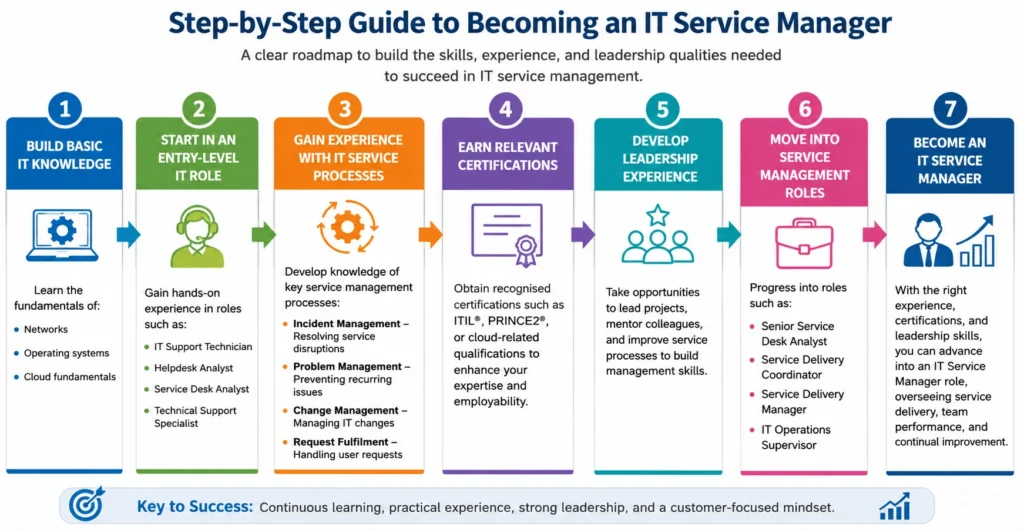
Step-by-Step Guide to Becoming an IT Service Manager

An IT Service Manager ensures IT services run efficiently and align with business goals. The role involves managing service delivery, improving processes, leading teams, and maintaining customer satisfaction. Follow these steps to build a successful career in IT service management.

Step 1: Build Basic IT Knowledge

Learn the fundamentals of:

  • ♦  Networks
  • ♦  Operating systems
  • ♦  Cloud fundamentals

Step 2: Start in an Entry-Level IT Role

Gain hands-on experience in roles such as:

  • ♦  IT Support Technician
  • ♦  Helpdesk Analyst
  • ♦  Service Desk Analyst
  • ♦  Technical Support Specialist

Step 3: Gain Experience with IT Service Processes

Develop knowledge of key service management processes:

  • ♦  Incident Management – Resolving service disruptions
  • ♦  Problem Management – Preventing recurring issues
  • ♦  Change Management – Managing IT changes
  • ♦  Request Fulfilment – Handling user requests

Step 4: Earn Relevant Certifications

Obtain recognised certifications such as ITIL®, PRINCE2®, or cloud-related qualifications to enhance your expertise and employability.

Step 5: Develop Leadership Experience

Take opportunities to lead projects, mentor colleagues, and improve service processes to build management skills.

Step 6: Move into Service Management Roles

Progress into roles such as:

  • ♦  Senior Service Desk Analyst
  • ♦  Service Delivery Coordinator
  • ♦  Service Delivery Manager
  • ♦  IT Operations Supervisor

Step 7: Become an IT Service Manager

With the right experience, certifications, and leadership skills, you can advance into an IT Service Manager role, overseeing service delivery, team performance, and continual improvement.

Common Career Paths to IT Service Management

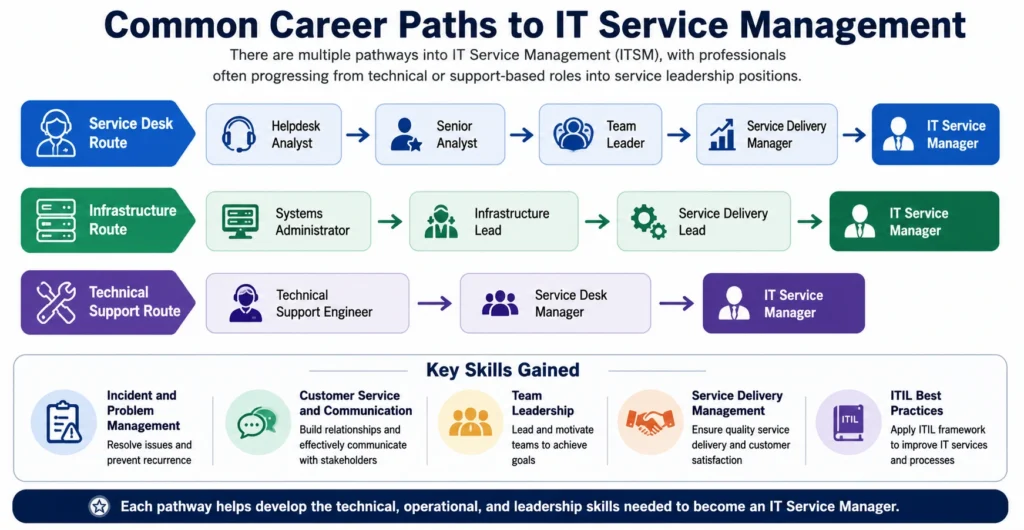
Common Career Paths to IT Service Management

There are multiple pathways into IT Service Management (ITSM), with professionals often progressing from technical or support-based roles into service leadership positions.

Service Desk Route

Helpdesk Analyst → Senior Analyst → Team Leader → Service Delivery Manager → IT Service Manager

Infrastructure Route

Systems Administrator → Infrastructure Lead → Service Delivery Lead → IT Service Manager

Technical Support Route

Technical Support Engineer → Service Desk Manager → IT Service Manager

Key Skills Gained

  • ♦  Incident and problem management
  • ♦  Customer service and communication
  • ♦  Team leadership
  • ♦  Service delivery management
  • ♦  ITIL best practices

Each pathway helps develop the technical, operational, and leadership skills needed to become an IT Service Manager.

Challenges IT Service Managers Face

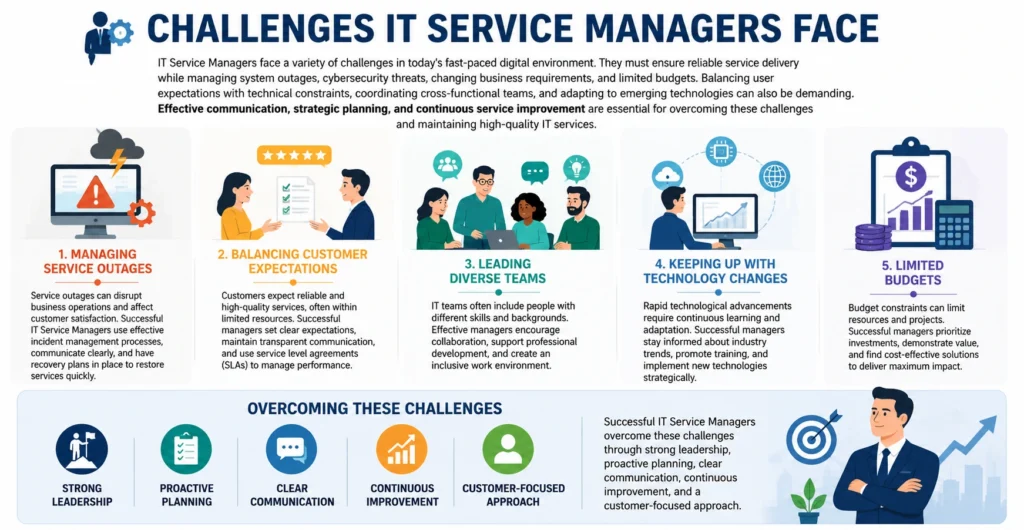
Challenges IT Service Managers Face

IT Service Managers face a variety of challenges in today’s fast-paced digital environment. They must ensure reliable service delivery while managing system outages, cybersecurity threats, changing business requirements, and limited budgets. Balancing user expectations with technical constraints, coordinating cross-functional teams, and adapting to emerging technologies can also be demanding. Effective communication, strategic planning, and continuous service improvement are essential for overcoming these challenges and maintaining high-quality IT services.

Managing Service Outages

Service outages can disrupt business operations and affect customer satisfaction. Successful IT Service Managers use effective incident management processes, communicate clearly, and have recovery plans in place to restore services quickly.

Balancing Customer Expectations

Customers expect reliable and high-quality services, often within limited resources. Successful managers set clear expectations, maintain transparent communication, and use service level agreements (SLAs) to manage performance.

Leading Diverse Teams

IT teams often include people with different skills and backgrounds. Effective managers encourage collaboration, support professional development, and create an inclusive work environment.

Keeping Up with Technology Changes

Rapid technological advancements require continuous learning and adaptation. Successful managers stay informed about industry trends, promote training, and implement new technologies strategically.

Overcoming These Challenges

Successful IT Service Managers overcome these challenges through strong leadership, proactive planning, clear communication, continuous improvement, and a customer-focused approach.

Future of IT Service Management Careers

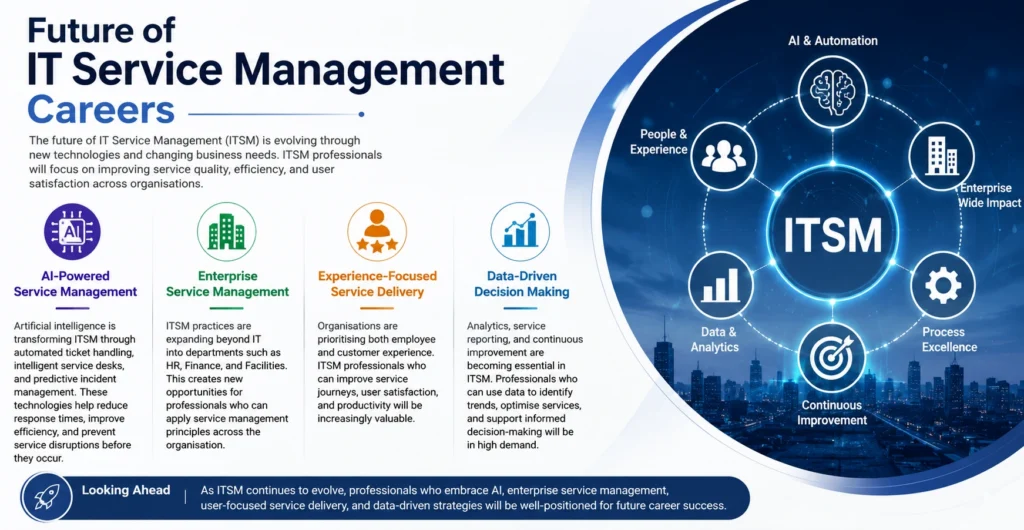
Future of IT Service Management Careers

The future of IT Service Management (ITSM) is evolving through new technologies and changing business needs. ITSM professionals will focus on improving service quality, efficiency, and user satisfaction across organisations.

AI-Powered Service Management

Artificial intelligence is transforming ITSM through automated ticket handling, intelligent service desks, and predictive incident management. These technologies help reduce response times, improve efficiency, and prevent service disruptions before they occur.

Enterprise Service Management

ITSM practices are expanding beyond IT into departments such as HR, Finance, and Facilities. This creates new opportunities for professionals who can apply service management principles across the organisation.

Experience-Focused Service Delivery

Organisations are prioritising both employee and customer experience. ITSM professionals who can improve service journeys, user satisfaction, and productivity will be increasingly valuable.

Data-Driven Decision Making

Analytics, service reporting, and continuous improvement are becoming essential in ITSM. Professionals who can use data to identify trends, optimise services, and support informed decision-making will be in high demand.

Looking Ahead

As ITSM continues to evolve, professionals who embrace AI, enterprise service management, user-focused service delivery, and data-driven strategies will be well-positioned for future career success.

How Long Does It Take to Become an IT Service Manager?

Becoming an IT Service Manager typically takes 4 to 8 years, depending on your experience, qualifications, and career progression. Most professionals start in entry-level IT roles and gradually move into technical and leadership positions before reaching management level.

Typical Career Timeline

Career Stage Average Time
Entry-Level IT Role 1–2 Years
Mid-Level Technical Role 2–4 Years
Team Lead or Supervisor 1–3 Years
IT Service Manager 4–8 Years Total

Career Path

  • ♦  Entry-Level IT Role (1–2 Years): Build foundational skills in IT support, service delivery, and troubleshooting.
  • ♦  Mid-Level Technical Role (2–4 Years): Develop technical expertise and gain experience managing IT systems and services.
  • ♦  Team Lead or Supervisor (1–3 Years): Take on leadership responsibilities, manage teams, and improve service performance.
  • ♦  IT Service Manager: Oversee IT service delivery, service improvement initiatives, and stakeholder relationships.

What Can Speed Up Your Progress?

Professional certifications such as ITIL®, leadership experience, continuous training, and strong technical skills can help you progress more quickly.

Conclusion

Becoming an IT Service Manager is a rewarding career path for individuals who enjoy combining technical expertise with leadership and strategic decision-making. By developing a strong understanding of IT service management frameworks, gaining practical industry experience, building essential communication and problem-solving skills, and pursuing recognised certifications, you can position yourself for long-term success in this field. As organisations continue to rely on technology to drive efficiency and growth, skilled IT Service Managers remain in high demand, making this an excellent career choice for those seeking professional development and advancement in the IT sector.

FAQs — How to Become an IT Service Manager

1. What does an IT Service Manager do?
An IT Service Manager oversees IT services, ensures smooth service delivery, manages incidents and service requests, and works to improve the overall user experience.
2. What qualifications do I need to become an IT Service Manager?
While a degree in IT, computer science, or a related field can be helpful, many employers also value professional certifications and relevant industry experience.
3. Is IT Service Management a good career choice?
Yes. IT Service Management offers strong career prospects, competitive salaries, and opportunities to work across a wide range of industries.
4. Which skills are important for an IT Service Manager?
Key skills include leadership, communication, problem-solving, project management, service delivery, and knowledge of IT Service Management frameworks.
5. Do I need ITIL certification to become an IT Service Manager?
ITIL certification is not always mandatory, but it is highly valued by employers and can improve your career prospects in IT Service Management.

Sam Walker

Article by

Sam Walker

Sam Walker is an education specialist and author at One Education, bringing over 4 years of experience in creating practical resources and strategies to support teachers and enhance student learning.

top
Home Courses Search