How Micro-Teaching Helps Build Confidence in New Educators

August 06, 2026 | 10 minutes | 8 Readers

Knowing a subject and teaching it are two different skills.  A new trainer knows their subject well. Ask them to explain it to a colleague over coffee and they’re fluent, relaxed, entirely in control. Ask them to stand in front of a group and teach the same material, and something shifts.The knowledge is still there, but it doesn’t automatically translate into confidence. It tends to show up after the first attempt, not before it. Micro-teaching is designed to close that

Knowing a subject and teaching it are two different skills. 

A new trainer knows their subject well. Ask them to explain it to a colleague over coffee and they’re fluent, relaxed, entirely in control. Ask them to stand in front of a group and teach the same material, and something shifts.The knowledge is still there, but it doesn’t automatically translate into confidence. It tends to show up after the first attempt, not before it. Micro-teaching is designed to close that gap before trainees enter a real classroom. 

A Safer First Step into Teaching

Many new trainers believe that because they are experts in their field, they will be confident teachers by default. In reality, standing in front of a group of learners brings challenges that subject expertise alone doesn’t prepare you for. 

That leaves a practical difficulty, not just a psychological one: new trainers want real-world experience to gain confidence, and a full class of learners is a high-stakes environment for that first encounter. A first attempt shouldn’t have to suffer the penalty of making a mistake in front of an actual class. In order to truly learn from that initial encounter, it is necessary to choose a place where the stakes are minimal. 

That’s where a micro-teaching session comes in. 

A Micro-Teaching Session.

It provides a low-stakes environment to practise teaching, which is why it’s built into the structure of the AET qualification deliberately, not as an afterthought.

As part of the qualification, learners complete at least one hour of micro-teaching in total. That includes delivering at least one 15-minute session that’s observed and formally assessed by a tutor. The remaining 45 minutes can be spent either delivering additional short sessions or observing other learners doing the same. Sessions are delivered to a small audience — a minimum of two learners or peers — and recorded on video, with structured feedback given afterwards. 

What Typically Happens During a Session

A micro-teaching session follows a straightforward cycle. You plan a short lesson, deliver it to a small group, receive constructive feedback, reflect on what went well and what could be improved, then apply those insights the next time you teach. Each stage builds on the last, turning practice into measurable progress. 

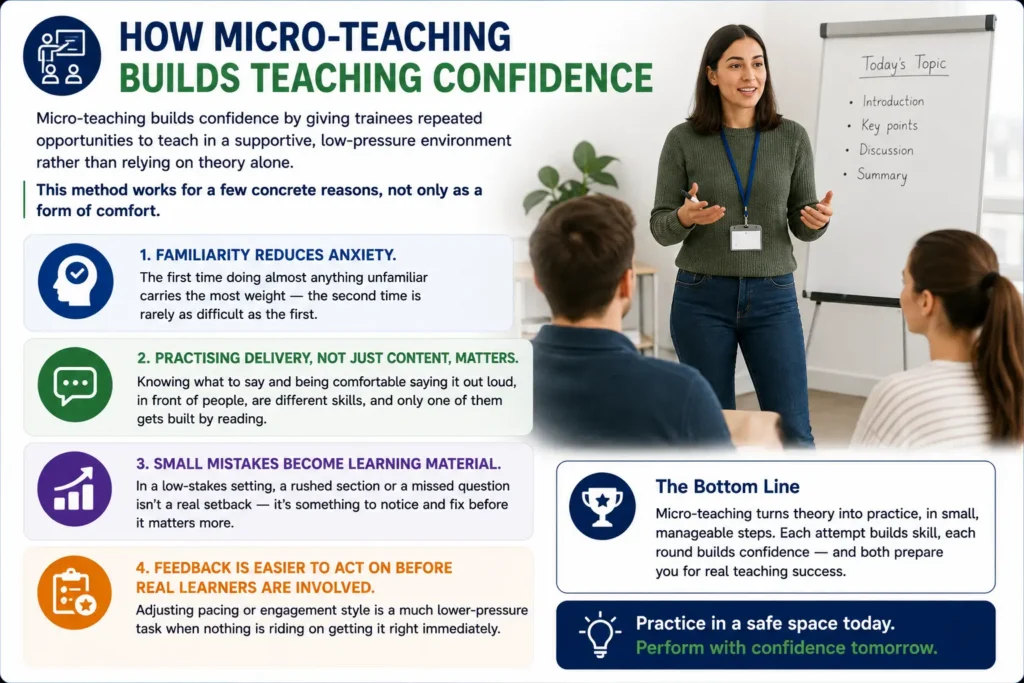
How Micro-Teaching Builds Teaching Confidence

How Micro-Teaching Builds Teaching Confidence

Micro-teaching builds confidence by giving trainees repeated opportunities to teach in a supportive, low-pressure environment rather than relying on theory alone. 

This method works for a few concrete reasons, not only as a form of comfort. 

  • ♦  Familiarity reduces anxiety. 

The first time doing almost anything unfamiliar carries the most weight — the second time is rarely as difficult as the first.

  • ♦  Practising delivery, not just content, matters. 

Knowing what to say and being comfortable saying it out loud, in front of people, are different skills, and only one of them gets built by reading.

  • ♦  Small mistakes become learning material. 

In a low-stakes setting, a rushed section or a missed question isn’t a real setback — it’s something to notice and fix before it matters more.

  • ♦  Feedback is easier to act on before real learners are involved. 

Adjusting pacing or engagement style is a much lower-pressure task when nothing is riding on getting it right immediately.

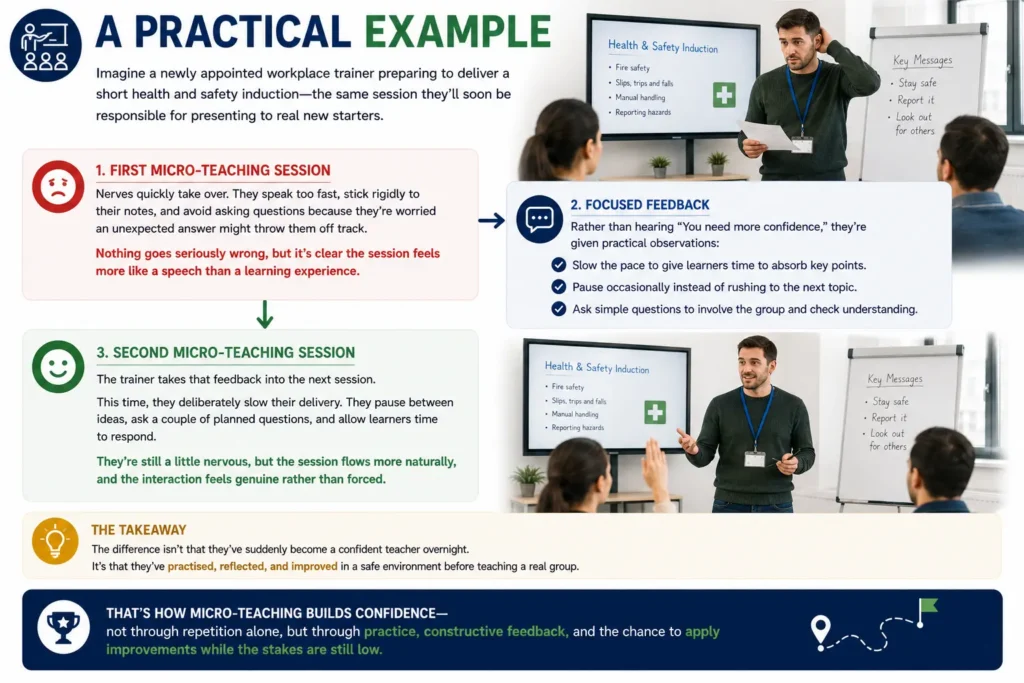
A Practical Example

A Practical Example

Imagine a newly appointed workplace trainer preparing to deliver a short health and safety induction—the same session they’ll soon be responsible for presenting to real new starters.

On their first micro-teaching session, nerves quickly take over. They speak too fast, stick rigidly to their notes, and avoid asking questions because they’re worried an unexpected answer might throw them off track.

Nothing goes seriously wrong, but it’s clear the session feels more like a speech than a learning experience.

Afterwards, they receive focused feedback. Rather than hearing “You need more confidence,” they’re given practical observations:

  • ♦  Slow the pace to give learners time to absorb key points.
  • ♦  Pause occasionally instead of rushing to the next topic.
  • ♦  Ask simple questions to involve the group and check understanding.

The trainer takes that feedback into the next micro-teaching session.

This time, they deliberately slow their delivery. They pause between ideas, ask a couple of planned questions, and allow learners time to respond. They’re still a little nervous, but the session flows more naturally, and the interaction feels genuine rather than forced.

The difference isn’t that they’ve suddenly become a confident teacher overnight. It’s that they’ve practised, reflected, and improved in a safe environment before teaching a real group.

That’s how micro-teaching builds confidence—not through repetition alone, but through practice, constructive feedback, and the chance to apply improvements while the stakes are still low.

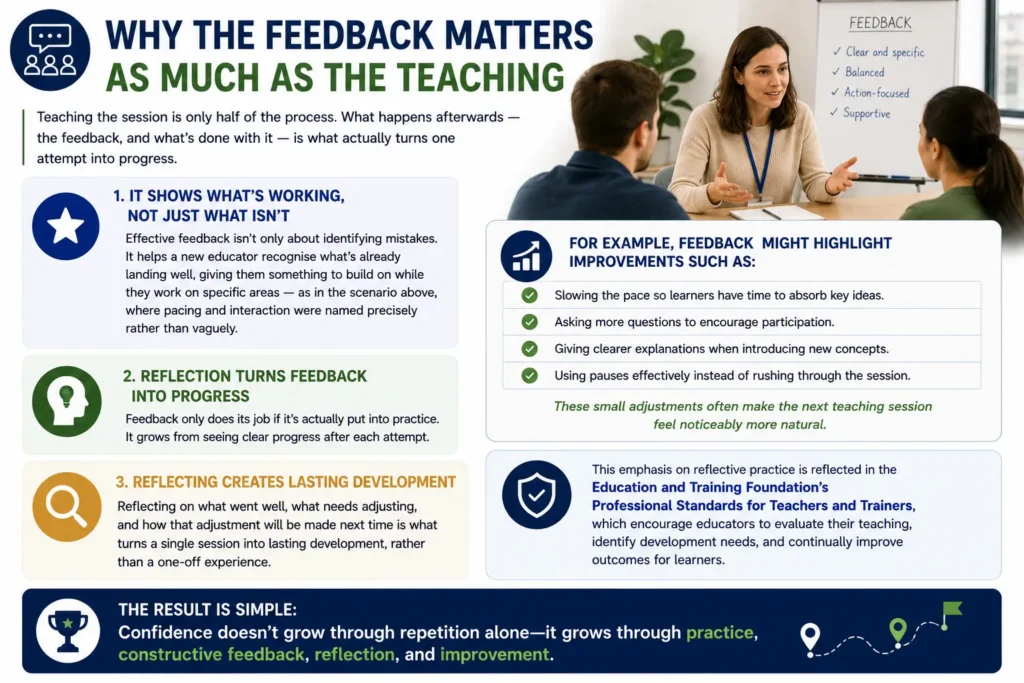
Why the Feedback Matters as Much as the Teaching

Why the Feedback Matters as Much as the Teaching

Teaching the session is only half of the process. What happens afterwards — the feedback, and what’s done with it — is what actually turns one attempt into progress.

It Shows What's Working, Not Just What Isn't

Effective feedback isn’t only about identifying mistakes. It helps a new educator recognise what’s already landing well, giving them something to build on while they work on specific areas — as in the scenario above, where pacing and interaction were named precisely rather than vaguely.

Reflection Turns Feedback Into Progress

Feedback only does its job if it’s actually put into practice. It grows from seeing clear progress after each attempt.

For example, feedback might highlight improvements such as:

  • ♦  Slowing the pace so learners have time to absorb key ideas.
  • ♦  Asking more questions to encourage participation.
  • ♦  Giving clearer explanations when introducing new concepts.
  • ♦  Using pauses effectively instead of rushing through the session.

These small adjustments often make the next teaching session feel noticeably more natural.

Reflecting on what went well, what needs adjusting, and how that adjustment will be made next time is what turns a single session into lasting development, rather than a one-off experience.

This emphasis on reflective practice is reflected in the Education and Training Foundation’s Professional Standards for Teachers and Trainers, which encourage educators to evaluate their teaching, identify development needs, and continually improve outcomes for learners.

The result is simple: confidence doesn’t grow through repetition alone—it grows through practice, constructive feedback, reflection, and improvement.

How This Fits Into the AET Level 3 Award

Micro-teaching is a practical assessment within the ATHE Level 3 Award in Education and Training, alongside written assignments. It gives learners the opportunity to apply teaching principles in a real teaching scenario, receive constructive feedback, and reflect on their performance. Rather than simply learning about teaching, they begin developing the confidence and practical skills needed to deliver it effectively. 

Confidence Comes From Doing, Not Waiting

Micro-teaching helps build confidence by allowing new educators to practise teaching, receive constructive feedback, and refine their approach before teaching real learners. This structured cycle of practice and reflection reduces uncertainty and helps transform teaching theory into practical experience.  

FAQs — How Micro-Teaching Helps Build Confidence in New Educators

What is the purpose of micro-teaching? 

It gives new trainers a structured way to practise teaching, receive specific feedback, and improve before working with real learners.

Does micro-teaching help reduce teaching anxiety? 

It helps mainly through familiarity and repetition rather than removing nerves outright. Practising delivery in a low-stakes setting, then reflecting on specific feedback, tends to make the next attempt noticeably steadier.

Is micro-teaching part of the ATHE Level 3 Award in Education and Training? 

Yes — it’s a required practical component, sitting alongside written assignments as part of the course’s assessment.

How long is a micro-teaching session? 

AET requires at least one hour of micro-teaching in total, including one 15-minute session that’s formally observed and assessed, with the remaining time spent delivering further sessions or observing peers.

Sam Walker

Article by

Sam Walker

Sam Walker is an education specialist and author at One Education, bringing over 4 years of experience in creating practical resources and strategies to support teachers and enhance student learning.

top
Home Courses Search