How to Develop Professional Teaching and Assessment Skills

August 09, 2026 | 10 minutes | 67 Readers

Can someone be an excellent teacher but a poor assessor? Yes — and the reverse holds just as often. Teaching is about guiding learning; assessment is about judging whether that learning has actually landed. The two work closely together, but they draw on different knowledge, different techniques, and different kinds of judgement. If you’re stepping into a teaching or training role — in further education, adult learning, or workplace training — deliberately strengthening both skills will get you further than

Can someone be an excellent teacher but a poor assessor?

Yes — and the reverse holds just as often. Teaching is about guiding learning; assessment is about judging whether that learning has actually landed. The two work closely together, but they draw on different knowledge, different techniques, and different kinds of judgement.

If you’re stepping into a teaching or training role — in further education, adult learning, or workplace training — deliberately strengthening both skills will get you further than simply assuming they’ll sharpen with time.

Teaching Skills and Assessment Skills Aren't the Same Thing

Teaching Skills and Assessment Skills Aren't the Same Thing

Teaching skills are what help people learn: 

  • explaining clearly, 
  • structuring a session, 
  • adapting when something isn’t landing. 

Assessment skills are what tell you whether any of that worked — 

  • checking understanding, 
  • making fair judgements about a learner’s progress, and 
  • giving feedback they can actually use.

Teaching informs assessment, and assessment strengthens teaching. 

Together, they form the foundation of effective learning. Yet they require different capabilities. Delivering an engaging lesson does not necessarily mean a trainer can accurately judge whether learning has taken place, just as a skilled assessor may still be refining their classroom delivery. Viewing them as complementary rather than interchangeable encourages more deliberate professional development. 

Building Confidence Through Practice

Practise in low-stakes settings first

Like any practical skill, teaching becomes more comfortable with regular practice. The easiest way to grow more at ease with it is to teach before the stakes are high. Low-pressure opportunities give you the freedom to experiment, make mistakes, and refine your approach without the pressure of delivering a formal session. Even a brief conversation, a process walkthrough, or a short induction activity can help. The goal isn’t to cover every detail, but to leave the learner with a clear understanding of one key idea.

Seek structured observation and feedback

Imagine delivering the same lesson five times. You might grow more at ease with the material, but unless someone points out what learners are responding to — and what they’re not — you could simply be repeating the same mistakes. That’s why observation and constructive feedback are so valuable. Experienced colleagues can offer practical suggestions that sharpen your delivery, while formal micro-teaching assessments provide objective feedback against recognised standards. Following each session with a short reflection on what worked and what needs adjusting helps every lesson become a stepping stone towards becoming a stronger educator.

Graphic Suggestion Location: After this section Purpose: Illustrate how confidence is built progressively rather than all at once Graphic Type: Timeline Suggested Content: Four-step visual — informal coaching → observed practice → structured feedback → confident independent delivery 

Learning to Assess Fairly and Accurately

Learning to Assess Fairly and Accurately

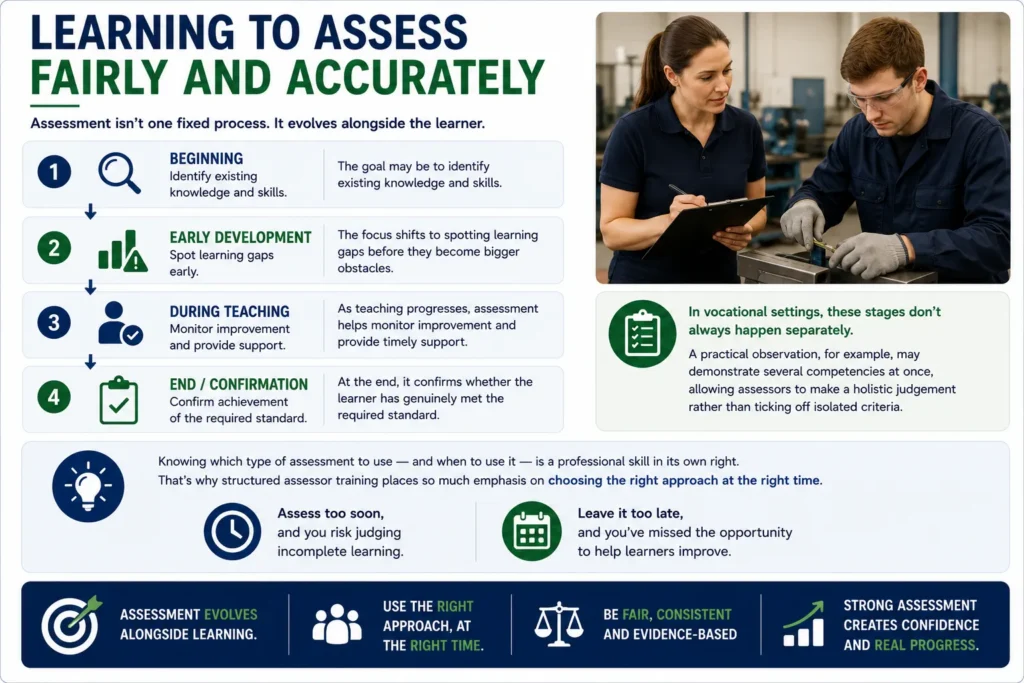
Assessment isn’t one fixed process. It evolves alongside the learner.

At the beginning, the goal may be to identify existing knowledge and skills. Later, the focus shifts to spotting learning gaps before they become bigger obstacles. 

As teaching progresses, assessment helps monitor improvement and provide timely support. 

At the end, it confirms whether the learner has genuinely met the required standard.

In vocational settings, these stages don’t always happen separately. A practical observation, for example, may demonstrate several competencies at once, allowing assessors to make a holistic judgement rather than ticking off isolated criteria.

Knowing which type of assessment to use — and when to use it — is a professional skill in its own right. That’s why structured assessor training places so much emphasis on choosing the right approach at the right time. Assess too soon, and you risk judging incomplete learning. Leave it too late, and you’ve missed the opportunity to help learners improve.

Why Structured Training Matters

Experience helps build familiarity with teaching, but familiarity alone doesn’t guarantee fair, consistent assessment.

Imagine two trainers assessing the same piece of work and reaching completely different conclusions. One judges it as meeting the standard, while the other recommends further improvement before it does.

Without shared assessment criteria, those inconsistencies quickly undermine trust. Learners begin questioning the fairness of the process, and organisations struggle to demonstrate quality.

A regulated qualification helps prevent exactly that. Instead of relying on experience alone, trainee teachers learn when and how to use different assessment methods — whether that’s written work, observed practical tasks, or structured questioning — within a framework that’s been quality assured from the outset.

These methods are supported by the Education and Training Foundation’s Professional Standards, which outline the professional expectations for teachers and trainers across the further education sector.

The takeaway is simple: experience teaches you how to deliver training, while regulated qualifications teach you how to assess it fairly. Together, they build professionals whose decisions learners and employers can trust.

Feedback Is Where Real Learning Happens

Feedback Is Where Real Learning Happens

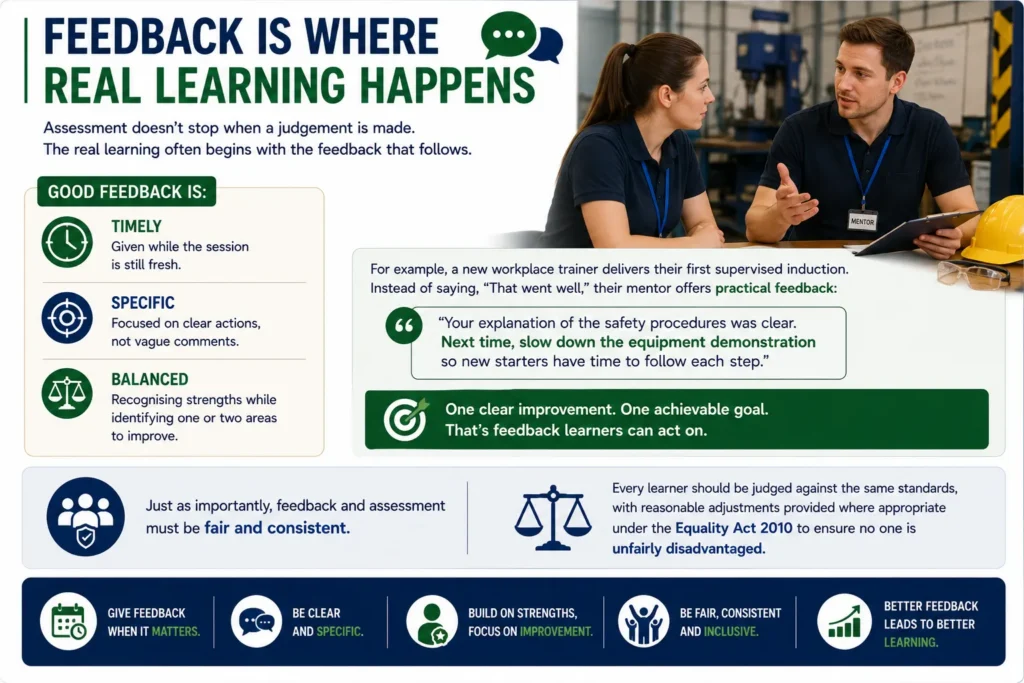
Assessment doesn’t stop when a judgement is made. The real learning often begins with the feedback that follows.

Good feedback is:

  • ♦  Timely – given while the session is still fresh.
  • ♦  Specific – focused on clear actions, not vague comments.
  • ♦  Balanced – recognising strengths while identifying one or two areas to improve.

For example, a new workplace trainer delivers their first supervised induction. Instead of saying, “That went well,” their mentor offers practical feedback:

“Your explanation of the safety procedures was clear. Next time, slow down the equipment demonstration so new starters have time to follow each step.”

One clear improvement. One achievable goal. That’s feedback learners can act on.

Just as importantly, feedback and assessment must be fair and consistent. Every learner should be judged against the same standards, with reasonable adjustments provided where appropriate under the Equality Act 2010 to ensure no one is unfairly disadvantaged. 

Turning Practice Into a Recognised Qualification

Knowing how to teach is only part of the role. Equally important is knowing how to assess fairly, provide constructive feedback, and keep accurate assessment records.

A recognised qualification, such as the Level 3 Award in Education and Training (AET), develops these skills through structured, standards-based learning rather than trial and error.

For many aspiring teachers and trainers, the Level 3 Award is the first step. Those planning a long-term career in further education often progress to Level 4 or Level 5 teaching qualifications, although these are not essential for every training or workplace coaching role.

FAQs — The Importance of Assessment Skills in Teaching and Training

Can I develop teaching and assessment skills without a formal qualification? 

Informal practice — delivering short sessions, seeking feedback, reflecting afterwards — does build real skill over time. But fair, consistent assessment in particular relies on shared standards and criteria that structured, regulated training is specifically designed to provide.

What does “regulated qualification” mean in this context? 

It means the qualification is overseen by an official regulator — in the case of the AET, Ofqual — which sets requirements for how the course is assessed, quality-assured, and awarded, giving it recognised standing beyond any individual provider.

How do I get better at giving feedback to learners? 

Focus on making feedback timely, specific, and balanced — clear about what worked, clear about what to change, and given close enough to the event that it’s still useful.

Do I need a teaching qualification to start training people at work? 

Not necessarily. Many workplace training and coaching roles don’t carry a formal qualification requirement. Roles within the further education and skills sector, however, typically expect a recognised qualification such as the AET.

How long does it take to feel confident as a trainer? 

There’s no fixed timeline — it depends on how often you’re practising, the quality of feedback you receive, and how deliberately you reflect on each session. Confidence tends to build steadily with consistent practice rather than arriving all at once.

Sam Walker

Article by

Sam Walker

Sam Walker is an education specialist and author at One Education, bringing over 4 years of experience in creating practical resources and strategies to support teachers and enhance student learning.

top
Home Courses Search