SEN Teaching Assistant Career Progression: UK Career Paths

November 05, 2026 | By Sophie johnson | 14 minutes | 65 Readers

Explore SEN teaching assistant career progression in the UK, from HLTA and specialist support roles to teaching, SEN leadership and further training opportunities.

Working as a special educational needs (SEN) teaching assistant can open doors to several career opportunities. Once you’ve gained classroom experience, you may want greater responsibility, a specialist role or a pathway into teaching.

SEN teaching assistant career progression can include becoming a Higher Level Teaching Assistant (HLTA), specialising in SEND support, moving into pastoral roles or training to become a qualified teacher.

The right direction depends on your experience, interests and the requirements of your chosen role. Here’s how the main career paths compare and what you can do to prepare for your next step.

What Career Progression Is Available for SEN Teaching Assistants?

SEN teaching assistants can progress within classroom support or use their experience to explore other education careers.

Some opportunities involve taking on additional responsibilities. Others require formal qualifications, workplace training or a change in professional role. 

Career Pathway Possible Next Role What to Consider
Classroom advancement Higher Level Teaching Assistant Experience, competence and HLTA recognition
Specialist support Specialist Teaching Assistant Specialist knowledge and relevant training
Pupil wellbeing Learning Mentor or Pastoral Support Worker Behaviour, communication and mentoring skills
Teaching Qualified Teacher Teacher training and Qualified Teacher Status (QTS)
SEN leadership SENCO Teaching qualifications and mandatory SENCO requirements

These opportunities vary between mainstream schools, special schools and other education settings. There isn’t one fixed promotion ladder that every teaching assistant follows.

Infographic showing five SEN teaching assistant career progression pathways in the UK

SEN Teaching Assistant Career Paths: 5 Options to Consider

Progress to a Higher Level Teaching Assistant (HLTA)

Becoming an HLTA is a common progression option for experienced teaching assistants who want greater classroom responsibility.

Depending on the school, HLTAs may support planned learning activities, deliver interventions, help assess pupil progress and lead classes under agreed arrangements.

The National Careers Service identifies HLTA work as a potential progression route for SEN teaching assistants.

To prepare, focus on developing classroom confidence, demonstrating your ability to support learning and taking opportunities to work with greater responsibility.

Remember that HLTA status is different from completing an SEN diploma. Employers may have specific experience, training or recognition requirements.

Become a Specialist Teaching Assistant

If you enjoy working with pupils who have particular learning or support needs, specialisation could be a suitable next step.

You might develop expertise in autism support, communication difficulties, sensory needs or social, emotional and mental health (SEMH).

If autism support interests you, exploring career opportunities working with autistic children can help you consider where your specialist skills might lead. 

England also offers a formal Level 5 Specialist Teaching Assistant apprenticeship, covering specialist practice in SEND, social and emotional wellbeing, or curriculum provision.

This apprenticeship typically involves 24 months of workplace training, followed by an end-point assessment. It is separate from standalone online SEN professional development courses.

Specialist skills can be particularly useful when applying for positions involving targeted interventions or supporting pupils with complex needs.

Move into Learning Mentor or Pastoral Support Roles

Not every career step involves additional classroom teaching responsibilities.

Experienced SEN teaching assistants may consider becoming learning mentors or pastoral support workers.

These roles can involve helping pupils improve engagement, develop confidence, manage emotional challenges and participate more successfully in school life.

Experience supporting behaviour, communicating with families and working alongside teachers can be valuable.

However, schools set their own recruitment criteria, and some positions require additional training or relevant pastoral experience.

Train to Become a Qualified Teacher

If you want to plan lessons, take responsibility for teaching and lead pupil learning, becoming a qualified teacher may be a longer-term goal.

Your SEN teaching assistant experience can provide useful classroom knowledge, but it does not replace formal teacher training.

If you’re considering different routes into education, our guide on how to become a teaching assistant explains the starting requirements and career options. 

Qualified Teacher Status (QTS) is required to teach in maintained primary, secondary and special schools in England, although requirements can differ in other school settings.

According to the government’s qualifications needed to become a teacher guidance, postgraduate teacher training normally requires a bachelor’s degree and specified GCSE qualifications.

Explore Longer-Term SEN Leadership or SENCO Careers

Experienced education professionals may eventually consider SEN leadership or coordination.

A Special Educational Needs Coordinator (SENCO) helps coordinate support for pupils with SEN across a school.

However, this isn’t a direct promotion from teaching assistant work.

In mainstream schools in England, SENCOs must be qualified teachers or headteachers working at the school. The SENCO National Professional Qualification (NPQ) is the mandatory qualification route, subject to applicable exceptions and transitional arrangements.

The Department for Education explains these mandatory SENCO qualification requirements.

If SEN leadership interests you, gaining teaching qualifications and relevant professional experience may form part of your longer-term plan.

What Skills and Qualifications Help SEN Teaching Assistants Progress?

Career development isn’t only about collecting certificates. Employers also want evidence that you can apply your knowledge effectively.

Exploring advanced training options for SEN teaching assistants can help you identify which skills and learning opportunities are most relevant to your career goals. 

SEN teaching assistant taking notes and collaborating with a teacher during professional development in a UK school

Build Specialist SEN Skills and Practical Experience

Useful skills for SEN teaching assistant progression include:

• Inclusive teaching support: Adapting activities and instructions to meet individual learning needs.

• Communication: Working effectively with pupils, teachers, families and specialists.

• Behaviour and emotional support: Following agreed approaches to promote wellbeing and participation.

• Observation and assessment support: Recording pupils’ progress and sharing relevant information with teachers.

• Collaboration: Contributing to consistent support across the school.

The Department for Education’s inclusive teaching resources provide practical, evidence-informed strategies for mainstream school staff in England.

For example, if you support a pupil with communication difficulties, you might work with the teacher to introduce visual instructions and monitor how the pupil responds.

Experiences like these can help demonstrate your professional development, particularly when applying for positions requiring greater responsibility.

Developing specialist skills for supporting pupils with SEN can also help you prepare for roles involving more targeted classroom support. 

Choose Training That Supports Your Career Goals

Further training can help strengthen your understanding of SEN, but the most suitable course depends on your intended career pathway.

Comparing CPD courses designed for SEN teaching assistants can help you choose training that matches your current responsibilities and development goals. 

One Education’s SEN Teaching Assistant course provides online professional development covering SEN support, inclusive teaching methodologies, communication, cognition and learning, and social, emotional and mental health needs.

If you’re considering more advanced study, it’s important to distinguish professional development from formal qualifications.

Courses marketed at Level 5 do not necessarily award regulated Level 5 qualifications. Training recognition, assessment and entry requirements can differ.

For example, a CPD-accredited SEN course may help you develop relevant knowledge, while an apprenticeship or regulated qualification follows separate requirements.

Before enrolling, check whether the training develops the skills you need or meets a specific requirement for the role you’re pursuing.

Does SEN Teaching Assistant Career Progression Increase Your Salary?

Career progression can create opportunities for higher earnings, particularly when moving into positions with additional responsibilities. However, pay increases aren’t automatic.

The National Careers Service salary estimates indicate annual earnings of approximately £19,000 for starters to £27,000 for experienced SEN teaching assistants.

These are occupational estimates rather than guaranteed salaries.

Actual earnings depend on your employer, location, working hours, responsibilities and contract.

Comparison infographic explaining salary context for SEN teaching assistants, including starter and experienced pay and the difference between FTE and actual salary

When comparing vacancies, pay particular attention to whether the advertised figure represents:

  • Full-time equivalent (FTE) salary: The annual salary for full-time hours.
  • Actual salary: The amount payable for the contracted hours and working weeks, which may be lower for term-time-only roles.

For example, two SEN teaching assistant positions may advertise similar FTE salaries but offer different actual earnings because of contracted hours.

A higher job grade may improve your earnings, but always compare actual salaries and working arrangements before changing positions.

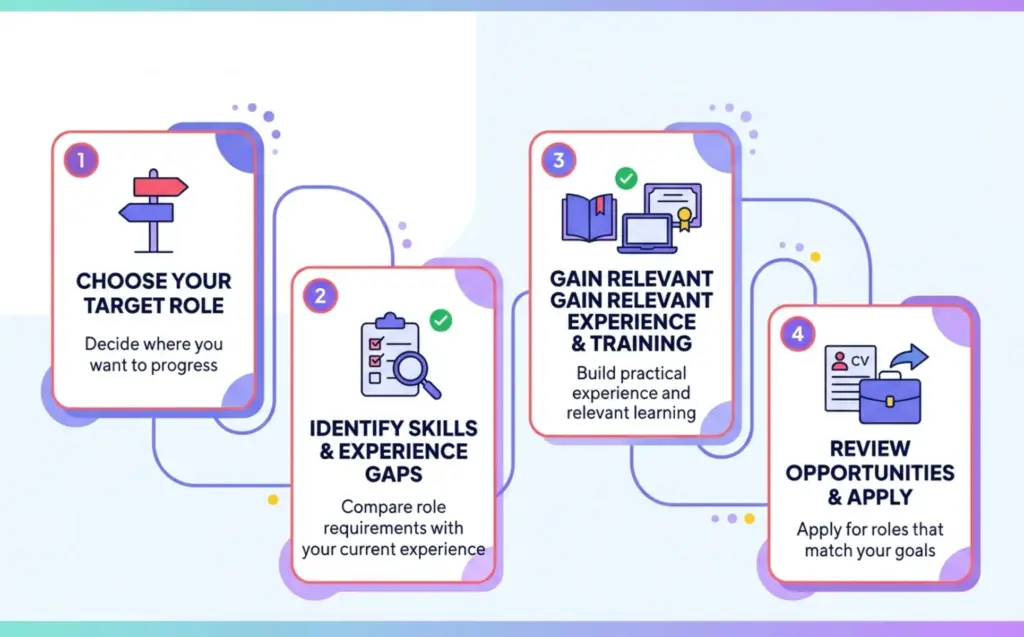
How to Plan Your Next Step as an SEN Teaching Assistant

Knowing your options is useful. Turning them into a realistic career development plan is what makes the difference.

Four-step process diagram showing how SEN teaching assistants can plan their next career move

Step 1: Choose the Role You Want to Progress Into

Start by identifying what you enjoy about your current work.

Do you prefer providing individual support, leading learning activities or helping pupils with emotional and behavioural needs?

Your answer can help you decide whether to pursue HLTA responsibilities, specialist support or a different education career.

Choose one primary goal rather than attempting every pathway simultaneously.

Step 2: Identify Your Skills and Experience Gaps

Look at vacancies for your preferred role and compare their requirements with your current experience.

Consider your:

• SEN knowledge and specialist skills

• Classroom and intervention experience

• Relevant qualifications or training

• Ability to demonstrate increased responsibility

Ask your line manager which skills you should strengthen and whether suitable development opportunities are available.

Step 3: Gain Relevant Experience and Training

Once you’ve identified your development needs, look for practical ways to address them.

You could volunteer for appropriate school projects, support agreed interventions, attend professional development sessions or undertake further study.

Keep a record of your learning and examples of how you’ve applied new skills.

For those wishing to extend their SEN knowledge, One Education’s SEN Teaching Diploma Level 5 offers CPD-accredited online professional development covering additional learning needs, SEN teaching methodologies and inclusive classroom support.

The course includes an assignment, a mock examination and a final assessment, with a CPD-accredited certificate available upon successful completion.

It does not replace a regulated Level 5 qualification, HLTA status, the formal Specialist Teaching Assistant apprenticeship or mandatory employer requirements.

When choosing any training programme, consider how its content relates to your development goals rather than relying solely on the level shown in its title.

If you’re unsure which option suits you, comparing an SEN teaching diploma with a teaching assistant course can help you make a more informed choice. 

Step 4: Review Opportunities and Apply for Suitable Roles

When you’re ready, explore internal vacancies, education recruitment opportunities and relevant apprenticeship pathways.

Update your CV with practical examples of your work rather than simply listing responsibilities.

For instance, explain how you supported a learning intervention, collaborated with teaching staff or helped improve a pupil’s participation.

Discuss possible progression opportunities with your school and set achievable goals for your next development review.

Your Next Step in SEN Teaching Assistant Career Progression

SEN teaching assistant career progression offers several possibilities, from HLTA and specialist support work to teaching and longer-term leadership roles.

The best next step depends on your experience, interests and career goals.

Choose a realistic pathway, identify the skills or qualifications it requires and build experience that supports your ambitions.

Frequently Asked Questions

Yes. Experienced SEN teaching assistants may progress into HLTA roles by developing relevant skills, gaining classroom experience and meeting applicable recognition or employer requirements.

Completing an SEN diploma alone does not automatically grant HLTA status.

Not necessarily. The training required depends on your intended role and the employer’s expectations.

A Level 5 SEN CPD course may support professional development, but it should not be confused with a regulated qualification or the formal Specialist Teaching Assistant apprenticeship.

Potentially, but it requires further career development.

In mainstream schools in England, SENCOs must be qualified teachers or headteachers and meet the mandatory SENCO qualification requirements.

SEN teaching assistant experience can provide a useful foundation, but it does not provide direct eligibility for the statutory role.

Yes. SEN teachers are needed in many UK schools because more pupils are receiving support for special educational needs and disabilities (SEND). However, demand varies by region, school type and specialism. In England, Department for Education data shows that the number of pupils identified with SEN has increased in recent years.

Qualified SEN teachers may find opportunities in mainstream schools, special schools and specialist settings. For those interested in school support roles, advanced SEN teaching assistant training can help build relevant knowledge, although it does not provide qualified teacher status.

.

You do not always need a specific SEN qualification to become a teaching assistant in the UK. Entry requirements depend on the school, employer and position. Some employers accept relevant experience, while others ask for GCSEs, a teaching assistant qualification or previous experience supporting children.

The National Careers Service SEN teaching assistant profile outlines routes through college courses, apprenticeships, volunteering and direct applications.

You can also build subject knowledge through One Education’s SEN Teaching Diploma Level 5. However, this is CPD-accredited professional development, not a regulated Level 5 qualification.

Not necessarily. In England, qualified SEN teachers generally follow the same statutory teacher pay framework as other qualified teachers in maintained schools. Some eligible teachers receive an additional SEN allowance, depending on their responsibilities and the relevant pay conditions.

An SEN teacher therefore may earn more than a teacher on the same basic pay point without an allowance, but this is not guaranteed. Salary also depends on experience, location, responsibilities and the school’s employment arrangements.

An SEN teaching assistant helps pupils with special educational needs participate in classroom learning. Their main duties may include adapting learning materials, providing individual or small-group support, encouraging communication, monitoring progress and supporting pupils’ emotional wellbeing.

They also work closely with teachers, SENCOs and other professionals, following agreed support plans and school procedures. The National Careers Service provides a detailed overview of SEN teaching assistant responsibilities.

Get career information and advice

For additional knowledge of classroom support, One Education offers the SEN Teaching Diploma Level 5.

To become an SEN teacher in England, you will generally need to gain qualified teacher status (QTS) through an approved teacher-training route. You can then develop specialist knowledge and experience in supporting pupils with special educational needs.

A common route is to complete a degree, undertake initial teacher training leading to QTS and apply for teaching roles involving SEN support. Some specialist teaching positions may require additional qualifications or experience.

The National Careers Service SEN teacher profile explains the available routes and career requirements.

Get career information and advice

If you’re starting in a classroom support role, the SEN Teaching Diploma Level 5 can help develop SEN-related knowledge, but it does not award QTS or qualify you to work as a teacher.

top
Home Courses Search