How to Choose Advanced SEN Teaching Assistant Training

November 03, 2026 | By Sophie johnson | 16 minutes | 20 Readers

Looking for advanced SEN teaching assistant training? Explore UK course options, useful skills and what to check before enrolling.

How to Choose Advanced SEN Teaching Assistant Training

Advanced SEN teaching assistant training can mean a specialist online course, a formal qualification, an apprenticeship or professional development arranged by an employer. These routes may use similar language, but they do not necessarily lead to the same certificate or prepare someone for the same responsibilities. 

The right option depends on your aims. You might be a teaching assistant looking to develop your current practice, a learning support assistant seeking further training or someone exploring work in SEN support. Before enrolling, check what the training covers, how learning is assessed and what the certificate represents.

This guide explains what advanced SEN training may include, how common UK routes differ and what to consider when comparing courses. It also looks at how training may apply at work and where the teaching assistant role could lead.

Looking for SEN-focused study? Explore One Education’s SEN Teaching Diploma Level 5 and review its course and certificate details to see whether it fits your goals.

What Does Advanced SEN Teaching Assistant Training Mean?

The word “advanced” can mean different things on a course page. A provider might use it to describe the depth of its content, the experience it expects learners to have or simply the course title. On its own, the word does not tell you whether a course leads to a regulated qualification.

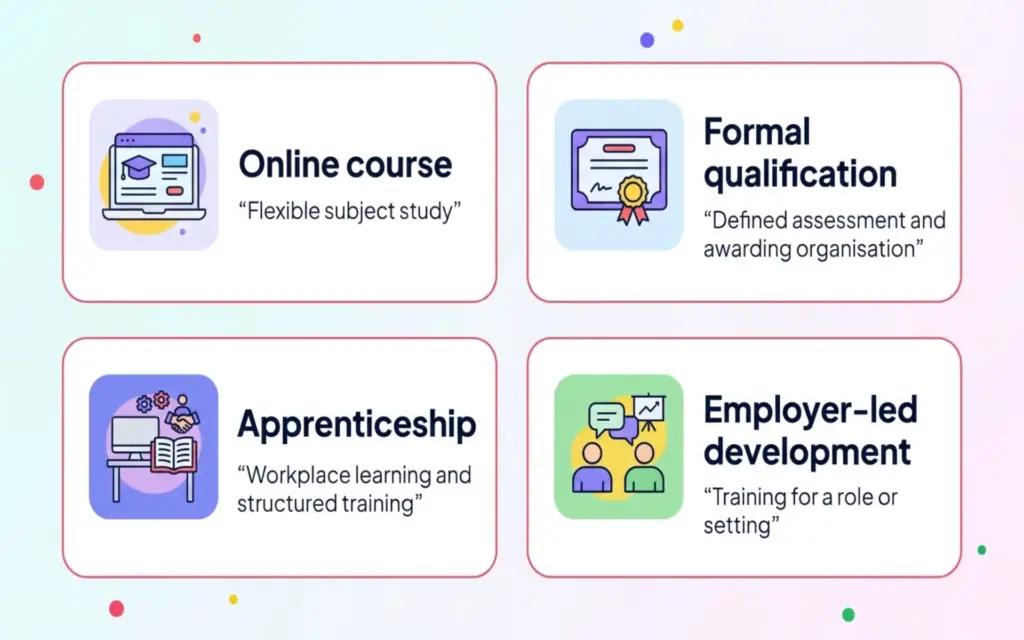
It helps to distinguish between the main types of learning:

  • Online courses may offer flexible, subject-focused study and a provider-issued certificate.
  • Formal qualifications have defined assessment requirements and an awarding organisation.
  • Apprenticeships combine workplace learning with structured training and assessment.
  • Employer-led development is arranged to support staff in a particular setting.
Infographic showing four routes for SEN teaching assistant training in the UK

SEN means special educational needs. SEND means special educational needs and disabilities. Both terms are used in UK education, but arrangements and terminology differ across the nations. For example, England’s SEND Code of Practice: 0 to 25 years is statutory guidance for the English SEND system. It should not be presented as a single set of rules for England, Scotland, Wales and Northern Ireland.

Advanced training should build on basic awareness and develop knowledge that may help learners support pupils. Depending on the syllabus, it could cover inclusive classroom practice, communication, adapting activities, observation or working with teachers and the SENCO. Content varies, so read the learning outcomes instead of relying on the word “advanced”.

Check the certificate information too. A provider-issued certificate, a regulated qualification and an apprenticeship are not interchangeable. If you need training for your job, ask your employer whether a course meets its requirements before enrolling.

Who Might Benefit from Advanced SEN Training?

Advanced training may suit teaching assistants who already work with pupils and want to strengthen their knowledge. It may also be relevant to learning support assistants and classroom assistants who support pupils with additional needs.

Some people explore SEN training before applying for school support roles. A course can help build subject knowledge, but it is only one part of preparing for employment. Employers may also look for relevant experience, particular qualifications or other requirements for a role.

For current staff, a clear goal can help narrow down the options. A teaching assistant might want to develop their understanding of inclusive practice, communicate observations more effectively or learn about a new area of support. Someone considering an apprenticeship may want structured learning alongside employment.

Before choosing, ask yourself what you want to do differently after the training. Are you developing in your current role, exploring school support work or trying to meet a requirement set by an employer? Knowing your aim makes it easier to judge whether a course is relevant.

Training does not guarantee a job, promotion or particular responsibilities. Schools decide how staff are deployed, and requirements vary between employers. For a broader introduction to the role, read what makes a wonderful teaching assistant, which discusses the responsibilities and typical work of a TA.

What Skills Should Advanced Training Develop?

Course content varies. The areas below are useful topics to look for when comparing syllabuses, but they are not a checklist every course must meet. The best fit depends on your role, experience and goals.

Four key SEN teaching assistant skills: adapting learning, communication, wellbeing support, and observation

Adapting Learning And Supporting Participation

A teaching assistant may help pupils take part in classroom learning by supporting access to activities and instructions. For example, a teacher might ask a TA to prepare resources in a particular way, repeat an agreed instruction or help a pupil work through a task in manageable steps.

Training may introduce inclusive approaches, visual supports, ways to structure activities and methods for encouraging participation. These approaches need to fit the pupil and the lesson. A strategy that helps one learner may not suit another, and support should reflect the teacher’s guidance and any agreed pupil plans.

Good training should help learners consider the purpose of an approach: what barrier is it intended to address, and how might it help the pupil participate? Support should encourage learning and independence where possible, rather than completing tasks for the pupil.

If you want to study inclusive classroom methods in more detail, One Education has an Inclusive Teaching and Learning Approaches course. Consider its course information alongside your goals and any employer requirements.

Communication And Relationships

Communication involves more than giving instructions. A teaching assistant may need to listen, allow time for a response, check understanding or use language that is clear for the pupil. Some pupils use communication methods or supports that staff need to understand and follow consistently.

Training may cover communication and interaction, positive relationships and ways to support pupils during lessons or routines. It can also help learners reflect on whether their approach is helping a pupil engage. For example, a pupil may respond better to one instruction at a time or need extra time before moving to the next activity.

Relationships with colleagues matter too. Teaching assistants work as part of a wider school team. Sharing relevant observations with teachers or the SENCO should follow the school’s expectations and the TA’s role. Contact with families and other professionals should also follow school procedures.

For more on how staff can work with a SENCO, see One Education’s article Collaborating with SENCOs: Best Practices for Teachers.

Supporting Behaviour, Wellbeing and Regulation

A pupil may find an activity, setting or transition difficult. A teaching assistant can support them using approaches agreed with the teacher, such as preparing them for a change, offering an agreed prompt or helping them return to a task.

Training may help staff think about what they observe and how they respond. It can encourage them to notice whether an activity, instruction or environment may be creating a barrier. This does not mean that a teaching assistant should diagnose a condition or make decisions outside their role.

A useful course should explain the importance of following school procedures and agreed plans. If an approach does not seem to be working, or a staff member has a concern about a pupil’s wellbeing or progress, they should raise it with the teacher or SENCO.

Look for training that explains professional boundaries as well as possible strategies. Broad promises about managing every behaviour or situation are not a substitute for school guidance or specialist advice. For a related safeguarding example, read how the 5 Rs of safeguarding work in practice.

Observation, Teamwork And Professional Boundaries

Teaching assistants may notice how a pupil responds to a resource, instruction or routine. Sharing relevant observations can help teachers understand what happens during a lesson. A clear observation describes what the TA saw without making assumptions about why it happened.

Training may help staff consider what information is useful, how to communicate it and when to raise a concern. It may also explain the different roles of teachers, SENCOs, families and other professionals. Schools have their own procedures for recording and sharing information.

It is important to understand the limits of the TA role. In England, the SEND Code of Practice says that teachers remain responsible and accountable for pupils’ progress and development, including where teaching assistants provide support. Teaching assistants contribute to support but should not independently change a pupil’s plan or take on decisions outside their responsibilities.

A course should help learners understand how to work collaboratively and when to seek guidance. For more on the separate SENCO role and related responsibilities, read how to become a SENCO in a primary school. 

For a closer look at these areas, read Specialist Skills SEN Teaching Assistants Can Develop.

What UK Training Routes Can You Compare?

There is no single route that suits everyone. Think about your goal: do you want flexible subject learning, a formal qualification or structured training alongside paid work?

Online Courses And Continuing Professional Development

An online course may suit someone looking for flexible, subject-focused learning. Before enrolling, check the syllabus, learning outcomes, assessment, tutor support, access period and certificate information.

Consider whether the course is intended for your experience level. A course designed for beginners may not offer the depth you need, while a specialist course may assume knowledge you have not yet developed. Check whether the learning helps you connect its topics to school practice.

If you’re comparing different training options, our guide to SEN CPD courses for teaching assistants explains what to check in the course content, accreditation, certification and learning format before enrolling.

One Education’s SEN Teaching Diploma Level 5 is an online course covering topics such as SEN support, teaching methods, communication and interaction, cognition and learning, and working in partnership. Its page describes a CPD-accredited certificate and states that it does not replace a regulated Level 5 qualification or mandatory training required by an employer. Check the current course page for curriculum and certificate details before deciding.

The words “Level 5” in a course title should not, by themselves, be treated as proof that it is a regulated Level 5 qualification. If qualification status matters for your job or progression, ask the provider and confirm the requirement with your employer.

For a focused explanation of how these options differ, read SEN Teaching Diploma vs SEN TA Course: Key Differences.

College Courses And Regulated Qualifications

A college course or regulated qualification may have defined entry criteria, assessment and an awarding organisation. Those details can help learners understand what they are expected to complete. However, not every SEN course is a regulated qualification, and employers may have different requirements.

Check who awards the qualification and what it is intended to support. If a course is described as regulated, verify that information through the relevant awarding organisation or official source. Review its level, assessment and progression details rather than relying on its marketing title.

Delivery format also matters. Some learners prefer classroom teaching, while others need flexible online study. The format alone does not determine a course’s qualification status or how an employer will view it.

To browse related subjects offered by One Education, visit its Teaching & Child Care courses. Use the course details to check whether an option fits your purpose.

Apprenticeships and Employer-Led Development

An apprenticeship combines workplace learning with structured training and assessment. It may suit someone already working in education whose employer can support the programme. Entry requirements and duration depend on the specific apprenticeship.

The National Careers Service lists Teaching Assistant Level 3 and Specialist Teaching Assistant Level 5 apprenticeships as possible routes. The official Specialist Teaching Assistant Level 5 apprenticeship listing gives information about that specific training standard. An apprenticeship is a work-based route and is different from a self-paced online course. 

An employer may also arrange training as part of staff development. Ask what the training is meant to develop, whether it is required for your role and how you will be assessed. If you are choosing a course yourself, confirm that it meets any employer requirement before paying for it.

How Do You Choose Advanced SEN Teaching Assistant Training?

Once you understand the routes, compare them against your goal. These checks can help you decide whether a course is suitable.

Decision diagram for choosing SEN teaching assistant training based on learning goals
  •  
  • 1.Set your aim. Decide whether you want to build knowledge for your current role, explore SEN support work or pursue a formal qualification or apprenticeship.
  • 2.Check who the course is for. Look for entry requirements and the experience level expected. Ask the provider if this information is unclear.
  • 3.Read the syllabus. Course titles can sound similar while the content differs. Check the learning outcomes against the skills you want to develop.
  • 4.Review the assessment. Find out whether you will complete assignments, exams or practical activities. Consider whether the assessment helps you apply the learning.
  • 5.Verify the certificate. Check who issues it and whether it is regulated, endorsed or CPD-accredited. These descriptions are not interchangeable.
  • 6.Check the practical details. Review the study format, tutor support, access period, materials and any extra costs.
  • 7.Ask your employer if relevant. If you are taking training for a school role, confirm what the employer recognises or requires.

One Education’s SEN Teaching Diploma Level 5 provides course-specific details to review, including its content and certificate information. Compare these with your aims and any employer requirements. Completing a course should not be treated as a guarantee of a job, promotion or particular responsibilities.

How Can Advanced SEN Training Apply at Work?

Imagine a pupil is finding it difficult to begin a classroom activity. The teacher and teaching assistant may agree that the TA will prepare resources, offer an agreed prompt and help the pupil start the first step. During the activity, the TA can notice which instructions or resources appear to support participation.

UK teaching assistant and teacher discussing classroom support strategies and learning resources

Afterwards, the TA can share relevant observations with the teacher through the school’s usual process. The teacher can decide whether the activity or support should change. If the teaching assistant has a concern about the pupil’s wellbeing or progress, they should raise it with the appropriate member of staff.

Training may give a TA ideas to reflect on and discuss with colleagues. Its value comes from using that learning thoughtfully within the pupil’s plan and the school’s procedures. A course cannot tell staff exactly what to do in every classroom, because pupils, lessons and school arrangements differ.

The aim is to support participation as part of a team while respecting the teacher’s responsibilities and the TA’s role.

Where Can SEN Teaching Assistant Training Lead?

Advanced SEN training may support SEN teaching assistant career progression, but it is only one part of professional development. Experience, vacancies, employer requirements and further learning can all influence the opportunities available. Some teaching assistants continue in school support roles with added responsibilities; others explore apprenticeships or further study.

The National Careers Service SEN teaching assistant profile provides information about typical duties, entry routes and progression. It currently lists an indicative salary range of £19,000 for a starter to £27,000 for an experienced worker, with typical hours of 24 to 40 per week during term time. Actual pay and hours vary by employer, location and contract, so these figures are guidance rather than a promise. 

Becoming a teacher or SENCO is a separate route with its own requirements. Do not assume that a SEN teaching assistant course qualifies someone for either role.

Choose Training That Fits Your Goal

Advanced SEN teaching assistant training can mean an online course, a formal qualification, an apprenticeship or employer-led development. Start with your goal, then check the course content, assessment and certificate status. If you are training for a current role, ask your employer what it expects.

One Education’s SEN Teaching Diploma Level 5 is an online course to consider if you are looking for SEN-focused learning. Review its current details alongside your goals and any employer requirements before deciding whether it is the right fit.

Frequently Asked Questions

Course content varies. It may include inclusive classroom support, communication, adapting activities, observing pupil responses and working with teachers or the SENCO. Check the syllabus to see which topics a particular course covers.

No. An online course may offer flexible, subject-focused learning. An apprenticeship combines structured training with workplace learning and assessment. Check the details of each route and any employer requirements.

Not necessarily. A course title alone does not establish that it is a regulated qualification. Check the awarding organisation, qualification status and certificate wording. Ask your employer if you need a specific qualification for work.

Entry requirements vary. An online course may be open to beginners, while an apprenticeship or job may require relevant employment or experience. Check the course criteria and employer requirements before applying.

No. Training may support your knowledge and professional development, but it cannot guarantee a job or promotion. Outcomes depend on experience, vacancies, employer requirements and other skills.

The National Careers Service currently gives an indicative range of £19,000 to £27,000 a year. Actual pay varies by employer, location, hours and contract.

top
Home Courses Search