How to Become a Speech Therapy Assistant in the UK

November 05, 2026 | By Michael Hansen | 11 minutes | 167 Readers

There is no single qualification that every speech and language therapy assistant in the UK must hold. Employers may consider relevant health or social care study, experience in healthcare or education, and the skills needed to support people with communication needs. Requirements depend on the vacancy, so check each employer’s person specification. You may see the role advertised as a speech and language therapy assistant or speech and language therapy support worker. This is different from becoming a qualified speech

There is no single qualification that every speech and language therapy assistant in the UK must hold. Employers may consider relevant health or social care study, experience in healthcare or education, and the skills needed to support people with communication needs. Requirements depend on the vacancy, so check each employer’s person specification.

You may see the role advertised as a speech and language therapy assistant or speech and language therapy support worker. This is different from becoming a qualified speech and language therapist, which has a separate education and registration route.

Want to build introductory knowledge of speech and language development and SEN support while exploring this career? One Education’s Speech Therapy and SEN Teaching Assistant Course covers these topics online. It can complement your preparation, but it does not replace employer requirements or qualify you to practise as a registered speech and language therapist.

Do Speech Therapy Assistants Need Formal Qualifications?

Not always. NHS Health Careers says there are no set entry requirements for speech and language therapy assistants, although employers may look for good literacy and numeracy, relevant experience, or qualifications in health and social care. The NHS Health Careers role profile offers guidance for people considering the role.

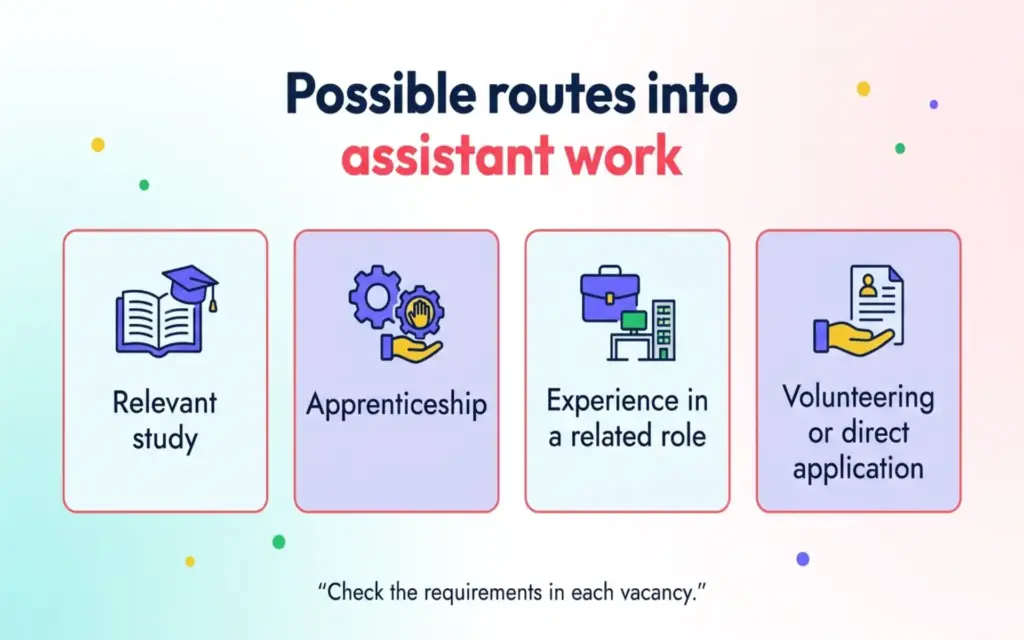
The National Careers Service also describes several routes into the work: college study, an apprenticeship, gaining experience in a related role, volunteering and applying directly. Relevant college courses may include a Level 2 Certificate in Health and Social Care, a Level 2 Certificate in Healthcare Support Services or a Level 3 Diploma in Healthcare Support. These are examples of courses that may help; they are not universal requirements for every assistant vacancy.

It helps to separate a qualification that may support an application from a qualification an employer specifically requires. One vacancy may ask for experience working with children or adults with communication needs; another may value a healthcare support qualification or equivalent experience. Read the advert and person specification carefully before deciding what training you need.

What Routes Can Help You Enter the Role?

There is more than one possible way to prepare for speech and language therapy assistant work. The best starting point depends on your current qualifications, experience and the type of setting you are interested in.

Four possible preparation routes for speech and language therapy assistant work.

Relevant College Courses

A course in health and social care or healthcare support can give you useful background knowledge. The National Careers Service lists relevant Level 2 and Level 3 courses, and notes that many health and social care courses include work placements. A placement can help you gain practical experience and decide whether the work suits you.

Entry requirements apply to the college course itself, not automatically to the assistant job. For example, the National Careers Service says Level 2 courses usually require two or more GCSEs at grades 9 to 3, or equivalent, while Level 3 courses usually require four or five GCSEs at grades 9 to 4, or equivalent. Check the course provider’s current requirements before applying.

For help assessing course options, see How to Choose a Speech and Language Support Course in the UK. 

Apprenticeships

A healthcare support apprenticeship may help you build skills while working. The National Careers Service lists a Level 2 Healthcare Support Worker apprenticeship and a Level 3 Senior Healthcare Support Worker apprenticeship as possible routes related to this field.

Apprenticeships have their own entry criteria and availability. Check the programme, employer and relevant UK nation rather than assuming there is one apprenticeship that everyone must complete to become an assistant.

Experience, Volunteering or Direct Application

Some people move into assistant work after gaining experience in healthcare, care or education. The National Careers Service notes that applicants with relevant skills and experience may apply directly and that someone could move into the role from healthcare assistant work with further training and promotion. Volunteering can also help you gain experience before applying.

If you already work as a teaching assistant, learning support assistant, care worker or healthcare assistant, look at how your current duties match the vacancy. Experience listening to people, supporting communication, keeping records and working with colleagues may be relevant, depending on the employer’s criteria.

What Might Employers Ask For?

Employers set the requirements for their own vacancies. A job advert may ask for a particular qualification, relevant experience, or a combination of both. It may also list desirable criteria that could strengthen an application but are not essential.

Depending on the role, an employer may ask for:

  • GCSEs or equivalent qualifications, particularly in English and maths
  • Experience in a healthcare, care or education setting
  • Experience supporting children or adults with additional needs
  • Clear spoken and written communication
  • Patience, active listening and sensitivity
  • The ability to work well with a wider team and keep accurate records
Examples of qualifications, experience and skills an employer may ask for in an assistant vacancy.

These are examples to help you read a vacancy, not a checklist that applies to every job. The National Careers Service profile for speech and language therapy assistants lists relevant skills and possible entry routes, while noting that some employers may ask for healthcare qualifications and GCSE subjects such as maths, English and science.

When you apply, address the criteria in the person specification. If it asks for experience working with children, for example, describe a relevant responsibility you have held and what you learned from it. If you do not meet every desirable criterion, focus on the essential requirements and the experience you can demonstrate.

Do Requirements Vary by Workplace?

Yes. Speech and language therapy assistants may work in settings such as hospitals, health centres, clients’ homes, nurseries and schools. The people they support and the duties involved can differ between roles.

A school-based vacancy may focus on supporting pupils and working with education staff. A healthcare vacancy may involve supporting patients, following therapy plans and updating records. The title may also vary: employers might use “assistant”, “support worker” or another local job title.

This means a course or experience that is relevant to one setting may not meet every employer’s requirements. Read the vacancy closely and check what the employer considers essential. For broader guidance on speech and language support for school staff, see Speech and Language Support Training for School Staff.

How is an Assistant Different from a Speech and Language Therapist?

A speech and language therapy assistant supports work carried out by a speech and language therapist. The role and level of responsibility depend on the employer and the work assigned. Assistants may help with activities, support communication practice, prepare resources or keep records.

A qualified speech and language therapist has a different professional route. In the UK, “speech and language therapist” and “speech therapist” are protected titles. The HCPC states that an individual must be registered with it to use a protected title. This requirement applies to the therapist title; it should not be confused with the varied entry requirements for assistant or support worker roles.

Some support workers may later consider training to become a qualified therapist. That requires further study and meeting the relevant professional requirements; working as an assistant does not itself provide therapist registration. The RCSLT explains the support worker to speech and language therapist route.

Can an Online Course Help You Prepare?

An online course can help you build introductory knowledge, but it may not meet a particular employer’s entry requirements. Check the job advert first, then decide whether training would address a gap in your knowledge or experience.

A UK teaching assistant studies speech, language and SEN support online at home.

One Education’s Speech Therapy and SEN Teaching Assistant Course introduces speech and language development, common communication difficulties and SEN support. Its course page describes a CPD-accredited certificate and an optional QLS-endorsed certificate. It also states that the provision is non-regulated and is not an Ofqual-regulated qualification. Check the course page for current content and certificate terms.

This course may be relevant if you want to develop your understanding of speech, language and inclusive support. It does not qualify you to use the protected title of ‘speech and language therapist’ or guarantee that you meet an employer’s requirements.

How to Take Your Next Step

Start by deciding which setting interests you: healthcare, education or another support service. Then review current vacancies and note the essential and desirable criteria. Compare those requirements with your qualifications and experience.

If you identify a gap, consider whether relevant study, volunteering or experience in a related role could help. Choose training for what it covers and how it fits your goals, while checking directly with employers about their requirements.

If course fees are part of your decision, see Speech and Language Support Course Costs Explained .

Frequently Asked Questions

A degree is not listed as a universal requirement for assistant roles. Employers set their own criteria, which may include relevant qualifications or experience. A degree-level route is relevant to becoming a qualified speech and language therapist, a separate role.

Some employers may consider applicants with relevant transferable skills, while others ask for experience in healthcare, care or education. Volunteering or a related role can help you build experience, but check the vacancy to see what that employer requires.

There is no single requirement that applies to every NHS vacancy. The NHS Health Careers role profile says employers may value literacy, numeracy, relevant experience or health and social care qualifications. Check the current advert and person specification for the specific post.

An online assistant or SEN support course does not, by itself, qualify you to use the protected title “speech and language therapist”. That professional route has separate education and HCPC registration requirements.

It may be possible to progress through further study and meet the relevant professional requirements. The RCSLT outlines routes for support workers considering this step. Existing experience may be relevant, but it does not replace the required professional education and registration.

top
Home Courses Search