
Table of Content
Share this Resource


Choosing between Continuing Professional Development (CPD) and a regulated qualification can affect how you prepare for a teaching assistant role. Both offer learning opportunities, but they serve different purposes and provide different forms of recognition.
A flexible CPD course may help you develop knowledge of safeguarding, classroom support and special educational needs and disabilities (SEND). A regulated qualification follows formal assessment requirements set by a recognised awarding organisation and may involve workplace assessment.
The right option depends on your experience, career plans, access to a school placement and the requirements of the jobs you want to apply for.
This guide explains the differences, how to check course recognition and what to consider before enrolling.
Become a Teaching Assistant
Flexible online study
What Is a Regulated Teaching Assistant Qualification?
An Ofqual-regulated qualification is a formally recognised qualification awarded by an organisation regulated by the Office of Qualifications and Examinations Regulation (Ofqual).
Ofqual regulates qualifications, examinations and assessments in England. Regulated vocational qualifications include those in areas such as Supporting Teaching and Learning.
These qualifications follow defined learning outcomes and assessment requirements. Depending on the qualification, learners may need to complete assignments, practical activities, workplace observations or other assessments.
Understanding Level 2 and Level 3 Qualifications
The Regulated Qualifications Framework (RQF) provides a way of describing the level of difficulty and complexity of regulated qualifications.
Level 2 qualifications can help learners develop knowledge and skills relevant to supporting teaching and learning. Their precise content and assessment requirements depend on the qualification.
Level 3 qualifications involve a higher level of learning complexity. They may cover more advanced aspects of supporting pupils, communication, professional responsibilities and classroom practice.
However, a higher qualification level does not automatically give someone a particular job title or greater classroom authority. Employment duties remain subject to the role and the school’s arrangements.
The government explains qualification levels in its official qualification levels guide.
Does a Regulated Qualification Require a School Placement?
Some teaching assistant qualifications require learners to demonstrate competence in a real educational environment. This may involve supervised practice, observations or workplace evidence.
Other qualifications have different assessment arrangements.
Before enrolling, check:
- Whether practical school experience is compulsory.
- Whether you must arrange your own placement.
- What assessments and observations are required.
- Whether the provider offers placement assistance.
- Which awarding organisation issues the qualification.
- Whether the qualification meets the requirements of your intended employer.
A regulated qualification may be appropriate if you need a formal award for a particular role or want to complete structured study that includes assessed workplace competence.
You can check a qualification’s official status using the GOV.UK Register of Regulated Qualifications.
What Is CPD for Teaching Assistants?
Continuing Professional Development (CPD) refers to learning activities that help individuals maintain, update or develop professional knowledge and skills.
For teaching assistants, CPD can cover classroom communication, safeguarding, behaviour management, child development and support for pupils with additional learning needs.
Unlike a regulated qualification, a knowledge-based CPD course does not necessarily assess a learner’s ability to perform teaching assistant duties in a real classroom.
How Does CPD Training Work?
CPD courses vary by provider, but many offer:
- Flexible, knowledge-based learning: Study relevant teaching assistant topics without committing to a longer qualification programme.
- Online and self-paced study: Work through learning materials around existing commitments.
- No mandatory placement for many short courses: Develop theoretical knowledge without arranging supervised classroom experience.
- Targeted professional development: Focus on subjects such as autism awareness, ADHD support, safeguarding or behaviour management.
- Evidence of course completion: Receive the certificate specified by the provider after meeting its completion or assessment requirements.
These features can make CPD useful for beginners exploring classroom support and existing teaching assistants who want to update their knowledge.
Is a CPD Certificate a Regulated Qualification?
No. A CPD certificate does not automatically represent an Ofqual-regulated qualification.
CPD certification can demonstrate that a learner has completed a particular programme of professional development. The certificate’s meaning depends on the provider, course content and assessment requirements.
Some courses are described as CPD accredited, CPD certified or endorsed. These labels should not be confused with statutory qualification regulation.
For example, an endorsed course may have undergone a particular quality review without awarding an Ofqual-regulated qualification.
Before enrolling, establish exactly what certificate you will receive, who issues it and whether it is accepted for your intended purpose.
CPD learning can complement a regulated qualification, but the two should not be presented as interchangeable.
CPD vs Regulated Qualifications: Key Differences
The table below compares teaching assistant CPD and regulated qualifications across the factors most likely to influence your decision.
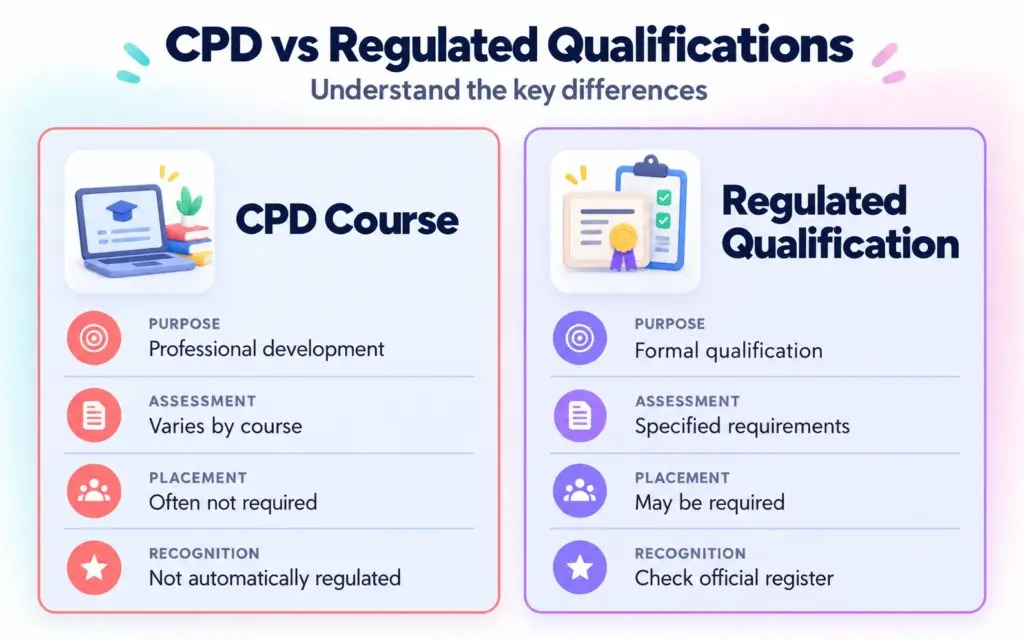
| Decision Factor | Ofqual-Regulated Qualification | CPD Course |
|---|---|---|
| Regulatory status | Regulated qualification within the relevant framework | May be independently certified or accredited; not automatically Ofqual regulated |
| School placement required? | Depends on the specific qualification and its assessment requirements | Usually not required for short knowledge-based courses |
| Completion time | Varies by qualification and provider | Often shorter and more flexible |
| Primary focus | Structured qualification and assessment | Targeted learning and professional development |
| Best used for | Building towards a formal regulated qualification | Developing knowledge, upskilling and CV development |
| What completion demonstrates | Achievement of the specified qualification following its assessment requirements | Completion of the stated CPD learning and assessment requirements |
| Workplace assessment | May be required, depending on the qualification | Often not included in knowledge-based online courses |
| Employer recognition | Relevant where the employer specifies that qualification | Depends on the employer and the relevance of the course |
| Flexibility | Depends on the delivery and assessment arrangements | Many courses allow self-paced online study |
A regulated qualification can provide formal evidence of assessed learning and, where applicable, workplace competence. CPD can demonstrate relevant knowledge and a commitment to professional development.
Neither guarantees employment.
Which Route Offers Better Career Value?
The answer depends on what you need the training to achieve.
A beginner who wants to understand classroom responsibilities before volunteering may benefit from an introductory CPD course.
Someone applying for a vacancy that specifically requires a regulated Level 3 qualification should prioritise meeting that requirement.
An existing teaching assistant who already holds a suitable qualification may gain more immediate value from focused CPD in SEND, literacy interventions or behaviour support.
Rather than judging courses by their titles alone, compare the actual learning outcomes and the evidence of achievement they provide.
Do You Need a Qualification to Work as a Teaching Assistant?
There is no single nationally prescribed teaching assistant qualification that every applicant must hold in England.
Schools and employers determine the requirements for their vacancies. Some accept applicants with relevant experience and transferable skills, while others specify particular qualifications.
The National Careers Service teaching assistant profile identifies several entry routes, including:
- College courses.
- Apprenticeships.
- Volunteering.
- Direct applications to schools or employers.
For direct applications, schools set their own entry requirements. GCSEs in English and maths at grades 9 to 4, or equivalent, are commonly expected.
The National Careers Service also identifies the Level 3 Teaching Assistant Advanced Apprenticeship as a possible route.
What Do Schools Look for When Recruiting Teaching Assistants?

Schools may consider a combination of qualifications, experience, practical abilities and suitability for working with children.
Typical school entry considerations include:
- Strong literacy and numeracy skills.
- A genuine interest in child development and learning support.
- Knowledge of safeguarding, SEN and classroom support.
- Clear communication and interpersonal skills.
- Relevant experience working with children or young people.
Employers may also consider how well candidates can follow teacher instructions, communicate with parents and colleagues, and support pupils with different learning needs.
For example, helping with a school reading programme may provide relevant experience of working with children. However, volunteering does not replace a qualification where an employer explicitly requires one.
The most reliable approach is to compare the person specifications of several local teaching assistant vacancies before selecting a course.
DBS Checks and Safeguarding Requirements
Working with children involves safeguarding responsibilities. Schools must follow relevant safer recruitment and safeguarding requirements when appointing staff and engaging volunteers.
The Department for Education’s Keeping Children Safe in Education 2026 guidance sets out safeguarding duties for schools and colleges in England.
From 1 September 2026, the supervision exemption was removed from the definition of regulated activity with children. This means that certain activities involving children can fall within regulated activity even when the individual is supervised.
The change mainly affects volunteers undertaking qualifying activities frequently, on more than three days in a 30-day period, or overnight. Volunteers whose activities now meet the definition of regulated activity require the appropriate enhanced DBS check with children’s barred list information.
Schools and employers must determine the appropriate checks and safeguarding arrangements. Applicants should follow the requirements of the organisation rather than assuming that all school roles or volunteering activities have identical checks.
For details, see the official DBS guidance on the September 2026 changes.
How Can You Check Whether a Teaching Assistant Qualification Is Regulated?
Course titles can be misleading if you rely on words such as diploma, advanced, certified or Level 3 without checking what they mean.
The safest approach is to verify the qualification before paying.
Five Steps to Verify a Course
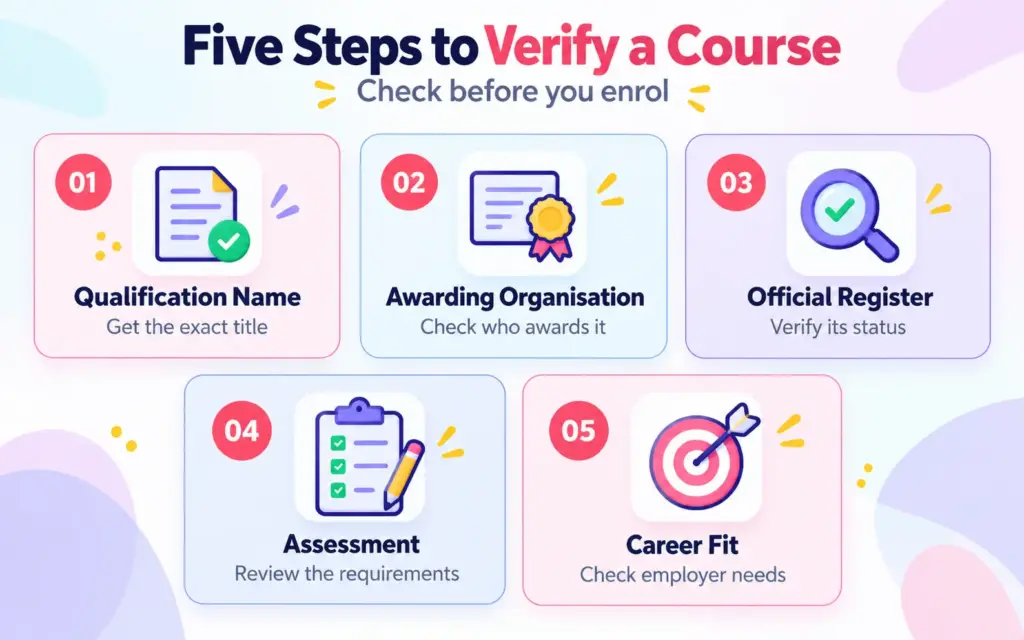
Step 1: Identify the exact qualification name
Ask the provider for the complete qualification title, including its level and awarding organisation.
Step 2: Check the awarding organisation
Find out who awards the qualification. The training provider and awarding organisation may be different.
Step 3: Search the official register
Use the Register of Regulated Qualifications to check whether the qualification is regulated in England or Northern Ireland.
Step 4: Review the assessment requirements
Check whether the qualification includes assignments, examinations, workplace observations or practical assessments. Confirm whether a school placement is necessary.
Step 5: Compare the qualification with your career goal
Check the requirements of relevant vacancies and, where necessary, ask prospective employers whether the qualification meets their expectations.
If a provider describes a course as CPD accredited but does not provide a regulated qualification number, do not assume it leads to an Ofqual-regulated award.
The same caution applies to course level labels. A course described as Level 3 or Level 5 is not necessarily a regulated qualification at that level.
What Should You Ask Before Paying?
Use this checklist when comparing providers.
- What is the full course or qualification title?
- Is it Ofqual regulated or a non-regulated CPD course?
- Who issues the final certificate?
- Is workplace assessment required?
- Will I need to arrange a school placement?
- What is the total fee, including any certificate charges?
- Can I study online at my own pace?
- Does the course meet my intended employer’s requirements?
These questions help prevent confusion between learning content, certification and formal qualification status.
Which Training Route Is Right for You?
Choosing between CPD and a regulated qualification is easier when you start with your current circumstances rather than a course’s advertised benefits.
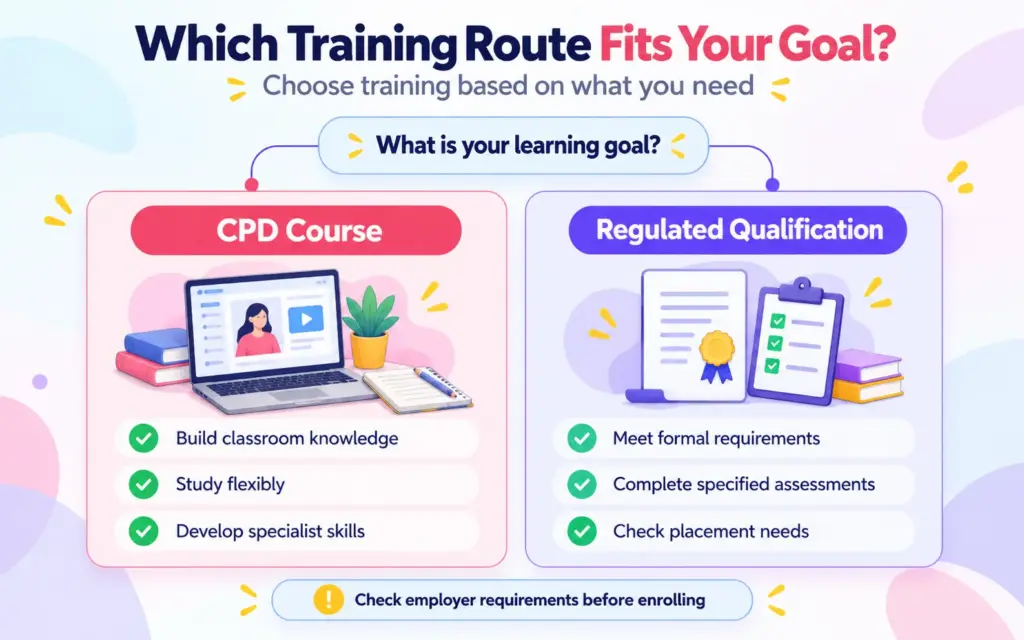
Choose a CPD Course If:
You are new to the education sector. You want to explore teaching support concepts before committing to a longer regulated qualification.
You do not currently have a school placement. A flexible CPD course can help you develop relevant knowledge while you explore volunteering or employment opportunities.
You want to upskill in specific areas. You are already a TA or volunteer who needs focused training in areas such as autism awareness, ADHD support or safeguarding.
You need flexible study. You prefer online learning that can fit around existing work, study or personal commitments.
Choose an Ofqual-Regulated Qualification If:
You want a formal regulated qualification. You are specifically looking for a qualification that sits within the regulated framework.
Your target employer requires it. A job advert states that a particular regulated qualification is an essential entry requirement.
You are prepared for structured assessment. The qualification includes assessment or workplace requirements that match your circumstances.
Practical Example 1: A Beginner Without School Experience
Imagine you are considering a teaching assistant career but have never worked in a classroom.
You might begin with a short CPD course covering child development, safeguarding and classroom responsibilities. Alongside your studies, you could investigate appropriate volunteering opportunities.
This approach allows you to build knowledge before deciding whether to pursue a particular regulated qualification.
However, if the roles you want require a Level 2 or Level 3 regulated qualification, CPD alone will not satisfy that requirement.
Practical Example 2: An Existing Teaching Assistant
Suppose you already work as a teaching assistant and want to develop your ability to support pupils with additional needs.
Focused CPD in autism awareness, speech and language support or behaviour management may be relevant to your professional development.
Teaching assistants considering specialist responsibilities can also review Specialist Skills SEN Teaching Assistants Can Develop to identify useful areas for further professional development.
If you are seeking promotion or applying for a role with specific qualification requirements, you should compare those requirements with your existing credentials and identify any additional formal training needed.
In both cases, the most suitable training is the one that addresses a genuine knowledge, skills or qualification requirement.
How Can One Education Support Your Teaching Assistant Learning?
For learners seeking flexible, knowledge-based study, One Education offers a Teaching Assistant Complete Course delivered online.
The course covers teaching assistant responsibilities, classroom support, child development, communication, safeguarding and support for pupils with special educational needs.
It also includes learning on autism, ADHD and dyslexia, making it relevant to learners interested in inclusive classroom practice.
What Does the Course Include?
According to the published course information, learners can access:
- Online, self-paced study materials.
- Teaching assistant role and responsibility modules.
- Child development and classroom support topics.
- SEND-related learning, including autism, ADHD and dyslexia.
- Literacy, numeracy and communication support content.
- A multiple-choice assessment.
- A CPD certificate following successful completion of the required assessment.
Important qualification distinction: This is a CPD knowledge-based course, not an Ofqual-regulated Level 2 or Level 3 Supporting Teaching and Learning qualification. Its certificate does not replace a regulated qualification, workplace assessment or the experience required by a particular employer.
Although the course is advertised at Level 5, this does not mean it awards an Ofqual-regulated Level 5 qualification. Check the certificate type and any optional certificate costs before enrolling.
The course may be suitable for learners who want to strengthen their understanding of classroom support before considering further training or employment opportunities.
Before enrolling, review the latest course curriculum, assessment conditions, certification arrangements and any additional costs.
View One Education’s Teaching Assistant Complete Course to check whether the learning content and study format match your needs.
Become a Teaching Assistant
Flexible online study
Final Checklist Before Enrolling
A course is worth considering only when its content, recognition and requirements match what you want to achieve.
Before making your decision, confirm the following:
- Your goal: Are you building introductory knowledge, improving existing skills or meeting a formal job requirement?
- Recognition: Is the course CPD based or an officially regulated qualification?
- Assessment: Will you complete online assessments, practical observations or workplace evidence?
- Placement: Do you need access to a school, and can you meet that requirement?
- Total cost: Have you checked tuition, assessment, registration and certificate charges?
- Employer expectations: Does the training meet the essential criteria of your intended role?
For beginners, CPD can offer a manageable introduction to classroom support. For people seeking a specific formal credential, a regulated qualification may be the more appropriate route.
Neither option should be chosen solely because of its course title, advertised level or certificate design.
The strongest decision is one based on verified course information, realistic career expectations and the requirements of the schools where you hope to work.
If flexible professional development suits your current needs, review One Education’s Teaching Assistant Complete Course and compare its learning outcomes with your next career step.
Frequently Asked Questions
A CPD certificate can be valuable for developing relevant knowledge and demonstrating professional development. Its usefulness depends on the course content and employer expectations. It does not automatically replace a regulated qualification.
Not every teaching assistant role requires a regulated qualification. Schools set their own entry requirements, and some accept relevant experience or alternative entry routes. Always check the vacancy’s essential criteria.
No. CPD certification records completion of specified professional learning, while an Ofqual-regulated qualification follows formal regulatory and assessment requirements. The two have different recognition and purposes.
Level 3 represents a higher level of learning complexity than Level 2. However, the exact curriculum, assessment methods and workplace requirements depend on the qualification. Level alone does not determine a person’s job duties.
You can apply for some teaching assistant roles without having completed a formal school placement. However, employers may prefer relevant experience, and certain regulated qualifications require workplace assessment.
Duration varies by qualification, provider and study arrangement. For example, the National Careers Service says the Level 3 Teaching Assistant Advanced Apprenticeship can take up to two years. Other qualification routes may have different timescales.
Related Articles

 Nov, 21, 2026