The Brain Anatomy: The Control Center of the Human Body

February 04, 2025 | 11 minutes | 2327 Readers

The brain is a powerful organ. It controls thinking, memory, and emotions. The brain also manages touch, movement, vision, breathing, and hunger. Every process in the body depends on the brain. The brain connects to the spinal cord. Together, they form the central nervous system (CNS). The CNS sends signals to the body. This helps us move, feel, and react. What Is the Brain Made Of? The brain is made of 60% fat. The rest is water, protein, carbs, and

The brain is a powerful organ. It controls thinking, memory, and emotions. The brain also manages touch, movement, vision, breathing, and hunger. Every process in the body depends on the brain.

The brain connects to the spinal cord. Together, they form the central nervous system (CNS). The CNS sends signals to the body. This helps us move, feel, and react.

What Is the Brain Made Of?

The brain is made of 60% fat. The rest is water, protein, carbs, and salts. It weighs about 3 pounds in adults. The brain is not a muscle. It has blood vessels and nerves. These include neurons and glial cells.

Neurons send signals. Glial cells support them. Together, they help us think, feel, and move.

How Does the Brain Work?

The brain sends and receives signals using chemicals and electricity. These signals control different body functions. Some make you sleepy, while others cause pain.

Some signals stay in the brain. Others travel through the spine and nerves to reach different body parts. The central nervous system uses billions of nerve cells, called neurons, to do this.

Main Parts of the Brain and Their Functions

The brain has three main parts: the cerebrum, brainstem, and cerebellum. Each part has a special job. Together, they help us think, move, and stay alive.

The cerebrum is the largest part of the brain. It has two main parts: gray matter (the cerebral cortex) and white matter in the center. It controls movement and helps regulate body temperature. This part of the brain also handles speech, thinking, and problem-solving. It plays a role in emotions, learning, and judgment. It also helps with vision, hearing, touch, and other senses.

Cerebrum

The cerebrum is the largest part of the brain. It has two main parts: gray matter (the cerebral cortex) and white matter in the center. It controls movement and helps regulate body temperature.

This part of the brain also handles speech, thinking, and problem-solving. It plays a role in emotions, learning, and judgment. It also helps with vision, hearing, touch, and other senses.

Cerebral Cortex

The word “cortex” comes from Latin and means “bark.” It refers to the brain’s outer layer. This layer, called the cerebral cortex, is made of gray matter. It has many folds, giving it a large surface area. It also makes up about half of the brain’s weight.

The cerebral cortex has two halves, called hemispheres. It is covered with ridges (gyri) and grooves (sulci). A deep groove, the medial longitudinal fissure, separates the two halves. This groove runs from the front of the head to the back.

Each hemisphere controls the opposite side of the body. The right side of the brain moves the left side of the body, and the left side controls the right. The two halves communicate through a C-shaped structure called the corpus callosum. This structure is in the center of the brain and is made of white matter and nerve pathways.

If you’re interested in learning more about the brain and the rest of the human body, you might enjoy a Level 3 Anatomy and Physiology course. These courses typically cover topics like the nervous system, muscles, and organ function in more detail. Look for courses offered by colleges, online learning platforms, or accredited training providers.

Brainstem

The brainstem sits in the middle of the brain. It connects the cerebrum to the spinal cord. It plays a key role in sending signals through the body.

The midbrain is a small but important part of the brain. It helps with hearing, movement, and quick reflexes. It also has the substantia nigra, which is linked to Parkinson’s disease. This area contains dopamine cells that help control movement.

The pons connects the midbrain and medulla. It helps with chewing, blinking, balance, and facial movement. It also plays a role in tears, vision focus, and hearing. The pons is important for many daily actions.

The medulla links the brain to the spinal cord. It controls breathing, heart rate, and blood flow. It also helps balance oxygen and carbon dioxide levels. The medulla triggers reflexes like sneezing, coughing, and swallowing.

Level 3 Diploma in Anatomy and Physiology of Human Body

Gain in-depth knowledge of human anatomy and physiology with our Level 3 Diploma. Ideal for careers in health and fitness.

Cerebellum

The cerebellum is a small part of the brain at the back of the head. It sits below the larger brain areas and above the brainstem. Like the rest of the brain, it has two halves. The outer layer has nerve cells, while the inner part connects to other brain areas.

This part of the brain helps control movement. It keeps muscles working smoothly and helps with balance and posture. Without it, simple actions like walking or grabbing objects would be hard.

Scientists are finding new roles for the cerebellum. It may affect thinking, emotions, and social skills. Some studies link it to conditions like autism, addiction, and schizophrenia.

Cerebellum Brain Coverings: Meninges

The brain and spinal cord are covered by three protective layers called meninges. These layers help shield the nervous system from injury. They also provide support and hold in cerebrospinal fluid, which cushions the brain and spine.

The dura mater is the outermost layer. It is thick and tough. This layer has two parts. The first part, the periosteal layer, lines the inside of the skull. The second part, the meningeal layer, sits just below it. There are spaces between these layers where blood vessels pass through to supply the brain.

Below the dura mater is the arachnoid mater. This layer is thin and looks like a web. It does not have nerves or blood vessels. Beneath it is cerebrospinal fluid (CSF). CSF cushions the brain and spinal cord. It also helps remove waste.

The pia mater is the deepest layer. It is very thin and sticks to the brain’s surface. This layer follows the brain’s curves and folds. It contains many small blood vessels.

Brain Coverings_ Meninges - visual selection

Lobes of the Brain and What They Control

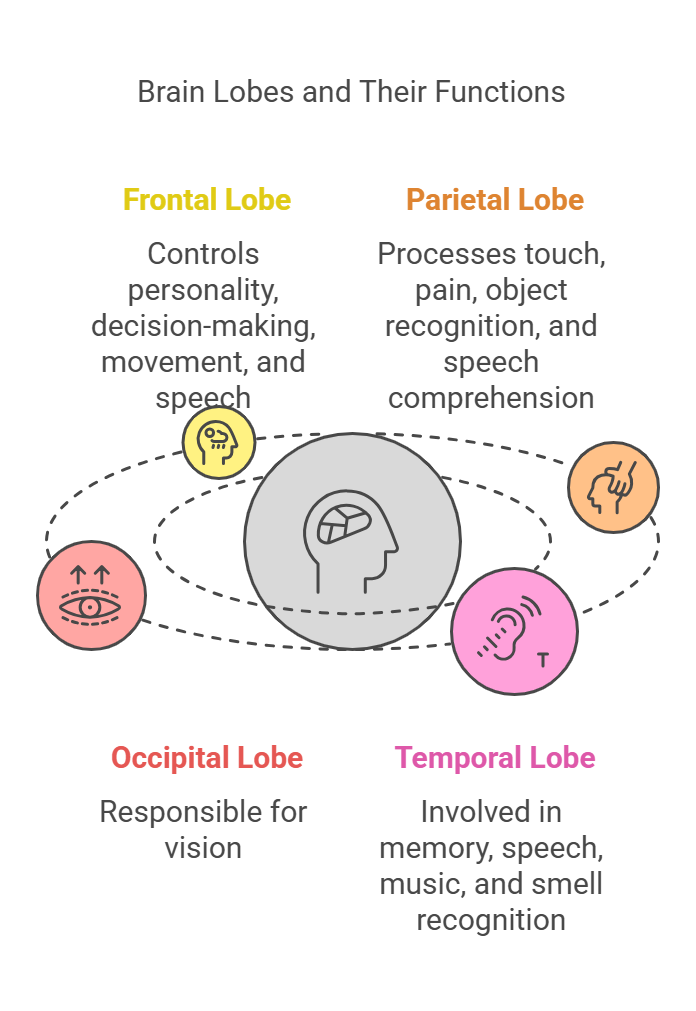
The brain has two halves, called hemispheres. Each half has four sections called lobes: frontal, parietal, temporal, and occipital. Each lobe has a special job.

Lobes of the Brain and What They Control - visual selection

Frontal Lobe: The frontal lobe is the largest part of the brain. It sits at the front of the head. This area controls personality, decision-making, and movement. It also helps recognize smells. Broca’s area, which controls speech, is found here.

Parietal Lobe: The parietal lobe is in the middle of the brain. It helps people recognize objects and understand where things are. It also processes touch and pain. Wernicke’s area, which helps understand speech, is in this lobe.

Occipital Lobe: The occipital lobe is at the back of the brain. It controls vision.

Temporal Lobe: The temporal lobes are on the sides of the brain. They help with short-term memory, speech, and music. They also play a small role in recognizing smells.

Deeper Structures Within the Brain

The brain has two halves, called hemispheres. Each half has four sections called lobes: frontal, parietal, temporal, and occipital. Each lobe has a special job.

Pituitary Gland

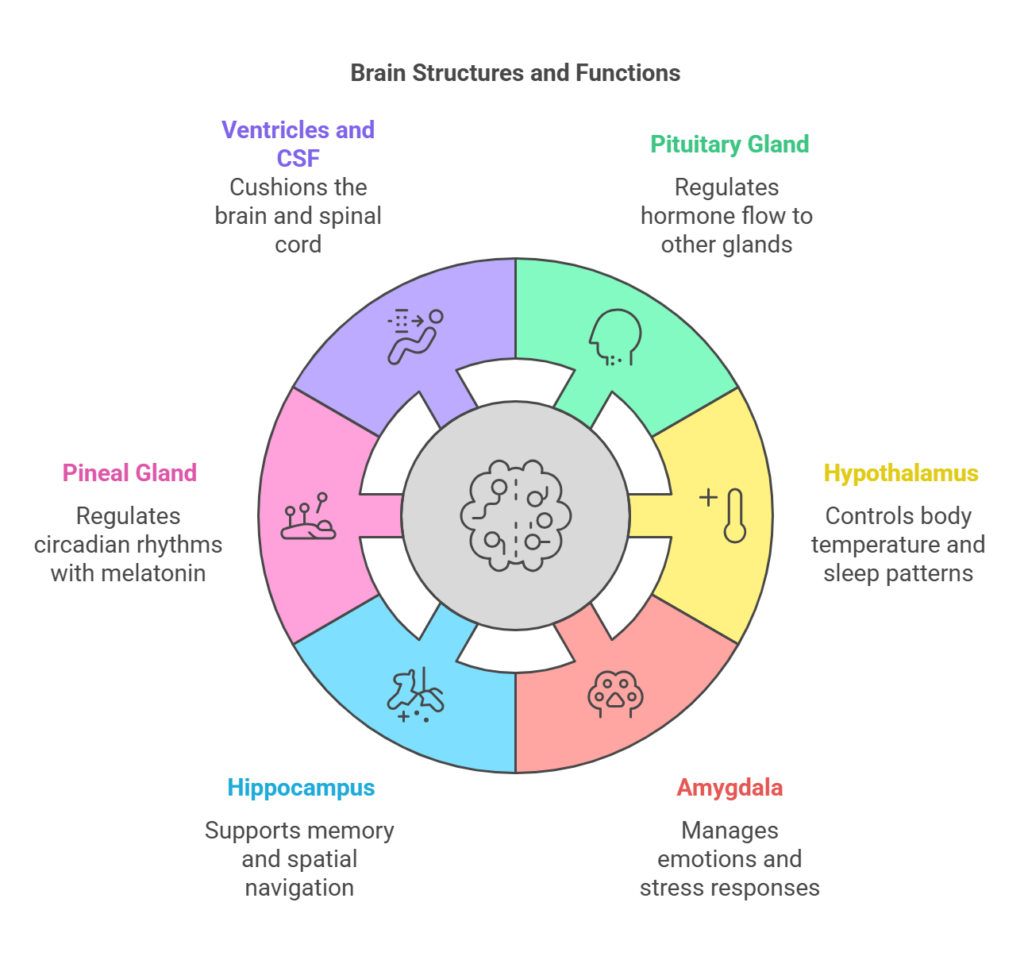
The pituitary gland is a tiny, pea-sized organ deep in the brain, just behind the nose. It is often called the “master gland” because it controls many other glands in the body.

This gland sends signals to the thyroid, adrenal glands, ovaries, and testicles. It gets messages from the hypothalamus, a part of the brain, through a small stalk and blood flow.

Hypothalamus

The hypothalamus sits above the pituitary gland. It sends chemical messages to control its function. It helps regulate body temperature. It also keeps sleep patterns in sync.

The hypothalamus controls hunger and thirst. It even plays a role in memory and emotion.

Amygdala

The amygdala is a small, almond-shaped part of the brain. There is one on each side, under each half of the brain.

It is part of the limbic system, which controls emotions and memory. The amygdala also helps with stress, rewards, and the “fight or flight” response to danger.

Hippocampus

The hippocampus is a small, curved organ under each side of the brain. It looks like a seahorse and is part of the hippocampal formation. This organ helps with memory, learning, and finding your way. It gets information from the brain’s outer layer.

The hippocampus is important for knowing where things are in space. It also plays a role in diseases like Alzheimer’s.

Pineal Gland

The pineal gland sits deep in the brain. It connects to the top of the third ventricle by a small stalk. This pineal gland reacts to light and darkness. It makes melatonin, a hormone that controls sleep and wake cycles.

Ventricles and Cerebrospinal Fluid

Deep inside the brain, there are four open spaces. These are called ventricles. They have small passageways between them. They also connect to the spinal canal and the space under the meninges.

The ventricles make cerebrospinal fluid (CSF). This clear liquid flows around the brain and spinal cord. CSF cushions the brain, removes waste, and carries nutrients.

Deeper Structures Within the Brain - visual selection

Blood Supply to the Brain

The brain gets blood from two sets of arteries: the vertebral arteries and the carotid arteries. These arteries bring oxygen to keep the brain working.

The external carotid arteries run along the sides of the neck. You can feel your pulse there with your fingers. The internal carotid arteries go inside the skull and send blood to the front of the brain.

The vertebral arteries move up the spine and enter the skull. They join to form the basilar artery, which sends blood to the back of the brain.

The circle of Willis is a loop of blood vessels at the brain’s base. It helps blood flow between the front and back of the brain.

Cranial Nerves

The first two nerves come from the cerebrum. The other ten start in the brainstem. The brainstem has three parts. These are the midbrain, the pons, and the medulla.

josh ashton

Article by

Josh Ashton

Josh is an education specialist and author at One Education, bringing over 4 years of experience in creating practical resources and strategies to support teachers and enhance student learning.

top
Home Courses Search