Use By vs Best Before: The Food Date Labels Everyone Gets Wrong

May 13, 2026 | 16 minutes | 540 Readers

Use by and best before dates exist for different reasons, carry different legal weight, and require different responses. Treating them as the same thing is a mistake that causes UK households to throw away food they could safely eat — and can leave food businesses on the wrong side of the law. You pull something from the fridge, glance at the packaging, and notice the date has passed. Is it still safe, or are you about to throw away perfectly

Use by and best before dates exist for different reasons, carry different legal weight, and require different responses. Treating them as the same thing is a mistake that causes UK households to throw away food they could safely eat — and can leave food businesses on the wrong side of the law.

You pull something from the fridge, glance at the packaging, and notice the date has passed. Is it still safe, or are you about to throw away perfectly good food? Many people in the UK make that decision based on guesswork because the difference between these labels is still widely misunderstood.

That confusion has real consequences. It drives avoidable food waste, and in professional settings it can become a legal and compliance issue. Whether you are a consumer, a food handler, a catering supervisor, or an employer responsible for a team, here is what these labels mean and what you are expected to do about them. 

What the Three UK Food Date Labels Mean

UK food date marking sits within food information and food safety law, with guidance and enforcement overseen by the Food Standards Agency and local authorities. There are three labels you will see on food packaging — and they are not interchangeable.

Use By — The Safety Date

The use by date is the one that matters most from a safety perspective. It tells you the date up to which food is safe to eat, provided it has been stored correctly. After this date, the food must not be eaten, sold, or served — even if it looks or smells fine. 

This point is critical. It can look fine, smell fine, and still carry harmful levels of bacteria.

Use by dates are found on highly perishable foods such as raw meat, fish, soft cheeses, ready meals, and some dairy products. 

Best Before — The Quality Date

The best before date is about quality, not safety. It shows when food is expected to be at its best for flavour, texture, and freshness.  After this date, the food may deteriorate in quality, but it does not automatically become unsafe to eat. 

Best before dates are common on longer-life foods such as tinned goods, dried pasta, frozen food, biscuits, and similar products. 

Display Until — The Retailer's Label

Display until and sell by dates are stock-control labels used by retailers. They are not consumer safety or quality dates, so shoppers should focus on the use by or best before date instead. 

For food sector workers — from chefs and supervisors to waiters and retail staff — they still have practical value for stock rotation and service checks, but they should never be used in place of the actual safety or quality date.  

Quick Comparison

Label What It Means Safety or Quality? Legal Weight
Use By Safe to eat until this date if stored correctly Safety Legally enforceable — must not be sold or served after
Best Before At its best until this date Quality Not a safety cut-off after the date
Display Until For retailer stock rotation Neither (Operational stock-control purpose) Not used to determine food safety or quality
Can You Legally Sell Food After the Use By or Best Before Date in the UK

Can You Legally Sell Food After the Use By or Best Before Date in the UK?

Not all food date labels carry the same legal weight. In the UK, the answer depends entirely on which date has passed.

If It Is Past the Use By Date, the Answer Is No

Selling, serving, or using food after its use by date is illegal. This is a safety date, and once it has passed, the food must not be sold or served — even if it still looks, smells, or tastes normal.

If It Is Past the Best Before Date, the Answer Is Sometimes

A best before date works differently. It is linked to quality, not an automatic legal ban. Food can sometimes still be sold after this date, but only if it remains safe to eat and in acceptable condition. If it has deteriorated and is no longer fit for consumption, selling it can still breach food safety law.

This Is Not Just a Business Issue

The legal responsibility sits with the food business, but date control is handled every day by the people working in it. Chefs, supervisors, kitchen staff, waiters, and retail staff all play a part in checking dates, rotating stock, preparing food, and making sure nothing unsafe is sold or served.

Why Getting It Wrong Matters

Confusing these two labels can lead to wasted food, unsafe service, failed inspections, and legal action. For food businesses, the consequences can include enforcement notices, prosecution, fines, and reputational damage. For food sector workers, it is a basic part of safe and lawful practice. 

Can You Still Eat Food After the Best Before Date?

Often, yes. A best before date is about quality, so food may still be fine to eat after that date if it remains in good condition.

Foods Commonly Marked Best Before

This usually applies to longer-life foods such as:

  • ♦  biscuits and crackers
  • ♦  tinned and canned goods
  • ♦  dried pasta and rice
  • ♦  cereals
  • ♦  frozen foods
  • ♦  dried herbs and spices
  • ♦  chocolate and other ambient snacks

What to Check First

The main change is usually quality rather than safety. Food may lose crispness, flavour, or texture, so check the appearance, smell, texture, and packaging before deciding whether to use it. This can help reduce unnecessary food waste at home.

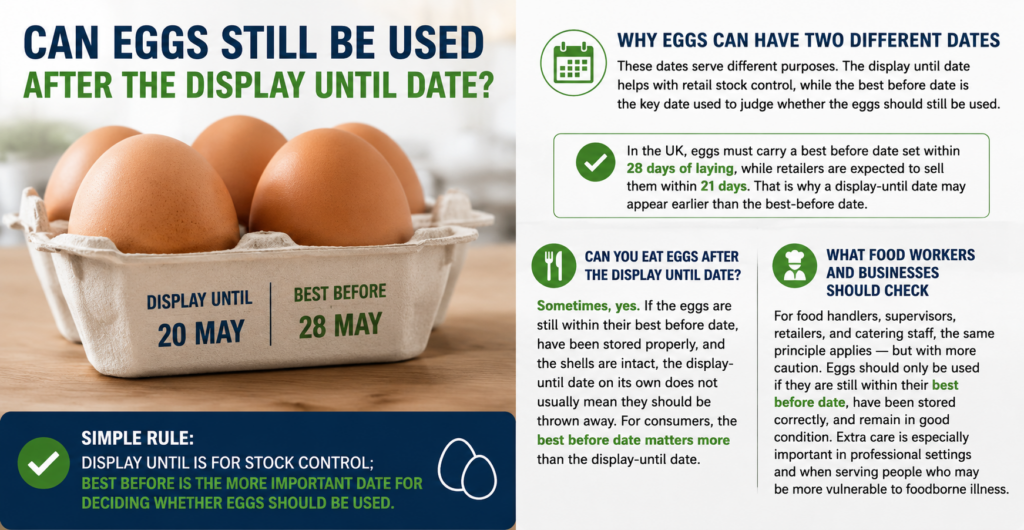
Can Eggs Still Be Used After the Display Until Date

Can Eggs Still Be Used After the Display Until Date?

A display until date on eggs is usually a stock-rotation date used by shops and retailers. The best before date is the more important date for deciding whether eggs are still suitable for sale, service, or use.

Why Eggs Can Have Two Different Dates

These dates serve different purposes. The display until date helps with retail stock control, while the best before date is the key date used to judge whether the eggs should still be used. In the UK, eggs must carry a best before date set within 28 days of laying, while retailers are expected to sell them within 21 days. That is why a display-until date may appear earlier than the best-before date.

Can You Eat Eggs After the Display Until Date?

Sometimes, yes. If the eggs are still within their best before date, have been stored properly, and the shells are intact, the display-until date on its own does not usually mean they should be thrown away. For consumers, the best before date matters more than the display-until date.

What Food Workers and Businesses Should Check

For food handlers, supervisors, retailers, and catering staff, the same principle applies — but with more caution. Eggs should only be used if they are still within their best before date, have been stored correctly, and remain in good condition. Extra care is especially important in professional settings and when serving people who may be more vulnerable to foodborne illness.

Simple rule: display until is for stock control; best before is the more important date for deciding whether eggs should be used.

Why Getting Date Labels Wrong Is a Bigger Risk Than Most People Think

The reason use by dates exist is not bureaucratic caution. It is microbiology.

Pathogens such as Salmonella, Listeria monocytogenes, and certain strains of E. coli can multiply to dangerous levels in perishable food without producing any visible or detectable signs. No off smell. No discolouration. Nothing to suggest the food is unsafe — because the bacteria responsible for food poisoning are not always the same ones responsible for spoilage.

Some food toxins produced by bacteria are heat-stable. That means even thorough cooking will not neutralise them once they have formed. This is why the use by date is a hard limit, not a guideline.

The Food Standards Agency has previously estimated around 2.4 million cases of foodborne illness annually in the UK. The consequences range from a few days of discomfort to hospitalisation and, in the most serious cases involving vulnerable individuals, death. Food businesses and food handlers are the last line of defence in many of these situations.

What Food Handlers and Catering Staff Need to Know

What Food Handlers and Catering Staff Need to Know

If you work with food professionally — in a kitchen, a care home, a school, a restaurant, or any food retail environment — your responsibilities around date labels go beyond common sense. They are a legal and professional obligation.

Checking Dates on Delivery and During Stock Rotation

Every delivery should be checked. Goods arriving close to or past their use by date should be rejected. Stock should be rotated so that items with earlier dates are used first — a practice known as FIFO (First In, First Out). Date labels should be checked at each stage of storage, not just on arrival.

Temperature Control and Shelf Life

Date labels are only valid when food is stored correctly. A use by date on a piece of raw chicken assumes it has been kept at or below 5°C throughout its shelf life. If the cold chain has been broken — even briefly — that date can no longer be relied upon. Temperature monitoring and accurate record-keeping are inseparable from date label compliance.

What to Do When Out-of-Date Stock Is Found

Remove it from use immediately. Label it clearly. Record the discovery and the action taken. Do not attempt to use it in cooked dishes, blend it into other products, or reroute it to reduce waste. In a professional food environment, none of those options are acceptable — and some are illegal.

Training and Employer Responsibility

Under UK food safety law, food business operators are responsible for ensuring their staff are trained in food hygiene to a level appropriate to their role. That includes understanding date labels, storage requirements, and the consequences of getting either wrong. Supervisors and managers carry particular responsibility — if a team member serves food past its use by date and a customer becomes ill, the business can be held accountable.

For those looking to formalise their knowledge, One Education’s Level 3 Food Safety and Hygiene course covers food law, HACCP principles, temperature control, contamination prevention, and staff training responsibilities in full. It is CPD QS accredited and completed entirely online.

Common Mistakes People Make With Food Date Labels

Common Mistakes People Make With Food Date Labels

These errors come up repeatedly in both domestic and professional settings:

  • ♦  Treating best before as a safety date — and discarding food that is perfectly safe to eat
  • ♦  Ignoring the use by date — and consuming or serving food that presents a genuine health risk
  • ♦  Misreading display until as a consumer guide — it is for shelf management only
  • ♦  Freezing food on or after its use by date — food must be frozen before the use by date to be safe
  • ♦  Relabelling food to extend its apparent shelf life — this is illegal for any food business and constitutes fraud
  • ♦  Overlooking “once opened” instructions — a product within its use by date can still become unsafe if post-opening storage guidance is ignored

How to Read Food Date Labels Correctly

Follow these five steps, whether you are at home or working in a food environment:

1. Identify the label type first. Is it a use by or a best before date? The type of label determines how you respond.

2. Check the storage instructions. Date labels are only valid if the product has been stored correctly — check the temperature guidance and any “once opened” instructions.

3. Never rely on appearance or smell alone for use by foods. Unsafe food can look and smell completely normal.

4. Use your judgement on best before foods. Assess quality — appearance, smell, texture — and decide accordingly.

5. In a professional setting, record your checks. Date label monitoring should be part of your due diligence documentation, particularly for high-risk foods.

Conclusion ​

Most food safety failures do not start with negligence. They start with assumptions — that food which looks fine is fine, that dates on packaging are interchangeable, that training can wait until something goes wrong.

Understanding food date labels properly is a small but meaningful part of getting food safety right. For households it means less waste and better decisions. For food businesses it means staying on the right side of the law. For food handlers and supervisors it means doing the job as it is meant to be done.

If you work in food and want the knowledge and certification to back that up, One Education’s Level 3 Food Safety and Hygiene course is a practical, CPD QS accredited qualification completed entirely online — covering everything from food law and HACCP to temperature control, contamination, and staff supervision.

FAQs — Food Date Labels Explained in the UK: Use By vs Best Before vs Display Until

1. Which date should I follow — use by, best before, or display until?

Always follow the use by or best before date. A display until date is only for stock rotation and should not be used to judge whether food is safe or suitable to use.

2. Why do some foods have more than one date?

Different dates serve different purposes. Use by relates to safety, best before relates to quality, and display until helps with stock control in retail settings. They are not interchangeable.

3. Can food look fine but still be unsafe?

Yes. Food past its use by date can look, smell, and taste normal but still contain harmful bacteria. That is why it should never be eaten or served after this date.

4. When should food be thrown away immediately?

Food should be discarded without hesitation if:

  • ♦  it is past its use by date

  • ♦  it has been stored incorrectly

  • ♦  packaging is damaged or compromised

5. Why do food businesses take date labels more seriously?

Because they are legally responsible for food safety. Selling or serving unsafe food can lead to enforcement action, fines, or prosecution, so strict date control is part of everyday practice in professional food settings.

Sam Walker

Article by

Sam Walker

Sam Walker is an education specialist and author at One Education, bringing over 4 years of experience in creating practical resources and strategies to support teachers and enhance student learning.

top
Home Courses Search