Types of Food Contamination & Risks in Catering Kitchens 

May 14, 2026 | 13 minutes | 72 Readers

In the UK’s fast-paced catering sector, food safety is the literal foundation of a successful business. Whether you are managing a high-end wedding marquee or a busy school canteen, the risk of food contamination is a constant shadow. For supervisors and kitchen managers, understanding these risks isn’t just about passing an inspection—it’s about protecting public health and complying with strict UK legislation like the Food Safety Act 1990. Contamination can occur at any stage: from the moment a delivery van

In the UK’s fast-paced catering sector, food safety is the literal foundation of a successful business. Whether you are managing a high-end wedding marquee or a busy school canteen, the risk of food contamination is a constant shadow. For supervisors and kitchen managers, understanding these risks isn’t just about passing an inspection—it’s about protecting public health and complying with strict UK legislation like the Food Safety Act 1990.

Contamination can occur at any stage: from the moment a delivery van arrives to the second a plate is placed in front of a guest. To effectively manage a team, you must be able to identify, categorise, and mitigate the four primary types of food contamination.

Supervisory Insight: Understanding these risks is a core component of the Level 3 Food Safety and Hygiene for Catering, which moves beyond basic cleaning to advanced hazard control.

What are the 4 Types of Food Contamination?

To maintain a rigorous Food Safety Management System (FSMS), food handlers must recognise that hazards aren’t always visible. Contamination is generally categorised into four distinct groups:

1. Biological: Harmful microorganisms such as bacteria, viruses, and fungi.

2. Chemical: Contamination from cleaning agents, pesticides, or non-food-grade plastics.

3. Physical: Foreign objects like glass, hair, or metal shavings entering the food.

4.  Allergen: The cross-contact of “The Big 14” allergens into allergen-free dishes.

1. Biological Contamination: The Invisible Threat

Biological contamination is one of the most important causes of foodborne illness and one of the biggest day-to-day risks in catering kitchens. Because pathogens like Campylobacter or Salmonella cannot be seen or tasted, they are the most difficult risks to manage without strict protocols.

In a busy catering kitchen, biological risks usually peak during the “prep” phase.

  • ♦  Cross-Contamination: Using the same vacuum sealer for raw meat and cooked ham.
  • ♦  The Danger Zone: The “Danger Zone” in the UK is typically between 8°C and 63°C, where bacteria grow rapidly. FSA guidance states that fridges should be kept at 5°C or below, while for food business operators in England, Wales and Northern Ireland it is a legal requirement to store cold foods below 8°C. Hot food held for service should generally be kept at 63°C or above. 

How to Prevent It:

Effective prevention requires more than just handwashing. It involves mastering temperature control. Food should be cooked thoroughly using safe time-and-temperature combinations, such as 70°C for 2 minutes or 75°C for 30 seconds, then cooled quickly and chilled safely. 

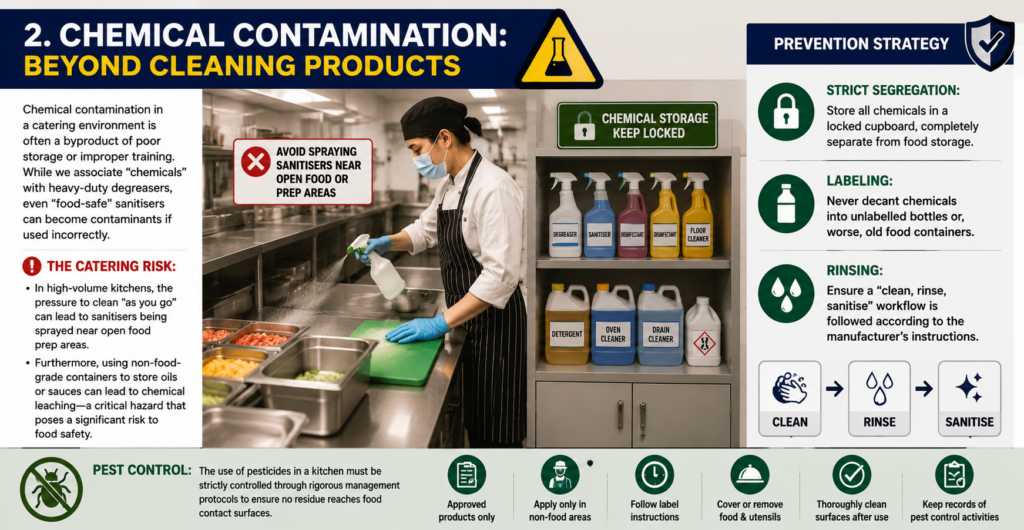
2. Chemical Contamination: Beyond Cleaning Products

2. Chemical Contamination: Beyond Cleaning Products

Chemical contamination in a catering environment is often a byproduct of poor storage or improper training. While we associate “chemicals” with heavy-duty degreasers, even “food-safe” sanitisers can become contaminants if used incorrectly.

  • ♦  The Catering Risk: In high-volume kitchens, the pressure to clean “as you go” can lead to sanitisers being sprayed near open food prep areas. Furthermore, using non-food-grade containers to store oils or sauces can lead to chemical leaching—a critical hazard that poses a significant risk to food safety.  
  • ♦  Pest Control: The use of pesticides in a kitchen must be strictly controlled through rigorous management protocols to ensure no residue reaches food contact surfaces.  

Prevention Strategy: * Strict Segregation: Store all chemicals in a locked cupboard, completely separate from food storage.

  • ♦  Labeling: Never decant chemicals into unlabelled bottles or, worse, old food containers.
  • ♦  Rinsing: Ensure a “clean, rinse, sanitise” workflow is followed according to the manufacturer’s instructions.

3. Physical Contamination: Hard Hazards and Foreign Objects

Physical contamination is often the most common cause of customer complaints in the UK hospitality industry. It involves “foreign bodies” entering the food, which can cause anything from a minor annoyance to a serious choking hazard or dental injury.

  • ♦  Common Sources: Broken glass from a dropped ramekin, metal shavings from a faulty tin opener, or staples from vegetable crates.
  • ♦  The Human Factor: In a busy kitchen, hair, loose buttons, or acrylic nails are constant risks. This is why maintaining strict personal hygiene standards is a critical component of daily kitchen operations.  

Prevention Strategy:

  • ♦  Maintenance: Conduct regular equipment audits to check for loose screws, failing parts, or peeling non-stick coatings. 
  • ♦  Glass Policy: Implement a “No Glass in the Kitchen” rule where possible, using shatterproof alternatives.
  • ♦  PPE: Enforce the use of hairnets, beard snoods, and the removal of all jewellery.
Allergen Risks

4. Allergen Risks: The Essential 14 and Natasha’s Law

In the UK, allergen management is no longer a “best practice”—it is a legal mandate. Since the introduction of Natasha’s Law, the stakes for pre-packaged food for direct sale (PPDS) have never been higher.

What is Natasha’s Law? Natasha’s Law requires all food businesses to provide full ingredient lists and allergen labelling on foods packaged on-site before a customer orders them (PPDS). This law was designed to protect the millions of people in the UK with food allergies by ensuring total transparency regarding ingredients.

Unlike other types of contamination, allergen risks involve “cross-contact.” Even a trace amount of flour or a drop of milk can trigger a life-threatening anaphylactic reaction in a sensitive guest.

  • ♦  The Catering Risk: The biggest danger in catering is shared equipment. Using the same fryer for breaded scampi and “gluten-free” chips is a high-risk error that supervisors must be trained to spot and prevent. 
  • ♦  Hidden Ingredients: It is vital to detect allergens hidden in complex ingredients, such as soy in a pre-made marinade or celery in a bouillon base, which can easily be overlooked during a busy service. 

Prevention Strategy:

  • ♦  Dedicated Equipment: Use purple-coded boards and knives specifically for allergen-free orders.
  • ♦  Communication: A robust system to ensure the “server-to-chef” allergen chain is never broken.
How Food Contamination Starts in Busy Catering Environments

How Food Contamination Starts in Busy Catering Environments

In a high-pressure catering environment, contamination is rarely the result of a single event. Instead, it is usually a failure in the “Flow of Food.” As a supervisor, you need to understand which steps in your process are critical control points — the points where control is essential to prevent, eliminate, or reduce a food safety hazard to an acceptable level. 

  • ♦  Delivery & Receipt: Contamination often starts before the food even enters your kitchen. Damaged packaging or high-risk foods delivered at the wrong temperature can introduce pathogens into your storage areas. 
  • ♦  Storage Errors: Storing raw meat above ready-to-eat salads in a walk-in fridge is a classic example of “gravitational” cross-contamination.
  • ♦  The Prep Stage: This is the most volatile phase. Busy chefs switching between multiple dishes under tight deadlines are prone to “process slip”—forgetting to sanitise a bench or using a knife that hasn’t been properly cleaned between tasks.
  • ♦  Waste Management: Overflowing bins or improper disposal of food waste attracts pests, which are primary carriers of biological contamination. Proper waste control is essential to maintaining a hygienic environment.  

Preventing Contamination via HACCP and FSMS

To combat these risks, UK law requires every food business to have a Food Safety Management System (FSMS) based on the principles of HACCP (Hazard Analysis and Critical Control Point).

While a Level 2 food handler follows safety rules, a Level 3 Supervisor is responsible for implementing and auditing the HACCP plan. If you are unsure which certification matches your current responsibilities, our guide on [Level 2 vs Level 3 Food Hygiene: Which Training Level Is Right for Your Catering Role?] provides a detailed breakdown to help you choose the correct path for your career. 

The HACCP Approach to Contamination:

1. Hazard Analysis: Identifying where biological, chemical, physical, or allergen risks exist in your specific menu.

2. Critical Control Points (CCPs): Determining the steps where you must apply a control to prevent a hazard (e.g., cooking chicken to 75°C). 

3. Monitoring: Maintaining accurate temperature logs and records is essential to prove your kitchen is compliant during a Local Authority inspection. Consistent monitoring ensures that all safety protocols are being followed and provides the necessary documentation for your food safety management system. 

Industry Standard: A robust FSMS can help demonstrate due diligence if the business needs to show what controls were in place. Our Level 3 Food Safety and Hygiene course provides the exact tools and templates needed to build a HACCP-compliant kitchen from the ground up.

Best Practices for Prevention and Compliance

Best Practices for Prevention and Compliance

To maintain a “5-Star” hygiene rating, supervisors must move beyond theory into active management. 

1. Effective Supervision: Leaders must focus on continuous staff training to ensure that food safety protocols become a daily habit rather than a chore. Consistent coaching helps maintain high standards even during the busiest shifts. 

2. Regular Audits: Conduct frequent “spot checks” on fridge temperatures and cleaning logs to ensure standards aren’t slipping during peak times, such as the Friday night rush. Consistent monitoring is the only way to guarantee ongoing compliance. 

3. Design Aspects: The physical layout of your kitchen plays a huge role in risk mitigation. Ensuring there is a clear linear flow from “dirty” (raw) zones to “clean” (plated) zones is one of the most effective ways to design out cross-contamination risks entirely. 

Protecting Your Guests and Your Career

Understanding the types of food contamination and risks in catering kitchens is more than a compliance box-ticking exercise—it is the cornerstone of professional hospitality. From the invisible threat of pathogens to the legal complexities of allergen management, a supervisor’s role is to be the final line of defence between a hazard and a customer.

In a busy kitchen, knowledge is your most effective tool for prevention. By mastering the principles of HACCP and effective staff supervision, you don’t just keep your kitchen clean—you keep your business profitable and your reputation untarnished.

Ready to Step into a Supervisory Role?

Take the next step in your professional development with our CPD Accredited Food Safety and Hygiene Level 3 course. Designed specifically for kitchen managers, head chefs, and supervisors, this course covers everything from food legislation and HACCP implementation to advanced hazard control.

  • ♦  100% Online & Self-Paced
  • ♦  UK Legislation Compliant (HACCP & Natasha’s Law)
  • ♦  Instant Accredited Certificate upon completion

[Enroll in the Food Safety & Hygiene Level 3 Course Today]

FAQs — How Many Litres in a Gallon? Quick Conversion Explained

Q: What are the 4 main types of food contamination? 

A: The four main types are Biological (bacteria/viruses), Chemical (cleaning agents/toxins), Physical (foreign objects), and Allergen (cross-contact with ingredients like nuts or gluten).

Q: What is the most common food contamination risk in UK catering? 

A: Biological contamination—specifically Campylobacter and Salmonella—is the most common cause of food poisoning. However, allergen cross-contact has become a top priority for UK inspectors following the implementation of Natasha’s Law.

Q: How can I prevent cross-contamination in a small kitchen? 

A: Use color-coded cutting boards, implement a “clean-as-you-go” policy, and ensure raw and ready-to-eat foods are stored in separate, sealed containers with raw products always placed on the bottom shelf.

Q: Is a Level 3 Food Safety certificate a legal requirement for supervisors? 

A: Not specifically. UK law does not say that supervisors must hold a Level 3 Food Safety certificate. Instead, businesses must ensure staff are supervised, instructed, and/or trained in food hygiene to a level appropriate to their role. Many employers still use Level 3 Food Safety training for supervisors because it fits supervisory responsibilities more closely, especially where HACCP and kitchen oversight are involved.  

Sam Walker

Article by

Sam Walker

Sam Walker is an education specialist and author at One Education, bringing over 4 years of experience in creating practical resources and strategies to support teachers and enhance student learning.

top
Home Courses Search