When Is Level 3 Food Safety Required in UK Kitchens? A Guide for Supervisors & Managers

May 16, 2026 | 14 minutes | 10 Readers

Level 3 Food Safety is not usually required by UK law by name, but it is widely expected when a role involves supervising staff, monitoring hygiene standards, supporting HACCP-based procedures, reviewing records, or helping manage food safety across a kitchen operation. UK food law focuses on appropriate training, supervision, and safe food management rather than one fixed certificate title.  That means Level 3 becomes relevant less because of job title alone and more because of responsibility. If someone is only

rating

Bestselling Course

View Details SAVE 94% NOW

Level 3 Food Safety is not usually required by UK law by name, but it is widely expected when a role involves supervising staff, monitoring hygiene standards, supporting HACCP-based procedures, reviewing records, or helping manage food safety across a kitchen operation. UK food law focuses on appropriate training, supervision, and safe food management rather than one fixed certificate title. 

That means Level 3 becomes relevant less because of job title alone and more because of responsibility. If someone is only handling food, Level 2 may often be enough. If they are overseeing food handlers, checking standards, or helping keep the business inspection-ready, Level 3 is usually the more appropriate training level in practice.

Is Level 3 Food Safety a Legal Requirement in the UK?

In the UK, a Level 3 Food Safety qualification is not always a legal requirement, but it is strongly recommended for supervisors, managers, and business owners in the food industry. Food businesses are legally required to ensure that all staff receive appropriate food hygiene training relevant to their job role under the Food Safety Act and UK food hygiene regulations. While basic food handlers may only need Level 1 or Level 2 training, Level 3 Food Safety helps managers understand how to supervise staff, maintain hygiene standards, and ensure compliance with food safety laws.

What UK Food Safety Law Actually Requires

The legal position is straightforward: the Food Standards Agency says food business operators must make sure food handlers receive appropriate supervision and training in food hygiene that matches the work they do. The FSA also says food businesses must put in place food safety management procedures based on HACCP principles. The law therefore focuses on competence, supervision, and systems, not on requiring every supervisor or manager to hold a certificate with a specific title.

This is an important distinction for employers and kitchen leaders. Many people ask, “Is Level 3 Food Safety required by law?” The more accurate answer is: not usually by name. What matters legally is whether the person has training appropriate to their role and whether the business can show it is managing food safety properly.

Why Level 3 Is Widely Expected in Practice

Even though the law does not usually prescribe Level 3 by title, it is often treated as the practical benchmark for supervisors and managers because those roles involve more than personal food handling. They commonly include staff oversight, hygiene monitoring, record checking, corrective action, and support for HACCP-based food safety management.

This is why Level 3 is commonly seen as the appropriate training level for supervisors and managers in kitchen settings. 

When You Supervise Food Handlers

When Is Level 3 Food Safety Required in Practice?


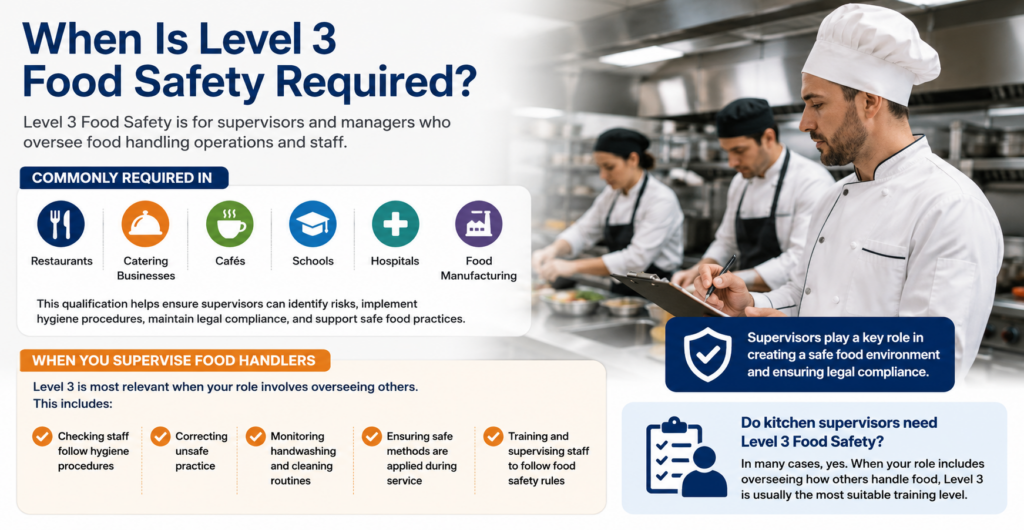
Level 3 Food Safety training is typically required for supervisors, managers, and team leaders who are responsible for overseeing food handling operations. It is commonly needed in restaurants, catering businesses, cafés, schools, hospitals, and food manufacturing settings where staff management and food safety supervision are essential. This qualification helps ensure that supervisors can identify food safety risks, implement hygiene procedures, maintain legal compliance, and support safe food practices within the workplace.

When You Supervise Food Handlers

Level 3 becomes much more relevant when someone is responsible for food handlers rather than only for their own tasks. In a working kitchen, that may mean checking whether staff follow hygiene procedures, correcting unsafe practice, monitoring handwashing and cleaning routines, and making sure safe methods are applied consistently during service. The FSA’s training-and-supervision guidance specifically emphasises that staff should be trained in the safe methods relevant to their job and supervised to check they are following them properly.

So, do kitchen supervisors need Level 3 Food Safety? In many cases, yes. Once the role includes overseeing how others handle food, Level 3 is usually the more suitable training level because it better reflects supervisory duties.

When You Manage a Kitchen or Food Business

Kitchen managers, catering managers, head chefs with leadership duties, and food business owners often need broader food safety knowledge because they are accountable for standards across the operation, not just one station or one shift. They may be expected to support staff training, maintain procedures, review records, respond to issues, and help prepare for inspections.

This is where the question shifts from “Can this person handle food safely?” to “Can this person help the business maintain safe systems?” For that reason, food safety training for kitchen managers and food safety certificate for supervisors often points towards Level 3 rather than Level 2.

When You Oversee HACCP and Food Safety Checks

A major reason Level 3 is needed in practice is HACCP oversight. The FSA states that food safety management procedures should be based on HACCP principles, and HACCP is the system used to identify hazards and put control measures in place. Roles that involve reviewing hazards, checking control points, verifying records, or responding to failures need more than basic awareness.

That means Level 3 Food Safety is needed for HACCP oversight whenever a supervisor or manager is expected to understand how hazards are controlled in day-to-day kitchen operations. This is especially true in structured catering environments where documentation, verification, and corrective action matter.

When You Work With Higher-Risk Food Operations

Level 3 also becomes more relevant in settings where the consequences of weak supervision are higher. Kitchens handling raw meat, poultry, seafood, dairy, ready-to-eat foods, or allergen-sensitive meals usually need tighter control over contamination prevention, chilling, cooking, cross-contamination, and safe systems of work. The FSA’s hygiene guidance repeatedly centres these control areas through the 4Cs and HACCP-based procedures.

In these environments, supervisory mistakes can affect the whole operation rather than one individual task. That is one reason who needs Level 3 Food Safety in UK kitchens often comes down to operational risk as much as seniority.

Which Roles Usually Need Level 3 Food Safety Training?

Level 3 Food Safety is usually most relevant for people in supervisory or management roles. This commonly includes:

  • ♦  kitchen supervisors and team leaders
  • ♦  head chefs with oversight duties
  • ♦  restaurant and catering managers
  • ♦  food business owners and employers
  • ♦  supervisors in schools, care settings, and healthcare catering

The common thread is responsibility. These roles often involve checking standards, guiding staff, reviewing records, and helping maintain food safety systems across a kitchen or wider operation.

What Responsibilities Make Level 3 More Appropriate

What Responsibilities Make Level 3 More Appropriate?

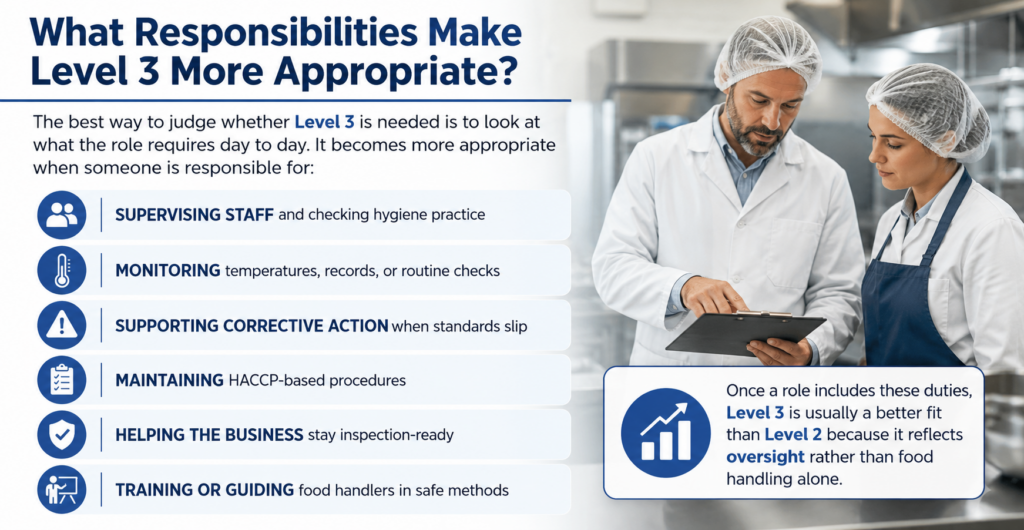
The best way to judge whether Level 3 is needed is to look at what the role requires day to day. It becomes more appropriate when someone is responsible for:

  • ♦  supervising staff and checking hygiene practice
  • ♦  monitoring temperatures, records, or routine checks
  • ♦  supporting corrective action when standards slip
  • ♦  maintaining HACCP-based procedures
  • ♦  helping the business stay inspection-ready
  • ♦  training or guiding food handlers in safe methods

Once a role includes these duties, Level 3 is usually a better fit than Level 2 because it reflects oversight rather than food handling alone.

What Does Level 3 Food Safety Training Cover?

A typical Level 3 course is designed for people who need a broader understanding of food safety supervision and management.

  • ♦  Food Safety Law and Legal Responsibilities

Understanding the legal duties linked to hygiene, supervision, and compliance.

  • ♦  HACCP Principles and Hazard Control

Recognising hazards, supporting control measures, and understanding how food safety systems work in practice.

  • ♦  Staff Supervision and Safe Working Practices

Checking that procedures are followed, guiding staff, and reinforcing consistent hygiene standards.

  • ♦  Contamination, Allergen, and Temperature Control

Monitoring the practical areas where food safety failures often occur.

  • ♦  Monitoring, Documentation, and Corrective Action

Reviewing records, spotting problems, and responding appropriately when standards slip.

These topics make Level 3 more suitable for supervisors and managers than frontline food handlers. For professionals stepping into leadership roles, a structured Food Safety and Hygiene Level 3 course can help build confidence in HACCP, food safety management, contamination control, and staff supervision in UK catering settings.

Level 2 vs Level 3 Food Safety

Level 2 vs Level 3 Food Safety: What’s the Difference?

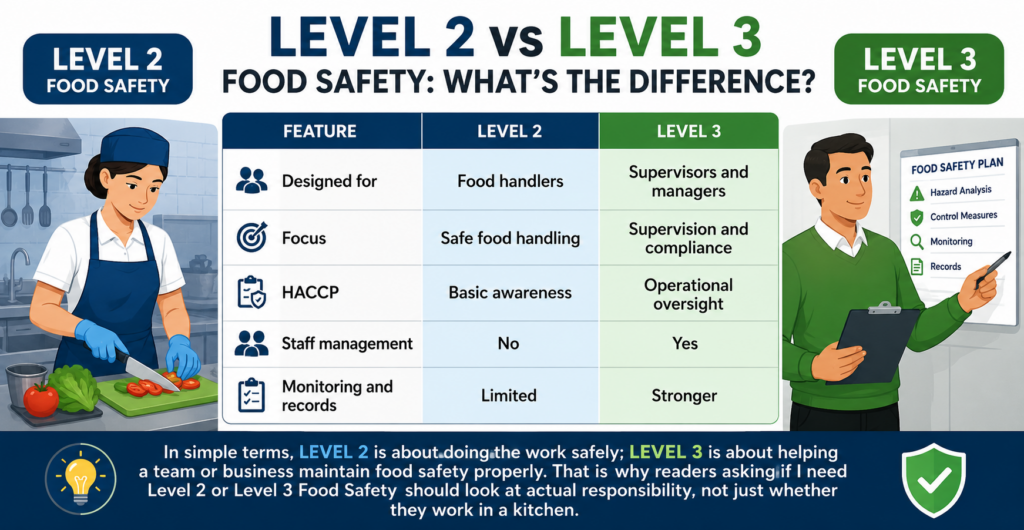
The difference between Level 2 and Level 3 Food Safety comes down to role and scope. Level 2 is mainly for food handlers. Level 3 is for people supervising food handlers or helping manage compliance.

Feature Level 2 Level 3
Designed for Food handlers Supervisors and managers
Focus Safe food handling Supervision and compliance
HACCP Basic awareness Operational oversight
Staff management No Yes
Monitoring and records Limited Stronger

In simple terms, Level 2 is about doing the work safely; Level 3 is about helping a team or business maintain food safety properly. That is why readers asking if I need Level 2 or Level 3 Food Safety should look at actual responsibility, not just whether they work in a kitchen.

Why Level 3 Food Safety Matters for Compliance and Inspections

Why Level 3 Food Safety Matters for Compliance and Inspections

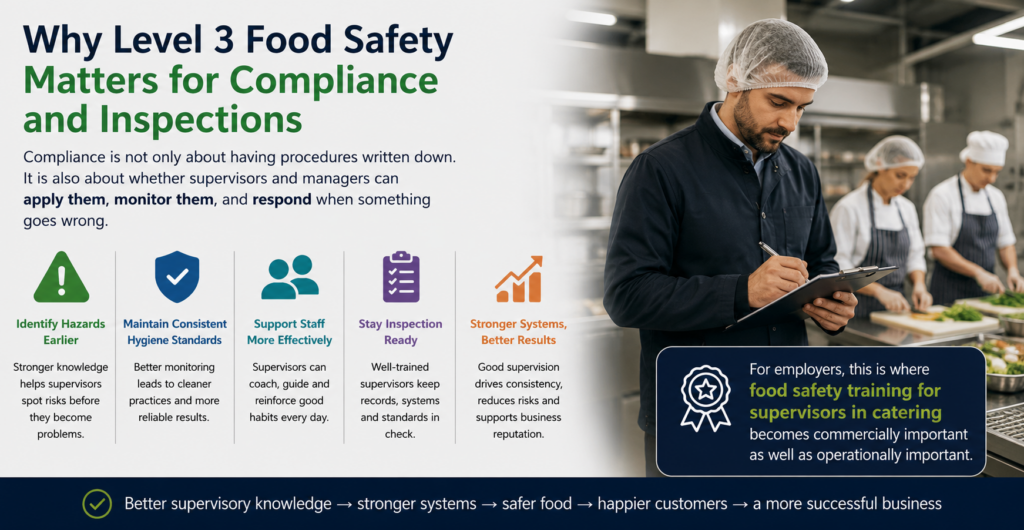
Level 3 matters because compliance is not only about having procedures written down. It is also about whether supervisors and managers can apply them, monitor them, and respond when something goes wrong. Stronger supervisory training can help businesses identify hazards earlier, maintain more consistent hygiene standards, support staff more effectively, and stay better prepared for inspections.

For employers, this is where food safety training for supervisors in catering becomes commercially important as well as operationally important. Better supervisory knowledge can support stronger systems, more reliable routines, and less dependence on reactive problem-solving.

When Should You Progress from Level 2 to Level 3?

Many people move from Level 2 to Level 3 when their role expands. A kitchen assistant may become a shift leader. A chef may begin training junior staff. A senior team member may start checking records or overseeing opening and closing checks. Once the role includes supervision, monitoring, or compliance support, Level 3 often becomes the better fit.

Good signs that a role has outgrown Level 2 include:

  • ♦  leading part of a shift or team
  • ♦  checking staff hygiene standards
  • ♦  reviewing records or routine checks
  • ♦  supporting allergen or HACCP controls
  • ♦  helping maintain food safety systems
  • ♦  training or supervising other staff.

If your role now includes supervision, compliance checks, or food safety oversight, Level 3 training is often the most appropriate next step. That is where a course such as Food Safety and Hygiene Level 3 becomes highly relevant for both day-to-day performance and longer-term progression.

Conclusion

So, when is Level 3 Food Safety required in UK kitchens? Legally, it is not usually required by title. In practice, it is often the most appropriate and widely expected training level when a role involves supervising food handlers, monitoring hygiene standards, supporting HACCP-based procedures, reviewing records, or helping manage compliance across a kitchen operation.

For supervisors, managers, head chefs, and food business owners, Level 3 is less about collecting a certificate and more about matching training to real responsibility. If your role includes food safety oversight rather than only food handling, Level 3 is usually the stronger fit. For readers assessing their next step, a structured Food Safety and Hygiene Level 3 course can provide the supervisory knowledge needed in HACCP, hazard control, staff guidance, temperature management, and compliance-focused kitchen leadership. 


FAQs — Level 3 Food Safety in UK Kitchens

1. Is Level 3 Food Safety legally required in the UK?

Not usually by name. UK law focuses on appropriate training, supervision, and HACCP-based food safety management rather than one named certificate.

2. Who should take Level 3 Food Safety training?

It is usually most relevant for supervisors, managers, head chefs with oversight duties, catering managers, and food business owners responsible for maintaining standards across a kitchen or food business.

3. Do kitchen supervisors need Level 3 Food Safety?

In many cases, yes. If the role includes supervising food handlers, checking hygiene standards, or reviewing records, Level 3 is usually more appropriate than Level 2.

4. Can I take Level 3 Food Safety without Level 2?

Often, yes, depending on the provider and your role. Many Level 3 courses are aimed directly at supervisors and managers rather than requiring a formal Level 2 prerequisite.

5. How long does Level 3 Food Safety take?

Course length varies by provider and format. Online provider pages commonly position Level 3 as flexible supervisory training rather than a fixed classroom timetable, so the exact duration depends on the course chosen.

top
Home Courses Search