Why Inclusive Teaching Skills Matter in Further Education and Adult Learning

July 29, 2026 | 9 minutes | 80 Readers

Walk into any further education or adult training setting today and you’ll hardly ever find a room where everyone shares the same starting point. Learners vary in age, educational background, first language, and, in some cases, additional learning needs – often all within the same group. Inclusive teaching is what decides whether that diversity becomes a learning obstacle or just a regular aspect of the class. The Learner Mix Behind Every FE and Adult Training Room Learners in further education,

Walk into any further education or adult training setting today and you’ll hardly ever find a room where everyone shares the same starting point. Learners vary in age, educational background, first language, and, in some cases, additional learning needs – often all within the same group. Inclusive teaching is what decides whether that diversity becomes a learning obstacle or just a regular aspect of the class.

The Learner Mix Behind Every FE and Adult Training Room

Learners in further education, adult learning and workplace training have never been a uniform group, but the diversity of their backgrounds, needs and aspirations has continued to grow. The same classroom may include learners at very different stages of life and with very different needs—from recent school leavers to career changers, learners studying in English as an additional language, and those with additional support needs —yet they are all expected to work towards the same learning outcomes on the same timetable. 

A one-size-fits-all approach to teaching rarely reaches every learner. This challenge is precisely what inclusive teaching seeks to address, providing the context before introducing the concept itself. 

What Inclusive Teaching Actually Means

At its core, inclusive teaching means creating learning experiences that recognise learner diversity and give everyone—whatever their background, ability, or learning needs—a fair opportunity to participate and succeed. 

It’s often confused with differentiation, but they serve different purposes. Differentiation tailors teaching to an individual learner once additional support is needed. Inclusive teaching works earlier than that – it’s about designing the session itself, materials, delivery, assessment, so that fewer gaps arise in the first place.

The two approaches are not alternatives—they work best together. Effective teaching starts by making learning accessible to a wide range of learners, then uses differentiation to provide targeted support where needed, rather than designing for the majority and adapting later for everyone else. 

The Legal and Professional Backdrop

The Legal and Professional Backdrop

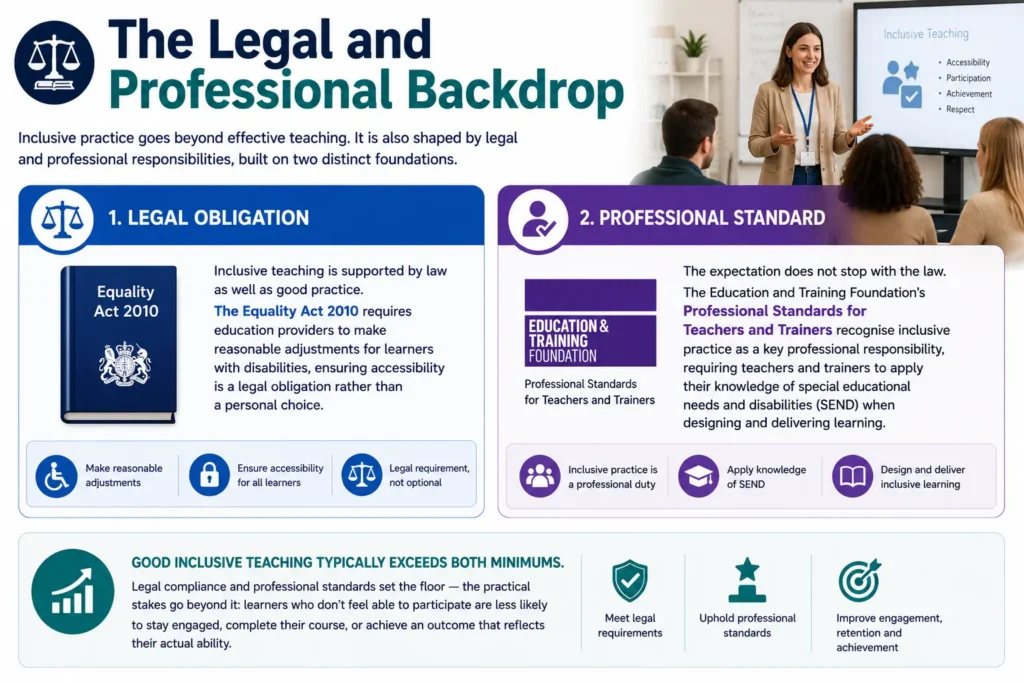
Inclusive practice goes beyond effective teaching. It is also shaped by legal and professional responsibilities, built on two distinct foundations. 

  • ♦  Legal Obligation: Inclusive teaching is supported by law as well as good practice. The Equality Act 2010 requires education providers to make reasonable adjustments for learners with disabilities, ensuring accessibility is a legal obligation rather than a personal choice.
  • ♦  Professional standard: The expectation does not stop with the law. The Education and Training Foundation’s Professional Standards for Teachers and Trainers recognise inclusive practice as a key professional responsibility, requiring teachers and trainers to apply their knowledge of special educational needs and disabilities (SEND) when designing and delivering learning. 

Good inclusive teaching typically exceeds both minimums. Legal compliance and professional standards set the floor — the practical stakes go beyond it: learners who don’t feel able to participate are less likely to stay engaged, complete their course, or achieve an outcome that reflects their actual ability. 

Inclusive Teaching in Action

Inclusive Teaching in Action

One Room, Five Starting Points

Think of an evening class for adult learners. A recent school leaver sits beside a parent returning to education after ten years away. Across the room, a career changer takes notes while a learner studying in English as an additional language follows carefully, translating as they go. One learner has disclosed dyslexia; another may need support but has chosen not to say so.

They’re all in the same session. None of them are starting from the same place.

What an Inclusive Trainer Does Differently

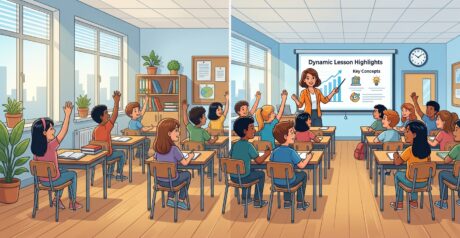
A trainer who teaches everyone the same way, the same style, at the same pace, will lose some of that room. An inclusive trainer plans with this mix in mind from the outset:

  • ♦  Key ideas are explained more than one way — through discussion, visuals, and written material
  • ♦  Learners can take part however suits them, not just by answering out loud
  • ♦  Support shifts as the session goes on, rather than being fixed in advance

Design First, Adjust Second

What makes the session inclusive isn’t a single adjustment for a handful of learners. It’s the collection of purposeful teaching decisions that make learning accessible from the start — removing barriers before they get in the way, rather than fixing them after the fact.

That’s the shift that matters: designing for the room as it actually is, not adjusting afterwards for whoever got left behind.

Where This Skill Is Actually Learned I

Where This Skill Is Actually Learned

Inclusive teaching isn’t something most people arrive with fully formed — it’s built through training, not picked up incidentally on the job. For those entering teaching or training roles, this grounding often starts at Level 3. The ATHE Level 3 Award in Education and Training (AET) includes applying inclusive teaching and learning approaches as one of its core taught areas, alongside understanding roles and responsibilities and the principles of assessment.

It’s equally valuable for experienced practitioners. Many have developed inclusive habits through experience; the AET helps turn those instincts into a structured approach supported by recognised terminology and best practice. 

Every Cohort Is Different

No two groups of learners are the same. What works well with one cohort may need adapting for the next, making inclusive teaching a habit of continuous learning rather than a one-time achievement. 

FAQs — Why Inclusive Teaching Skills Matter in Modern Education

What is inclusive teaching and why does it matter?

Inclusive teaching is an approach to designing and delivering learning so that all learners, regardless of background, ability or additional need, can genuinely access and engage with it. It matters because it directly affects engagement, retention and fair outcomes.

What’s the difference between inclusive teaching and differentiation?

Differentiation adjusts content or support for an individual learner once a barrier appears. Inclusive teaching designs the session so fewer barriers arise in the first place. The two typically work together rather than replacing one another.

Is inclusive teaching a legal requirement for FE teachers and trainers?

Partly. Under the Equality Act 2010, education providers must make reasonable adjustments for learners with disabilities. Good inclusive teaching generally extends beyond this legal minimum.

Do all FE teachers and trainers need formal training in inclusive practice?

It isn’t legally mandatory in every setting, but it’s treated as a core professional standard in the FE and training sector, and qualifications such as AET Level 3 build it in as a taught component for those entering the profession.

What are some examples of inclusive teaching in practice?

Offering material in multiple formats, providing flexible ways for learners to demonstrate understanding, and remaining attentive to learners’ different starting points are common examples, rather than any single fixed technique.

Sam Walker

Article by

Sam Walker

Sam Walker is an education specialist and author at One Education, bringing over 4 years of experience in creating practical resources and strategies to support teachers and enhance student learning.

top
Home Courses Search