How Much Does an Online SEN Diploma Cost?

November 03, 2026 | By Sophie johnson | 11 minutes | 48 Readers

Find out how much an online SEN diploma costs in the UK, why prices vary, what extra fees to expect and which option suits your goals.

If you’re thinking about training in special educational needs (SEN), the price is probably one of the first things you want to know. The online SEN diploma cost you’ll come across can range from nothing at all to several hundred pounds or more, and course listings rarely explain why.

This guide covers what you can expect to pay in the UK and why prices vary so much. It also covers which extra costs to look out for and how to choose a course that fits what you want to do next.

How Much Does an Online SEN Diploma Cost in The UK?

Most online SEN courses fall into three broad price bands:

  • Free courses are usually short awareness modules.
  • CPD-accredited online SEN diplomas typically cost [£20–£400] and can be studied at your own pace. (These are frequently heavily discounted to around £20–£40 during platform sales). 
  • Regulated SEN qualifications, assessed through an awarding body, generally cost more, at around [£250–£800+].

The biggest factor in the price isn’t the word “diploma” in the title. It’s whether the course is a regulated qualification or a CPD-accredited course and how much assessment and tutor support comes with it.

Typical SEN Course Costs By Type

Here’s how the main options compare. Prices change often, so treat these as a guide rather than a quote.

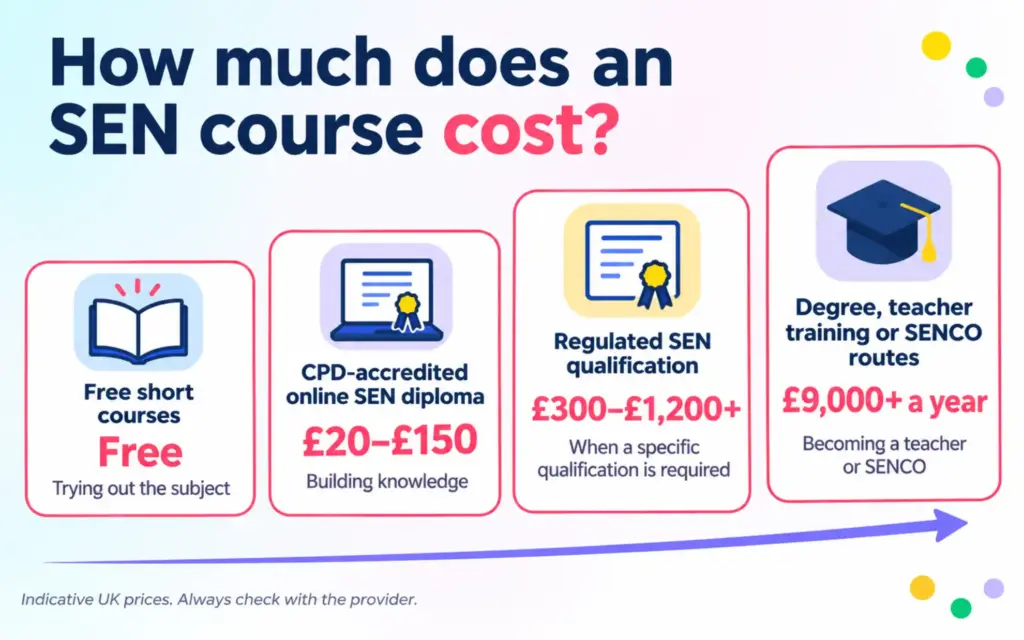
Infographic comparing UK SEN course costs, from free short courses to CPD diplomas, regulated qualifications and degree or SENCO routes.
SEN Course Types
Course Type Typical Cost How It's Assessed & Recognised Best Suited To
Free short courses Free Usually no formal assessment; sometimes a basic certificate. Trying out the subject.
CPD-accredited online SEN diploma £20–£150 Online assessments and a certificate of completion. Building knowledge, personal development, strengthening a job application.
Regulated SEN qualification (e.g. Level 2 or 3) £300–£1,200+ Assessed and quality assured through an Ofqual-regulated awarding body. Roles or employers asking for a specific qualification.
Degree, teacher training or SENCO routes Over £9,000 a year (undergraduate tuition in England) University and school-based assessment. Becoming a qualified teacher or SENCO.

← Scroll to see all columns →

A higher price doesn’t automatically mean a better course, and a lower price doesn’t mean poor content. These are different products built for different purposes. 

A level number in a course title doesn’t always refer to the national qualification framework. If a provider says a course is regulated, you can confirm it on Ofqual’s Register of Regulated Qualifications.

The distinction between course levels and regulated qualifications matters when comparing prices. Is a Level 5 SEN Diploma Recognised in the UK? clarifies what the qualification status means. 

Why Do SEN Diploma Prices Vary So Much

Several factors push the price of an SEN course up or down.

factors that affect the cost of an SEN course: course type, assessment, tutor support, course length, certificate format and pricing model.

Regulated or CPD-accredited. Regulated qualifications are delivered through awarding bodies overseen by Ofqual. Learner registration, assessment and external quality assurance are all built into the fee. 

CPD-accredited courses are reviewed against continuing professional development standards rather than national qualification standards, which keeps them more affordable. 

Assessment. Tutor-marked assignments and workplace observation cost more to deliver than online multiple-choice tests.

Tutor support. One-to-one feedback and named tutors add to the price. Self-paced courses with help-desk support tend to cost less.

Length and depth. A course with more guided learning hours usually costs more than a short introduction.

Certificate format. Some prices include a digital certificate only, with a separate charge for a printed copy.

How the provider prices courses. Many online providers sell single courses, bundles or wider course access, and run regular offers. The same course can cost noticeably different amounts from one month to the next.

What's Included, and What Extra Costs to Look Out for

Before you pay, check exactly what the price covers. For most online courses, that should include:

  • access to the course for a clearly stated period;
  • learning materials and assessments;
  • a certificate in at least one format;
  • some form of support, whether a tutor or a help desk.

Some costs may sit outside the headline price. These can include hard copy certificates or transcripts, registration or exam fees for regulated qualifications, resubmission fees and postage.

There are also costs linked to working with children. School roles require an enhanced DBS check, which the employer requests as part of recruitment. Who pays the fee varies, so it’s worth asking.

Finally, time is a cost too. Think realistically about how many hours a week you can study alongside work or family life.

Can You Get Funding or a Free SEN Course?

Sometimes, but it depends on the type of course.

If you’re 19 or over and studying an approved regulated qualification at Level 3 to Level 6, you may be able to apply for an Advanced Learner Loan. These loans don’t usually cover CPD-accredited courses.

Some local colleges offer funded or reduced-cost adult courses. Eligibility depends on your age, income and where you live.

If you already work in a school or nursery, ask your employer. Many fund CPD for staff, especially in areas like SEN support.

Free courses do exist, but they tend to be short introductions rather than full diplomas. If you’re paying for a course yourself, check whether the provider offers instalments. 

Which SEN Course is Right for Your Goal and Budget?

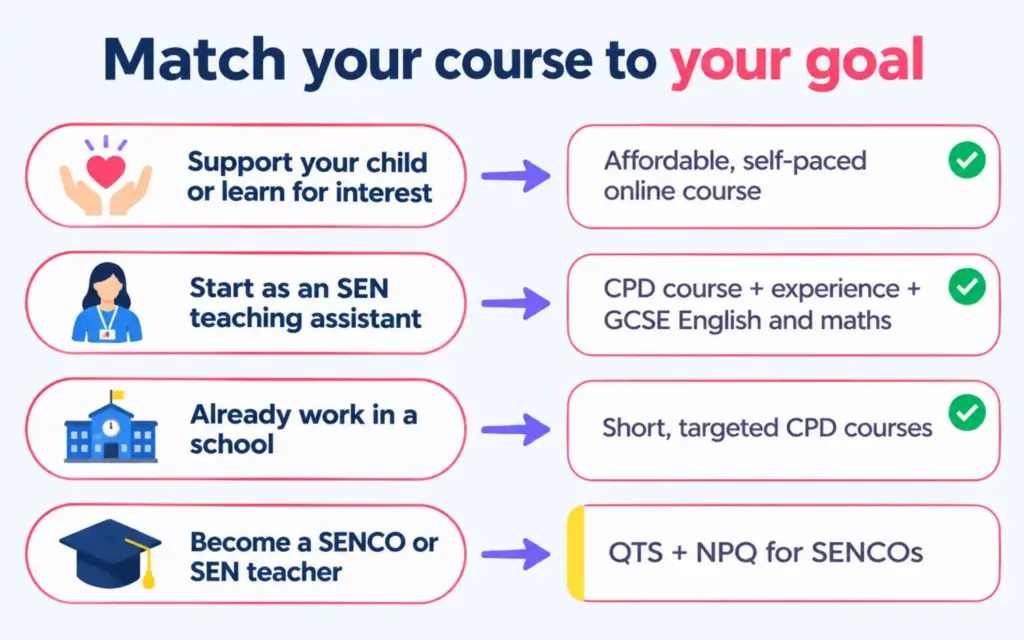
If You Want to Support Your Own Child or Learn for Interest

An affordable, self-paced online course is often all you need. It can help you understand conditions such as autism, ADHD and dyslexia, and how support works in school.

If You Want to Become an SEN Teaching Assistant

Many school support roles don’t require a specific SEN qualification. The National Careers Service teaching assistant job profile sets out several routes in, including college courses, apprenticeships and volunteering. Employers often also look for GCSEs, or equivalent, in English and maths.

Not sure which qualification suits your ambitions? Level 5 SEN Diploma vs Level 3: Which Should You Choose? compares both options to help you choose a course that matches your experience and career plans. 

This is where a flexible online course can help. For example, commercial self-paced options, such as One Education’s SEN Teaching Diploma Level 5, introduce core special educational needs, speech and language development, communication support, and practical SEN teaching strategies (always check the course specification page for full module listings and accreditation details).
A course like this can build your knowledge and show employers you’re serious about SEN work. Experience in a school, nursery or care setting will still carry real weight. 

Before committing to a course, make sure you meet its entry criteria. Level 5 SEN Diploma: What Are the Entry Requirements? explains what prospective learners should check before enrolling.

If You Already Work in a School

Short, targeted courses can be a cost-effective way to build CPD in a specific area, such as autism awareness or behaviour support. 

If You Want to Become an SENCO or SEN Teacher

This is a different route. A SENCO in a mainstream school must be a qualified teacher. New SENCOs must also complete the NPQ for SENCOs within three years of taking up the role. An online diploma can support your learning, but it doesn’t replace these requirements. 

Questions to Ask Before You Pay For an SEN Course

A few quick questions can save you money and disappointment:

1.Is this a regulated qualification or a CPD-accredited course?

2.How is it assessed, and who marks the work?

3.What certificate will I receive, and is there an extra fee for it?

4.How long will I have access to the course?

5.Is tutor support included?

6.Does the content reflect the SEND Code of Practice, the statutory guidance schools in England follow?

Before committing to a course, Is a Level 5 SEN Diploma Right for You? UK Course Guide can help you assess whether Level 5 suits your experience and ambitions.

Teaching assistant supporting a pupil with visual learning cards in a UK primary school classroom.

Choosing an SEN Course That's Worth The Cost

The right SEN course isn’t the most expensive one. It’s the one that matches your goal, whether that’s supporting your child, starting out in a school or building on the experience you already have.

Check what’s included, look out for extra fees and be clear about what the certificate represents. If a flexible starting point suits you, take a look at our online SEN teaching diploma and see whether it fits your plans.

FAQs

Yes, but most are short awareness courses rather than full diplomas. They’re a good way to explore the subject. If you want a more detailed course or a recognised qualification, expect to pay something.

Not always. Many schools recruit based on experience, attitude and basic qualifications such as GCSE English and maths. Relevant training can strengthen your application, and some employers will train you once you’re in post.

It depends on the course. Self-paced CPD diplomas can often be completed in a few weeks of steady study. Regulated qualifications usually take several months. Check the course page for guided learning hours.

Yes. Many UK providers offer online SEN diplomas, mostly CPD-accredited and self-paced. Some regulated SEN qualifications are also available online, so check before enrolling.

 It depends on the role. State school SEN teachers in England usually need QTS, while teaching assistants often need experience, GCSEs and a DBS check.

 To teach in a state school, you need a degree and qualified teacher status (QTS). New SENCOs must also complete the NPQ for SENCOs.

top
Home Courses Search